
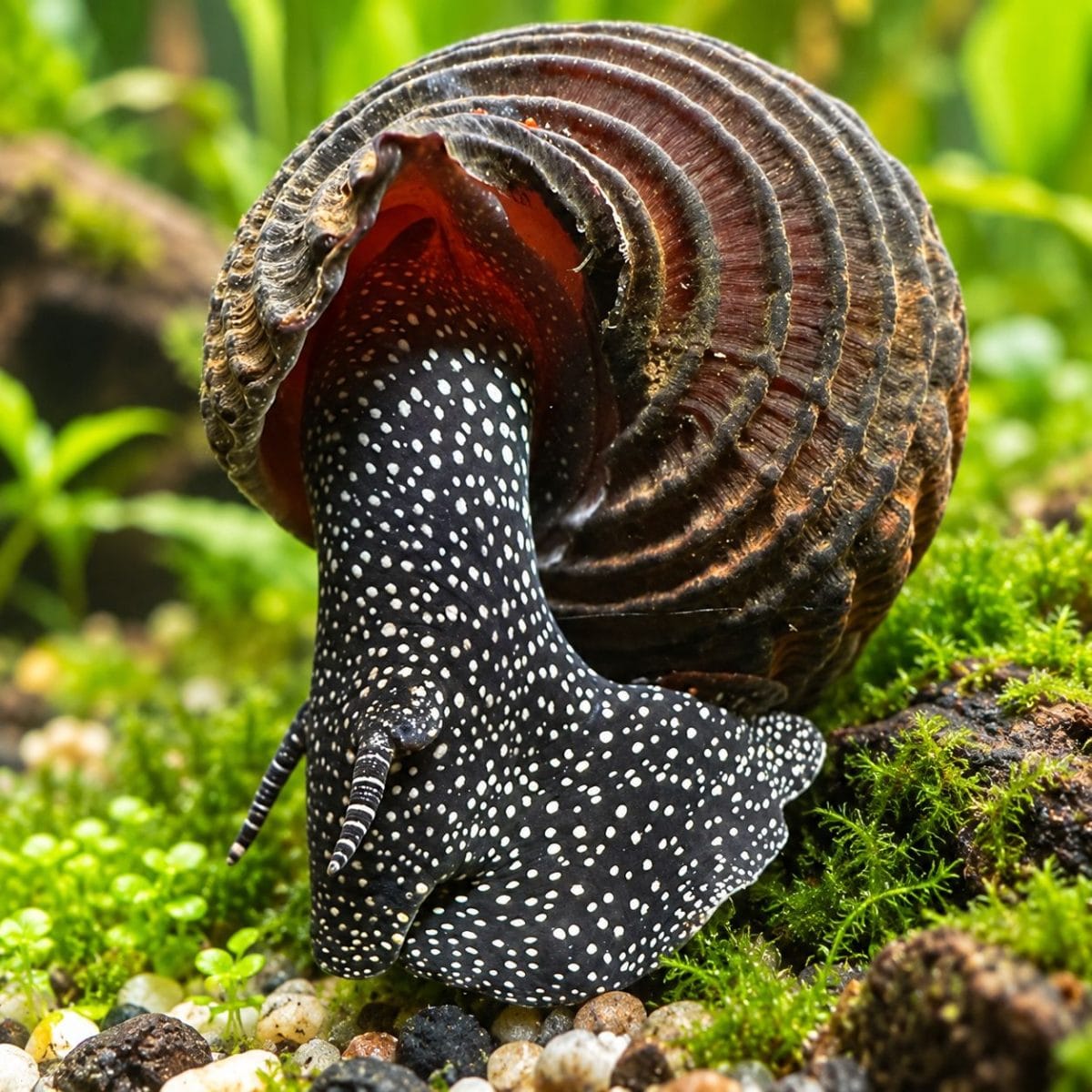
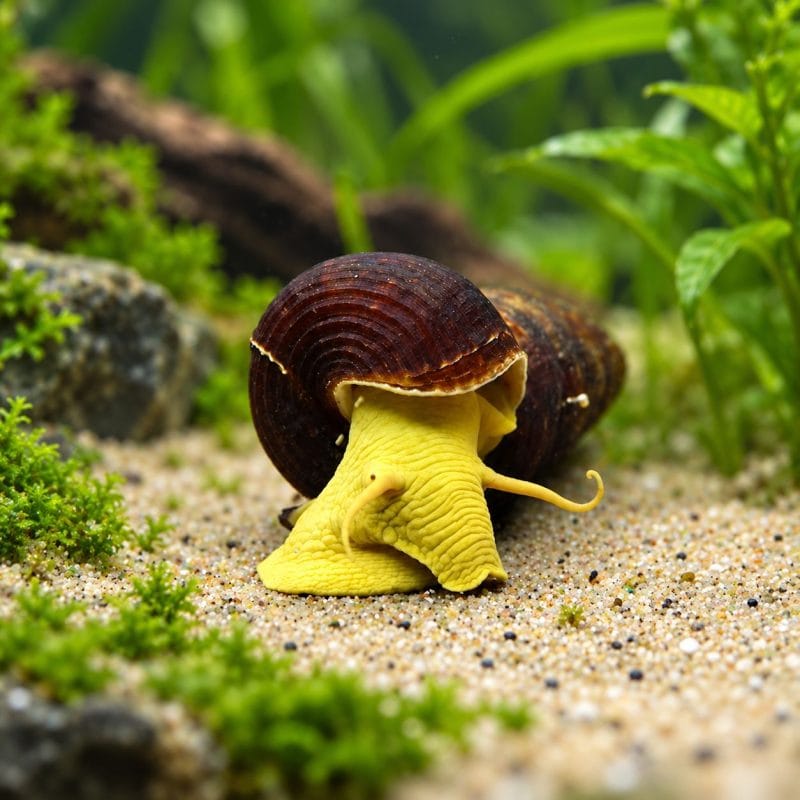
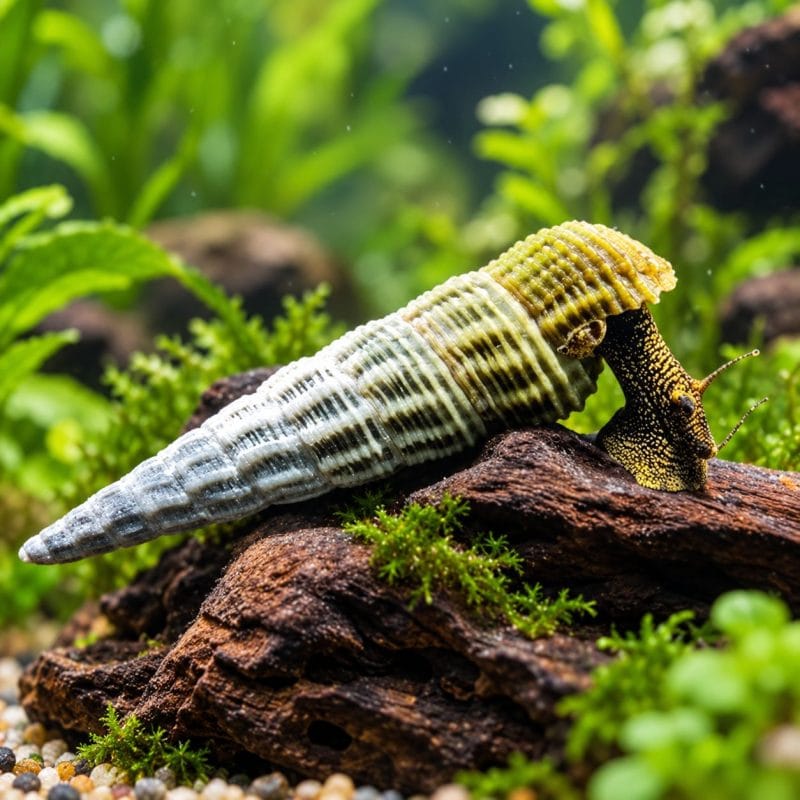
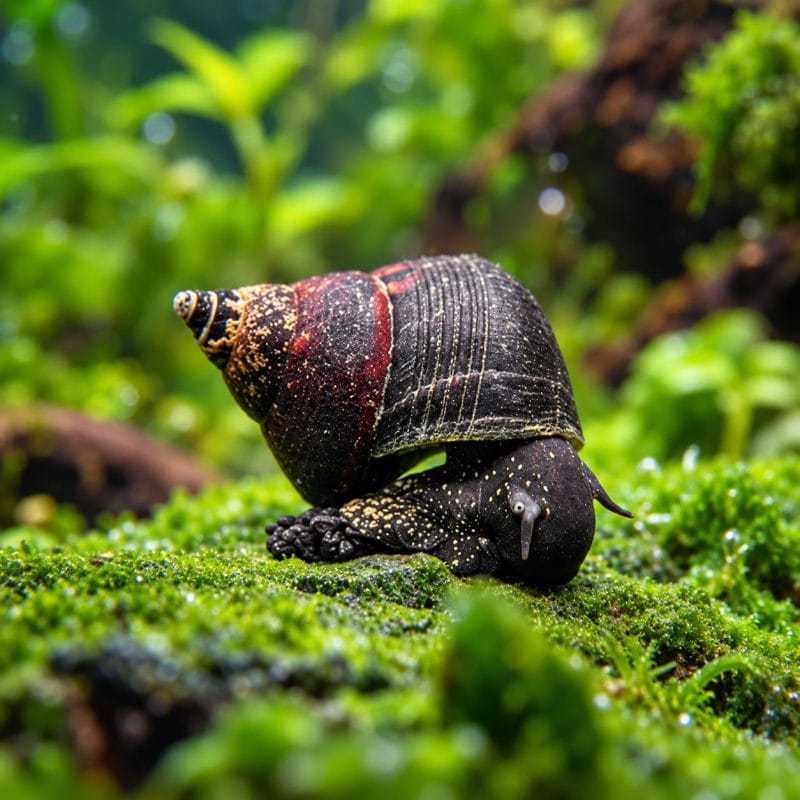
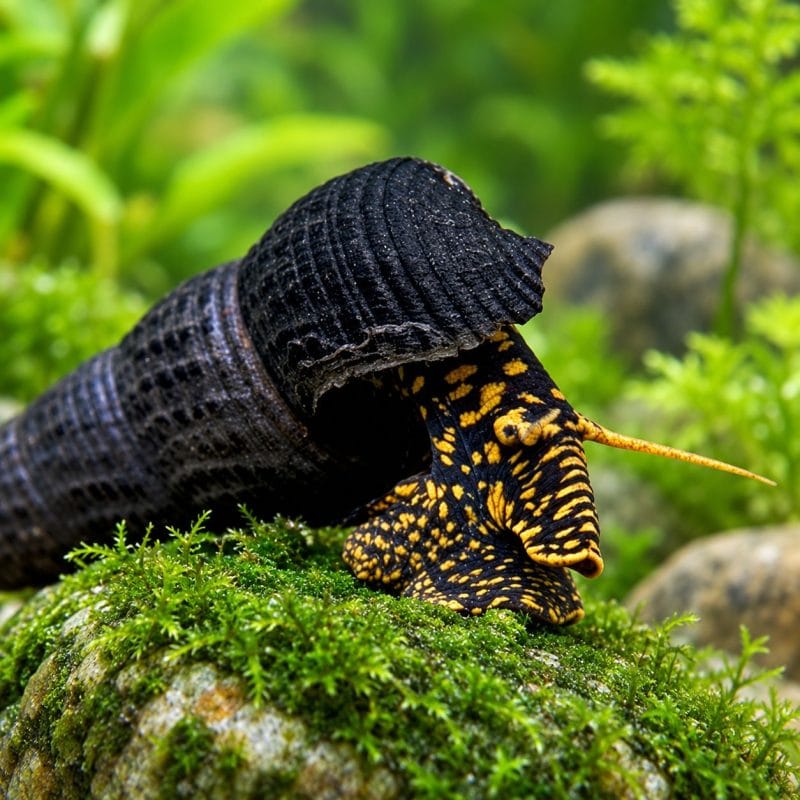
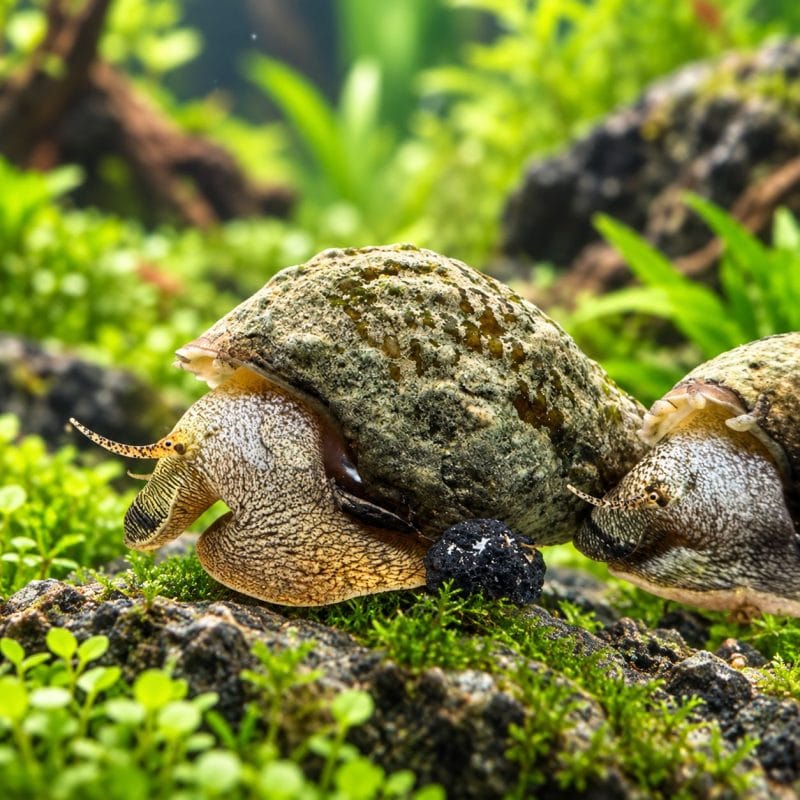
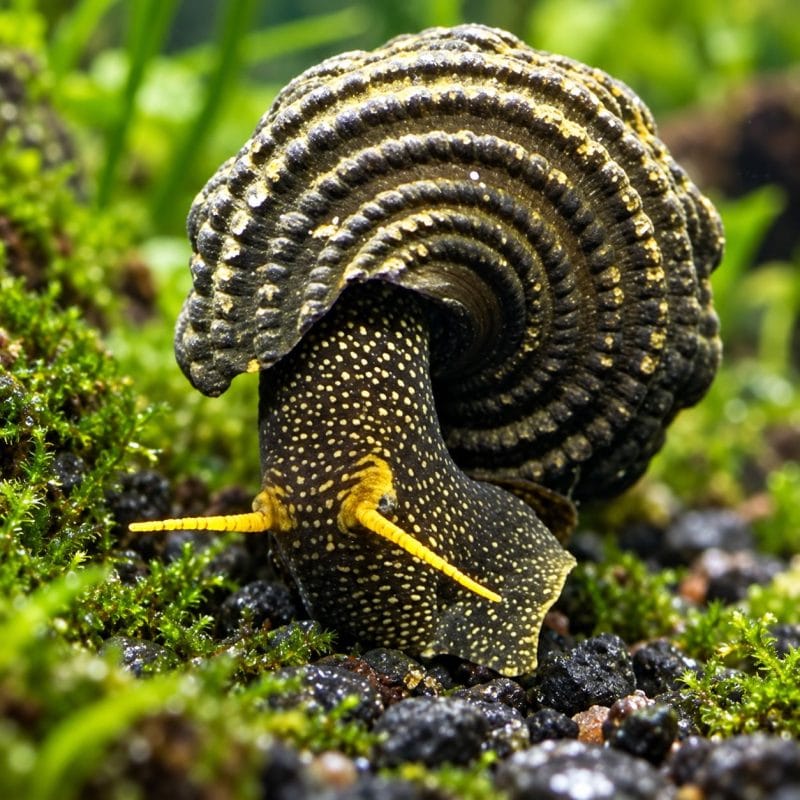
The Black Spotted Rabbit Snail is a Sulawesi rabbit snail, Tylomelania sp., bred by Shrimp Aquatics and not collected from the wild. It’s a good buy only if you already run a warm, alkaline Sulawesi tank that holds 79-86°F (26-30°C) and pH 7.5-8.5 week after week, with algae and biofilm already growing on the rock.
Is the Black Spotted Rabbit Snail a confirmed Tylomelania patriarchalis?
No. You’ll see black spotted rabbit snails labelled Tylomelania patriarchalis in some shops and care sheets, but that name hasn’t been confirmed for this line, and we won’t print a species we can’t back. We sell it as Tylomelania sp., and “Black Spotted” is a trade name for its look.
Why does that matter to you? Sizes, lake of origin and conservation status quoted for a named wild species describe that species, not the snail in your order. What you’re buying is a large, slow, live-bearing grazer, tank-bred and shipped from Vietnam. We don’t promise breeding, sex or the number of young from any order.
What water does a Black Spotted Rabbit Snail need?
Warm, alkaline, mineral-rich water that stays put, as set out below. We rate the snail itself moderate, since it’s hardier than the Sulawesi shrimp that live in this water. The tank is the hard part, and buying a snail in place of shrimp doesn’t make Sulawesi keeping any easier. Pick any line in our Sulawesi snail range and you’re signing up for the same numbers.
| Care level | Moderate snail, advanced tank |
|---|---|
| Temperature | 79-86°F (26-30°C) |
| pH | 7.5-8.5 |
| GH | 4-8 dGH |
| KH | 3-6 dKH |
| TDS | 150-250 ppm |
| Nitrate | Under 10 ppm |
| Substrate | Inert sand and rock, no pH-lowering soil |
Log a week of readings first
One good test day proves little. Write down temperature, pH, GH, KH and TDS across at least a week, and hold off ordering while any number sits outside the table or keeps wandering. Care sheets that quote wider hardness or TDS ranges for this snail aren’t a reason to loosen them. If you’d like a second opinion, send your readings, tank size, cycle status and current livestock to contact@shrimpaquatics.com.
Is your Sulawesi tank ready for a Black Spotted Rabbit Snail?
It is when every line below is true. A tank can test clean and still have nothing growing for a grazer this size.
- Ammonia and nitrite have read 0 for weeks, with an established biological filter.
- Your readings have stayed inside the table between water changes, not just on test day.
- You can see a film of algae and biofilm on the rock and glass.
- Substrate and hardscape are inert.
- The tank can feed one more large grazer on top of what already lives there.
Which tankmates suit a Black Spotted Rabbit Snail?
Sulawesi shrimp, mainly. They share the water and graze the same film, so the only thing to weigh is whether your rock grows enough food for all of them.
Leave out assassin snails, because they prey on other snails. Bee and Taiwan Bee shrimp want soft, acidic water. Neocaridina don’t fit either: they top out at 78°F (26°C), and this tank starts at 79°F (26°C). Many small community fish that care sheets suggest can eat shrimplets, and they need the same warm, alkaline water to work at all, so we’d keep this tank for Sulawesi animals. Never dose copper or a copper-based medication.
Plants are an open question. No published record shows rabbit snails eating living plants or leaving them alone, so treat soft-leaved plants as at risk and tie hardy epiphytes to rock.
How to settle a Black Spotted Rabbit Snail on arrival day
Follow the instructions packed with your order, and keep the transport water out of your tank. Set the snail down the right way up near a surface it can climb, keep the lights low and skip feeding for the first day. It may stay shut in its shell for a while after the trip, and that’s normal.
From then on, the film on your rock and glass is the main meal. Prepared food can top it up but can’t stand in for a tank that hasn’t grown that film. Lift anything uneaten within a few hours, because food breaks down fast in warm water. If the snail stays shut longer than you’d expect, the checks in our Sulawesi rabbit snail care guide show what’s normal and what needs a closer look.


There are no reviews yet.