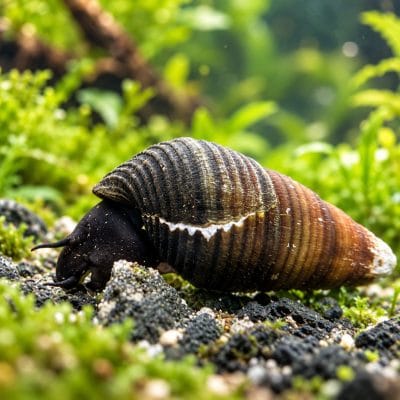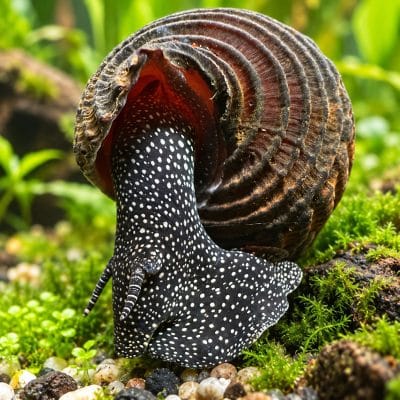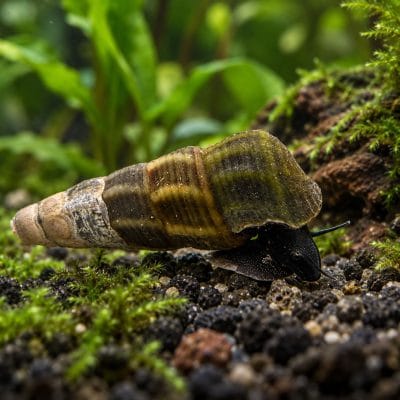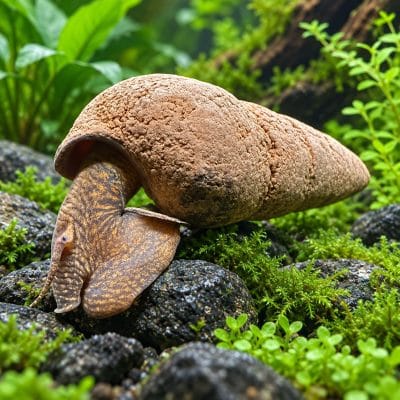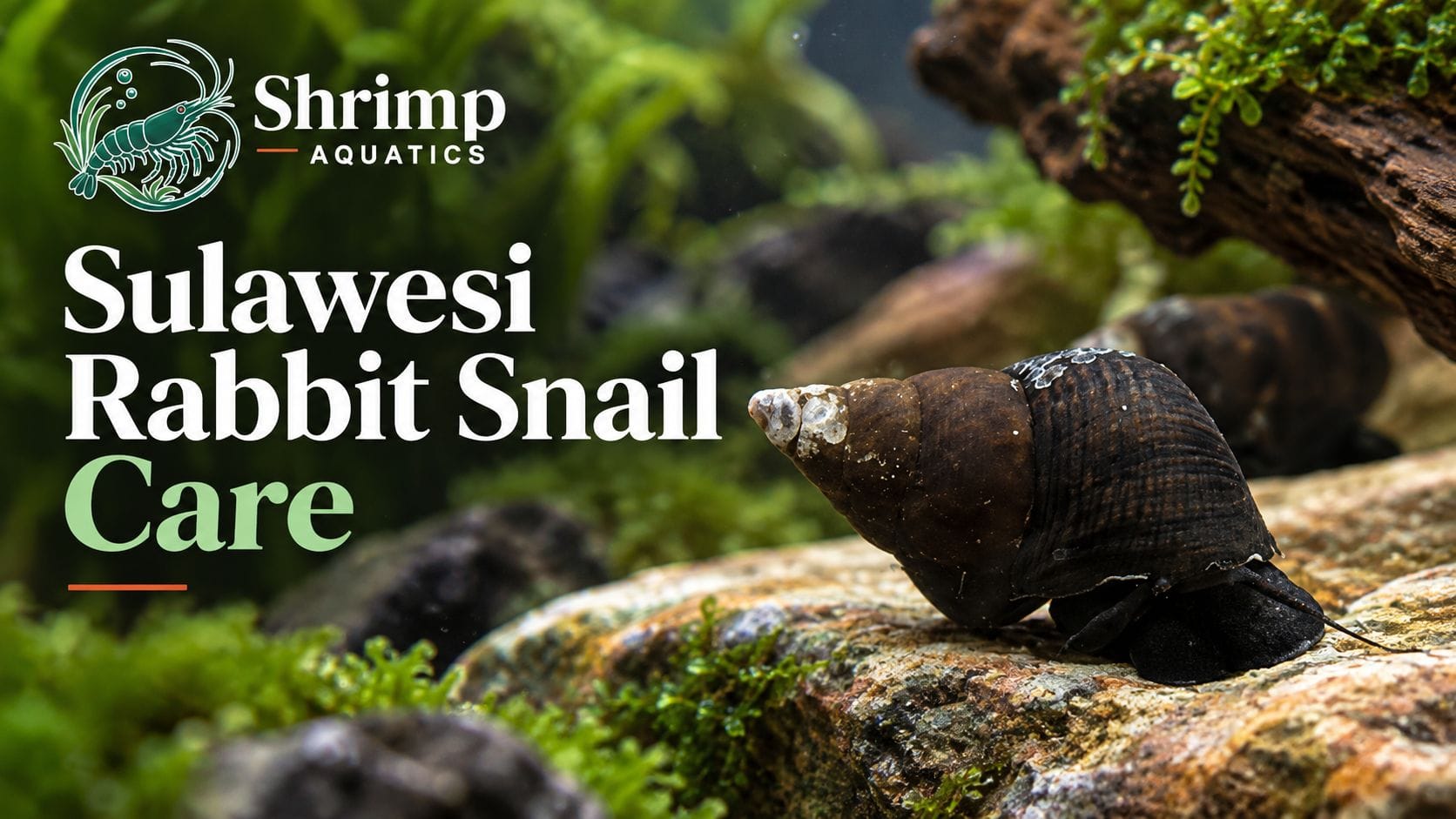
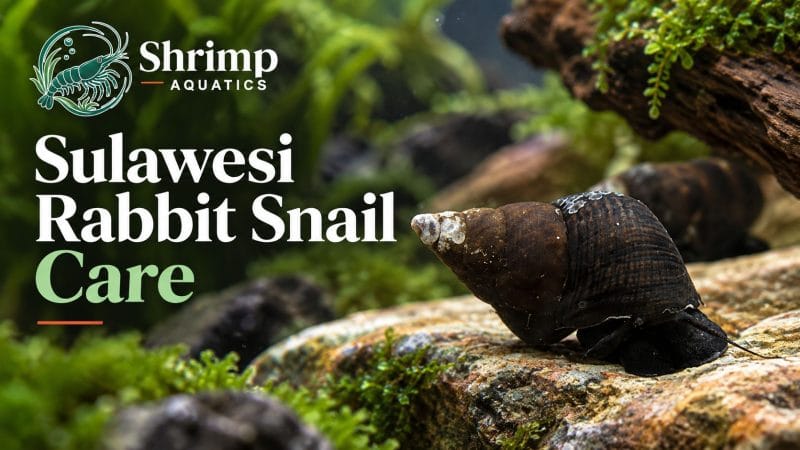
A Sulawesi rabbit snail (Tylomelania sp.) is moderate to keep, but it needs an advanced tank: 79-86°F (26-30°C), pH 7.5-8.5, GH 4-8 dGH, KH 3-6 dKH, TDS 150-250 ppm and nitrate under 10 ppm, in a system mature enough to grow food on its rock. Build that tank first. Once it’s running, the snail mostly looks after itself.
Set up the tank before you order a rabbit snail
Get the water right and let the tank mature before the snail arrives. This is a Sulawesi animal and it needs a Sulawesi tank: warm, alkaline, mineral rich, with something already growing on the rock. The snail forgives a slow hand better than a Cardinal shrimp does, so we rate it moderate. The tank around it is advanced, and swapping shrimp for a snail doesn’t change that.
| Temperature | 79-86°F (26-30°C) |
|---|---|
| pH | 7.5-8.5 |
| GH | 4-8 dGH |
| KH | 3-6 dKH |
| TDS | 150-250 ppm |
| Nitrate | Under 10 ppm |
| Substrate | Soft sand and rock, no pH lowering soil |
| Care level | Moderate animal, advanced system |
Those are the numbers we keep our Sulawesi shrimp in, and the snails live in the same water. No published study gives an aquarium range for Tylomelania. Don’t copy a lake reading into the tank instead: the lakes are more dilute than this range, and the Lake Matano water parameters show how much the published readings disagree with each other.
How to make that water, from the RO base and minerals to the heater and the long cycle, is in our beginner guide to keeping Sulawesi shrimp. Adding a snail doesn’t shorten any of it.
Size the tank for waste and grazing, not length
A rabbit snail is long, but it doesn’t need swimming room. What it needs is enough filtration for its waste and enough surface to graze. That matters more in this water than most, because ammonia turns more toxic as pH and temperature rise, roughly tenfold per pH unit and about double for every ten degrees Celsius.1 Put filtration and maturity first, and the snail after. How much filtration and floor a given tank can support is worked out in rabbit snail tank size.
Check your tank is ready for a grazer
A cycled tank handles waste. A mature tank grows food. This snail needs both, and the second takes longer.
- Ammonia and nitrite read zero, and have for weeks without you chasing them.
- Temperature, pH, GH, KH and TDS hold steady between water changes.
- Rock and glass carry a visible film. If the tank still looks clean, it isn’t ready.
- Don’t stock because the calendar says four weeks. A calendar doesn’t feed anything.
Choosing and ordering your rabbit snails
When those checks hold, you’re ready to order. Every snail we sell is bred in our own tanks rather than collected from the wild. We keep four lines, all listed as Tylomelania sp..
All four live in the water above, so choose on looks. Our guide to the types of rabbit snails explains what those names do and don’t tell you. If you just want a grazer, start with one and let your nitrate readings decide the second. If you want young, plan for a small group.
Shipping is a flat USD 120 per order to every country, and Shrimp Aquatics pays the duties and taxes the courier bills against the shipment. Once the courier collects the box, transit is normally 2-3 days. If snails arrive dead and you report it within 2 hours of delivery, we replace them under our live arrival policy; you cover shipping on the replacement box. Confirming your own import rules is part of ordering. You can see all four lines together in our tank-bred Sulawesi rabbit snails range.
Arrival day and the first week
For a sealed bag from us, match the temperature and move the snail across without adding the transport water. Follow the instructions packed with your order, because packing method and transit time can change the right answer.
- Float the sealed bag until the temperatures match. Keep the lights low while you work.
- Lift the snail out and set it on the substrate the right way up, near a surface it can climb. Leave the transport water out of the tank.
- Leave it alone. A snail that stays shut for a day or two after a journey is behaving normally.
- Through the first week, test ammonia, nitrite and nitrate every couple of days. You’re watching the tank, not the snail.
- Feed the tank, not the animal. If there’s a film on the rock, it has already started eating.
Found it outside the tank? Put it back the right way up and give it a day before you decide anything. The trap door is a real seal, and in other snails that seal buys time out of water.2
Sulawesi Keepers, which runs a conservation breeding program, reports that thousands of Sulawesi snails end up in unsuitable conditions every year and die within a few months.3 Get the water and the grazing surface right before the animal arrives and you’ve dealt with most of it.
What to feed a rabbit snail
Mostly nothing, if the tank is mature. These snails graze biofilm, aufwuchs and algae off hard surfaces, so the film on your rock and glass is the main meal. Give them both open sand and hard surfaces, because where a rabbit snail grazes is part of what it is.4 Soft sand also lets them dig and sift, which keepers report they do. That’s why fine, inert sand under the rock is the best substrate for rabbit snails.
When you do feed, put a small amount of prepared food on open sand, away from the rock the tank grazes, and lift whatever is left within a few hours. Warm water breaks food down fast, and uneaten food turns into ammonia.
Don’t buy this snail to clear algae. Sulawesi Keepers, a conservation group that keeps these animals, says filamentous green algae are not their natural food.5 Which surfaces to give them, how little prepared food to add and whether they touch your plants all come down to what rabbit snails eat.
Is your rabbit snail dying, or is this normal?
Usually it’s normal. These snails are slow, they shut the trap door, and they sit, sometimes for days after a move, a water change or a temperature shift. Keepers describe them as most active at night. If yours has stayed shut much longer and you cannot tell whether it is alive, rabbit snail not moving has the check to run first.
If you’re worried, check in this order:
- Is the trap door still sealed, or hanging loose? A sealed snail is a living snail.
- Does it smell bad?
- Are your numbers where they were last week?
- Has anything gone into the tank that shouldn’t have, such as a medication or a new fish that nips?
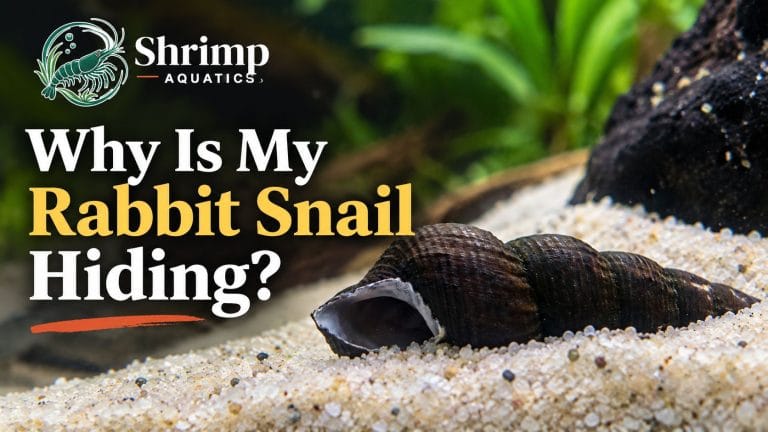
A snail that gapes open and doesn’t react when you lift it usually isn’t alive.
Shell wear at the tip is normal, damage at the edge is not
A worn, pitted or blunt shell tip on an adult is normal and not a sign you’ve failed. Wild snails were described with worn tips back in 1897.6 Fresh damage at the growing edge, where new shell is being laid down, is the one to act on. Check your KH and GH and stop them drifting down between water changes, since low minerals and low pH wear shells in other snails.7 Fresh damage at the opening is a different matter, and when a rabbit snail shell is eroding there, KH is the first reading to check.
Who can share the water with a rabbit snail
Mostly Sulawesi shrimp. Same lakes, same water, same grazing layer. The only question is whether the tank grows enough food for both. The shortlist of rabbit snail tankmates beyond them is short, because the water rules out most fish.
Anything else has to want 79-86°F (26-30°C) and pH 7.5-8.5 too, and that rules out most of what people already own:
- Nippy fish: no. The antennae are how the snail finds food, and keepers report that a snail nipped often stops coming out.
- Neocaridina: a small group, with care. Neocaridina are usually kept at 65-78°F (18-26°C) and this tank starts at 79°F (26°C), so on paper the ranges don’t meet, yet a small group lives and breeds in some of our own Sulawesi tanks. Keep the heater in the snail’s range and the group small, the two rules we follow for rabbit snails with Neocaridina shrimp.
- Bee and Taiwan Bee Caridina: no. They want soft acidic water.
- Assassin snails: never. They eat other snails.
- Mystery snails: only in a big, mature tank, because both graze the same film and a mystery snail lays hundreds of eggs at a time. The trade-offs are laid out in rabbit snail vs mystery snail.
Copper
Copper kills invertebrates, and it takes very little.8 There is no safe level we’re willing to publish. Check fish medications, algaecides, plant fertilizers and snail treatments for copper before anything goes into this tank.
How many rabbit snails one tank can carry
As many as the tank can feed. Two big grazers on one modest rock will strip it, and then you’re hand feeding in warm water that punishes leftovers. In a Sulawesi shrimp tank, the honest way to work out how many Sulawesi shrimp and rabbit snails it will carry is to add one snail, watch nitrate for a few weeks, and let the reading decide the next. Young can add to the count over time. What to expect from rabbit snail breeding has its own page.
Questions keepers still ask about rabbit snails
How long does a rabbit snail live?
Plan for a long-lived animal. Sulawesi Keepers reports up to ten years in an aquarium.5 That ten year figure is a keeper estimate, and how long rabbit snails live explains why no measured number exists. That’s a keeper group’s account, not a study.
How big do they get?
Bigger than most aquarium snails. The sizes in the original species descriptions are for named wild species, not for snails on sale.
Will a rabbit snail eat my plants?
Play it safe: treat soft-leaved plants as at risk and stick to hardy epiphytes tied onto rock.
Where do rabbit snails come from?
Only from Sulawesi, Indonesia, in lakes and in rivers. The full story is in where rabbit snails come from. Many of the wild species there are threatened, and are rabbit snails endangered shows which ones and why.
References
8 Sources
- Aquatic Life Ambient Water Quality Criteria for Ammonia, Freshwater, U.S. Environmental Protection Agency, Office of Water, April 2013.
- Population influences desiccation tolerance in an invasive aquatic snail, Potamopyrgus antipodarum (Tateidae, Mollusca), PeerJ, 2023.
- Conservation Breeding, Sulawesi Keepers, read September 17, 2026.
- Evolutionary Divergence and Radula Diversification in Two Ecomorphs from an Adaptive Radiation of Freshwater Snails, Genes 13(6), 2022.
- Do you know Sulawesi snails?, Sulawesi Keepers, read September 17, 2026.
- Materialien zur Naturgeschichte der Insel Celebes, volume 1, Paul and Fritz Sarasin, C. W. Kreidel’s Verlag, 1897.
- The effect of calcium and pH on Florida apple snail, Pomacea paludosa (Gastropoda: Ampullariidae), shell growth and crush weight, Aquatic Ecology 43, 2009.
- Toxicity of Metals to a Freshwater Snail, Melanoides tuberculata, The Scientific World Journal, 2012.
Ready to get started?
Shop our Sulawesi Snail collection
12 products available · Live Arrival Guarantee