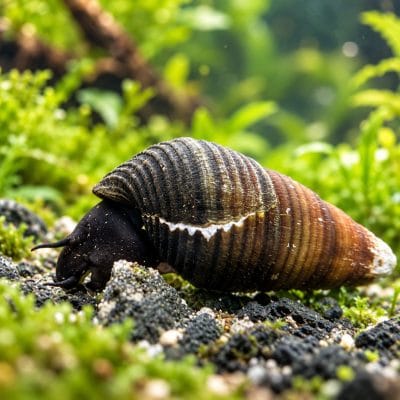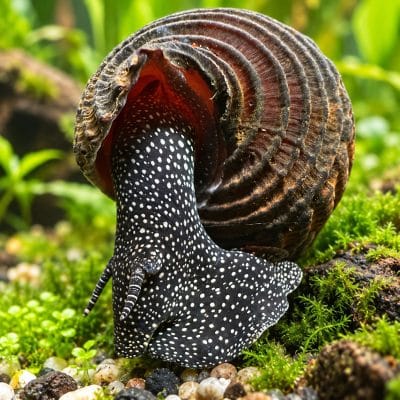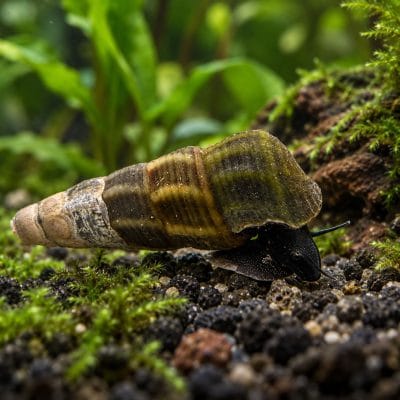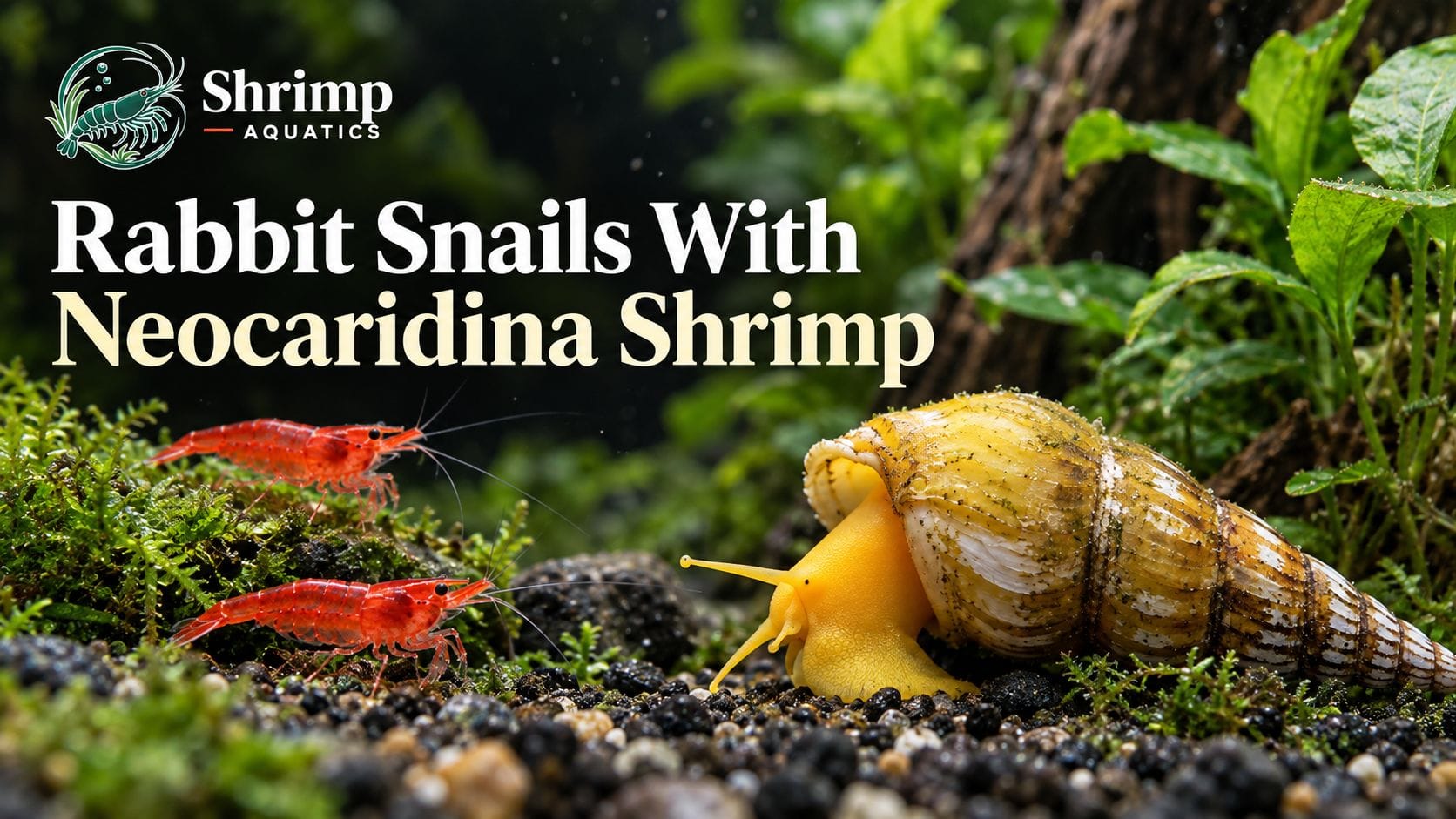
Yes, Sulawesi rabbit snails (Tylomelania sp.) and Neocaridina shrimp (Neocaridina davidi) can share a tank, as long as the snail sets the temperature and the shrimp stay a small group. On paper the two don’t meet: Neocaridina are usually kept up to 78°F (26°C), and a rabbit snail tank starts at 79°F (26°C). In practice Neocaridina are hardy, and they live and breed in some of our own Sulawesi tanks.
Do rabbit snail and Neocaridina water ranges overlap?
They overlap on chemistry and sit just apart on temperature. Put the two ranges side by side and the shared ground is pH 7.5-8.0, GH 6-8 dGH, KH 3-6 dKH and TDS 150-250 ppm, so a mineral-rich, alkaline rabbit snail tank is already water Neocaridina can use.
| Parameter | Rabbit snails | Neocaridina shrimp |
|---|---|---|
| Temperature | 79-86°F (26-30°C) | 65-78°F (18-26°C) |
| pH | 7.5-8.5 | 6.5-8.0 |
| GH | 4-8 dGH | 6-12 dGH |
| KH | 3-6 dKH | 2-8 dKH |
| TDS | 150-250 ppm | 150-300 ppm |
Temperature is the one gap. Neocaridina top out at 78°F in the range we list for them, and rabbit snails start at 79°F. That range is where Neocaridina are usually kept, though, and it isn’t the limit of what they’ll live in.
How do Neocaridina do in a warm rabbit snail tank?
Hardy Neocaridina can live and breed there. That’s what we see in our own tanks, and it’s the reason we’d call this pairing workable rather than off limits.
At Shrimp Aquatics, we keep Neocaridina in some of our Sulawesi tanks, which run in the same warm, alkaline, mineral-rich water as our rabbit snails, and the Neocaridina live and breed there.
Our tanks aren’t yours, so treat that as what’s possible, not a promise. Your shrimp are living above the temperature they’re usually kept at, so watch them closely for the first few weeks. A group that grazes, molts and stays out in the open is settling in. Shrimp that hide all day or keep dying need moving to cooler water.
Should you cool the tank down for the shrimp?
No, keep it at 79-86°F (26-30°C), because the snail can’t come down to meet the shrimp. No published study gives an aquarium range for rabbit snails, so there’s nothing to show a cooler tank is safe for them. If you want to go easy on the shrimp, hold the heater toward the cool end of that range and keep it steady.
Rabbit snails are found only on Sulawesi,1 and species of the genus have been described from the Malili lake system.2 Lake Towuti, the largest of those lakes, commonly has surface water at about 82-84°F (28-29°C) and a water column of about 82-88°F (28-31°C).3 Those are measurements of a deep wild lake, useful as background and not as a setting for your heater.
The target in your own tank stays the 79-86°F (26-30°C) in the table above. Everything else in Sulawesi rabbit snail care still applies once the shrimp are in.
How do you set up a tank for rabbit snails and Neocaridina together?
Build the tank for the snail first, then add a small group of Neocaridina once it’s ready. Check each of these before either animal goes in:
- Fully cycled, with ammonia and nitrite at 0 and an established biological filter.
- Temperature, pH, GH, KH and TDS inside the rabbit snail range from the table above, and holding there.
- A visible film of algae and biofilm on the rock and glass, because that film is what both animals graze.
- An inert substrate and hardscape, with no active soil that pulls pH down.
Start the shrimp as a modest group, not a colony you’re trying to grow fast. Neocaridina that breed well will multiply, and every extra shrimp grazes the same film the snail depends on. If the rock and glass start looking bare, move some shrimp out before you reach for more food; prepared food doesn’t make up for a young or overgrazed tank. Rabbit snails eat biofilm off the same surfaces, so every shrimp you add is a share the snail doesn’t get.
When should you keep rabbit snails and Neocaridina apart?
Keep them apart when the shrimp are the main event. If you’re breeding Neocaridina for color, numbers or sale, give them their own tank at 65-78°F (18-26°C), where you’re working inside their usual range instead of at its edge.
A tank that’s still young, or one where the film never builds up, is also a poor place for both. And Bee and Crystal shrimp don’t belong with rabbit snails at all: they’re kept in cool, soft, acidic water, which is the opposite of what the snail needs. Among Caridina, only the Sulawesi species share the snail’s water, which is why rabbit snails with Caridina shrimp means Sulawesi shrimp in practice.
If a warm, alkaline tank is the one you’re building, our Sulawesi rabbit snails are tank-bred by Shrimp Aquatics, not collected from the wild. The snail itself is moderate to keep. The tank is the demanding part: it has to be warm, alkaline, mineral-rich and mature before the snail arrives, so it isn’t an easy way into Sulawesi keeping or a good first tank.
References
3 Sources
- A snail perspective on the biogeography of Sulawesi, Indonesia: origin and intra-island dispersal of the viviparous freshwater gastropod Tylomelania, von Rintelen T, Stelbrink B, Marwoto RM, Glaubrecht M, PLOS ONE, 2014.
- Three new species of the freshwater snail genus Tylomelania (Caenogastropoda: Pachychilidae) from the Malili lake system, Sulawesi, Indonesia, von Rintelen T, Glaubrecht M, Zootaxa 1852: 37-49, 2008 (Zenodo record).
- Geomicrobiological features of ferruginous sediments from Lake Towuti, Indonesia, Vuillemin A, Friese A, Alawi M, Henny C, Nomosatryo S, Wagner D, Crowe SA, Kallmeyer J, Frontiers in Microbiology, 2016.
Ready to get started?
Shop our Sulawesi Snail collection
12 products available · Live Arrival Guarantee