
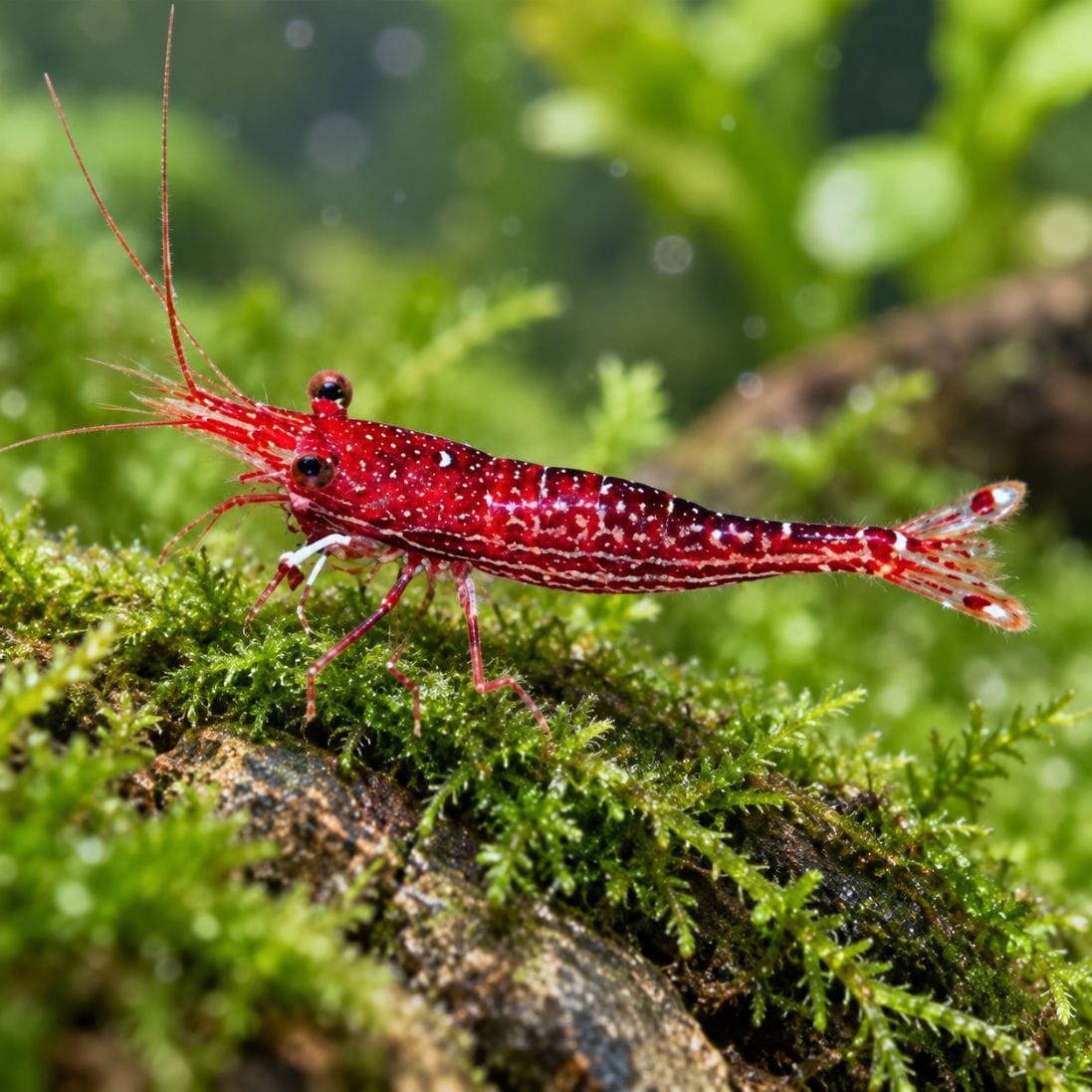
The Red Line Blue Dot is a lake Caridina from Sulawesi, and the name describes it well: fine red striping along the flanks, scattered through with pale blue-white dots that read cyan under cool light. It’s an advanced to expert shrimp, and the tank decides the outcome far more than the animal does.
Which shrimp the Red Line Blue Dot name actually refers to
This line is sold as Caridina sp. “Red Line Blue Dot,” an undescribed species from the Malili lake system in Sulawesi, Indonesia. Exporters and shops have often listed it as Caridina striata, the Red Line, or treated it as a color form of the Red Orchid, so two listings with the same photo may not be the same shrimp. If you’re comparing sellers, the name alone won’t settle it, because Sulawesi shrimp types split into true species and color lines of a single species. Ask what the seller is actually working with before you order.
The water a Red Line Blue Dot needs before you order
Every Sulawesi lake species we sell wants the same warm, mildly alkaline, mineral-light water. Here are the numbers we keep to. Hold them steady; a shrimp sitting at a steady 82°F is safer than one chased toward a perfect reading.
| Difficulty | Advanced to expert |
|---|---|
| Temperature | 79-86°F (26-30°C) |
| pH | 7.5-8.5 |
| GH | 4-8 dGH |
| KH | 3-6 dKH |
| TDS | 150-250 ppm |
| Nitrate | Keep nitrate under 10 ppm |
| Substrate | Inert sand and rock; no pH lowering shrimp soil |
| Behavior | Peaceful and often shy |
Test your own water first
Measure temperature, pH, GH, KH and TDS in the tank these shrimp are going into, not in the tap, and do it before you add this to your cart. If your readings sit outside the range above, fix the water over weeks and order afterward. Moving an established tank quickly is its own kill.
Is your tank ready for this shrimp yet?
Cycled is not the same as ready. These shrimp graze all day, so they need a surface that already feeds them. Work down this list, and if one line fails, wait.
- Ammonia and nitrite both read 0, with an established biological filter
- The tank has been running long enough that rock and glass carry visible biofilm and diatoms
- Temperature holds inside 79-86°F (26-30°C) without swinging day to night
- KH and TDS have stayed put across your last few water changes
- You mix replacement water outside the tank and test it before it goes in
- Don’t stock on a calendar date alone, and don’t add this line to a soft, acidic bee shrimp tank
What ships to you from Shrimp Aquatics
Every Red Line Blue Dot we send is tank-bred by Shrimp Aquatics, not collected from the wild. At Shrimp Aquatics, most of our Sulawesi systems currently run at TDS 150 ppm, GH 6-7 dGH and pH 7.5. That matters to you on arrival day: the closer your tank sits to those readings, the smaller the jump the shrimp has to make, and if your tank runs at the top of the range, bring it down slowly in the weeks before the order, not on the day the box lands. You can compare this line against the rest of our tank-bred Sulawesi shrimp if you’re still deciding what to start with.
Which tankmates suit a Red Line Blue Dot colony
Our advice is to keep them on their own, at least to begin with. Sulawesi snails such as rabbit snails share the same warm, alkaline water, but they add waste and graze the same rock, so count them in your stocking. Bee and Crystal Caridina are a straight no; their soft, acidic water and this warm alkaline water have almost no overlap, and a compromise setting suits neither. Fish are a risk to shrimplets even when they are peaceful with adults. Mixing this line with other Sulawesi shrimp is possible, though shrimp kept together can interbreed, so keep lines separate if you care about what the offspring look like.
What to feed them, starting on arrival day
Mature biofilm, diatoms and algae do most of the feeding in a Sulawesi tank, and prepared food is occasional. A safe default is a small amount once a week, lifted out once the shrimp have finished with it. Warm water breaks down leftovers fast, and that waste is what pushes ammonia and nitrate up. On arrival day, follow the instructions packed with your order. Shrimp Aquatics’ current shipment protocol equalizes temperature with the transport bag sealed, then moves the shrimp across without letting transport water into the aquarium. Keep the lights low, skip feeding for the first day, and leave them alone while they find the rock.





There are no reviews yet.