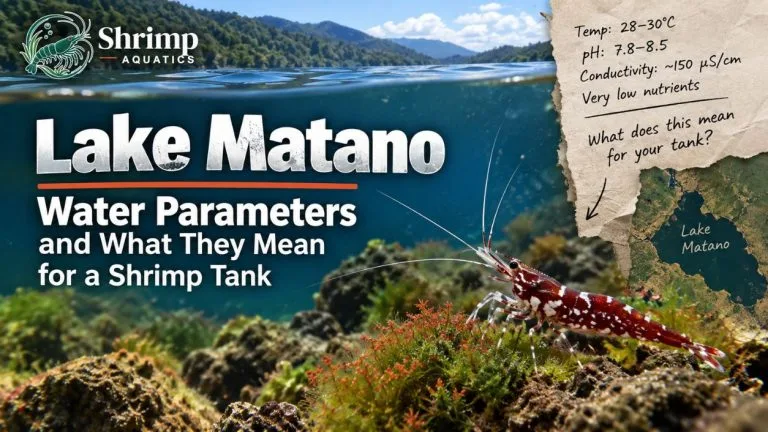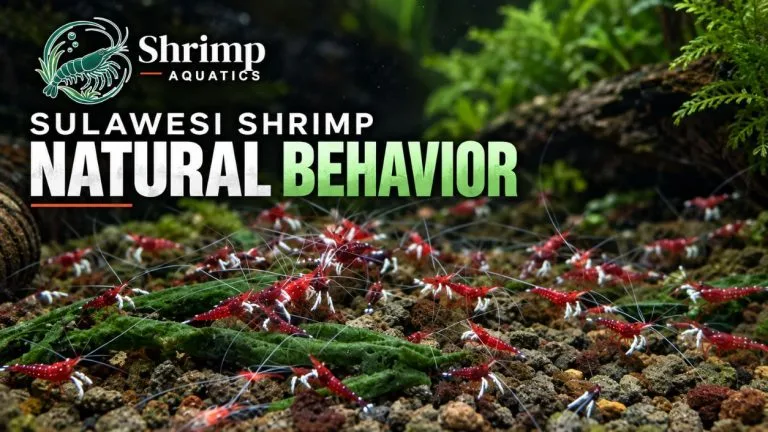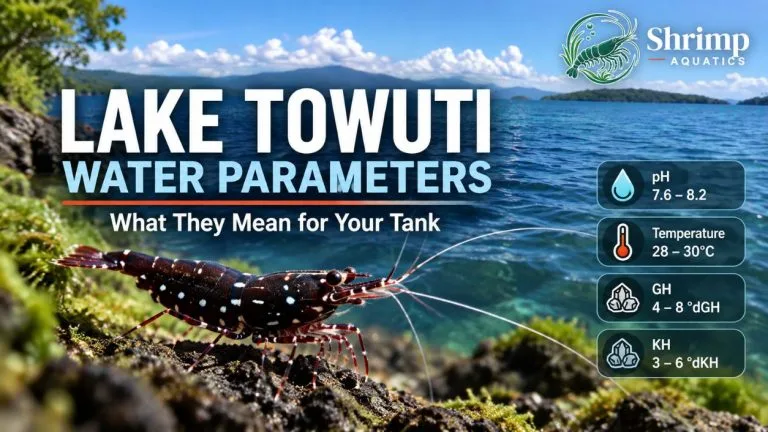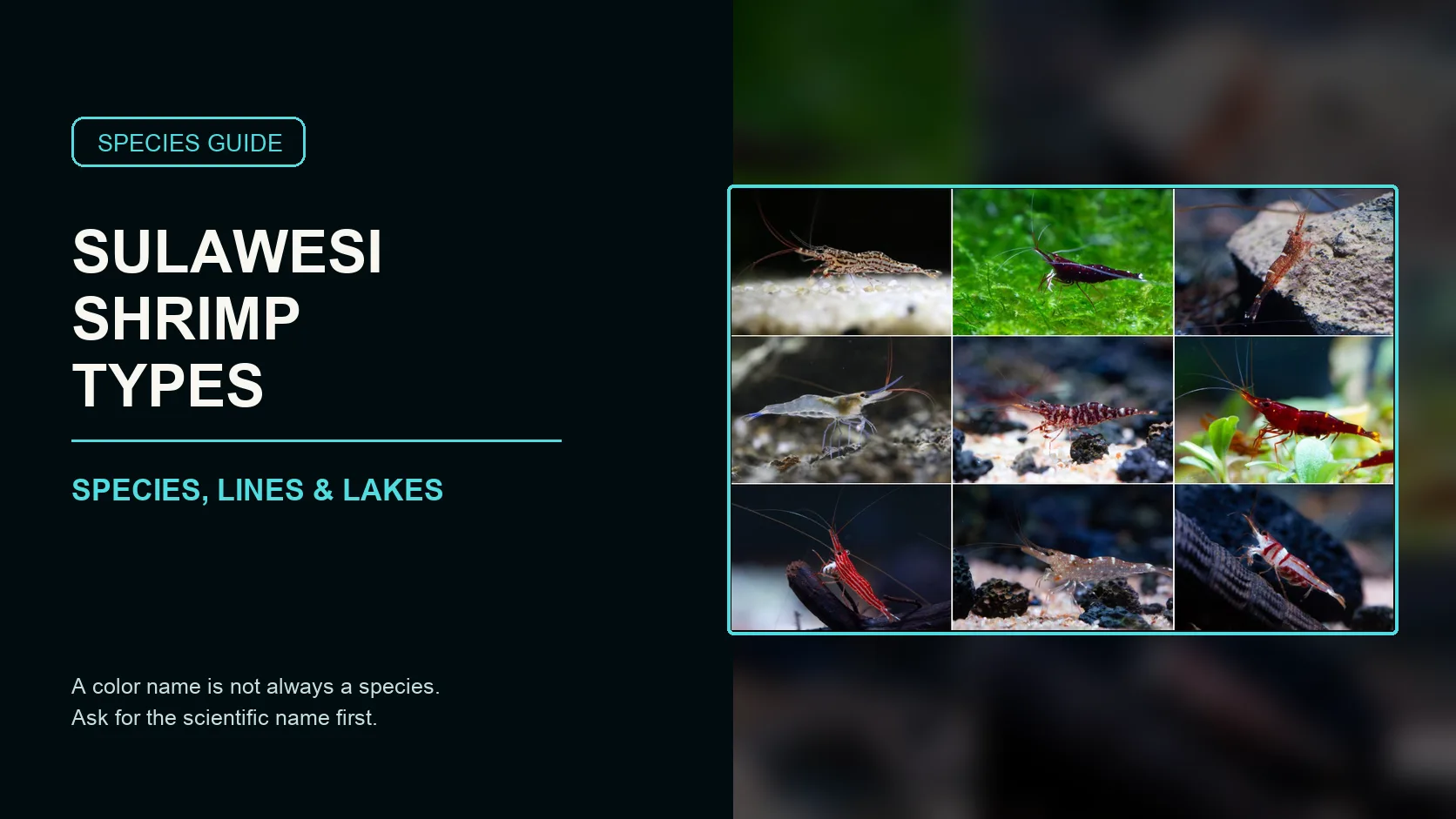
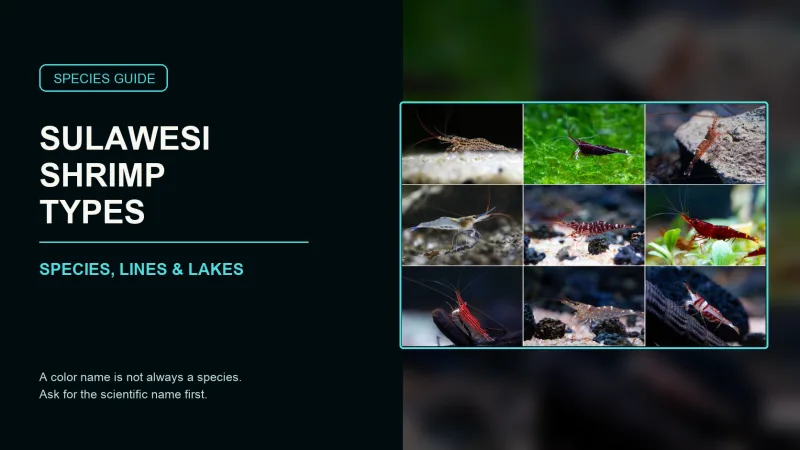
You’ve got a Sulawesi price list open, and it’s full of names that sound like different shrimp. Most of them are color lines of a handful of endemic Caridina species from two ancient lake systems on one Indonesian island. Every one of those species needs the same warm, alkaline water. The island holds far more shrimp than the trade does. The most recent island-wide survey records 62 atyid shrimp species on Sulawesi, 43 of them found nowhere else and 24 restricted to those ancient lakes.1 At least 10 more river species are still undescribed.1 Only a short list of all that ever reaches an aquarium.
Is a Sulawesi shrimp type a species or a trade name?
Usually it’s a trade name. A type on a listing can name a species, a color line or a lake, and only the species is a unit science recognizes. Ask two sellers what types of Sulawesi shrimp they stock and you’ll get two different kinds of answer, sometimes three, and all of them circulate as types.
A species is a described population with its own scientific name. A color line is a strain selected in captivity out of one of those species, and that’s where names like Blue Ghost, Galaxy and Orange Eyes White Sock come from. A lake population is neither. It’s shorthand for where the animal was originally collected, which is why you’ll see Poso attached to some names and Matano to others.
A few common-name pairings are stable enough to rely on. The remineralizer used across much of the specialist hobby names cardinal shrimp as Caridina dennerli, the freshwater harlequin shrimp as Caridina woltereckae and the red-banded shrimp as Caridina striata.2 Beyond pairings like those, trade names aren’t standardized between sellers or countries. So read the name on a listing as a description of what the animal looks like, not as an identification.
Ask for the species, not the color name
If two shops use one name for animals that plainly don’t look alike, ask for the scientific name and the line the stock came from. That answer changes what will breed true in your tank and what you can safely keep in one display. It won’t change the water you have to run.
The species count is a separate question, and the answer to how many types of Sulawesi shrimp there are keeps changing as the lakes are surveyed.
Why only a handful of Sulawesi Caridina species ever reach aquariums
Because nearly every hobby species lives in a single lake, and the trade only carries the few that breed in tanks. That’s why one price list after another shows the same short set, however many Sulawesi shrimp types there are in the lakes.
The Sulawesi shrimp types you’ll actually be offered
Nine species cover almost everything sold under the Sulawesi name, and each one collects its own set of trade names. The wild distributions below come from the 2009 revision that described or redescribed these species.3
Ancient lake species behind the common trade names
| Species | Trade names you will see | Wild distribution | What you are looking at |
|---|---|---|---|
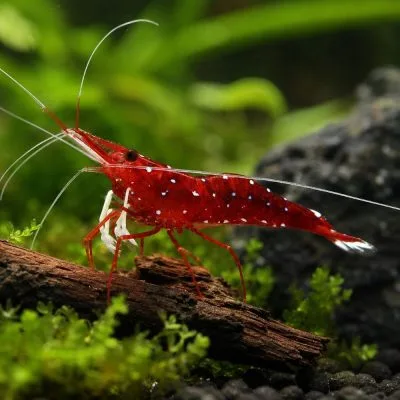
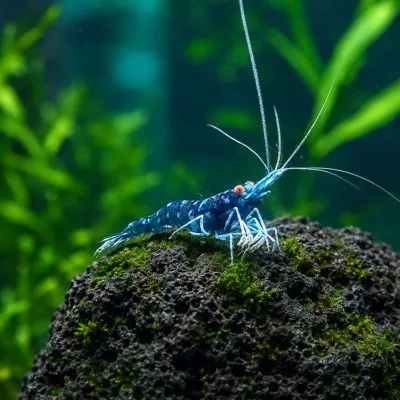
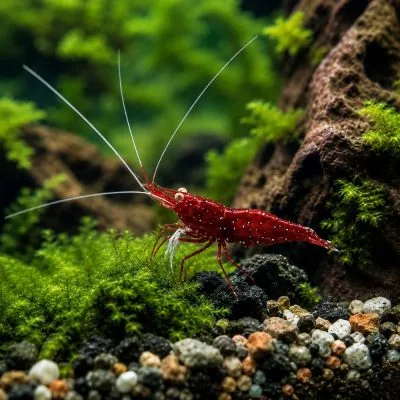
| Caridina dennerli | Cardinal, White Sock, Orange Eyes White Sock, Blue Ghost, Yellow Ghost, Galaxy, Oiran | Endemic to Lake Matano and widely distributed within it, Malili lake system | Deep red to near black body with fine white or pale blue speckling, and bright white front legs that work almost constantly while grazing |
| Caridina spinata | Yellow Nose, Yellow Cheek, Goldflake | Lake Towuti only, Malili lake system | Crimson to deep red body with orange or yellow appendages and yellow markings toward the head |
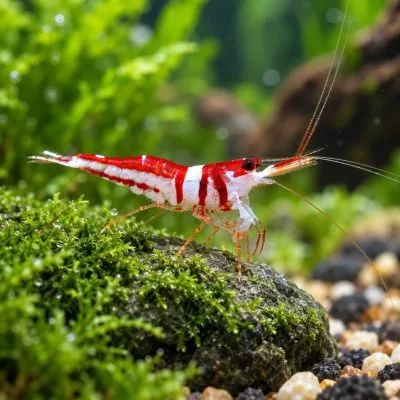
| Caridina striata | Red Line, red-banded shrimp | On rocks in Lake Towuti or Lake Mahalona, Malili lake system | Red body carrying several long white stripes that run lengthwise |
| Caridina woltereckae | Harlequin, Sulawesi harlequin | On rocks in Lake Towuti only, Malili lake system | The largest of the harlequin-patterned shrimp, with bold dark and white banding and a long rostrum |
| Caridina spongicola | Sponge shrimp | On sponges in the outlet bay of Lake Towuti | A much smaller brown and white harlequin-like shrimp that lives on freshwater sponges rather than open rock |
| Caridina glaubrechti | Red Orchid, Brown Camo | Endemic to Lake Towuti, mainly the western part of the lake | Brown and red mottling that reads as camouflage against gravel |
| Caridina holthuisi | Matano Black Tiger | Endemic to the Malili lake system, in all three major lakes and the Petea River | Dark brown body with pale banding, and the one common trade species usually found off bare rock |
| Caridina longidigita | Pink Boxer | Lake Poso | Brownish to greenish body with conspicuously long front claws, which is where the boxer name comes from |
| Caridina caerulea | Blue Leg Poso, Blue Leg | Endemic to Lake Poso | Near transparent body with orange antennae and pale blue legs and tail fan |
Two of those species sit at opposite ends of the range, and it’s worth knowing which before you buy. Cardinal shrimp, or Sulawesi White Sock shrimp, is the animal most people picture when they hear Sulawesi. It’s endemic to Lake Matano and assessed on the IUCN Red List as Critically Endangered and possibly extinct in the wild.4 Blue leg Poso sits at the other end, endemic to Lake Poso and assessed as Vulnerable.5 Neither status tells you how the animal behaves in a tank. Both are a good reason to buy captive-bred stock and to ask where a batch came from.
Color lines bred from a single Sulawesi species
Most of the color names on a Sulawesi price list are lines, not species. Across our own tank-bred Sulawesi shrimp lines, White Sock, Orange Eyes White Sock, Blue Ghost, Galaxy and Oiran are all Caridina dennerli. Yellow Nose and Yellow Cheek are both Caridina spinata, and Pink Boxer is Caridina longidigita. That’s eight listings and three species, which is worth remembering when you shop for the most colorful Sulawesi shrimp.
That cuts both ways. A mixed Sulawesi display usually isn’t the species mix it looks like, which is good news for compatibility and bad news if you were hoping for real variety. And because color is the trait being selected, a line only holds its look while it’s bred apart from the lines it can cross with.
Does the Sulawesi type you pick change the water you have to run?
No. Every Sulawesi lake species in the trade wants the same warm, alkaline, mineral-prepared water, and no color line shifts those targets. A type that sounds forgiving gives you more margin when something drifts. It doesn’t change where the numbers have to sit.
| Difficulty | Advanced to expert |
|---|---|
| Temperature | 79-86°F (26-30°C) |
| pH | 7.5-8.5 |
| GH | 4-8 dGH |
| KH | 3-6 dKH |
| TDS | 150-250 ppm |
| Nitrate | Aim for under 10 ppm |
| Substrate | Inert substrate and hardscape, never an active pH lowering soil |
| Tank | Mature and stable, with established grazing surfaces and biofilm |
Hitting these numbers once is the easy half. Holding Sulawesi shrimp care parameters steady week after week is what actually keeps a colony together, and it’s why this group carries the rating it does.
Two boundaries around that table matter. The first is Bee and Crystal Caridina, which share the genus name and almost nothing else. They want cool, soft, acidic water, and a soft-water setup built for them is one of the most common ways a Sulawesi order is lost in its first month. If you’re weighing the two, the differences between Bee Caridina and Sulawesi shrimp come down to opposite water, not degrees of difficulty. The second boundary is that not every Sulawesi Caridina is a lake animal. The island also carries river species, including the undescribed ones counted in that survey, and a stream shrimp doesn’t inherit the lake water.
Do the published difficulty rankings between Sulawesi types hold up?
Not really. Almost every ranked list of Sulawesi types online is a tier list with no stated criteria, and no published trial compares survival or breeding between two Sulawesi species under matched conditions. So where do all those confident tiers come from? The lists don’t say, and there’s no measured ranking to check them against.
What does exist is narrower and more useful. The Red List habitat description for blue leg Poso calls the species a generalist, found on various types of substrate.5 That’s the closest thing to a documented statement that any species in this group is flexible. It describes wild habitat use, not tank tolerance, but it’s still more than the rest of the rankings have behind them.
One more data point comes from a manufacturer, not a trial. The maker of that hobby remineralizer calls the cardinal shrimp one of the less finicky Sulawesi species, kept and bred with positive outcomes on its salt.2
The one measured husbandry study on a Sulawesi shrimp reared Caridina dennerli under four combinations of feed and shelter. Commercial pellets with Hydrilla shelter gave the highest average length gain, about 0.119 cm. The same combination gave the highest survival, 72.727 percent, against 22.727 percent for the weakest one.6 Read that as evidence about setup. The same animal did more than three times better on survival depending on what it was given to eat and live on.
So which line you buy matters less than whether your system is ready for any of them. Settle honestly whether Sulawesi shrimp are easy to care for before you go shopping for a species that will forgive you.
The easiest Sulawesi shrimp question gets the same answer: the setup decides more than the species does.
What to confirm about a Sulawesi line before you order it
The listing photo tells you the least useful thing about a Sulawesi shrimp. Get these answers in writing before the order goes out.
- The scientific name, not only the color name, so you know which species you’re actually buying.
- Whether the stock is tank-bred, since several species in these lakes are already under pressure in the wild.
- The line name, and whether it has been kept apart from the lines it can cross with.
- Whether your tank has run long enough to carry real grazing surfaces, not just long enough to finish a cycle.
- Don’t add a second named line to an established display on the assumption that lines stay separate on their own.
At Shrimp Aquatics we haven’t seen routine crossing among unrelated Sulawesi species in our Sulawesi shrimp tanks, but we treat White Sock, Blue Ghost, Yellow Ghost and Oiran as Sulawesi shrimp lines that may crossbreed when they’re kept together.
If you want a line to stay recognizable over several generations, give it its own tank instead of mixing two named lines in one display, and keep a note of which line each batch came from.
If you’re buying to breed Sulawesi shrimp, one line per tank and a female-heavy group are the two decisions that follow from everything above. And if this is your first tank in this group, the system goes in before the shopping does. That’s the whole shape of keeping Sulawesi shrimp as a beginner.
Pick a species you can name, buy it tank-bred, keep the line on its own, and let the tank, not the label, decide how your first year goes.
References
6 Sources
- Multiple colonizations of an ‘anomalous island’: origin and phylogeography of Sulawesi’s endemic freshwater shrimp Caridina (Crustacea: Decapoda: Atyidae), Biological Journal of the Linnean Society 147(2), 15 February 2026.
- Sulawesi Mineral 7,5, minerals and trace elements, SaltyShrimp product information page, accessed 2 September 2026.
- Radiation of endemic species flocks in ancient lakes: systematic revision of the freshwater shrimp Caridina from the ancient lakes of Sulawesi, Indonesia, with the description of eight new species, The Raffles Bulletin of Zoology 57(2), 2009, publisher PDF.
- Caridina dennerli, IUCN Red List assessment, IUCN Red List of Threatened Species, assessed 20 August 2018.
- Caridina caerulea, IUCN Red List assessment, IUCN Red List of Threatened Species, assessed 16 November 2011.
- Effect of Using Different Shelter and Feed Types on Growth and Survival Rate of Sulawesi Endemic Ornamental Shrimps (Caridina dennerli), Jurnal Ilmiah PLATAX 13(1), 2025, journal PDF.
Ready to get started?
Shop our Sulawesi Shrimp collection
27 products available · Live Arrival Guarantee
Featured Sulawesi Shrimp
Sulawesi Orange Eyes White Sock
Caridina dennerli
Advanced · 79-86°F · pH 7.5-8.5
From $19.99View Product