
No. Compared with other freshwater shrimp, Sulawesi shrimp are one of the least forgiving groups in the hobby, and typical difficulty for the group runs advanced to expert. The daily routine is light once a tank is mature, but the water preparation, tank maturity and stability behind that routine are what most keepers underestimate.
Why Sulawesi Shrimp Are Rated Advanced to Expert
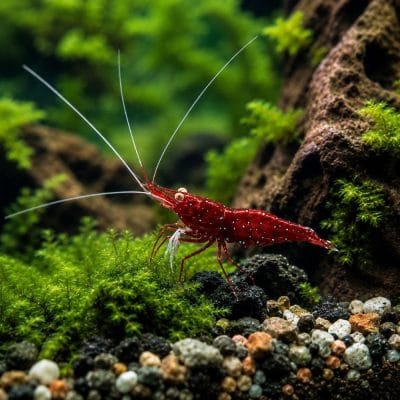
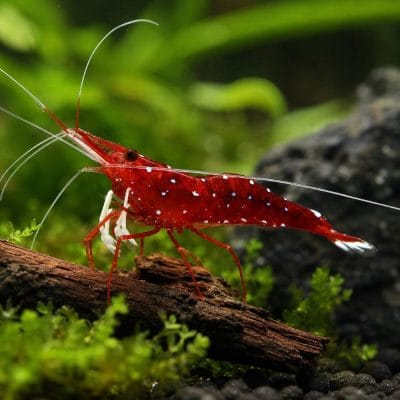
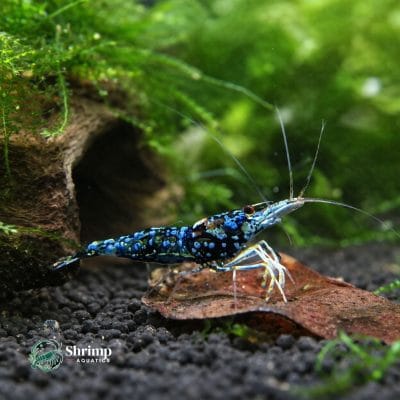
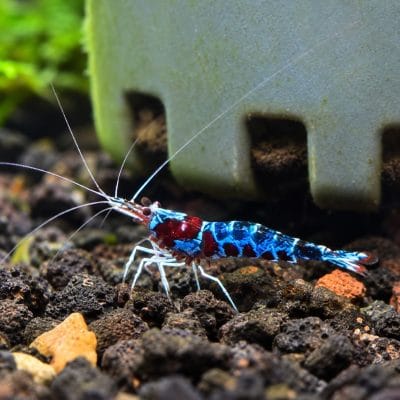
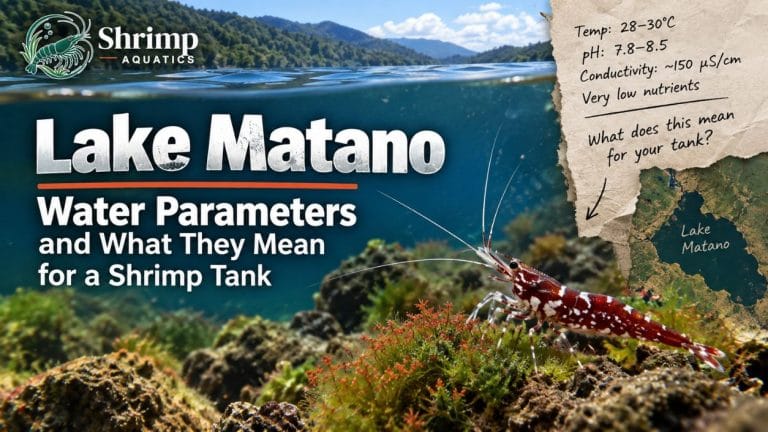
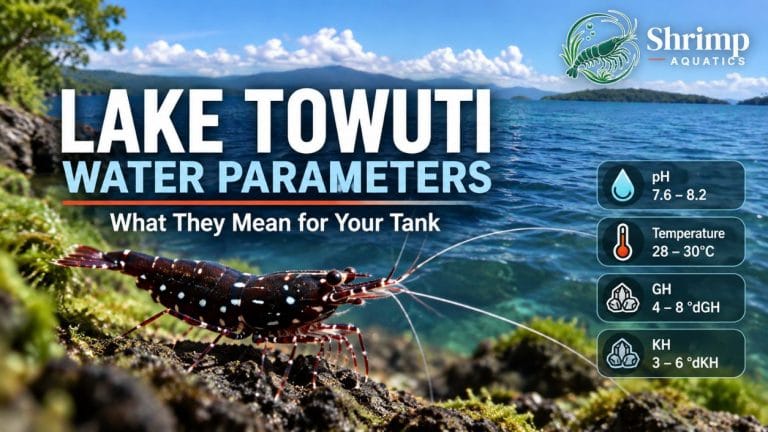
“Sulawesi shrimp” is a trade name for the lake dwelling Caridina species from Sulawesi in Indonesia, including the Cardinal or Oiran, White Sock and Blue Leg lines. They come from a chain of tectonic lakes where conditions barely move. In Lake Towuti, part of the Malili chain of five tectonic lakes, surface water is commonly 82-84°F (28-29°C) with slightly alkaline chemistry around pH 7.8, and productivity in the water column is limited.1 Warm, mineral bearing, nutrient poor and almost seasonless is a difficult combination to reproduce in a glass box.
Scarcity raises the stakes further. The Cardinal shrimp, Caridina dennerli, is assessed on the IUCN Red List as Critically Endangered and endemic to Lake Matano.2 For a buyer that means these animals are expensive, slow to replace and worth preparing for properly. Livestock sold by Shrimp Aquatics is bred in our own breeding tanks rather than collected from the wild, but that doesn’t make the group beginner friendly.
Difficulty also varies inside the group. Some lines settle into aquarium life more readily than others, and a listing may carry a narrower requirement than the general group range. Treat the group guidance below as your planning baseline, then check the specific species or line you intend to buy.
Why Warm, Alkaline Water Makes Sulawesi Shrimp Less Forgiving Than Neocaridina or Bee Caridina
Most shrimp keeping habits are built in cooler, softer water. Sulawesi systems invert two of those habits at once, and the two changes compound each other.
The first is chemistry. Ammonia in water exists as ammonium and as un-ionized ammonia, and the un-ionized form is the more toxic one. As pH and temperature rise, the proportion of that toxic form increases, which is why regulatory ammonia criteria become more stringent at higher pH and temperature.3 A trace of ammonia that a room temperature, slightly acidic Neocaridina tank would shrug off is a more serious event in a warm tank at pH 8.
The second is oxygen. Warm water holds less dissolved oxygen than cold water, and oxygen is also consumed while bacteria oxidize ammonia.4 So the same tank that punishes waste hardest is also the one carrying the smallest oxygen reserve. That’s why a Sulawesi tank needs a genuinely established biological filter and good surface movement rather than a heavy flow that pushes shrimp off their grazing surfaces.
| Parameter | Neocaridina | Bee/Crystal Caridina | Sulawesi shrimp |
|---|---|---|---|
| Difficulty | Often beginner-friendly in a stable, suitable tank | Intermediate to advanced | Advanced to expert |
| Temperature | 65-78°F (18-26°C) | 60-72°F (15.5-22°C) | 79-86°F (26-30°C) |
| pH | 6.5-8.0 | 5.8-6.8 | 7.5-8.5 |
| GH | 6-12 dGH | 4-6 dGH | 4-8 dGH |
| KH | 2-8 dKH | 0-2 dKH | 3-6 dKH |
| TDS | 150-300 ppm | 100-150 ppm | 150-250 ppm |
Read that table as three separate kinds of water rather than one difficulty ladder. Moving from Neocaridina to Bee Caridina means going softer, more acidic and cooler. Moving to Sulawesi means going warmer and alkaline again while keeping mineral content moderate. Experience with one group doesn’t transfer automatically to the next.
Do Not Move Sulawesi Shrimp Into a Bee Caridina Soft Water Setup
This is the single most expensive of all Sulawesi shrimp care mistakes, and it comes from a reasonable assumption. Keepers see that both groups are Caridina, decide that the harder group must want even softer and more acidic water, and add Sulawesi shrimp to an active soil tank built for Crystal Reds. Active buffering substrates are designed to pull pH down into the acidic range, which is the opposite of what a Sulawesi system needs.
Before you buy
A Bee or Crystal Caridina tank isn’t a Sulawesi tank with different livestock. Bee/Crystal lines sit at pH 5.8-6.8 and 60-72°F (15.5-22°C), while Sulawesi shrimp sit at pH 7.5-8.5 and 79-86°F (26-30°C). The two can’t be met in the same water, so plan a dedicated system.
Three other setup decisions follow from the same logic:
- Choose inert substrate and hardscape. An active pH lowering soil isn’t a suitable default for a Sulawesi tank.
- Don’t plan a mixed colony of Sulawesi shrimp with Bee shrimp or Taiwan Bee Caridina. The water they need is incompatible with a warm, alkaline Sulawesi system, so one group is always compromised.
- Don’t judge readiness by the calendar alone. A tank that’s a month old on paper can still show ammonia or nitrite. Once shrimp are in, any nitrite at all is an emergency, and with Sulawesi shrimp nitrite poisoning most of the damage comes from correcting too hard.
What Water Parameters Do Sulawesi Shrimp Need?
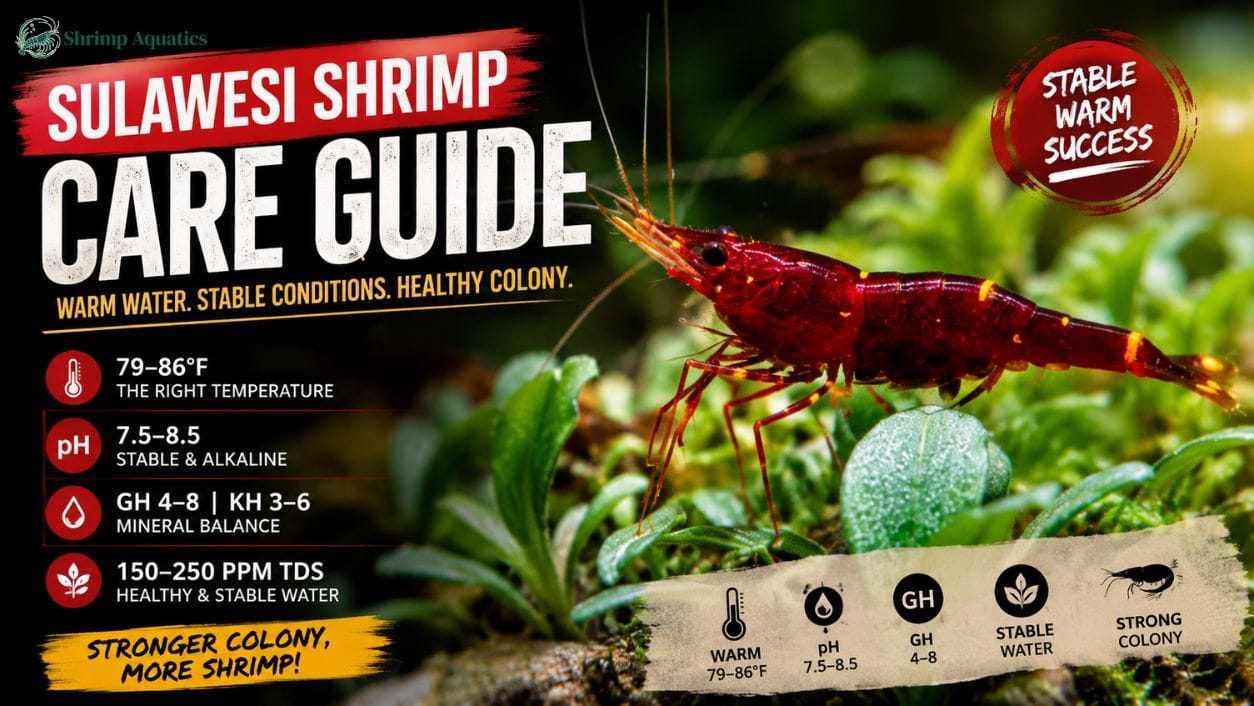
The values below are typical ranges for lake system Sulawesi Caridina as a group. Verify the identity and any narrower requirement of the exact species or line you buy, and treat stability inside the range as more important than hitting a favorite number.
| Difficulty | Advanced to expert |
|---|---|
| Temperature | 79-86°F (26-30°C) |
| pH | 7.5-8.5 |
| GH | 4-8 dGH |
| KH | 3-6 dKH |
| TDS | 150-250 ppm |
| Nitrate | Aim for under 10 ppm; that is a target, not a proven tolerance limit |
| Ammonia and nitrite | 0 in a fully cycled system with an established biological filter |
| Substrate | Inert substrate and hardscape, not an active pH lowering soil |
| Tank | Mature, stable system with established grazing surfaces and biofilm |
| Behavior | Peaceful and often shy, with variation by environment |
GH deserves particular attention because it’s the practical measure of the calcium and magnesium available to the shrimp. Crustaceans renew the whole exoskeleton at every molt, and the calcium used to mineralize the new cuticle comes largely from the surrounding water.5 Molting is therefore the moment when unstable or unsuitable mineral content shows up as a visible problem.
The full Sulawesi shrimp care parameters, with the reasoning behind each number, sit on their own page; here the point is only whether your water source can reach them.
Build Sulawesi Water From RO and a Sulawesi Mineral Salt Before Stocking
Tap water isn’t a reliable starting point here. Its mineral profile, hardness and pH vary by supply and season, and it can carry copper and other metals that are risky for invertebrates. The workable method is to start from water with nothing in it and add back a mineral product formulated for Sulawesi conditions, then confirm the result with your own test kit.
- Prepare RO water in a separate mixing container, not in the aquarium.
- Add a Sulawesi specific mineral product following the current manufacturer instructions for that product. Sulawesi salts are sold in different pH versions, so check which version matches your target.
- Mix and aerate until the water is clear and the reading stops drifting. Some Sulawesi mineral products dissolve slowly, so don’t assume the water is finished simply because the powder is gone from view.
- Test the finished water for pH, GH, KH and TDS and compare it against the range you’re targeting.
- Match temperature before the water is used, whether it’s going into a new tank or into an established one.
How Do You Know a Sulawesi Tank Is Mature Enough for Shrimp?
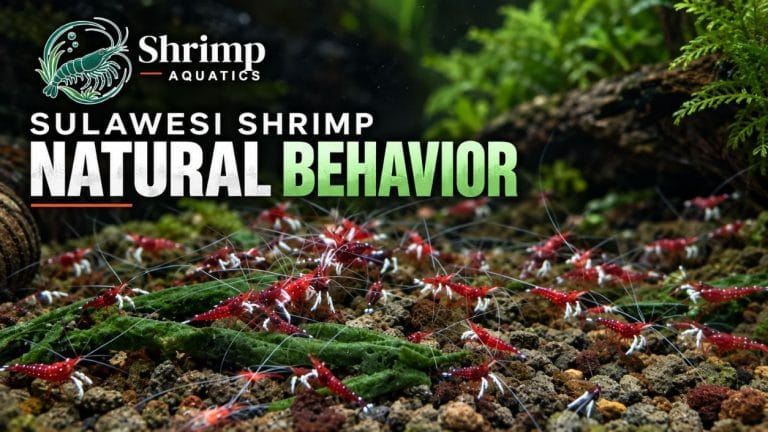
A cycled tank and a mature tank aren’t the same thing. Cycling gives you a biological filter that converts ammonia and nitrite. Maturity adds the second half of a Sulawesi system, which is the film of algae, biofilm and microorganisms on rock and glass that these shrimp graze on continuously. Adding shrimp to a tank that’s only technically cycled is one of the most common causes of early losses.
- Ammonia and nitrite both read 0 on a reliable test.
- Temperature, pH, GH, KH and TDS hold steady across repeated tests.
- Rock and glass show visible algae and biofilm growth, not bare surfaces.
- The heater and thermostat have been observed holding temperature through a full day and night cycle.
- Don’t stock because a set number of weeks has passed.
- Don’t stock a full colony into a tank that has never held livestock, when a smaller starter group would test the system first.
Our cycling window
We don’t rush a new Sulawesi tank. With a powdered bacterial starter, our normal minimum is 3-4 weeks. With a liquid or live culture, the process may reach the same checkpoint in 2-3 weeks. The calendar doesn’t decide when shrimp go in. We wait for 0 ammonia and nitrite, stable water and established biofilm before stocking. During the early cycle, we normally run the light for 8-10 hours a day so algae and biofilm can establish on the rock and glass. In an empty cycling tank, we sometimes add a small amount of shrimp food to support early microbial growth, then remove what remains after about 24 hours.
Keep Sulawesi Shrimp Stable Through Water Changes and Evaporation Top Offs
Once the tank is running, the work becomes small and repetitive. That’s good news for anyone worried about daily effort, and bad news for anyone who likes big weekend interventions. Almost every routine task in a Sulawesi tank is about not moving the parameters.
Match Replacement Water to the Tank Before It Goes In
Prepare replacement water in advance and check it against the tank for temperature, pH, GH and TDS. Small, regular changes are easier to match than large ones, and adding the water slowly gives the shrimp time to adjust. If the replacement water isn’t ready, waiting is the safer choice.
Top Off Evaporation With Pure RO to Stop Mineral Creep
Evaporation removes water and leaves the dissolved minerals behind, so the tank concentrates as it evaporates. Topping off with remineralized water instead of pure RO adds minerals on top of minerals, and GH and TDS climb quietly over weeks until they sit well outside the range you thought you were maintaining. Use pure RO for evaporation and save remineralized water for actual water changes.
Feed Sparingly and Remove Leftovers Before They Foul Warm Water
Established algae and biofilm are the main food source in a mature Sulawesi tank. Prepared food is supplemental, and uneaten food breaking down in warm, alkaline water feeds exactly the ammonia problem described earlier. Acceptance of prepared food varies by species, system and product, so watch what your own colony actually grazes on.
Watch for drift, not just spikes
Slow losses over several weeks usually point to a parameter that moved gradually rather than a single accident. Logging TDS, GH and temperature at the same time each week makes that drift visible while it’s still fixable.
Should You Start a Sulawesi Tank Now or Practice on an Easier Group First?
The honest answer depends less on how long you’ve kept shrimp and more on whether you already run water by measurement. Use these two profiles to place yourself.
Start a Sulawesi tank if
You can dedicate a tank to one set of water values, you already prepare RO water and test pH, GH, KH and TDS as routine, you’re willing to wait weeks for biofilm before stocking, and you accept that losses are possible even when the setup is correct.
Build experience first if
You’d be adding Sulawesi shrimp to an existing community tank, you rely on tap water and occasional testing, you need the tank stocked within a few weeks, or a colony loss would end the project financially.
A useful middle path
Set up the Sulawesi tank now and stock it later. Running the system empty for several weeks with prepared water, a heater and lighting teaches you how your own equipment behaves, and it produces the grazing surfaces the shrimp will need on arrival. If you want a check before ordering, email contact@shrimpaquatics.com with your pH, GH, KH, TDS, temperature, tank size, cycle status and current livestock and we will tell you honestly whether the setup is ready.
If the answer is yes, the beginner guide to keeping Sulawesi shrimp takes the setup in the order you’ll actually meet it.
If your water source and your patience pass those tests, tank-bred Sulawesi shrimp from a single breeder are the next step; if they don’t, an easier group first costs less and teaches the same habits.
If the answer is yes, compare the easiest Sulawesi shrimp lines against what your tank can already hold before you pick one.
References
5 Sources
- Geomicrobiological Features of Ferruginous Sediments from Lake Towuti, Indonesia, Frontiers in Microbiology, published 2016, accessed 2026-07-20.
- Caridina dennerli, The IUCN Red List of Threatened Species, IUCN, assessment published 2018, accessed 2026-07-20.
- Aquatic Life Criteria for Ammonia, US Environmental Protection Agency, accessed 2026-07-20.
- Dissolved Oxygen, CADDIS Volume 2, US Environmental Protection Agency, updated 2025, accessed 2026-07-20.
- Biomineralizations: insights and prospects from crustaceans, ZooKeys, published 2012, accessed 2026-07-20.
Ready to get started?
Shop our Sulawesi Shrimp collection
27 products available · Live Arrival Guarantee
Featured Sulawesi Shrimp
Sulawesi Orange Eyes White Sock
Caridina dennerli
Advanced · 79–86°F · pH 7.5–8.5
From $19.99View Product