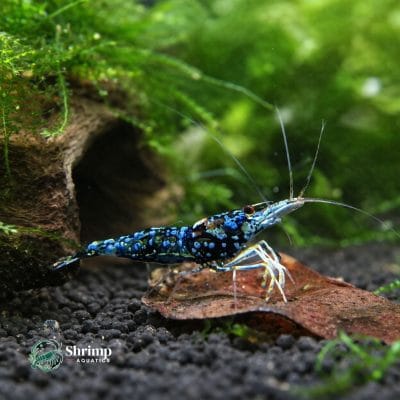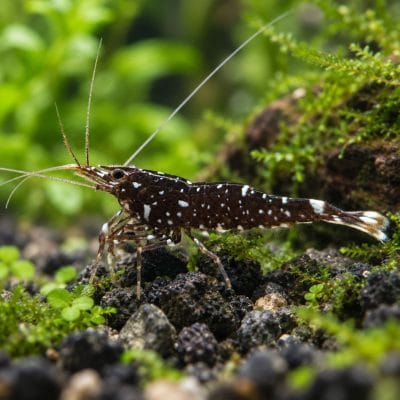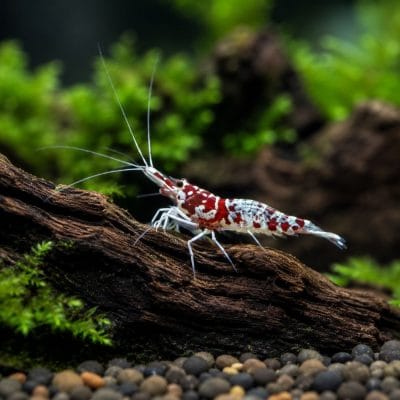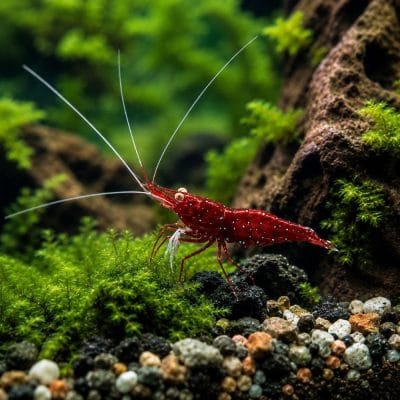
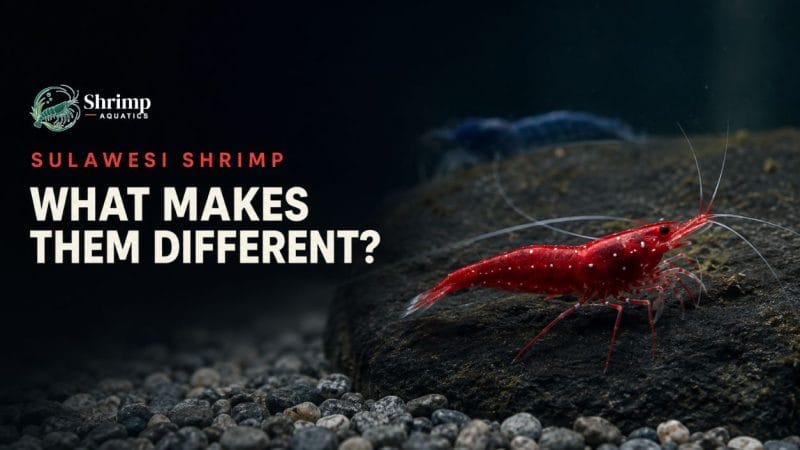
Sulawesi shrimp are lake specialists, and most of what works in a cherry shrimp or crystal shrimp tank has to change for them. They need water held warm and alkaline at 79-86°F (26-30°C) and pH 7.5-8.5, an inert tank with a real grazing surface, and a routine built around holding those numbers steady. Everything below is a difference that changes what you build or what you do, not trivia about where they come from.
Sulawesi shrimp need warm alkaline water, not the soft acidic water bee shrimp want
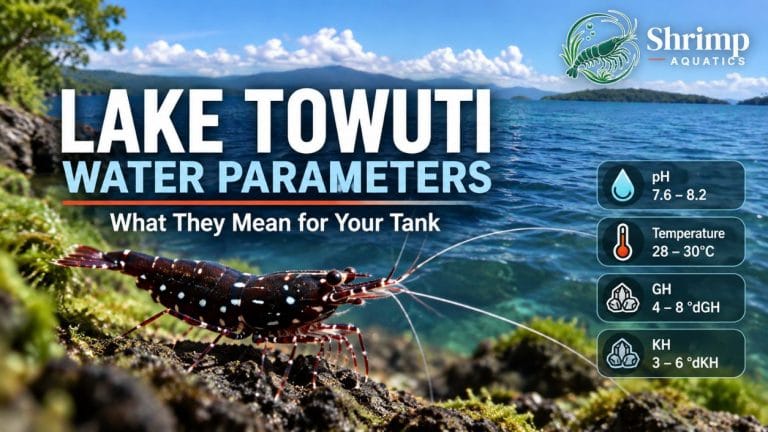
Put the three groups the hobby actually keeps beside each other and the pattern is easy to read. Neocaridina sit close to ordinary tap water in much of the world. Bee and crystal Caridina sit at the soft acidic end. Sulawesi shrimp sit at the warm alkaline end, and they’re the only one of the three that needs carbonate hardness held up rather than stripped out. Amano shrimp, the large river Caridina sold to graze algae in planted community tanks, sit outside all three, and temperature alone keeps Sulawesi shrimp and Amano shrimp out of the same tank.
| Parameter | Sulawesi lake Caridina | Neocaridina, cherry lines | Bee and crystal Caridina |
|---|---|---|---|
| Difficulty | Advanced to expert | Often beginner friendly in a stable, suitable tank | Intermediate to advanced |
| Temperature | 79-86°F (26-30°C) | 65-78°F (18-26°C) | 60-72°F (15.5-22°C) |
| pH | 7.5-8.5 | 6.5-8.0 | 5.8-6.8 |
| GH | 4-8 dGH | 6-12 dGH | 4-6 dGH |
| KH | 3-6 dKH | 2-8 dKH | 0-2 dKH |
| TDS | 150-250 ppm | 150-300 ppm | 100-150 ppm |
Two rows do most of the work. The first is temperature. The Sulawesi range starts at 79°F (26°C), which is above the top of the Neocaridina range, so a room temperature tank isn’t a Sulawesi tank and a heater isn’t an optional refinement. The second is carbonate hardness. A bee tank is run at 0-2 dKH and the substrate is chosen to keep it there. A Sulawesi tank has to hold 3-6 dKH, which means nothing in the tank can be quietly working against it.
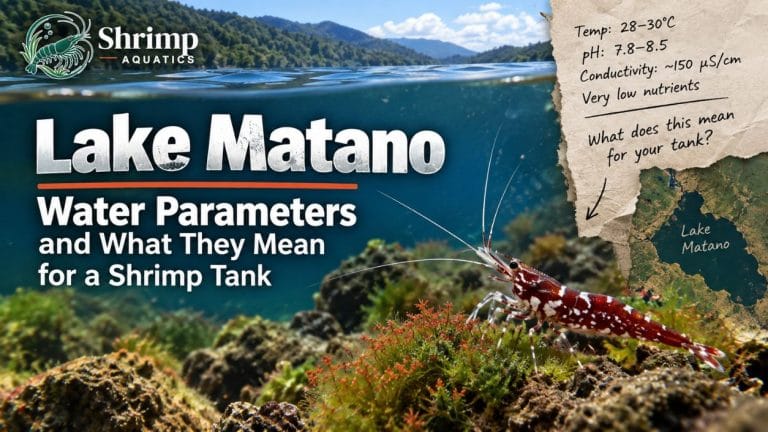
The reason sits in where these animals live. They’re lake shrimp from unique ancient lake systems in central Sulawesi, and that water is warm and alkaline year round. Surface water sampled across the Poso watershed in 2021 was warm and strongly alkaline, with pH readings above 9 at every sampling zone.1
Don’t aim at the lake
Those field readings describe a watershed, river and estuary stations included, not an aquarium. The range to build and hold in a tank is pH 7.5-8.5, and there is nothing to gain by pushing past it.
Can you reuse a bee shrimp setup for Sulawesi shrimp?
No, and the two parts that have to change are the two parts people most want to keep: the substrate and the mineral.
A bee or crystal tank is usually built on an active buffering substrate, chosen to hold the water at pH 5.8-6.8 with KH 0-2 dKH. That substrate is doing its job in a bee tank and the wrong job in this one, because a Sulawesi tank has to hold 3-6 dKH instead. What a Sulawesi tank wants is inert substrate and inert hardscape, rock and sand that don’t react with the water, and inert applies to wood and leaves as well. If you want botanicals in the tank for looks, test KH and pH before and after adding them.
The mineral changes with it, because the target is different: a Sulawesi mix has to lift carbonate hardness and general hardness together, which isn’t what a bee tank asks of a remineralizer. These salts also behave differently in the bucket. SaltyShrimp’s Sulawesi Mineral 8.5, to take a product with published instructions, raises carbonate and total hardness at a ratio of KH to dH of 0.78 to 1.0, and the maker states that it dissolves almost completely only when CO2 is added over about 3-4 days, after which the water needs at least three hours of aeration with an air stone to drive that CO2 back out before it’s used.2 Remineralizing RO water for this group is a process with a waiting period in it, not a scoop and a stir.
There’s one more reason the mineral side isn’t negotiable. The calcium a crustacean puts into a new shell comes mainly from the water it lives in rather than from what it eats.3 The hardness in the tank is the material the animals build with.
How much do Sulawesi shrimp need feeding compared with cherry shrimp?
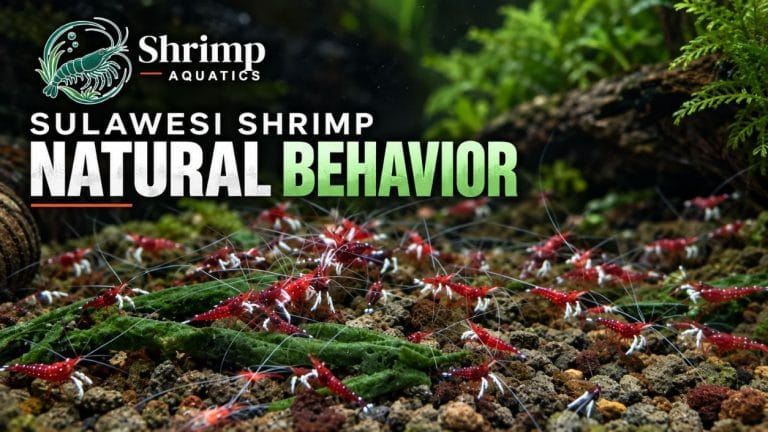
Less, and the reason is where the food comes from. Mature biofilm, aufwuchs and algae on rock and glass are the grazing base in a Sulawesi tank, which is the real reason a mature tank has to be in place before the shrimp arrive. Prepared food doesn’t stand in for a system that hasn’t grown its grazing surface yet. A Neocaridina tank runs on the same biofilm plus a normal schedule of prepared food, and that schedule is exactly what most keepers carry over out of habit.
At Shrimp Aquatics, mature algae and biofilm do most of the feeding in our Sulawesi systems. We normally offer prepared food only about once a week and remove leftovers, both because many of the shrimp in these systems show limited interest in it and because food that sits in warm water adds organic waste.
How that translates to your tank depends on how much grazing surface you have and how many shrimp are on it. Acceptance varies by species, by system and by the food itself, so don’t read one refused feeding as proof that a line eats nothing prepared, and don’t assume a line that takes food will keep taking it. Offer a small amount, watch whether it’s grazed, and take out what isn’t.
Warm alkaline water punishes slips that a cherry shrimp tank forgives
This is the part that catches keepers who have run shrimp tanks for years. The same forgotten pellet does more damage here, and the reason is chemistry.
Ammonia in water sits in two forms, and the un-ionized form is the one that drives toxicity. The ratio of un-ionized ammonia to ammonium ion in fresh water rises about tenfold for each rise of a single pH unit, and roughly twofold for each rise of 10 degrees Celsius between 0 and 30 degrees Celsius.4 A Sulawesi tank is run high on both scales at once. A test kit doesn’t show you that: the same total ammonia reading means something different at pH 8 and 84°F than it does in a cherry shrimp tank at pH 6.5 and 72°F.
Oxygen pulls in the same direction. Cold water holds more dissolved oxygen than warm water,5 so a tank held at 79-86°F (26-30°C) has less of it to work with than the same tank at room temperature. The oxygen buffer under a heavy feeding day is smaller here, which is another reason the same slip costs more.
The water also moves on its own. Evaporation concentrates the dissolved solids left behind,6 so TDS climbs between water changes even in a tank you haven’t touched. Top up with unmineralized RO water instead of prepared water, and read TDS often enough to see the trend coming.
So the routine changes shape. Keep ammonia and nitrite at zero, keep nitrate low, under 10 ppm as a working target, and replace water in small volumes with water matched for temperature, pH, hardness and TDS before it goes in. Fast swings in temperature, pH, hardness or TDS are the thing to design against, and they’re easier to cause in a tank that’s warm, buffered and small.
A Sulawesi colony grows nothing like a Neocaridina colony
Plan for a slow tank. The taxonomic revision of the Sulawesi lake Caridina counted the eggs that wild egg carrying females held: 8-14 eggs in Caridina dennerli from seven females, 17-31 in C. spinata from three, and 19-29 in C. woltereckae from two, with counts across the described species running from 8 to 80 eggs depending on which species is measured.7 Those are small wild samples caught at one moment, and they aren’t captive averages, and the spread is precisely why no single brood number describes the group.
What the counts are good for is setting expectations. Where a number hasn’t been measured we’d rather not print one, so take the direction and not a rate: a Sulawesi colony adds animals slowly, and a quiet month isn’t by itself evidence that something is wrong. Buy the group size you actually want to keep rather than a starter pair and a plan to multiply, give it a mature tank, and read the tank by whether the shrimp are out grazing and behaving normally.
Can Sulawesi shrimp share a tank with your other shrimp?
With bee shrimp or crystal shrimp, no. The two sets of water values point in opposite directions and no single setting satisfies both.
With Neocaridina, start from the ranges: Neocaridina sit at 65-78°F (18-26°C) and Sulawesi start at 79-86°F (26-30°C), so on temperature the two groups don’t overlap at all. If you’re still considering it, the questions to settle first are whether both animals genuinely fit the temperature and chemistry you’ll run, whether the tank can carry both bioloads, and whether there’s enough grazing surface for two populations that both feed on it. A breeding colony of another shrimp species inside a specialist Sulawesi tank isn’t something we’d set up by default.
Fish deserve the same caution. Sulawesi shrimp are peaceful and often shy, so a shy grazer in a warm tank with fish is a shrimp you’ll rarely see, quite apart from the predation risk. Fish described as generally shrimp safe can still take shrimplets and sometimes adults, and that residual risk doesn’t disappear because the species has a good reputation.
What to check before you buy Sulawesi shrimp
Run this against your own tank honestly. This is an advanced to expert group, and the usual failure isn’t one dramatic mistake but a tank that was never quite right.
- You can hold 79-86°F (26-30°C) steadily, overnight and through a room that cools.
- You can hold pH 7.5-8.5, GH 4-8 dGH, KH 3-6 dKH and TDS 150-250 ppm, and you know what your water does between changes.
- Your substrate and hardscape are inert, so nothing in the tank is pulling carbonate hardness back down.
- The tank is mature, with ammonia and nitrite at zero and visible grazing surfaces on rock and glass.
- You can prepare and match replacement water before it goes in, so you never have to top up from the tap.
- You’re hoping to add them to an established community tank, a bee tank or a tank running on active soil. That’s a different build, not a stocking decision.
- You want a colony that fills the tank within a few months.
Where the animals came from belongs in the same decision. The best known species in the group, the cardinal shrimp (Caridina dennerli), is endemic to Lake Matano in the Malili Lakes system, and it was assessed for the IUCN Red List in August 2018 as Critically Endangered under criterion A2e and tagged possibly extinct in the wild, with the aquarium trade recorded among its uses.8 That makes sourcing part of what you’re buying: ask whether stock was bred in tanks or taken from the lakes before you order, and note that our Sulawesi shrimp are bred by Shrimp Aquatics and not collected from the wild.
If the honest answer to the checklist isn’t yet, the useful move is to build and mature the tank first and buy afterwards. A settling tank is the hardest environment you can hand this group, and nothing added later makes up for it.
References
8 Sources
- Trophic Status of Waters in Poso Watershed, Central Sulawesi, abstract, IOP Conference Series: Earth and Environmental Science 950, 2022.
- Sulawesi Mineral 8,5, minerals and trace elements, SaltyShrimp product information page, copyright 2018.
- Biomineralizations: insights and prospects from crustaceans, ZooKeys 176, 2012.
- Aquatic Life Ambient Water Quality Criteria for Ammonia, Freshwater, U.S. Environmental Protection Agency, Office of Water, April 2013.
- Dissolved Oxygen and Water, U.S. Geological Survey Water Science School, updated August 24, 2026.
- Chloride, Salinity, and Dissolved Solids, U.S. Geological Survey, March 1, 2019.
- Radiation of endemic species flocks in ancient lakes: systematic revision of the freshwater shrimp Caridina from the ancient lakes of Sulawesi, Indonesia, Raffles Bulletin of Zoology 57(2), 2009.
- Caridina dennerli, Red List assessment, IUCN Red List of Threatened Species, assessed 20 August 2018.
Ready to get started?
Shop our Sulawesi Shrimp collection
27 products available · Live Arrival Guarantee
Featured Sulawesi Shrimp
Sulawesi Orange Eyes White Sock
Caridina dennerli
Advanced · 79–86°F · pH 7.5–8.5
From $19.99View Product