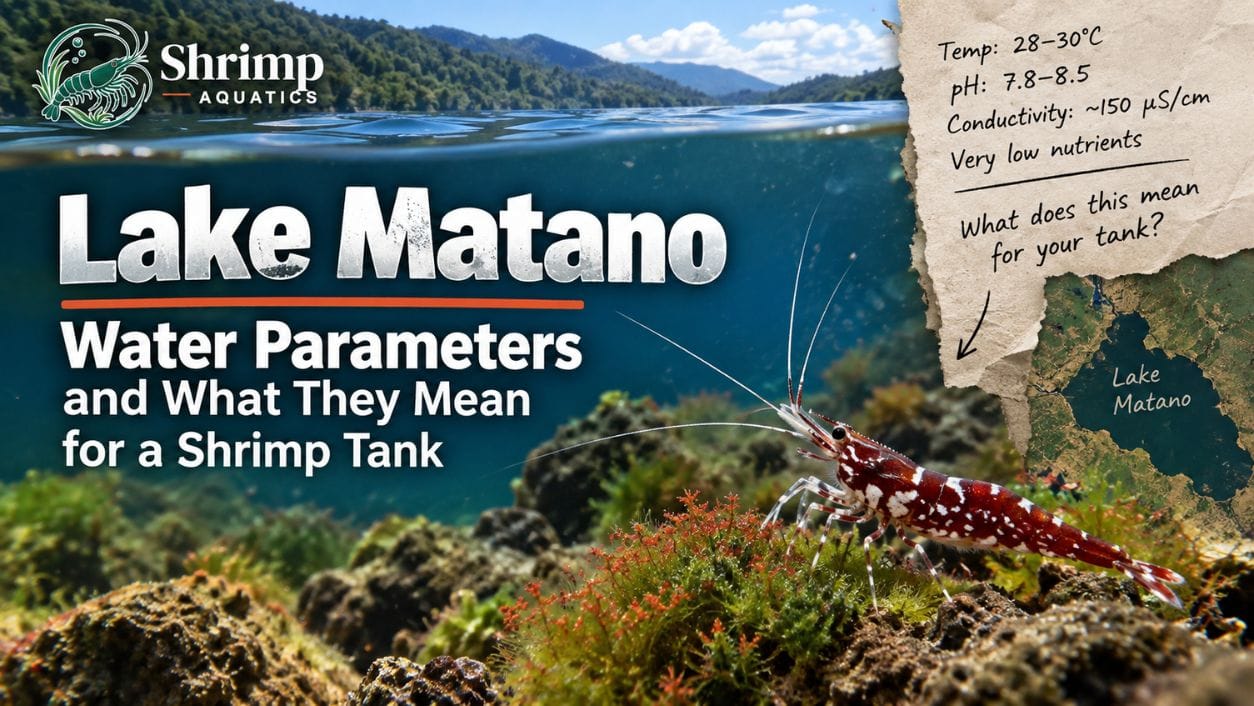
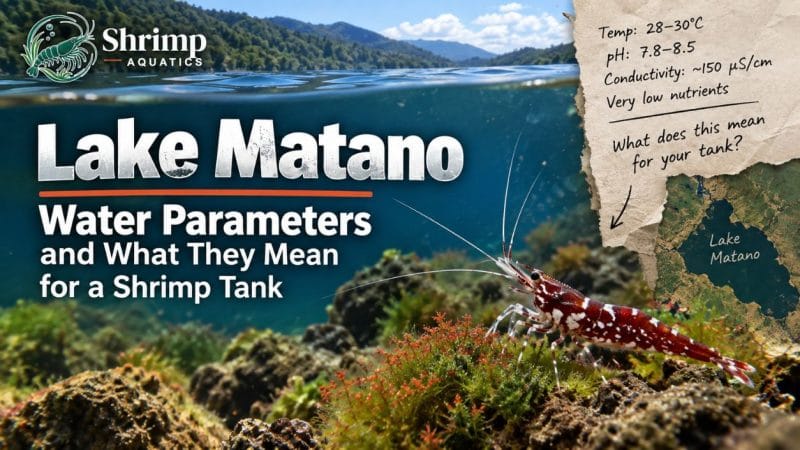
Lake Matano is the lake most Sulawesi keepers end up reading about. The cardinal shrimp lives there and nowhere else. Its surface water is warm, startlingly clear and very short of dissolved minerals. What almost nobody mentions is that the two published sources that put instruments in the lake don’t agree with each other, and neither set of numbers is what you should be aiming for at home.
What the measurements say about Lake Matano’s surface water
The fullest published account comes from a 2008 study that profiled the lake from the surface down past 500 m.1 It helps to know what that team was there for. They were studying ancient ocean chemistry, not shrimp. The water they describe is a by-product of that work, which is why the figures arrive in a chemist’s units rather than a hobbyist’s.
| Water temperature | 77-82°F (25-28°C) |
|---|---|
| pH in the surface mixed layer | 8.6 |
| pH in the deep water | 7.00 |
| Dissolved oxygen at the surface | At saturation |
| Dissolved oxygen below the boundary | Under 1 µmol/L |
| Sulfate at the surface | Under 20 µmol/L |
| Phosphate at the surface | Under 0.025 µmol/L |
| Dissolved silica at the surface | 300 µmol/L |
| Depth sunlight still reaches | Under 130 m |
| Maximum depth | Over 590 m, the eighth deepest lake in the world |
Two of those rows are the ones a keeper reacts to. The surface sits at a pH of 8.6, higher than almost any tank you’ll see these shrimp in. And the phosphate reading is so low you’d never get a hobby kit to show it. Hold on to both. They come back later.
Why the deep half of a Lake Matano profile has nothing to do with your tank
Lake Matano doesn’t turn over. A lasting density boundary sits near 100 m, and everything under it has been cut off from the air long enough to lose its oxygen.1 Below that boundary the same study measured dissolved oxygen under 1 µmol/L and dissolved iron around 140 µmol/L.1 That is not a habitat with a slightly different chemistry. It is water nothing with gills can use.
This matters because most of the Lake Matano data you’ll find online is deep-water data. That’s the part scientists find interesting. If a table quotes you an iron concentration, a methane figure or a pH of 7.00 for Lake Matano, it is describing water hundreds of meters below anything a shrimp has seen. Read the depth column before you read the number.
What Lake Matano’s clarity tells you about feeding a Sulawesi tank
The lake is clear because almost nothing grows in it. Sunlight still reaches under 130 m, and the measured rate of photosynthesis in the surface water sits in the same territory as ultra-oligotrophic lakes in the high arctic.1 The reason is the phosphate row above. Iron particles sinking through the water strip phosphorus out of the sunlit layer, so the algae never get going.1
So what is a Lake Matano shrimp eating? A thin, slow-growing film on rock, in water with next to no nutrients in it. That is a very different animal from one evolved to find a meal. If one thing here changes what you do tomorrow, make it this: grow the surfaces before you buy the shrimp, and treat prepared food as an occasional extra. Lifting anything uneaten within a few minutes is the usual rule, and it matters more here than in a cool tank, because warm water works through leftovers fast.
Why a second published source gives Lake Matano a different pH
The 2009 taxonomic revision of the Sulawesi Caridina species gives Lake Matano a lower pH than the 2008 profile. It does so in a one-line habitat note the hobby has mostly skipped. It reports Lake Matano at a pH of 7.4 with a conductivity of 224 µS, and temperatures across Matano, Mahalona and Towuti of 81-88°F (27-31°C).2 It also says a stable thermocline or chemocline is basically missing in these lakes.2
Compare that with the table above. One source has a permanently stratified lake with an alkaline surface at a pH of 8.6. The other has a well-mixed lake at a pH of 7.4. Those can’t both be a full description of the same water.
Before you copy a number from anywhere
Lake chemistry gets copied from care sheet to care sheet, and the citation attached to it often doesn’t say what the page claims. That 2009 revision is a common credit. What it actually reports about Matano water is the pH of 7.4 and the conductivity of 224 µS quoted above, and nothing else. If a care sheet hands you a full lake table with a source attached, open the source.
Which would we trust? For the water itself, the 2008 profile. Measuring the lake was the whole point of that study, and it reports a full depth series rather than a single line. The 2009 figures read like spot readings taken on a collecting trip. That is a reasonable thing for a taxonomist to record and a poor thing to build a tank on. But we’d rather tell you the two disagree than pick one and pretend the question is settled. Nobody has published a modern survey of the shallow margins where these shrimp actually live.
Whether to copy Lake Matano’s numbers into your own tank
No. The reason is simple: you can’t. A lake that deep holds its chemistry steady through sheer volume. A 20 gallon glass box has no such buffer. The only way to get stability at home is to build the water deliberately and hold it there, which is what the numbers below are for.
| Temperature | 79-86°F (26-30°C) |
|---|---|
| pH | 7.5-8.5 |
| GH | 4-8 dGH |
| KH | 3-6 dKH |
| TDS | 150-250 ppm |
| Nitrate | Under 10 ppm |
Temperature is the one place the lake and the tank nearly agree
Both published figures for the lake sit inside or just above the band these shrimp are kept in. That is the main reason the band looks the way it does. If you want the reasoning behind it, and what running warm costs you in oxygen, that belongs with why Sulawesi shrimp need warm water. What the lake adds is a warning about chasing the top of the band. The higher of the two published readings is a single spot measurement in a body of water that can absorb it. Your heater in a small tank can’t.
The lake is far softer than the water these shrimp are kept in
This is the real surprise. A conductivity of 224 µS is dilute, mineral-poor water, and the sulfate and phosphate readings say the same thing from a different direction. Yet we keep these shrimp at 150-250 ppm TDS. Why the gap? Because the mineral load in a tank isn’t only feeding the animal. It holds your KH up so the pH doesn’t slide, and it replaces dissolved calcium and magnesium that a lake renews continuously and a closed tank doesn’t. Mixing replacement water to the numbers above, outside the tank, is covered properly in the guide to Sulawesi shrimp care parameters.
At Shrimp Aquatics, most of our Sulawesi systems currently run at TDS 150 ppm, GH 6-7 dGH and pH 7.5. If you’ve read the lake figures and you’re wondering whether to aim high or low inside the published band, that is where we sit, and it is closer to the lake than the top of the band is.
Which Sulawesi shrimp the Lake Matano numbers actually apply to
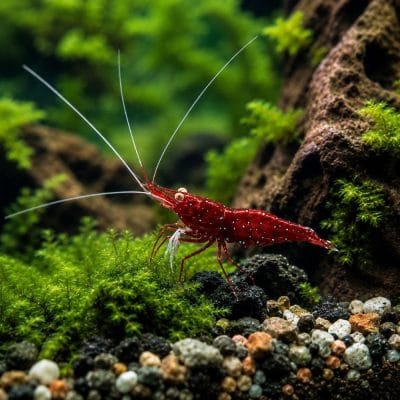
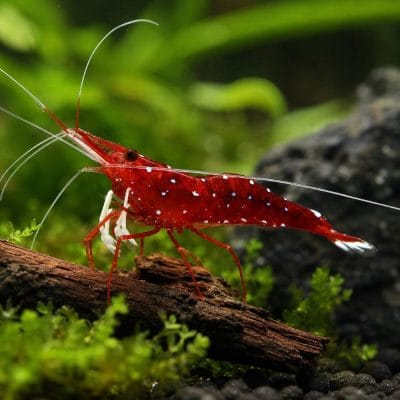
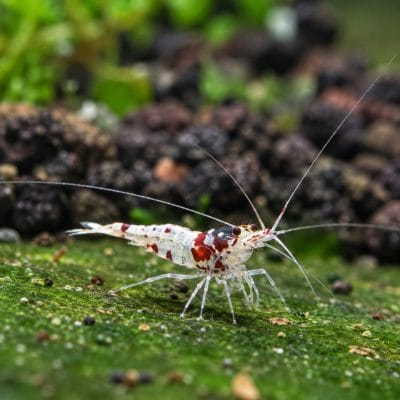
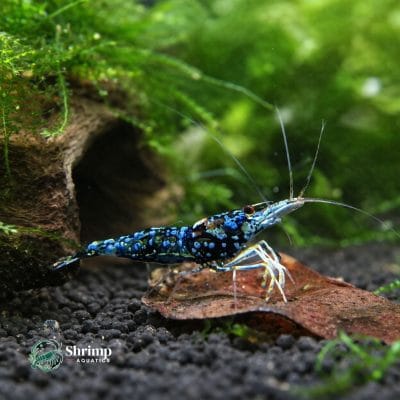
Lake Matano is one lake in the Malili system, and its shrimp are its own. Caridina dennerli, the cardinal or White Sock shrimp, is endemic to Lake Matano and found nowhere else.3 Plenty of the lines sold as Sulawesi shrimp don’t come from Matano at all, and a Matano reading is not their habitat. Sorting out which line belongs to which lake is the job of the guide on where Sulawesi shrimp come from, and it’s worth doing before you treat any lake figure as a target.
There is a harder fact attached to C. dennerli. It was assessed in 2018 as Critically Endangered and tagged Possibly Extinct in the Wild, after surveys in 2017 and 2018 recorded no specimens. The assessment lists dams and water management, industrial effluents and agricultural runoff among the threats.3 Whatever the lake measured in 2008, it is not measuring that now, and nobody is going to settle the disagreement above with fresh field data soon.
That is also the practical reason to buy tank-bred. Every line in our Sulawesi shrimp range is bred here, not collected. A tank-bred shrimp reaches you from water somebody can give you the readings for, which a wild-caught one never does.
References
3 Sources
- Photoferrotrophs thrive in an Archean Ocean analogue, Crowe et al., Proceedings of the National Academy of Sciences 105(41), 2008.
- Radiation of endemic species flocks in ancient lakes: systematic revision of the freshwater shrimp Caridina from the ancient lakes of Sulawesi, Indonesia, von Rintelen and Cai, Raffles Bulletin of Zoology 57(2), 2009.
- Caridina dennerli, IUCN Red List assessment, von Rintelen, K., IUCN Red List of Threatened Species, assessed 2018.
Ready to get started?
Shop our Sulawesi Shrimp collection
27 products available · Live Arrival Guarantee
Featured Sulawesi Shrimp
Sulawesi Orange Eyes White Sock
Caridina dennerli
Advanced · 79–86°F · pH 7.5–8.5
From $19.99View Product