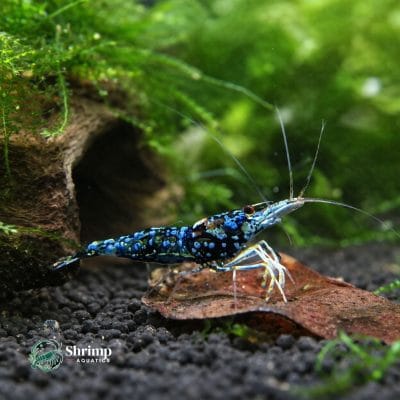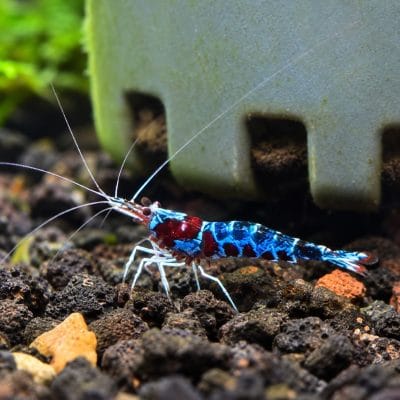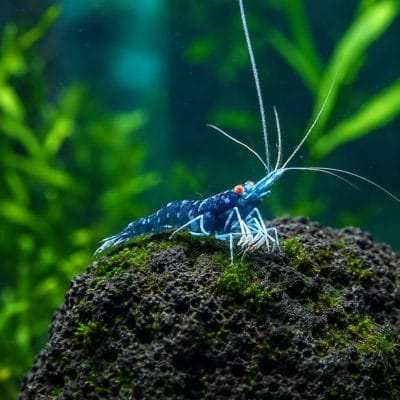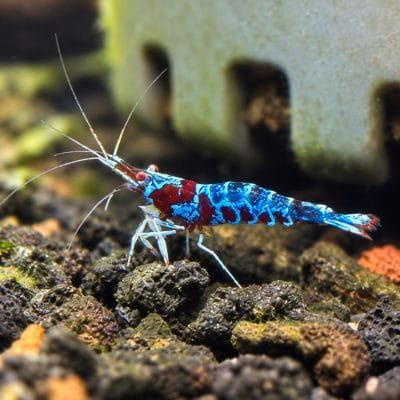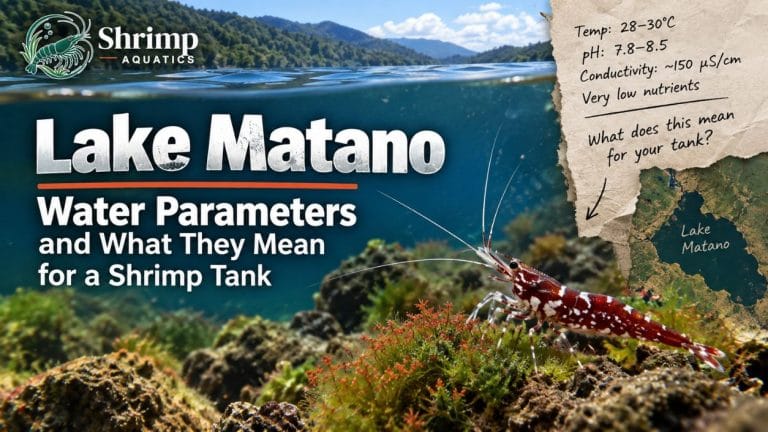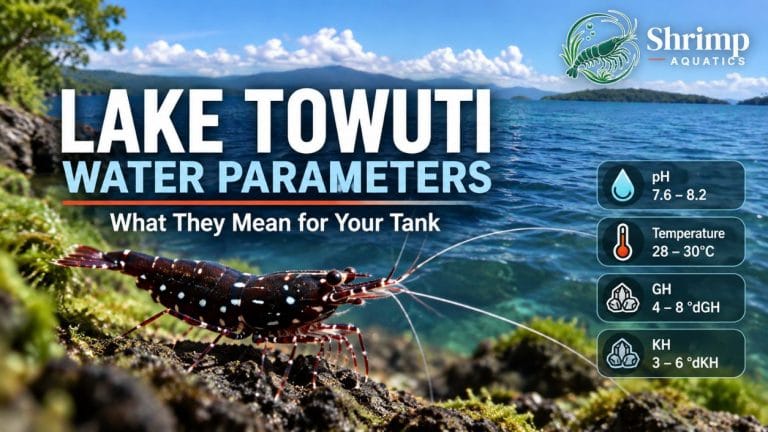
Sulawesi shrimp need warm water because the water they evolved in is warm and stays that way. The lake Caridina sold under this name are endemic to the ancient lakes of central Sulawesi. The cardinal shrimp Caridina dennerli is restricted to Lake Matano and Caridina glaubrechti to Lake Towuti.1 Lake Towuti has been reported at about 82°F (28°C) throughout the year.2 In a home tank that becomes 79-86°F (26-30°C), and holding one figure inside that band matters more than which end of it you pick.
Where the Sulawesi temperature range comes from
The range isn’t a number the hobby settled on by agreement. It’s copied from two lakes that have been measured, and the measurements are worth looking at directly, because they say something the usual care sheet doesn’t.
| What was reported | Where | Reported value |
|---|---|---|
| Surface water temperature | Lake Towuti, Malili lake system | Commonly 82°F to 84°F (28°C to 29°C)2 |
| Water temperature across the year | Lake Towuti | About 82°F (28°C), with only weak thermal stratification of the water column2 |
| Average air temperature | Lake Towuti catchment | About 79°F (26°C), with little variation between months2 |
| Seasonal temperature variability | Lake Matano | Minimal, and named as one reason the lake was studied3 |
Read that table again and the striking figure isn’t the heat. It’s how little anything moves. The air over the catchment barely changes between months, and the water under it barely changes at all. These shrimp aren’t adapted to a hot tank so much as to a tank that doesn’t argue with itself. That’s the part most keepers get wrong when they buy a heater and then let the room decide the rest. A tank that drifts several degrees between afternoon and dawn is doing something the reported lake figures don’t describe, and it’s doing it every day.
How much to trust the lower temperature limit on a Sulawesi care sheet
Not much, and it’s worth knowing why. Every care sheet gives a floor. Some say the shrimp stop feeding below one figure, others give a temperature at which molting fails or a colony collapses. The pages that rank for this question don’t cite a measurement for any of it, and their figures don’t agree with each other. We haven’t found a published lower lethal limit or critical thermal minimum for any Sulawesi lake Caridina.
The closest thing to measured data is a 2025 rearing trial on Caridina dennerli. It grew shrimp of about 1.4 cm total length under four feed and shelter treatments, and it recorded its tank water at 79.5°F to 83.7°F (26.4°C to 28.7°C).4 That trial was testing food and shelter, not temperature, so it tells you nothing about a floor. What it does tell you is simpler. The one piece of controlled work anyone has done on one of these species was carried out inside the same band the care sheets recommend. That’s a better reason to stay there than any of the cutoffs being quoted at you.
What the missing data does and doesn’t license
An absent published limit isn’t permission to run the tank cooler and watch what happens. It means the opposite in practice. With no measured threshold to work back from, the only defensible position is the range the animals are known to live in, held steady. If your shrimp go off their food or stop molting cleanly, temperature belongs on the list of things to check. A symptom isn’t a diagnosis, and a care article isn’t a substitute for a qualified opinion.
Warm water holds less oxygen, so a Sulawesi tank needs gentle surface movement
Cold water can hold more dissolved oxygen than warm water.5 That single physical fact is the first thing the Sulawesi range costs you. A tank held near the top of the band simply has less dissolved oxygen in reserve than the same tank would at room temperature. That reserve is what covers you when something goes wrong overnight.
The answer isn’t more current. These are lake animals whose food is the biofilm on rock and hardscape surfaces. What the tank needs is gas exchange. That comes from surface area and a surface that keeps moving, not from velocity down at substrate level.
At Shrimp Aquatics, our Sulawesi systems use biological filtration together with a Kaldnes moving-bed filter. The combination gives us strong aeration and active biological media, but we tune the outlet so the shrimp aren’t pushed around while grazing. The goal is high oxygen with gentle movement at shrimp level.
That’s a setup, not a specification. Tank size, bioload, media volume, pump output and where the outlet points all change the result. Judge your own tank by whether the surface is genuinely moving and the shrimp are still grazing in the open.
Why the same ammonia reading is more dangerous in a warm Sulawesi tank
Sulawesi water also has to be alkaline, pH 7.5-8.5, and this is where the temperature stops being only a heating question. Total ammonia in fresh water sits in equilibrium between the ammonium ion and un-ionized ammonia, and it’s the un-ionized form that drives toxicity. High external un-ionized ammonia reduces or reverses the diffusive gradient an animal uses to get rid of it, so ammonia builds up in internal tissues and blood. That share isn’t fixed. It rises about tenfold for each single pH unit, and roughly doubles for each rise of 10°C (18°F) between freezing and the top of the Sulawesi band.6
None of that’s specific to these shrimp. What’s specific is that the water they need puts them at a high pH and a high temperature at the same time. So the same total ammonia reading doesn’t mean here what it would mean in a soft acidic Bee tank. It’s a fair part of why this group has a reputation for being unforgiving. The animals aren’t fragile in some mysterious way. The water chemistry they need converts small Sulawesi shrimp care mistakes into larger ones.
Treat waste as the temperature problem it becomes
Stock only into a fully cycled, mature Sulawesi tank reading zero ammonia and zero nitrite, and treat those zeros as the baseline rather than a number to creep toward. Feed lightly and take leftovers out, because anything left to decay adds to the ammonia the tank has to process. If a reading moves, deal with the source and the water change before you touch anything else.
Whether running a Sulawesi tank hotter or cooler is a lever worth pulling
Two questions follow from all of this. Can you sit at the top of the range to push growth or breeding along, and can you sit at the bottom to be safe? Neither works the way it sounds like it should.
Temperature has been shown to affect both the interval between molts and how much an animal gains at each molt in many crustaceans. Lesser blue crabs reared at elevated temperature molted at shorter intervals but grew less each time, and ended up smaller at every instar. The authors note that if the pattern held through the pubertal molt, warmer animals would also be smaller at maturity.7 More frequent molting isn’t the same thing as faster growth, and a shrimp isn’t owed extra size for the extra heat.
Running cool has its own cost, and here the closest evidence comes from a different Caridina. In a wild population of the amphidromous shrimp Caridina leucosticta in a Japanese river, growth was generally low while water temperature was falling. It picked up again as it rose.8 That’s a temperate river species rather than a Sulawesi lake species, so take it as direction and not as a figure for your tank. The direction is the point: cooler water buys you nothing the shrimp want.
Holding a Sulawesi tank steady inside 79-86°F (26-30°C)
If you want a single temperature for Sulawesi shrimp to set the heater to, 82°F (28°C) sits in the middle of the range. It also matches what has been reported for Lake Towuti across the year. Where exactly you land matters far less than whether the tank stays there. Will it hold once the room cools at night, the lights go off, or a water change arrives colder than what’s already in the tank?
- Pick one figure inside 79-86°F (26-30°C), set the heater to it, and stop adjusting.
- Read the tank at its warmest and its coolest point in the day, not once in the evening, so you learn the real span rather than one comfortable number.
- Match replacement water to tank temperature before it goes in, so the water change isn’t itself the shock you were avoiding.
- Keep the surface visibly moving, and check it’s still moving after you clean or reposition anything.
- Fix a room that swings hard between seasons before you stock, not after.
- Don’t raise the temperature to force breeding, color or growth.
Sort the heating and the surface movement first, then decide which tank-bred Sulawesi shrimp you want to start with. A tank that already holds one temperature without supervision is most of the difficulty of this group solved before the animals arrive.
References
8 Sources
- Radiation of endemic species flocks in ancient lakes: systematic revision of the freshwater shrimp Caridina H. Milne Edwards, 1837 from the ancient lakes of Sulawesi, Indonesia, with the description of eight new species, von Rintelen and Cai, The Raffles Bulletin of Zoology 57(2), 343 to 452, 2009.
- Geomicrobiological Features of Ferruginous Sediments from Lake Towuti, Indonesia, Vuillemin and others, Frontiers in Microbiology 7, article 1007, 2016.
- The biogeochemistry of tropical lakes: A case study from Lake Matano, Indonesia, Crowe and others, Limnology and Oceanography 53(1), 2008, repository record and abstract.
- Effect of Using Different Shelter and Feed Types on Growth and Survival Rate of Sulawesi Endemic Ornamental Shrimps (Caridina dennerli), Abdullah, Hasim and Mulis, Jurnal Ilmiah PLATAX 13(1), 191 to 204, 2025, journal PDF.
- Dissolved Oxygen and Water, U.S. Geological Survey Water Science School, updated August 24, 2026.
- Aquatic Life Ambient Water Quality Criteria for Ammonia, Freshwater, U.S. Environmental Protection Agency, Office of Water, April 2013.
- Elevated temperature induces a decrease in intermolt period and growth per molt in the lesser blue crab Callinectes similis Williams, 1966, Kuhn and Darnell, Journal of Crustacean Biology 39(1), 22 to 27, 2019, abstract.
- Life history of the amphidromous shrimp Caridina leucosticta in the Isazu River, Japan, Yatsuya, Ueno and Yamashita, Journal of Crustacean Biology 33(4), 488 to 502, 2013, abstract.
Ready to get started?
Shop our Sulawesi Shrimp collection
27 products available · Live Arrival Guarantee