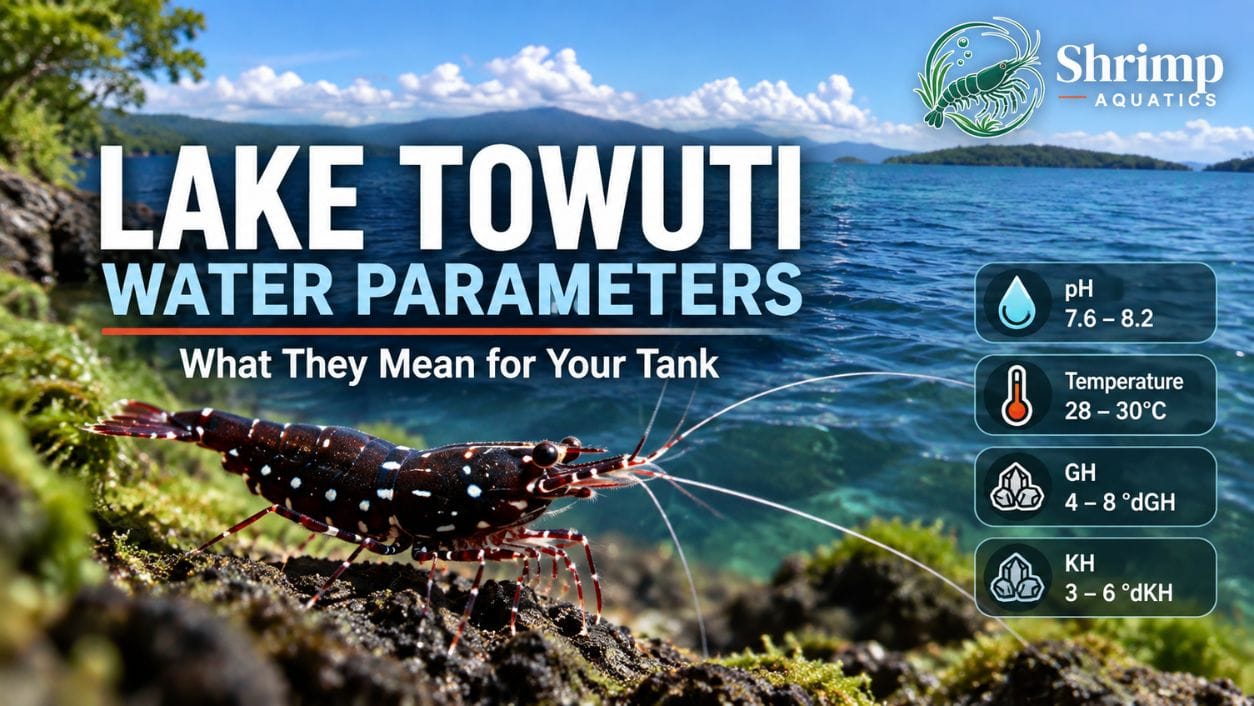
Lake Towuti’s surface water has been measured, and it’s warmer, more alkaline and far more dilute than most keepers picture. Seven surface stations were sampled between June and October 2009. The lake averaged 85.3°F (29.6°C) and reached above 86°F (30°C) at the warm end, at pH 7.46-8.40, with dissolved oxygen 4.7-7.4 ppm and a conductivity of only 139-156 µS/cm.1 Almost none of that belongs in your tank as a target. One part of it does.
The one Towuti reading worth copying is how little waste nitrogen it carries
Lake Towuti’s water carries almost no waste nitrogen, and that’s the one reading worth copying into your tank. Across the sampled stations nitrate ran from 0 to 0.697 ppm, averaging 0.076 ppm. Nitrite sat at 0.001-0.007 ppm. Ammonium stayed between 0 and 0.009 ppm, and phosphate between 0 and 0.022 ppm, averaging 0.008 ppm.1 Those aren’t hobby figures rounded down for effect. That’s what the water actually holds.
So these shrimp came out of water carrying almost nothing to break down. That’s the part of Towuti you can genuinely reproduce at home, and it doesn’t need a product. It needs a mature tank, light feeding, and leftovers lifted out within a few minutes. Get that right and ammonia and nitrite read zero, with nitrate under 10 ppm. Everything else on this page is a reason not to copy the lake.
Two studies measured Towuti’s pH and conductivity and they do not agree
Two peer reviewed papers measured Lake Towuti’s pH and conductivity, and their figures don’t match. Anyone quoting a single Towuti figure is quoting one paper and quietly dropping the other. Here’s what each of them reported.12
| Measurement | Nasution and others, 2015 | Costa and others, 2015 |
|---|---|---|
| Basis | Seven surface stations, June to October 2009 | Whole lake description supporting a sediment core study |
| Surface temperature | 83.5-88.3°F (28.6-31.3°C), average 85.3°F (29.6°C) | Bottom water 83.1°F (28.4°C) below about 90 m |
| pH | 7.46-8.40 | 7.3-7.7 |
| Conductivity | 139-156 µS/cm | 210 µS/cm |
| Dissolved oxygen | 4.7-7.4 ppm, average 6.25 ppm | Anoxic below about 140 m |
| Sulfate | Not reported | 1.5-2 ppm |
Neither paper is wrong. They sampled differently, in different years, for different reasons. A lake this big isn’t one number. What you can’t do is average them, and what we won’t do is pick whichever one flatters a care sheet.
You’ll also see 79°F (26°C) quoted as Towuti’s temperature. That figure is the region’s monthly air temperature, lifted out of the second paper’s climate paragraph. It isn’t a water measurement at all, and the same paper puts the lake’s bottom water at 83.1°F (28.4°C).2 It’s an easy sentence to misread, and it has travelled a long way.
Why a Towuti reading from deep water tells you nothing about your tank
Towuti runs to roughly 200 m, and it stops being shrimp habitat long before the bottom. Oxygen thins through a broad oxycline between 70 and 140 m, and the water below that is anoxic. Sulfate across the lake sits at only 1.5-2 ppm.2 Deeper down the chemistry keeps moving. Surface water near 8.4 falls toward 7.2 with depth, and oxygen is gone below roughly 130 m.3
So when a Towuti figure turns up with no depth attached, ask which layer it came from. Your shrimp would live in the top few meters of a lake that’s 200 m deep. An oxygen reading taken at 150 m describes water that would kill them inside a day. It has no business in a care sheet.
Do not chase Towuti’s low mineral level down in your own tank
Lake Towuti’s water is far more dilute than a Sulawesi tank should be, and copying it is where the lake becomes a dangerous model. Either conductivity figure in the table describes very dilute water, well under the TDS 150-250 ppm we keep to in a Sulawesi tank. Your own pen will tell you the same story in its own units. The temptation writes itself. If the lake is that soft, why hold your tank harder?
Because your shrimp pull the calcium for a new shell mostly out of the water around them, not out of their food.4 A lake buffers itself. A 10 gallon tank holds whatever you last put in it, and it drifts every day between water changes. Slightly mineral rich and steady is the safer error to make. Sliding downhill toward a lake reading isn’t.
Do not lower your minerals to match the lake
Pulling GH, KH or TDS down toward a Towuti reading is a swing, and a swing at the wrong moment lands on a shrimp that’s halfway out of its shell. You build this water rather than find it, so the salt you pick does most of the work. Remineralizing RO water for Sulawesi shrimp is where GH, KH and TDS all get decided together.
What should you set your Sulawesi tank to instead?
Set it to the range we keep to at Shrimp Aquatics, not to the lake. It overlaps Towuti in places and deliberately doesn’t in others. Those gaps are the whole point of this page.
| Temperature | 79-86°F (26-30°C) |
|---|---|
| pH | 7.5-8.5 |
| GH | 4-8 dGH |
| KH | 3-6 dKH |
| TDS | 150-250 ppm |
| Nitrate | under 10 ppm |
Pick one set point inside each band and then defend it. Poor water stability between water changes costs a colony far more than any single Sulawesi shrimp care parameter sitting slightly off center. The lake’s stability is the thing worth envying here, not its readings.
If you’re still choosing between lines, every one of our tank-bred Sulawesi shrimp wants that same water. The choice changes the color and the price, not a number you’ll have to hold.
References
4 Sources
- Habitat characteristics of Lake Towuti, South Sulawesi, Indonesia, the home of endemic fishes, Nasution, Sulastri and Muchlisin, AACL Bioflux 8(2): 213-223, 2015.
- Hydrological connectivity and mixing of Lake Towuti, Indonesia in response to paleoclimatic changes over the last 60,000 years, Costa, Russell, Vogel and Bijaksana, Palaeogeography, Palaeoclimatology, Palaeoecology 417: 467-475, author copy PDF, 2015.
- Vivianite formation in ferruginous sediments from Lake Towuti, Indonesia, Vuillemin and others, Biogeosciences, volume 17, 2020.
- Biomineralizations: insights and prospects from crustaceans, Luquet, ZooKeys 176: 103-121, 2012.
Ready to get started?
Shop our Sulawesi Shrimp collection
27 products available · Live Arrival Guarantee