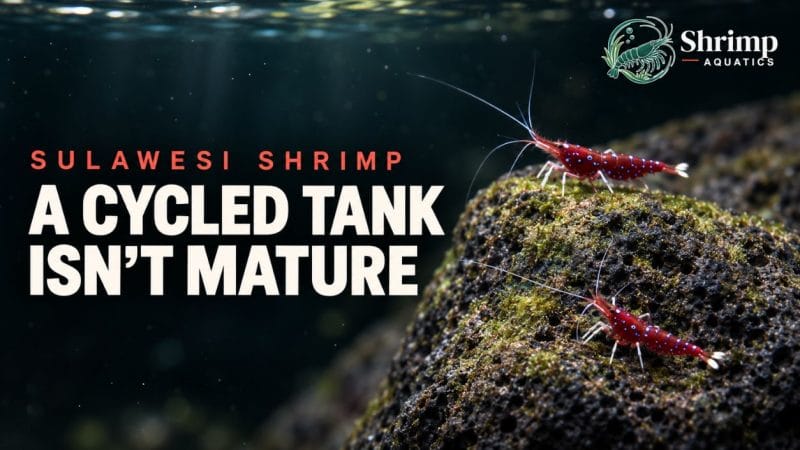
Maturing a Sulawesi tank means two things happening in order. First, a biological filter that clears ammonia and nitrite to zero in warm alkaline water. Then a grazing layer of biofilm and algae grown on the hardscape afterwards. Mix the water to its final numbers first, cycle the tank in that water, then keep the light on it for several more weeks while the rock develops a crust. Stock when the test results and the rock surfaces agree, not when the calendar says a month has passed.
Why a cycled Sulawesi tank is still not ready for shrimp
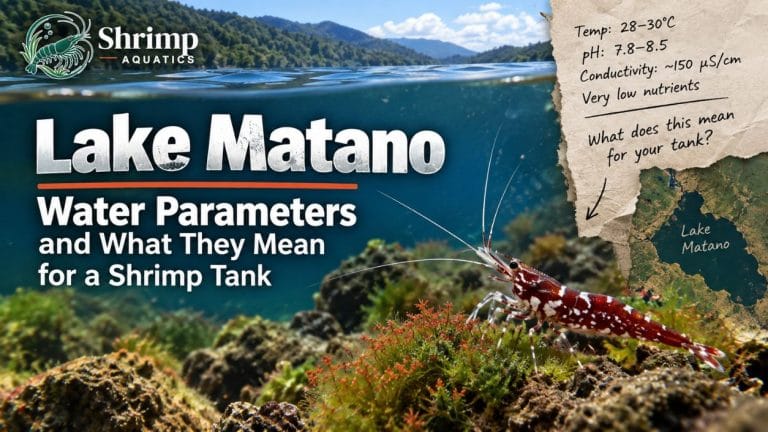
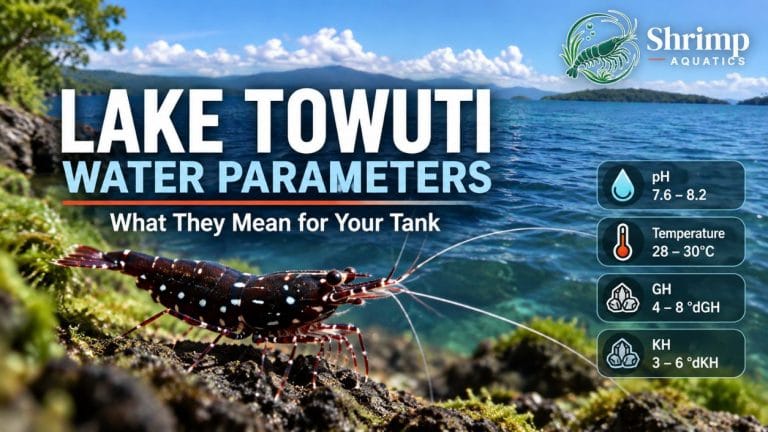
A cycled tank is one whose filter converts ammonia to nitrite and nitrite to nitrate. That’s a safety threshold, and it isn’t the same as a tank a Sulawesi shrimp can live in. These are lake shrimp, described from their natural habitat in the ancient lake systems of Sulawesi, where Caridina dennerli is endemic to Lake Matano.1 In those lakes the animals graze a film that covers hard surfaces, and the water they graze it in barely moves through the year. Reported surface temperatures in Lake Towuti sit at roughly 28 degrees Celsius (about 82°F) year round.2 Lake Matano is studied in part for its minimal seasonal temperature variability.3
So what is a mature Sulawesi tank? A cycled tank plus two more things: a food surface, and a chemistry that has proven it holds still. A new tank that has just finished its nitrogen cycle usually has neither. The rock is clean, and the water has only been at its target numbers for a few days, which isn’t long enough to know whether it drifts. Both gaps close with time under light, and neither closes faster because the ammonia test has gone to zero.
This is also why the usual shortcut fails. Moving media from an established Bee or Neocaridina tank brings a bacterial population that grew in cooler, softer, more acidic water. It may still help, but it doesn’t deliver a finished Sulawesi filter, and it brings no grazing surface at all.
Mix your Sulawesi water before the tank starts cycling
Fill the tank with the water you intend to keep, not with tap water you plan to correct later. Everything that follows, the bacteria on the media, the algae on the rock and the pH the tank settles at, develops in whatever chemistry is present while it develops. Remineralize RO water with a Sulawesi mineral outside the tank, test the finished pH, GH and TDS, and only then fill.
The alkaline half of the water is what makes this worth the trouble. Alkalinity is the water’s capacity to neutralize acid and hold a fairly stable pH. It comes from dissolved bicarbonates, carbonates and hydroxides.4 A carbonate level you set on purpose is what stops the pH sliding while a young tank produces acid. So KH is a parameter to hit before stocking rather than to chase afterwards.
| Temperature | 79-86°F (26-30°C) |
|---|---|
| pH | 7.5-8.5 |
| GH | 4-8 dGH |
| KH | 3-6 dKH |
| TDS | 150-250 ppm |
| Nitrate | Aim for under 10 ppm |
| Substrate | Inert substrate and hardscape, not an active pH-lowering soil |
| Difficulty | Advanced to expert |
Hardscape choice belongs to this step too, because it’s what the grazing layer will grow on. Use inert rock and substrate. An active, pH-lowering shrimp soil is the standard base for Bee and Crystal Caridina and it works against everything above, so it isn’t the default for a Sulawesi setup. Porous hardscape rock is worth using for its surface area. The crust you’re about to grow needs somewhere to grow, and open rock faces give the shrimp more to work over later.
Which Sulawesi mineral you use changes how long the water takes to prepare
The two common Sulawesi salts, Sulawesi Mineral 7.5 and 8.5, behave differently enough that they change your schedule. SaltyShrimp Sulawesi Mineral 7.5 almost totally dissolves within seconds, needs no CO2 or special equipment, buffers the pH at around 7.5 and raises carbonate and total hardness at a ratio of KH/dH = 0.42/1.0.5 So a batch can be mixed and used the same day. Sulawesi Mineral 8.5 is the opposite. At a regular CO2 quantity of one bubble per second the salt dissolves totally in approximately 3-4 days, and it raises hardness at a ratio of KH/dH = 0.78/1.0. The manufacturer instructs you to aerate the water afterwards for at least three hours with an air stone. It notes that less finicky Sulawesi shrimp such as Caridina dennerli have been kept and bred with either product.6
Degas 8.5 water before it goes near a tank
Don’t skip the aeration step at the end of the 8.5 preparation. Water still carrying dissolved CO2 reads a lower pH than it will settle at. Filling from it moves the tank twice, once down and once back up as the gas leaves. During maturation there’s nothing in the tank to harm. That’s exactly why this is the point to build the habit and to learn how long your own container takes to settle.
Follow the current instructions on the product you actually buy, and confirm the finished pH, GH and TDS in the mixing container before the water is used. The dosages printed on these pages are the manufacturer’s, and mixing to a number you’ve measured is more reliable than mixing to a spoon count.
Run the cycle warm and alkaline from the first day
Heat the tank to its target before you start, add your ammonia source and a bacterial starter, and leave the chemistry alone while the filter establishes. The population you’re selecting for has to work at 79-86°F (26-30°C) and pH 7.5-8.5, so there’s no reason to cycle cool and warm it up later.
At Shrimp Aquatics, we don’t rush a new Sulawesi tank. With a powdered bacterial starter, our normal minimum is 3-4 weeks. With a liquid or live culture, the process may reach the same checkpoint in 2-3 weeks. Treat either figure as the earliest the nitrogen half of the job can finish, not as a stocking date. Expect the grazing surface to need longer than the filter does.
Test with a liquid drop kit rather than strips. Strips are coarse at the best of times, and they’re hardest to read exactly where this tank lives, at the alkaline end of the scale. There the difference between two color blocks covers more ammonia than you want to guess at.
Why warm alkaline water leaves so little margin for a half-finished cycle
Total ammonia in water splits between the ammonium ion and un-ionized ammonia, and the un-ionized form is the one that drives toxicity in aquatic animals. That split moves with chemistry. The ratio of un-ionized ammonia to ammonium ion in fresh water increases by 10-fold for each rise of a single pH unit. It rises by approximately two-fold for each rise of 10 degrees Celsius in temperature across the range from 0 to 30 degrees Celsius.7 A Sulawesi tank sits high on both scales at once. So the same number on the same test kit means something harsher here than it does in a soft, cool Bee tank.
Oxygen works against you in the same direction. Cold water can hold more dissolved oxygen than warm water.8 So a tank held in the upper 70s and 80s Fahrenheit starts with less dissolved oxygen. That affects the filter bacteria and the animals that will live in it. Both facts point at the same practice during maturation. Keep gas exchange generous, keep the organic load small, and give the filter the weeks it needs rather than the days you’d like.
Grow the grazing surface your Sulawesi shrimp will feed on
Once ammonia and nitrite are reading zero, the work changes from chemistry to farming. Mature biofilm, aufwuchs and algae are the important grazing resources for these shrimp. They take weeks of light on stable water to build into anything a colony can graze.
During the early cycle we normally run the light for 8-10 hours a day so algae and biofilm can establish on the rock and glass. In these systems that natural growth is the main grazing base and prepared food stays supplemental. That’s a deliberately moderate photoperiod. Very long or continuous lighting is often recommended to force a fast algae bloom. The cost of forcing one is that the growth you get is loose and filamentous, not the tight film the shrimp actually work. A heavy bloom that collapses puts its whole mass back into warm water as organic waste at exactly the wrong moment.
Leave the surfaces alone while this happens. Don’t scrub the glass on the shaded sides, don’t wipe the rock, and don’t vacuum the hardscape. What looks like neglect is the crop. A brown diatom haze arriving first is normal, and it’s usually followed by a firmer green and gold film that stays put when water moves over it. Extra food won’t accelerate this, and supplemental feeding can’t compensate for a system that hasn’t matured.
Hold the water steady while the Sulawesi tank matures
Two months is long enough for a tank to drift somewhere you didn’t put it. Evaporation is the usual culprit, because it concentrates dissolved solids in the water that remains.9 The minerals stay behind while the water leaves, so TDS and hardness climb on their own in an uncovered warm tank. Top off with plain RO water, not with remineralized water, and top off often enough that the correction is small.
Keep the heater at one setting and check it against a separate thermometer. Keep the lid or cover in place, since it slows both evaporation and heat loss. If you change water during maturation, match the replacement water to the tank on temperature, pH, GH and TDS before it goes in. That way the tank never learns to swing. A maturing tank with no livestock in it is the cheapest place you’ll ever have to practice that.
Nitrate rising slowly through this period is expected, since that’s where the nitrogen ends up. Bring it down with a matched water change, and don’t cut the cycle short.
How to tell a Sulawesi tank is ready to stock
Readiness is a set of conditions met at the same time, not a date. Work through them in the order below, and if any one of them isn’t true, the answer is more time, not a smaller first batch.
- Ammonia reads 0 and nitrite reads 0 on a liquid test, and they stay there after the filter has had something to process.
- The biological filter is established, not merely running, which means it has been converting a load.
- Nitrate is low and stable, with under 10 ppm as the target.
- Temperature, pH, GH, KH and TDS hold their values across several days of testing without you adjusting anything.
- The rock and glass carry a visible grazing surface, a film that doesn’t lift off at the first movement of water.
- A calendar reading four weeks, eight weeks or three months proves nothing on its own.
When those hold, stock lightly and slowly. A first group smaller than the tank could support gives the grazing layer time to keep up with grazing pressure. It also keeps the bioload inside what a young filter has actually proven it can handle. Choose lines that all want the same warm alkaline water, which is how our own tank-bred Sulawesi shrimp are grouped. Add the second group only after the first has been feeding and molting normally for several weeks.
What to do when a Sulawesi tank fails its readiness check
Most failures at this stage are the tank telling you which half of the job is unfinished. None of them are emergencies while the tank is empty, which is the whole argument for finding them now.
| What you see | What it usually points to | What to do next |
|---|---|---|
| Ammonia falls but nitrite stalls | The second half of the filter is still establishing | Hold the temperature and pH steady, stop adding ammonia above the level the filter is already clearing, and wait |
| Nitrate well above 10 ppm at the end of the cycle | Accumulated nitrogen from the cycling process | Change water with aerated, parameter-matched remineralized water, in stages rather than all at once |
| Glass greening but rock still bare | Light is reaching the wrong surfaces | Reposition the light over the hardscape, keep the photoperiod moderate, and leave the rock unscrubbed |
| Loose stringy algae instead of a firm film | Too much light for too long, or nutrients running ahead of grazing | Shorten the photoperiod, remove the strands by hand, and let the low-profile film re-establish |
| Grey or slimy patches with a sour smell | Organic load the system isn’t processing | Remove the affected material, improve gas exchange, and stop adding food or carbon sources |
| pH or TDS moving between tests | Buffering or top-off practice isn’t settled yet | Recheck KH, top off with plain RO water only, and give the tank more time before stocking |
A tank that needs another month is a tank that told you so before the shrimp arrived. The cost of waiting is a month. The cost of stocking a system that hasn’t finished either half of maturation is usually the colony. It’s paid over the following weeks.
References
9 Sources
- Radiation of endemic species flocks in ancient lakes: systematic revision of the freshwater shrimp Caridina from the ancient lakes of Sulawesi, Indonesia, with the description of eight new species, Raffles Bulletin of Zoology 57(2), Lee Kong Chian Natural History Museum, National University of Singapore, 2009.
- Geomicrobiological Features of Ferruginous Sediments from Lake Towuti, Indonesia, Frontiers in Microbiology 7, article 1007, 2016.
- The biogeochemistry of tropical lakes: A case study from Lake Matano, Indonesia, repository record and abstract, Limnology and Oceanography 53(1), 2008.
- Alkalinity and Water, U.S. Geological Survey Water Science School, updated August 24, 2026.
- Sulawesi Mineral 7,5, Minerals and trace elements, SaltyShrimp (Garnelenhaus), manufacturer product information.
- Sulawesi Mineral 8,5, Minerals and trace elements, SaltyShrimp (Garnelenhaus), manufacturer product information.
- Aquatic Life Ambient Water Quality Criteria for Ammonia, Freshwater, U.S. Environmental Protection Agency, Office of Water, April 2013.
- Dissolved Oxygen and Water, U.S. Geological Survey Water Science School, updated August 24, 2026.
- Chloride, Salinity, and Dissolved Solids, U.S. Geological Survey, Water Resources Mission Area, March 1, 2019.
Ready to get started?
Shop our Sulawesi Shrimp collection
27 products available · Live Arrival Guarantee