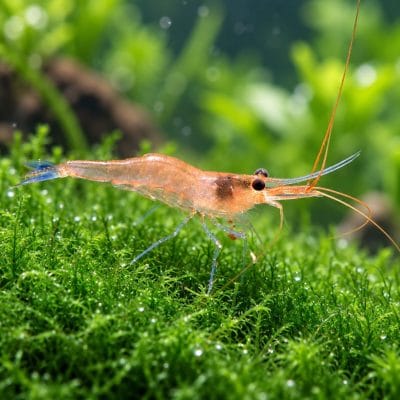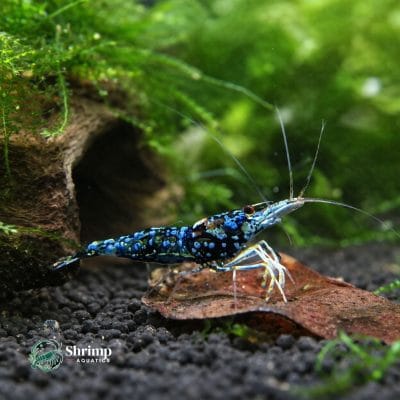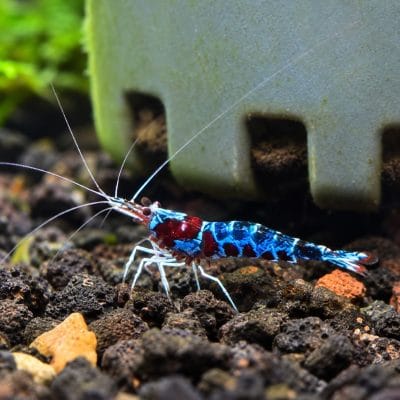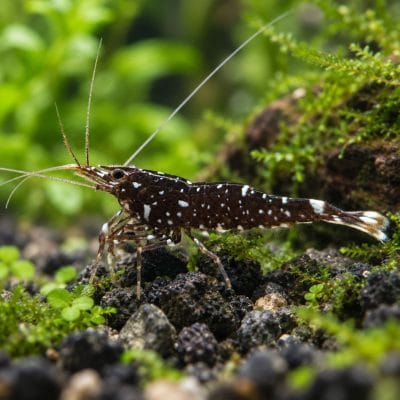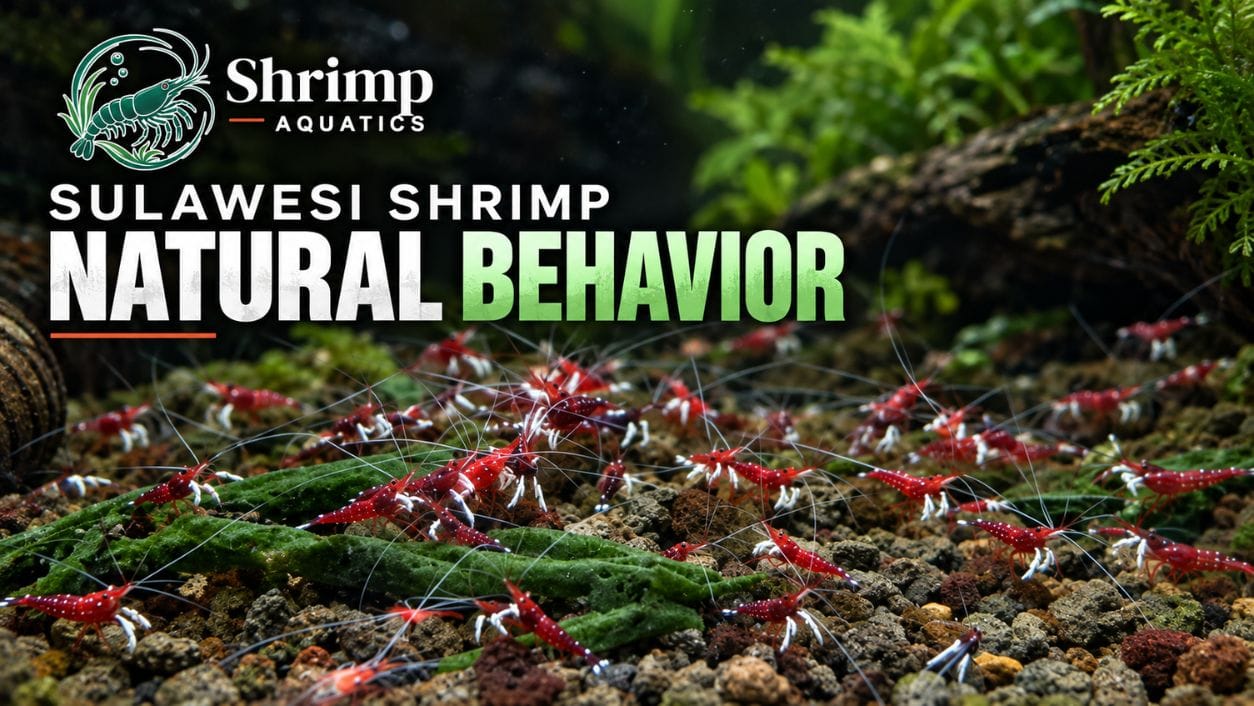
A settled Sulawesi shrimp spends almost all its time doing one thing. It works a thin living film off rock with its front legs, a few square millimeters at a time. It moves slowly, stays in contact with a surface, ignores its neighbors, and vanishes into cover when something large passes the glass. That’s close to the whole repertoire. Almost everything keepers read as a personality problem in a new tank is one of those four habits meeting a tank that isn’t ready for them.
What Sulawesi shrimp do all day in a healthy tank
Watch a settled colony for ten minutes and you’ll see three things. Shrimp out on open rock, moving at a crawl, front legs going almost continuously. Shrimp sitting still in a crevice with only antennae showing. And every so often one animal crossing open ground fast and directionally. That last one is a different behavior, and it usually means a female has just molted.
What you won’t see is anything you’d call interaction. They don’t hold territory. They don’t fight over a patch of film. A rich surface will carry several animals at once, with nothing more than the odd antenna contact between them. Peaceful and shy is the honest summary, and it holds across the lake species in the trade.
Why Sulawesi shrimp graze rock instead of waiting to be fed
Sulawesi shrimp graze rock because the lake species they come from radiated into separate ecological niches, each tied to the surfaces it feeds on. The study that tested this found 12 of the 15 endemic Malili species to be habitat specialists, in a radiation involving habitat-specific diversification of trophic morphology.1 In plain terms, the mouthparts and front legs changed shape along with the surfaces each species settled on. A shrimp built to comb film off porous rock isn’t built to tear into a pellet. A Sulawesi shrimp won’t behave like a cherry shrimp mobbing a wafer.
So the most useful thing you can do for their behavior is grow the food rather than add it. Feed less than you think, because the biofilm and algae Sulawesi shrimp actually graze is already growing on your rock. A tank with mature surfaces produces visible, constant grazing. A bare tank produces animals that sit in the rockwork and look sick, when nothing is wrong except the menu.
What one feeding trial actually shows
It’d be neat to say they eat only biofilm. It isn’t true. A controlled rearing trial on Caridina dennerli started with animals about 1.445 cm in total length and ran four combinations of feed and shelter for 30 to 37 days. Commercial pellets with a plant shelter gave the largest average length gain, 0.119 cm, and the highest survival at 72.727%. A bacterial starter with stone shelter gave 0.013 cm and 31.818%.2 Those survival figures describe that trial and its tanks, not yours, and the paper sets no feeding schedule for a home aquarium. What it does show is that these shrimp will take prepared food and grow on it. A keeper who withholds everything on principle is guessing too.
What this changes in your tank
Judge your feeding by the rock, not by the clock. If film is visibly thinning across the hardscape, the colony has outgrown its grazing surface. If prepared food is still sitting there an hour later, you’re adding waste the tank didn’t need.
Why your Sulawesi shrimp stay out of sight
Sulawesi shrimp stay out of sight because cover is where they live, not because they’re stressed. New keepers usually ask about it a week after the order arrives.
The cover these species use in the lakes
A 2021 survey describing five new Lake Poso species gives the clearest picture of how narrow that cover gets. One species was found under rocks in more than 5 m of water. One was on very fine sand or silt in 1.5-2.5 m. One was hiding inside empty snail shells. One was in packs of small to medium stones close to shore.3 The same survey recorded few, large eggs, roughly 5 to 36 per female and about 0.7-1.1 mm long once the eyespots develop, which indicates direct larval development.3 So the young hatch as crawling shrimp into the same crevices the adults use. You aren’t waiting for babies to appear in open water. You’re waiting to notice them.
Depth is part of the same story. Until recently these shrimp were known from roughly 1-15 m, with 20 m as the deepest record. In 2025, bamboo traps set on the bottom of Lake Poso brought up Caridina longidigita at about 60 m and Caridina caerulea at about 74 m, including six egg carrying C. longidigita females.4 An animal that makes a living in the dark at 74 m isn’t going to parade across an open glass bottom for you.
The far end of the range is Caridina spongicola, in the outlet of Lake Towuti. It lives on a freshwater sponge and inside its openings at depths of 2-5 m, and its gut contents were a variety of diatoms with none of the sponge’s own spicules.5 That association is exclusive, probably commensal, and the first shrimp and sponge partnership described in fresh water. The shrimp is thought to have come from a rock dwelling ancestor.6 None of the lines you can buy are that specialized. It still tells you what kind of animal you’re dealing with.
Are Sulawesi shrimp nocturnal?
Nobody knows. No published study measures a day and night activity rhythm for any Sulawesi lake Caridina. The care sheets that assert one contradict each other, some calling them strictly nocturnal, others describing grazing around the clock. What the published record does support is that they’re cryptic by habitat. Cryptic isn’t the same as nocturnal.
Practically, run a normal light period. Judge the tank by whether shrimp come out to graze at some point in the day, not by whether they’re out when you happen to look. Dimming the tank to force them into the open trades your grazing surfaces for a brief sighting, and that’s a bad trade.
At Shrimp Aquatics, we keep about five Neocaridina in some of our Sulawesi systems, and the Sulawesi shrimp there stay more visible, or retreat less, when people approach the tank. It’s worth trying if you never see yours. Only do it if the temperature suits both groups, there’s grazing surface to spare, and the tank has stocking capacity for both.
Do Sulawesi shrimp need a group to behave normally?
Yes, though not for the reason usually given. They aren’t schooling animals, and there’s no published work on group size in these species, so anyone quoting a minimum number is quoting a habit. The real argument is arithmetic. Mating turns on a short window after a female molts, and a male has to be nearby and searching when it opens. In six animals spread through a heavily built rockscape, that meeting may simply never happen.
Keepers who get results with these usually start with a group rather than a pair or a trio. A bigger group also means more grazing surface and more waste in water that’s already unforgiving, so it isn’t free. Which lake your Sulawesi shrimp come from is worth knowing for its own sake, but it doesn’t change the water you have to hold, and the behaviors on this page look much the same across the group.
What mating looks like in a Sulawesi colony
In shrimps generally, mating happens at the female’s premating molt. In pure search species the males don’t recognize or guard a female approaching her molt. They stay socially active instead, and when one meets a just molted receptive female, recognition and mating occur within seconds or a few minutes. Then the partners separate quickly. That short period of attractiveness is what protects her from harassment, which can injure or even kill her.7 Read it as the pattern for the wider group of shrimps, not as a measured observation on Caridina dennerli.
It does explain the burst of fast, directional swimming you’ll occasionally see, and it explains why a female heavy group is the usual advice. A cast shell on the sand is the cue worth watching, because the signs Sulawesi shrimp are mating show up in the period right after a female molts.
What follows is small. The taxonomic revision of the Sulawesi lake shrimps counted eggs on wild caught females. It recorded 8 to 14 eggs across seven Caridina dennerli females, each egg 1.0-1.2 x 0.5-0.7 mm.8 Across the species in that paper, the per species counts run from about 8 to 80. A clutch you can count on one hand is normal here, and a single figure quoted for the whole group doesn’t mean much. Colonies grow slowly. That’s the biology, not a fault in your tank.
What your tank has to hold before any of this behavior shows up
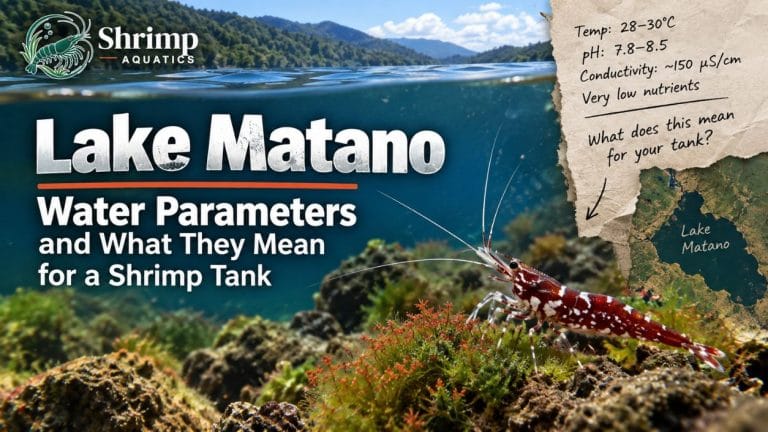
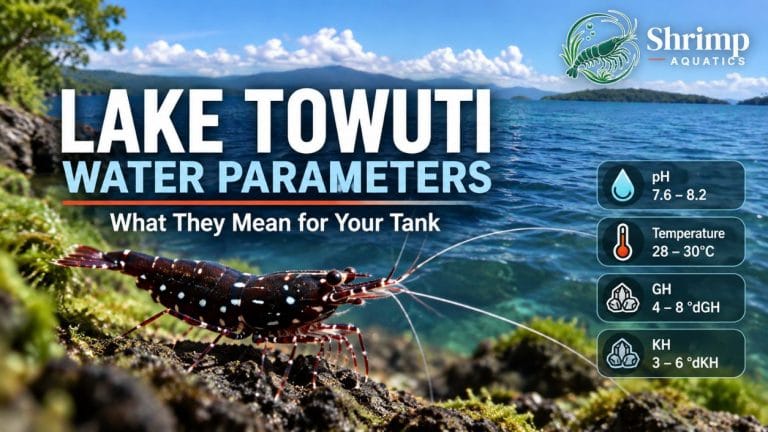
Sulawesi shrimp only show their natural behavior in a mature tank with established grazing surfaces and water that doesn’t move around. These are advanced to expert animals. The numbers below are the typical band this site keeps to for the lake species, not a survival limit.
| Difficulty | Advanced to expert |
|---|---|
| Temperature | 79-86°F (26-30°C) |
| pH | 7.5-8.5 |
| GH | 4-8 dGH |
| KH | 3-6 dKH |
| TDS | 150-250 ppm |
| Nitrate | Under 10 ppm |
| Ammonia and nitrite | 0 |
| Substrate and hardscape | Inert, with plenty of grazing surface and crevices |
Holding Sulawesi shrimp care parameters steady matters more to behavior than hitting any single number inside that band. If your readings sit there and your rock already carries a visible film, that’s the point to choose which tank-bred Sulawesi shrimp lines you want. Build the rockwork before they arrive, not after.
When Sulawesi shrimp behavior is a warning, not a habit
Sulawesi shrimp behavior is a warning when it breaks the quiet grazing pattern of a settled colony, for example when shrimp stop coming out for days.
- Grazing has stopped. Animals are out on the rock but not working the surface.
- Several Sulawesi shrimp are swimming erratically, fast and all at once, with no cast shell anywhere in the tank.
- An animal is on its side, on the substrate, out in the open.
- A shrimp sitting in a crevice for hours is not, on its own, a warning.
- A colony you rarely see in a rock heavy tank is not, on its own, a warning.
If they’ve stopped coming out at all, test before you change anything, because Sulawesi shrimp hiding that goes on for days is far more often chemistry than mood. Ammonia and nitrite first, then temperature, pH, GH, KH and TDS against the band above. Warm water is less forgiving of waste than a cool tank, so take the readings before you touch anything. Don’t dose a tank you haven’t tested.
References
8 Sources
- Adaptive radiation and ecological diversification of Sulawesi’s ancient lake shrimps (abstract), von Rintelen K., Glaubrecht M., Schubart C. D., Wessel A. and von Rintelen T., Evolution 64(11): 3287-3299, 2010.
- Effect of Using Different Shelter and Feed Types on Growth and Survival Rate of Sulawesi Endemic Ornamental Shrimps (Caridina dennerli), Abdullah D., Hasim and Mulis, Jurnal Ilmiah PLATAX 13(1): 191-204, 2025.
- Lake Poso’s shrimp fauna revisited: the description of five new species of the genus Caridina (Crustacea, Decapoda, Atyidae) more than doubles the number of endemic lacustrine species, Klotz W., von Rintelen T., Wowor D., Lukhaup C. and von Rintelen K., ZooKeys 1009, 2021.
- First report on deep-water Caridina spp from Lake Poso, Sulawesi, Dwiyanto D., Bandjolu K. P., Wowor D., von Rintelen T., Annawaty, Farajallah A. and Perwitasari D., BIO Web of Conferences 185: 02002, 2025.
- Caridina spongicola, new species, a freshwater shrimp (Crustacea: Decapoda: Atyidae) from the ancient Malili lake system of Sulawesi, Indonesia, Zitzler K. and Cai Y., Raffles Bulletin of Zoology 54(2): 271-276, 2006.
- Freshwater shrimp-sponge association from an ancient lake (abstract), von Rintelen K., von Rintelen T., Meixner M., Luter C., Cai Y. and Glaubrecht M., Biology Letters 3(3): 262-264, 2007.
- Mating Behavior and Strategies (research page), Bauer R. T., University of Louisiana at Lafayette.
- Radiation of endemic species flocks in ancient lakes: systematic revision of the freshwater shrimp Caridina from the ancient lakes of Sulawesi, Indonesia, with the description of eight new species, von Rintelen K. and Cai Y., Raffles Bulletin of Zoology 57(2): 343-452, 2009.
Ready to get started?
Shop our Sulawesi Shrimp collection
27 products available · Live Arrival Guarantee