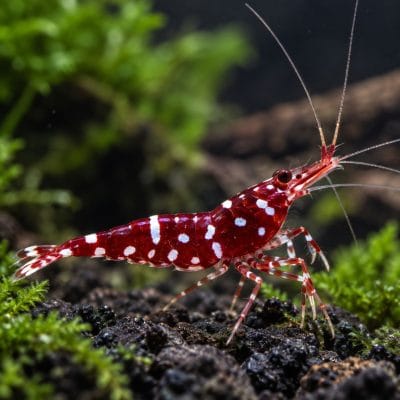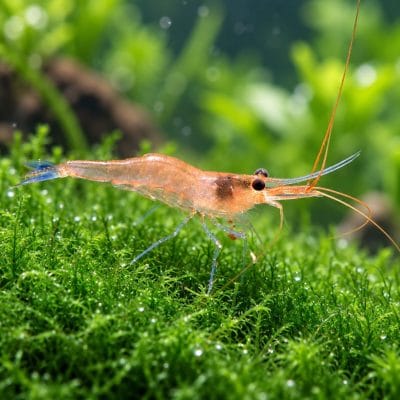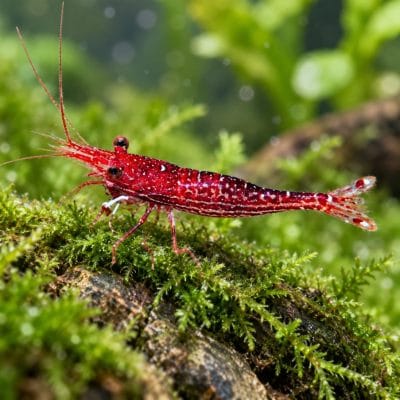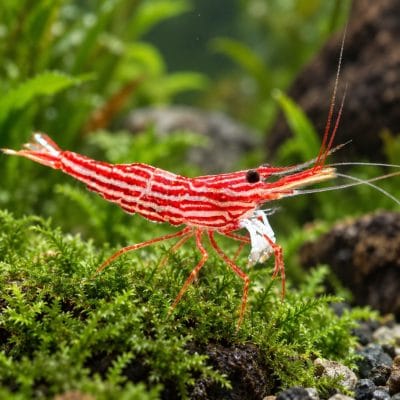
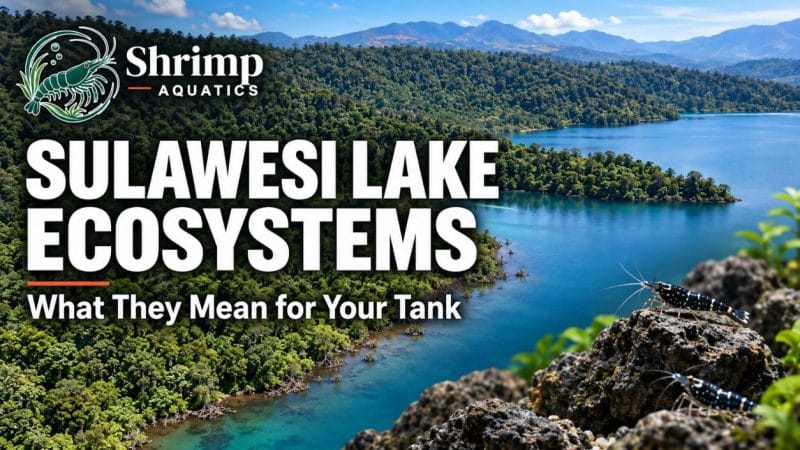
Sulawesi shrimp aren’t warm water cherry shrimp with better paintwork. They come out of a handful of very old Indonesian lakes that hold almost nothing a shrimp can eat, and that poverty is what shaped them. Knowing the lakes won’t hand you a magic number. It will tell you which parts of a Sulawesi tank matter and which parts are scenery.
What makes Sulawesi’s lakes ancient, and why that produced a specialist shrimp
Sulawesi’s lake shrimp come from two separate ancient lake systems, Lake Poso and the Malili lakes, and the two have little to do with each other. Lake Poso sits alone in the central highlands. The Malili system to the southeast is a chain of connected lakes, the largest of them Matano, Mahalona and Towuti. Both systems have been isolated long enough to grow their own animals from scratch, which is why biologists treat them as two separate experiments rather than one habitat.1
For shrimp that means two separate radiations. The 2009 revision of the lake Caridina recognizes 21 species here. Fifteen live in the Malili lakes and six in Lake Poso, and the two systems are described as completely isolated from one another. Most of those species live in one lake and nowhere else.2
So when a care sheet says Sulawesi shrimp all want the same thing, it’s half right. The water is shared. The animals aren’t interchangeable, and a trade name on a listing rarely tells you which basin you’re buying out of.
Why the Sulawesi lakes are so poor in nutrients, and what that built into the shrimp
A big part of why Sulawesi lakes are unique is that the Malili lakes are the only hydrologically connected ancient lakes in the world, and they’re ultra oligotrophic with unusual physicochemical conditions. That’s the limnologist’s way of saying there’s very little in that water for anything to eat. Speciation there has been driven mainly by competition for limited resources, and each lake behaves as its own environment.3
Think what a couple of million years of that does to an animal. Nothing rains down from above. Everything edible is a thin film on a hard surface, and something else is already working on it. A Sulawesi shrimp grazes all day for a very small return. That’s why a busy colony is usually a healthy one, and why the jar of food on your shelf matters less than you’d expect. Build the grazing film first and feed second, because what Sulawesi shrimp eat off mature rock is most of their diet.
The practical version is blunt. In water this warm, uneaten food is a liability rather than insurance. The usual rule is to offer less than you think, then lift out whatever is still sitting there a few minutes later.
Nothing in a Sulawesi lake changes fast, and that is the real husbandry target
A first Sulawesi colony is usually lost on the day a reading moves, not because a steady reading sat slightly off.
So what do you actually copy from an ancient lake? Not its readings. A basin that old changes on a timescale no aquarium can match, and its animals never had a reason to tolerate a busy Saturday afternoon. What transfers is the rate of change, and the target rate is close to zero. Here’s the range we keep to. The useful thing about the table is the width of each band, not the middle of it.
| Difficulty | Advanced to expert |
|---|---|
| Temperature | 79-86°F (26-30°C) |
| pH | 7.5-8.5 |
| GH | 4-8 dGH |
| KH | 3-6 dKH |
| TDS | 150-250 ppm |
| Nitrate | Under 10 ppm |
| Substrate | Inert sand and rock, never an acidic soil |
| Tank | Mature and stable, grazing surfaces already grown in |
Pick one setting inside each band and hold it. A tank sitting quietly near an edge of the range beats a tank nudged toward the middle every week. Most of that work happens in the replacement water, not in the tank. Tempted to run the heater at the top of the band? Read why Sulawesi shrimp need warm water first, because the extra heat costs you dissolved oxygen.
Clean rock is the habitat in a Sulawesi lake, and silt is what takes it away
Sulawesi lake shrimp live on bare rock. The rock carries a living film, and that film is the pasture. There’s no carpet of plants to hide in and no leaf litter doing the feeding. A planted Sulawesi tank that looks like an aquascape is usually a Sulawesi tank feeding nobody.
That film is also the first thing a lake loses when the land above it is disturbed. Mining for nickel has developed inside the Malili watershed, and sedimentation sits alongside it among the pressures recorded on these lakes.4
Your tank runs a small version of the same problem. Detritus drifts into the low spots and settles over the texture the shrimp were grazing. The colony quietly loses pasture while the test kit still reads fine. Texture matters more than shape when you pick the best rocks for Sulawesi shrimp, and a bed you can siphon under beats a bed that looks like the lake.
What the Sulawesi lakes do that no aquarium can copy
Lake Matano is the deepest lake in Southeast Asia, at 590 m.4 Nothing in that sentence is reproducible at home. It’s worth saying plainly, because the biotope instinct sends people chasing features that were never the point.
The depth, the chemistry of water sitting hundreds of meters down, the predatory fish that made these shrimp shy, the sponge one species lives inside: all of it belongs to the lake. None of it belongs in a 20 gallon tank. What you’re reproducing is a warm, mildly alkaline, mineral-poor, very stable body of water with plenty of grazeable rock in it. That’s the whole assignment.
Do not aim at a lake reading
A field measurement from a lake is one spot on one day, taken with different gear for a different purpose. Treating it as a target is how keepers end up moving a tank that was already steady, and the move is usually what does the damage.
Read the measured lake figures once, on where Sulawesi shrimp come from, then set your tank to the band in the table.
What mining, invasive fish and collecting have changed about buying Sulawesi shrimp
The shrimps and snails of the Sulawesi lakes, with their color, have proven very popular in the aquarium trade.4 That popularity landed on animals with nowhere else to go. Every one of the fourteen Malili atyid shrimp species assessed on the IUCN Red List is listed as Endangered or Critically Endangered.4
Then there’s what got put in. The flowerhorn cichlid, a hybrid bred for the ornamental trade, was introduced into Lake Matano and has since spread to all of the lake’s coastal areas.4
Lake Poso has had it worse. The 17 fish species introduced there now outnumber the 13 native ones. The Malawi golden cichlid Melanochromis auratus went from a single record at the outlet in 2012 to abundant across the whole lake by 2019. Its stomach contents cover a broad range of food, juvenile Caridina among them, though remains of adult shrimp turned up surprisingly rarely and attacks on living shrimp were seen directly.5
None of that is a reason to feel bad about keeping these animals. It’s a reason to be fussy about where yours came from. Comparing two listings? The first question worth asking is whether the shrimp were bred in a tank, and every one of our Sulawesi shrimp lines is tank-bred by Shrimp Aquatics.
The lakes aren’t a design brief to copy. They’re the explanation for why this animal is fussy, why it grazes instead of waiting for dinner, and why the tank has to be finished before the shrimp arrive.
References
5 Sources
- The species flocks of lacustrine gastropods: Tylomelania on Sulawesi as models in speciation and adaptive radiation (abstract), Hydrobiologia 615: 181-199, Springer, 2008.
- Radiation of endemic species flocks in ancient lakes: systematic revision of the freshwater shrimp Caridina from the ancient lakes of Sulawesi, Indonesia, with the description of eight new species, The Raffles Bulletin of Zoology 57(2): 343-452, Lee Kong Chian Natural History Museum, 2009.
- The Ancient Lakes of Indonesia: Towards Integrated Research on Speciation (abstract), Integrative and Comparative Biology 51(4): 634-643, Oxford University Press, 2011.
- Wallace’s Dreamponds: Conserving Sulawesi’s Ancient Lakes, Shoal, a programme of Synchronicity Earth.
- More non-native fish species than natives, and an invasion of Malawi cichlids, in ancient Lake Poso, Sulawesi, Indonesia, Aquatic Invasions 17(1), 2022.
Ready to get started?
Shop our Sulawesi Shrimp collection
27 products available · Live Arrival Guarantee
Featured Sulawesi Shrimp
Sulawesi Red Line Blue Dot
Caridina sp. "Red Line Blue Dot"
Advanced · 79–86°F · pH 7.5–8.5
From $15.99View Product