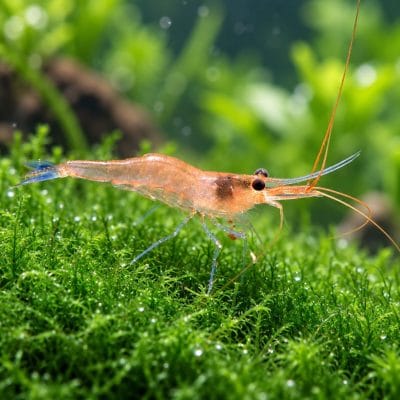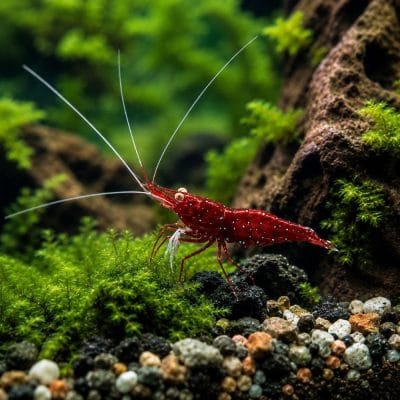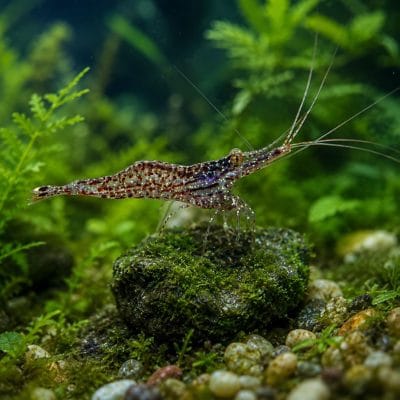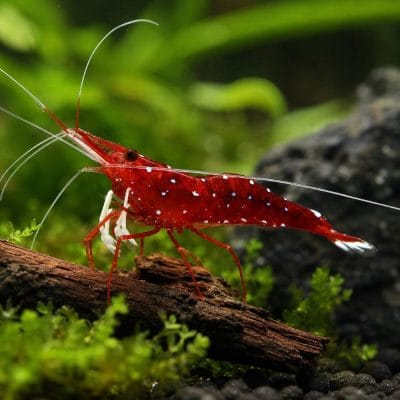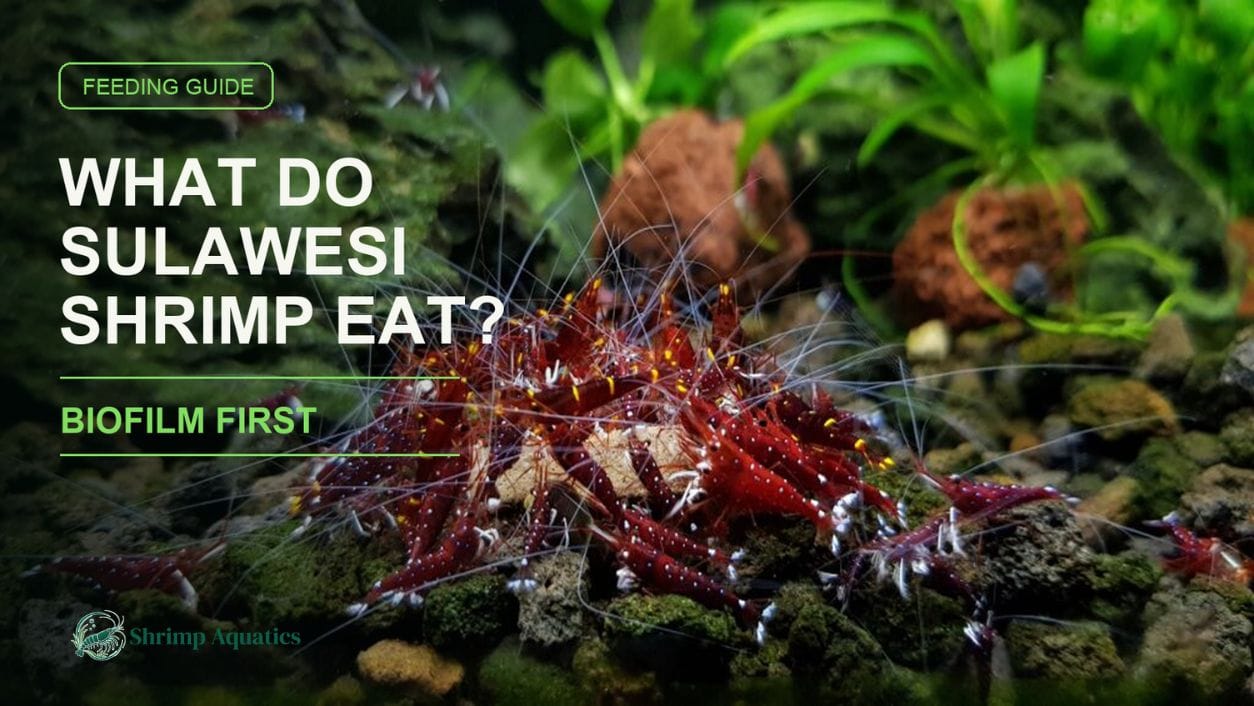

Sulawesi shrimp live mostly on the layer of biofilm, algae and microorganisms growing on rock, glass, hardscape and filter media, and prepared food is a small supplement on top of it. Getting the balance wrong in the other direction, by feeding a warm alkaline tank like a standard shrimp tank, is one of the most common ways keepers lose a Sulawesi colony.
What Do Sulawesi Shrimp Eat in a Mature Aquarium?
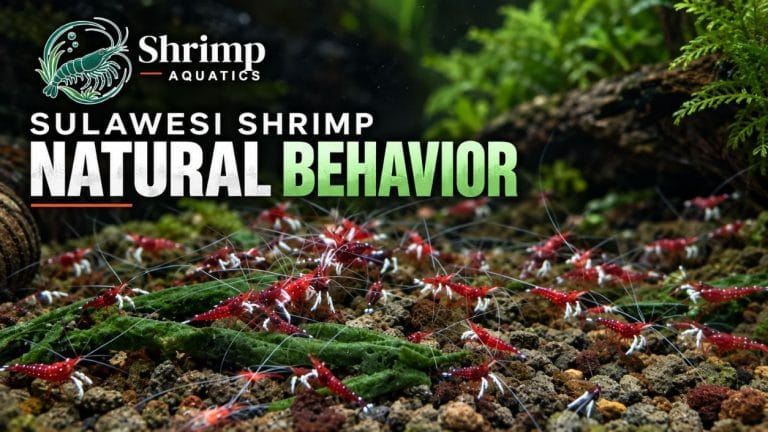
Sulawesi shrimp are grazers. In a settled tank you’ll see them working continuously across rock faces, glass and hardscape, picking at a film that’s far too thin to see clearly. That film, often called biofilm or aufwuchs, is a mixed community of bacteria, microalgae, diatoms, fungi and fine organic particles bound to hard surfaces. It’s the base of the diet, and everything else you add is secondary to it.
This makes sense from where these shrimp come from. The ancient Malili Lakes of Sulawesi are ultra oligotrophic, meaning nutrients in open water are extremely scarce, and competition for those limited resources appears to have driven much of the adaptive radiation seen in the lake fauna.1 The endemic Caridina species flocks of these lake systems show clear substrate preferences and trophic specialization, not a single generalist feeding style.2 One species makes the point vividly: the harlequin shrimp, Caridina spongicola, lives in an exclusive and probably commensal association with a freshwater sponge in Lake Towuti, and it descends from rock dwelling ancestors.3
Where this guide applies and where it doesn’t
This is guidance for the whole group of lake system Sulawesi Caridina such as Cardinal, Oiran, White Sock and Blue Leg lines. Species differ, and evidence for feeding preferences in most of them is thin. Nothing here should be read as proof that every Sulawesi species eats only biofilm or that any of them will refuse prepared food.
Two practical conclusions follow. First, a Sulawesi tank needs abundant hard, textured, well lit grazing surface, because surface area is literally food capacity. Second, if the colony looks hungry, the honest first question is whether the tank is producing enough grazing material, not whether you should add another food product.
Build the Grazing Layer Before Sulawesi Shrimp Go In
The single most common feeding mistake is stocking a tank that has no food in it yet, then trying to compensate with prepared food. That fails twice over: the shrimp still can’t graze properly, and the uneaten food degrades in warm water. Supplemental food doesn’t substitute for a mature system.
How Long a New Sulawesi Tank Needs Before It Can Feed Shrimp
Your tank is ready when its tests say so, not when the calendar does. Time alone proves nothing. Before stocking, confirm all of the following:
- Ammonia and nitrite both read 0 on a reliable test.
- Temperature and water chemistry have held steady across several days of testing.
- The biological filter is established and running at operating temperature.
- Rock, glass and hardscape show visible grazing growth.
- Don’t stock on a calendar date while any of the above is still unresolved.
Lighting and Surfaces That Grow Biofilm for Sulawesi Shrimp
Light is what turns hardscape into food. Photosynthetic growth on rock and glass needs a consistent daily photoperiod, and in a maturing tank that growth is the point.
In our Sulawesi shrimp tanks, during the early cycle we normally run the light for 8-10 hours a day so algae and biofilm can establish on the rock and glass. We still watch temperature and water quality, because longer lighting is useful only when the system remains stable.
In an empty cycling tank, we sometimes add a small amount of shrimp food to support early microbial growth, then remove what remains after about 24 hours. We still use ammonia, nitrite, stability and visible biofilm to decide when the tank is ready.
Note the scope on that second practice. It applies to an empty tank with no livestock present, and the leftovers still come out. Leaving food to break down in a stocked warm alkaline tank is a different situation with a different risk, which is the subject of the next section.
Growing that layer is the slow middle of keeping Sulawesi shrimp, and it’s the step most first tanks skip.
Why Leftover Food Is Riskier in a Warm Alkaline Sulawesi Tank Than in a Bee Caridina Tank
Keepers moving from Bee or Crystal Caridina to Sulawesi often carry over a feeding routine that used to be forgiving. It isn’t forgiving here, and the reason is chemistry.
That risk is the same warm alkaline chemistry described in the Sulawesi shrimp care parameters, seen from the feeding side.
Decomposition of organic waste matter is a natural source of ammonia in water, ammonia toxicity acts directly on aquatic life, and how toxic a given amount is depends on environmental factors including pH and temperature.4 A Sulawesi tank sits at the warm alkaline end of the freshwater hobby, which is exactly the combination that makes an equivalent lump of decaying food a more serious event than it would be in a cool acidic Bee tank. Warmth also speeds the breakdown itself, so the problem develops faster.
| Condition | Sulawesi lake Caridina | Bee and Crystal Caridina | Why it changes feeding |
|---|---|---|---|
| Temperature | 79-86°F (26-30°C) | 60-72°F (15.5-22°C) | Warmer water speeds decomposition of uneaten food |
| pH | 7.5-8.5 | 5.8-6.8 | Ammonia toxicity depends on pH as well as temperature |
| Nitrate target | Under 10 ppm | Under 20 ppm | Less headroom for the waste that feeding adds |
These are typical ranges used for the group, not a promise that any individual tank is safe at a given number, and the nitrate figures are targets rather than proven tolerance limits. Don’t merge the two columns into one care routine. Bee and Crystal Caridina keep soft acidic water, Sulawesi shrimp keep warm alkaline water, and sharing the genus Caridina doesn’t make them one feeding group.
Which Supplemental Foods Suit Sulawesi Shrimp Grazing Behavior?
Once the grazing layer is established, supplemental food has a narrow but real job: filling gaps when a colony grows, supporting shrimplets, and adding variety in a tank whose natural production is limited. Choose it around how these shrimp actually behave, which is slow, shy, surface oriented feeding rather than a fast scramble. In a tank with little natural growth a blanched vegetable adds variety, and whether Sulawesi shrimp can eat vegetables comes down to preparation.
Powdered and Fine Foods for Shy Sulawesi Grazers
Fine powders settle across many surfaces at once instead of forming one pile that only the boldest shrimp reach. That suits animals which often stay in cover for the first weeks and feed in short passes. The trade off is that powder is easy to overdose, because you can’t see how much has actually been eaten. Start with clearly less than you think is needed and adjust upward slowly over several feedings. Start with clearly less than you think they need, the safe habit in how much to feed Sulawesi shrimp.
Food Formats That Stay Intact and Can Be Lifted Out of a Sulawesi Tank
A food that holds together lets you take the remainder out before it breaks down. That single property matters more in this tank than the ingredient list on the package. Sticks, wafers, sinking sheets and similar formats can be placed on hardscape where the shrimp already graze, then removed whole. Fast crumbling pellets do the opposite: fragments fall into gaps between rocks and substrate where you can’t retrieve them. Soft vegetables are the opposite case. Sulawesi shrimp will eat spinach, but a leaf that falls apart can’t be lifted out whole, so it stays a rare, small visit.
- Feeding a Sulawesi tank on the schedule that worked for a Neocaridina colony.
- Adding more food because the shrimp are hiding, when the tank is simply still new.
- Leaving uneaten food in overnight so nothing goes to waste.
- Scrubbing every surface clean, then feeding heavily to replace the grazing layer that was just removed.
On ingredients, be careful with confident claims. Plant based and algae based shrimp foods are widely used for this group, and specialist Sulawesi and Caridina foods are generally formulated lower in protein than foods aimed at Neocaridina. We don’t have evidence adequate to tell you that animal protein harms Sulawesi shrimp specifically, so treat that as an open question, and judge a product on how it behaves in your water. Plant and algae based foods are widely used for this group, and whether Sulawesi shrimp can eat spirulina is one of the common questions.
How Much and How Often to Feed a Sulawesi Shrimp Colony
Feed a small measured amount, watch what happens to it, and let the result set the next portion, because the right amount depends on colony size, tank maturity and how much natural growth the system produces.
At Shrimp Aquatics, in our Sulawesi systems mature algae and biofilm do most of the feeding. We normally offer prepared food only about once a week and remove leftovers, because food that sits in warm water adds organic waste and can raise ammonia, nitrite and nitrate as it breaks down.
In these systems, many of our Sulawesi shrimp show limited interest in prepared food. Acceptance varies by species, system and food, so watch what your own colony does with a small portion before settling on a schedule.
Use that as a starting point, and calibrate with a simple loop:
- Offer a portion small enough that you expect it to be finished, placed where the shrimp already graze.
- Watch for the first hour or two. Note how many shrimp come to it and whether they stay.
- Remove whatever is left before it breaks down.
- If the food was ignored or barely touched, reduce the next portion or extend the interval.
- If it was cleared quickly and the tank looks heavily grazed, increase slightly, then recheck your parameters at the next test.
Adult dwarf shrimp handle short gaps between prepared feedings without difficulty when a grazing layer is present. Skipping a scheduled feeding is a much smaller risk than adding one more portion into a tank that hasn’t finished the last one. Skipping a feed is a smaller risk than adding one, the rule behind how often to feed Sulawesi shrimp.
Feeding Sulawesi Shrimplets Without Fouling a Small Colony Tank
Sulawesi shrimp hatch as miniature versions of the adults with no free swimming larval stage, and the young stay close to cover with a very small foraging range. They can’t travel to a feeding spot, so their food has to already be where they are. In practice that means the biofilm layer again: shrimplet survival tracks how mature and well colonized the surfaces are far more closely than it tracks any product you add.
Fine powdered foods are the reasonable supplement here, because they disperse and settle broadly rather than landing in one place. Keep the amounts smaller than feels right. A dose that an adult colony would clear can sit and decay in a tank where most of the population is too small to consume it, and that returns you to the ammonia problem described above.
Be honest with yourself about the cause when baby Sulawesi shrimp die or disappear. Losses at this stage usually reflect tank maturity, stability and grazing availability. We can’t promise breeding success, survival rates or coloration from any feeding routine.
Use Grazing Behavior to Decide Whether Your Sulawesi Shrimp Need More Food
Feeding decisions in an established Sulawesi tank should be made by watching the animals, not by following a calendar. Grazing behavior is the readout, and it tells you different things depending on what else you observe.
Feed a little more if
Shrimp are active and visible, they work surfaces continuously, offered food is cleared quickly, the colony has grown, and your ammonia, nitrite, nitrate and other parameters are all where you want them.
Feed less or pause if
Food sits uneaten, you find fragments in the substrate, nitrate is climbing between water changes, or you’re adding food mainly because you haven’t seen the shrimp lately. Food sitting uneaten while nitrate climbs between changes is the clearest sign of overfeeding Sulawesi shrimp.
Stop and test instead of feeding if
Shrimp have stopped grazing, are sitting still in one spot, are clustered at the surface, or are failing to complete molts. These are water and stability signals rather than hunger signals. Test ammonia, nitrite, nitrate, temperature, pH and TDS, review anything that changed recently, and correct that before you change the feeding routine. If shrimp are dying and the cause isn’t clear from testing, get help from a qualified aquatic specialist before adding treatments to a tank of invertebrates.
The habit worth building is simple. Read the tank first, feed second, and let the grazing layer stay the main meal.
A tank whose surfaces already carry that film is a tank ready for tank-bred Sulawesi shrimp; one that still needs the food dish isn’t ready yet.
References
4 Sources
- The Ancient Lakes of Indonesia: Towards Integrated Research on Speciation, Integrative and Comparative Biology, published October 2011, accessed 2026-07-20.
- Lake Poso’s shrimp fauna revisited: the description of five new species of the genus Caridina (Crustacea, Decapoda, Atyidae) more than doubles the number of endemic lacustrine species, ZooKeys, published 4 January 2021, accessed 2026-07-20.
- Freshwater shrimp-sponge association from an ancient lake, Biology Letters via PubMed, published 22 June 2007, accessed 2026-07-20.
- Aquatic Life Criteria – Ammonia, United States Environmental Protection Agency, last updated 18 May 2026, accessed 2026-07-20.
Ready to get started?
Shop our Sulawesi Shrimp collection
27 products available · Live Arrival Guarantee
Featured Sulawesi Shrimp
Sulawesi Orange Eyes White Sock
Caridina dennerli
Advanced · 79–86°F · pH 7.5–8.5
From $19.99View Product