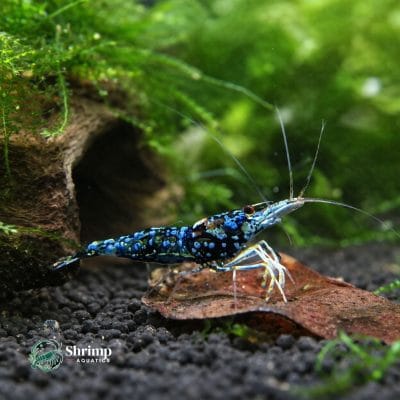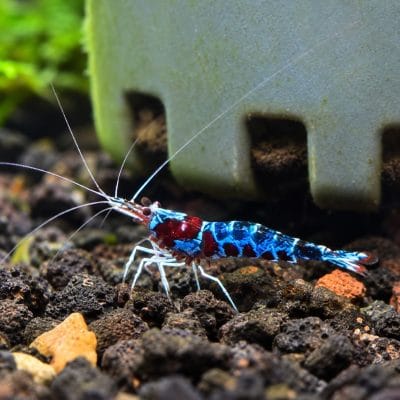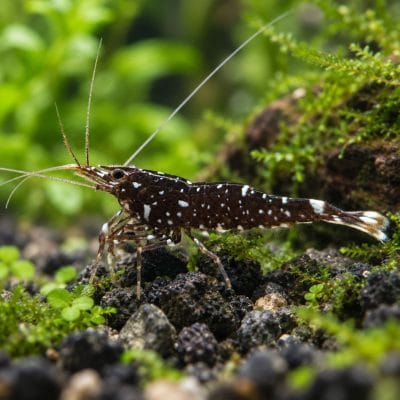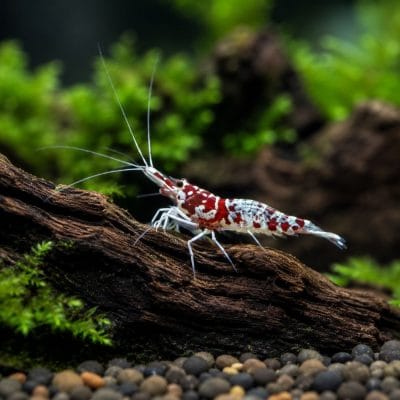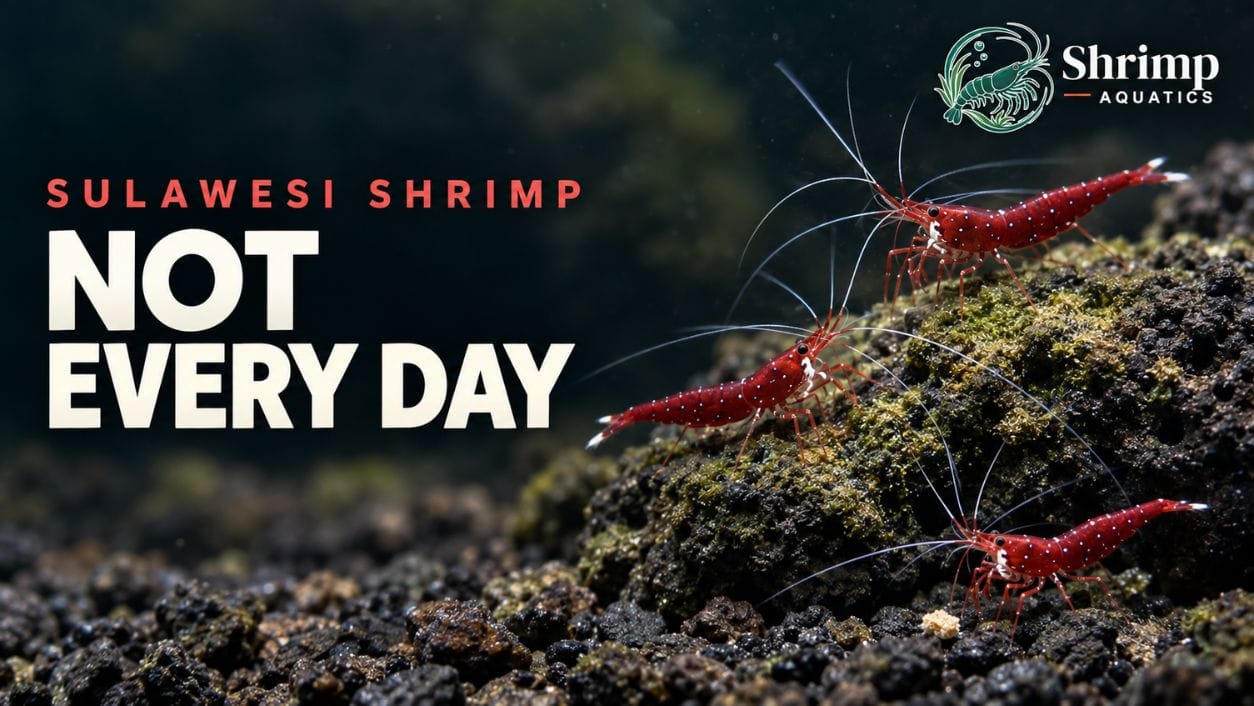
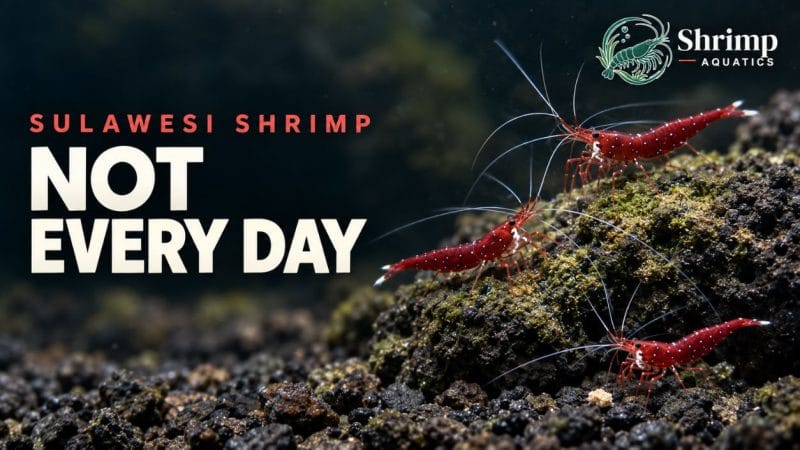
Not daily. In an established tank, Sulawesi shrimp (Caridina spp.) spend the whole day grazing the biofilm and algae already growing on rock, glass and substrate. Prepared food is a top-up on that. The honest interval is the one your own grazing surfaces set. In our Sulawesi tanks at Shrimp Aquatics that has settled at about once a week, with anything left over taken out afterward. Many of the shrimp in these systems show limited interest in prepared food, and food sitting in warm water adds organic waste.
Let the grazing surfaces in your Sulawesi tank decide the interval
A feeding schedule written on paper can’t know how much film your rock is carrying this week. Two tanks running the same parameters can want very different intervals. A two-year-old system with heavily colonized lava rock and a dozen shrimp may go a fortnight without anything added. A lightly furnished tank holding the same colony runs its grazing surfaces bare in days. So treat the cadence as something you read off the tank rather than something you decide in advance.
So when is the next feed due? Before each supplemental feed, look at three things.
- Whether the previous portion was actually cleared, and how long it took.
- Whether the rock and hardscape still carry visible film, or look scrubbed and pale where the shrimp have been working.
- Where the shrimp are: a colony spread across open surfaces and working steadily is grazing on what the tank already provides.
If the last portion vanished quickly and the hardscape looks grazed clean, the tank is asking for the next feed sooner. If food is still sitting there hours later, the tank isn’t. The answer is to wait rather than to reduce the portion and keep the same day of the week. Adjust one step at a time, then give the change a week before you judge it.
Why one extra feed costs more in a warm, alkaline Sulawesi tank
The reason this group gets fed so cautiously is chemistry, not fussiness. Total ammonia in water is split between the ammonium ion and un-ionized ammonia, and the un-ionized form is the one that drives ammonia toxicity in aquatic animals. That split moves with the water. The ratio of un-ionized ammonia to ammonium ion in fresh water rises about tenfold for each single pH unit. It rises roughly twofold for each 10 degrees Celsius of warming across the 0-30 degrees Celsius band.1 A Sulawesi system sits at the warm, alkaline end of both. So the same total ammonia reading means more of the harmful form than it would in a cool, acidic Bee or Crystal tank.
Warm water also holds less dissolved oxygen than cold water does.2 Neither of those relationships sets a safe ammonia level or a minimum oxygen level for shrimp. No study we can point to has established one for any Sulawesi species. What they do establish is direction: at Sulawesi temperature and pH there’s less margin around a feeding mistake than a Neocaridina keeper is used to.
| Temperature | Typical range 79-86°F (26-30°C) |
|---|---|
| pH | Typical range 7.5-8.5 |
| Nitrate | Aim for under 10 ppm; that is a target, not a tolerance limit |
Don’t feed into a problem
If shrimp are dying, hiding or refusing food, stop supplemental feeding and remove anything uneaten. Test ammonia, nitrite and nitrate, and check temperature and mineral content before you change anything else. Adding food to a system that’s already struggling to process waste makes the next reading worse, not better.
Feeding more often won’t grow bigger Sulawesi shrimp or fix a molting problem
Two pieces of crustacean biology close off the usual reasons keepers reach for the food dish. First, growth only arrives at a molt: like other crustaceans, these shrimp have to cast the exoskeleton in order to grow.3 Extra food between molts has nowhere to go. Second, the calcium that mineralizes the new shell is mostly exogenous, taken from the water the animal lives in, with diet and stored reserves contributing less.4 A failed molt in Sulawesi shrimp is a water and mineral question, not a hunger question. Extra food between molts has nowhere to go, so the film on your rock matters more than the dish, the core of what Sulawesi shrimp eat.
The measured evidence points the same way. The only published feeding experiment on a Sulawesi lake species compared feed and shelter types, not feeding intervals. Caridina dennerli starting at an average total length of 1.445 cm gained an average of 0.119 cm over 30 days on commercial pellets with Hydrilla shelter. The same trial recorded 0.017 cm over 37 days on a bacterial starter with Hydrilla. Survival was 72.727% and 22.727% in those two groups.5 Those figures describe that trial and its conditions, not an expected result in a home aquarium, and no schedule can be read out of them. What they do show is scale. A month of feeding moves an adult Sulawesi shrimp by a fraction of a millimeter, so nothing you do at the dish this week will be visible next week.
When a Sulawesi colony genuinely needs feeding more often
There are a few situations where a longer interval is the wrong answer, and one where it’s the only answer.
A larger colony strips the film faster than a small one, so the same tank that fed twelve shrimp on its own will need help once it holds forty. Watch how quickly grazed patches recolor: the film, not the headcount, is the limit. That regrowth rate is also the number worth checking before you decide how many more Sulawesi shrimp your system can carry. Adding grazers to a tank that’s already grazed bare just moves the shortage.
When shrimplets are present, keepers often want to feed more often, and a fine powdered food offered in small amounts is reasonable. No requirement for feeding shrimplets has been measured in Sulawesi species, so treat any cadence, including ours, as practice, not evidence. Keep portions small enough to disappear, and take out what doesn’t.
A young tank is the case that goes the other way. If the hardscape carries almost no visible growth, the tank isn’t yet mature, and prepared food can’t stand in for grazing surfaces that haven’t developed. Give it light, time and surface area, hold the shrimp at a low density, and let the film catch up. Feeding harder into an immature system adds waste without adding grazing.
Signs your Sulawesi shrimp are getting too much food, or too little
Between water tests, the tank itself gives you feedback on the interval you picked.
You’re feeding too often
Portions are still sitting on the substrate hours later, the glass films over quickly between cleanings, the water loses its edge of clarity, or pest snails climb steeply in number. Skip the next feed, take out anything uneaten, and let the tank catch up before you resume.
You could feed a little more often
Anything offered is gone within an hour, and the hardscape looks scrubbed and pale. The shrimp work open rock through the day instead of picking around cover. Shorten the interval by a step, or add grazing surface, and watch the film for a week.
Neither picture is an emergency on its own, and neither replaces a test kit. Change one thing, wait, and let the grazing surfaces confirm the interval before you change it again.
References
5 Sources
- Aquatic Life Ambient Water Quality Criteria for Ammonia, Freshwater, U.S. Environmental Protection Agency, Office of Water, April 2013.
- Dissolved Oxygen and Water, U.S. Geological Survey Water Science School, updated August 24, 2026.
- Farming freshwater prawns, Chapter 1: Biology, Food and Agriculture Organization of the United Nations, FAO Fisheries Technical Paper T428.
- Biomineralizations: insights and prospects from crustaceans, Gilles Luquet, ZooKeys 176: 103-121, 2012.
- Effect of Using Different Shelter and Feed Types on Growth and Survival Rate of Sulawesi Endemic Ornamental Shrimps (Caridina dennerli), journal PDF, Jurnal Ilmiah PLATAX 13(1): 191-204, 2025.
Ready to get started?
Shop our Sulawesi Shrimp collection
27 products available · Live Arrival Guarantee