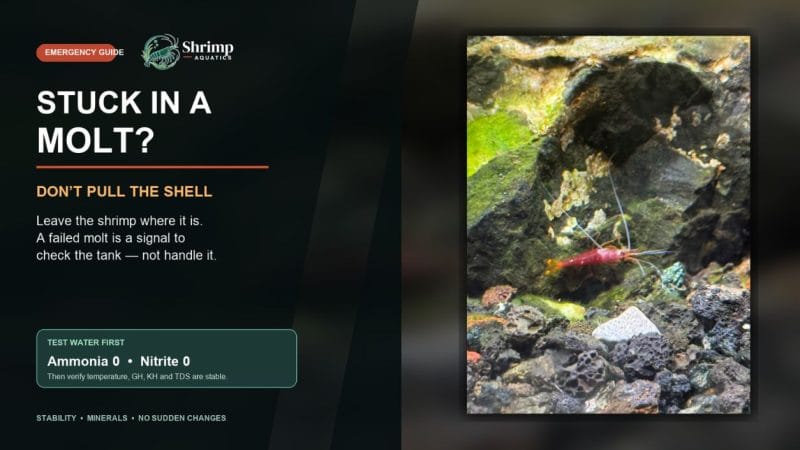
Yes, and it’s one of the few things in a Sulawesi tank worth treating as an emergency rather than a setback. Shrimp grow only by casting the old exoskeleton and building a new one 1, so a molt that stalls partway isn’t a stage the animal can sit out. The shed is expensive in its own right. In mud crabs the process consumes so much energy that the animal is left substantially weakened and fasts for a day or two afterward 2. Nobody has published a survival figure for Sulawesi shrimp (Caridina spp.) that fail to complete a molt, so treat any survival percentage you find as unsourced. What the aquaculture literature does record is that shrimp held in unsuitable water may still go through the motions of a molt. The usual outcome is death, often with a shell that never hardens 3. Plan on losing the individual, leave it where it is, and spend your effort on the tank.
Is your Sulawesi shrimp stuck in a molt, or is this a normal shed?
Two different situations get described as a shrimp that hasn’t molted properly, and only one of them is urgent. The first is an animal that has begun to shed and stopped. The carapace has separated from the abdomen, a pale band shows at the join, and the shrimp is lying in the open flicking its abdomen without moving forward. Keepers call that band the white ring, or an exposed neck on a Sulawesi shrimp. The second is a shrimp that simply hasn’t shed for longer than you expected, which is a question about growth rate.
Before you conclude anything, look at the whole tank, not just the one animal. Sulawesi shrimp are shy, so a shrimp out on open rock in daylight, on its side, is already unusual. Check whether the others are grazing normally, whether any of them are also sitting still in the open, and whether you can see intact shed shells anywhere. Is it one animal in trouble while the colony behaves normally, or four animals down at once? The two point in different directions.
An intact empty shell on the substrate is a molt that worked
The most common false alarm is the exuvia itself. Because the whole exoskeleton is cast in one piece, a successful molt leaves a hollow, colorless copy of the shrimp that keeps its shape. It’s easy to mistake for a dead animal at a glance. A shed shell is translucent and unmoving, and it holds no color in the body; a dead shrimp usually keeps its pigment. Leave the shed shell in the tank and stop worrying about it.
A longer gap between molts in a grown shrimp isn’t a stuck molt
Molt interval isn’t a fixed number, and it lengthens as an animal gets bigger. In laboratory work on the caridean shrimp Palaemon varians held at a constant 21 degrees Celsius, the molt cycle ran 6 to 12 days. Smaller individuals molted faster than larger ones, with a very strong correlation 4. That experiment ran on a different shrimp and far cooler than a Sulawesi tank, so the days don’t transfer. What transfers is the direction. An adult shedding less often than the juveniles around it is the expected pattern, not a warning sign.
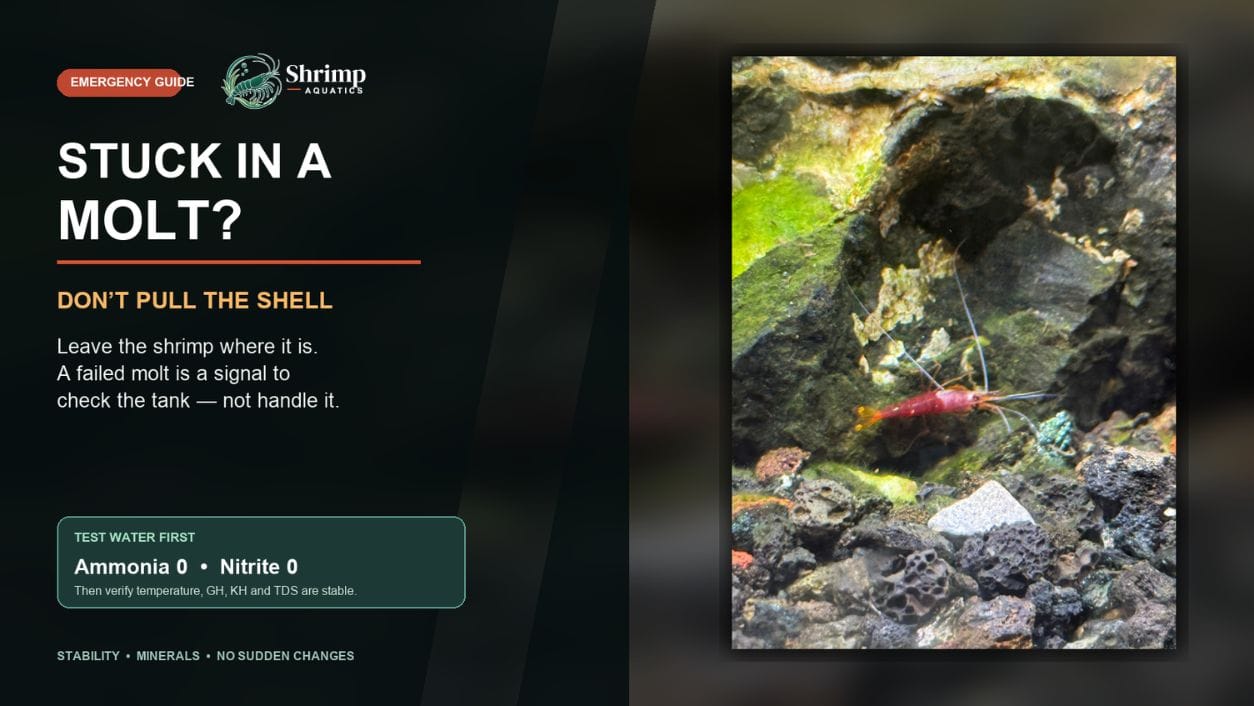
Never pull a Sulawesi shrimp out of a stuck molt
The instinct to reach in with tweezers is understandable and it’s the wrong move. No method for freeing a shrimp from a stalled molt has been documented. The animal is also smaller than the intention behind the attempt. In a published rearing trial for Caridina dennerli, the animals averaged 1.445 cm in total length 5. At that size there’s nothing on the old shell you can grip that isn’t also a leg or an antenna. The reason the shell is still on the shrimp is that the separation didn’t complete. On top of that, the rescue itself means lifting an exhausted animal out of warm, stable water into open air and a container at another temperature. That’s the same kind of shift this page asks you to avoid everywhere else.
Leave the shrimp where it is
Don’t lift it, don’t brush the shell and don’t isolate it in a cup. If it dies, remove the body promptly so it doesn’t add to the bioload in a warm tank, then treat the loss as a prompt to test the water.
What to test in the tank after a Sulawesi shrimp fails to finish a molt
A failed molt is a reading on the environment, so work through the non-invasive checks before you alter anything. Resist the reflex to run a large corrective water change now: it delivers a second chemistry shift to a colony that has just shown you it can’t absorb one. Read it as one signal among several, the way common health problems in Sulawesi shrimp sorts them before any treatment.
- Ammonia and nitrite, which should both read 0 in a cycled tank
- Temperature now, and how far it drifts between the warmest and coolest part of the day
- pH, GH, KH and TDS, read against the ranges below and against your own last recorded values
- Anything that entered the tank in the previous week: replacement water, a top-off, new rock or plants, food, fertilizer or any medication used in the room
- Whether one animal is affected or several, since a colony-wide event points at the water rather than at an individual
| Difficulty | Advanced to expert |
|---|---|
| Temperature | 79-86°F (26-30°C) |
| pH | 7.5-8.5 |
| GH | 4-8 dGH |
| KH | 3-6 dKH |
| TDS | 150-250 ppm |
| Nitrate | Aim for under 10 ppm |
| Ammonia and nitrite | 0 in a cycled, established tank |
These are typical ranges for lake Sulawesi Caridina as a group, not survival limits, and a verified record for one line or one stock may be narrower. Where your own tank sits inside a range matters less than whether it stays there. A reading that has moved since the last time you measured is more informative than a reading that’s a little off a published number.
The same ammonia reading is more dangerous in warm alkaline water
Total ammonia in water splits between the ammonium ion and the un-ionized form, and it’s the un-ionized share that matters. At high external concentrations it reverses the diffusion gradient so that ammonia accumulates in internal tissues and blood. That share isn’t fixed. It rises about ten-fold for every rise of one pH unit, and roughly two-fold for every rise of 10 degrees Celsius between 0 and 30 degrees Celsius 6. A Sulawesi tank is held at pH 7.5-8.5 and 79-86°F (26-30°C). So the same number on the same test kit represents a harsher exposure here than it would in a cooler, more acidic shrimp tank. That’s the practical reason a Sulawesi colony has so little tolerance for an overfed week or a filter that has been off overnight. Warm water also holds less dissolved oxygen than cool water 7, so surface movement and aeration belong near the top of the checklist.
Why your water routine decides whether the next Sulawesi molt works
Because the new shell is built out of what’s dissolved in the tank, and because the routine is where sudden changes come from. The major source of the calcium a crustacean uses to calcify a new exoskeleton is exogenous, meaning the water the animal lives in. Stored premolt reserves and food, including eaten exuviae, contribute less 8. That reframes a habit worth reframing: leaving shed shells in the tank is fine and harmless, but it isn’t a mineral supplement. Your GH is the supply the animal actually draws on at every molt, which is a reason to hold it steady instead of correcting it in jumps.
The second half is stability. Replacement water should already match the tank on temperature, GH, KH and TDS before any of it goes in. It should enter slowly enough that no meter in the tank would register a step. If a value has drifted out of range, walk it back over several days instead of in one session. The correction is capable of doing more harm than the drift it fixes. Sulawesi shrimp are an advanced to expert group kept in a narrow, warm, alkaline window. At Shrimp Aquatics, most of the real work is holding that window still while the colony gets on with growing.
References
8 Sources
- Farming freshwater prawns. A manual for the culture of the giant river prawn (Macrobrachium rosenbergii), biology chapter, Food and Agriculture Organization of the United Nations, FAO Fisheries Technical Paper 428.
- Molting Alters the Microbiome, Immune Response, and Digestive Enzyme Activity in Mud Crab (Scylla paramamosain), mSystems, American Society for Microbiology, 2021.
- Disease Prevention and Health Management in Coastal Shrimp Culture, S. J. Funge-Smith, Food and Agriculture Organization of the United Nations, TCP/BGD/6714 Field Document No. 1, 1997.
- Moult cycle and setal development of the Atlantic ditch shrimp Palaemon varians Leach, 1814 (Decapoda: Caridea: Palaemonidae), Journal of Crustacean Biology 44(4), Oxford University Press, December 2024.
- Effect of Using Different Shelter and Feed Types on Growth and Survival Rate of Sulawesi Endemic Ornamental Shrimps (Caridina dennerli), journal PDF, Jurnal Ilmiah PLATAX 13(1), Universitas Sam Ratulangi, 2025.
- Aquatic Life Ambient Water Quality Criteria for Ammonia, Freshwater (2013), U.S. Environmental Protection Agency, Office of Water, April 2013.
- Dissolved Oxygen, U.S. Geological Survey, Water Science School, June 5, 2018.
- Biomineralizations: insights and prospects from crustaceans, open access copy at PubMed Central, ZooKeys 176, 2012.
Ready to get started?
Shop our Sulawesi Shrimp collection
27 products available · Live Arrival Guarantee
Featured Sulawesi Shrimp
Sulawesi Orange Eyes White Sock
Caridina dennerli
Advanced · 79–86°F · pH 7.5–8.5
From $19.99View Product