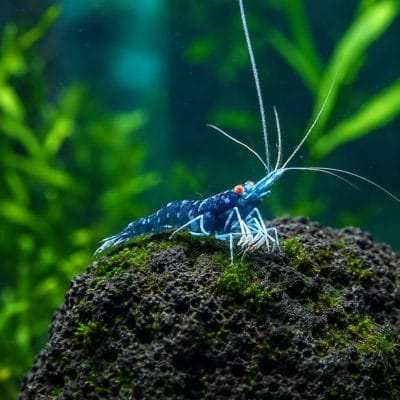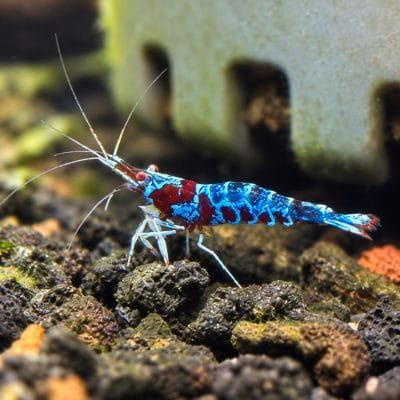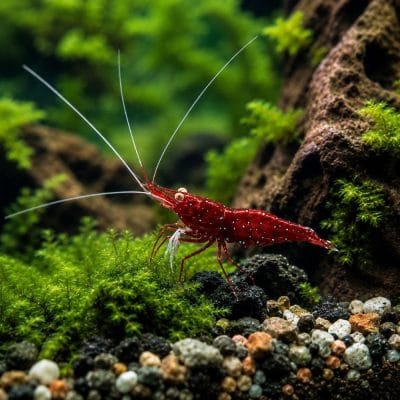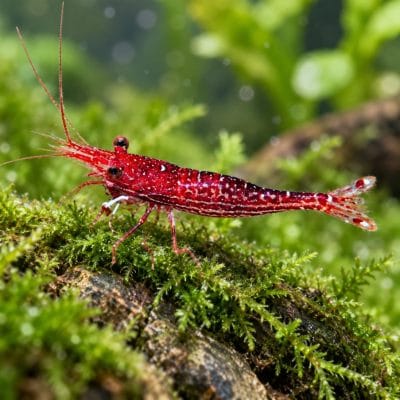
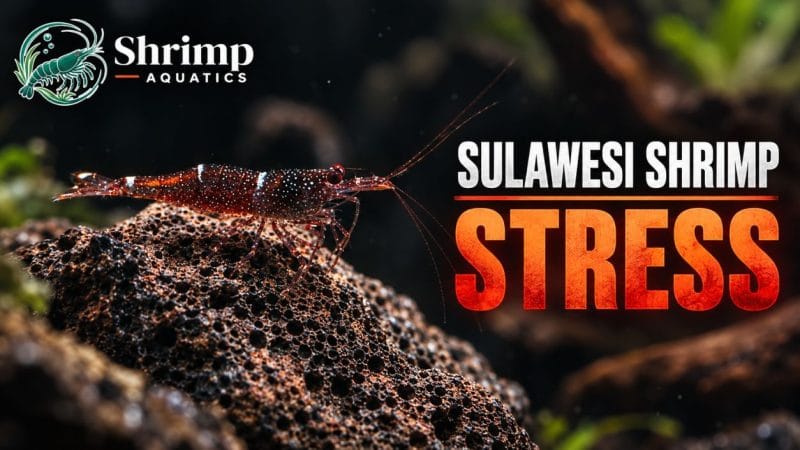
If your Sulawesi shrimp have stopped grazing, gone pale, or started darting around the glass, the tank is almost certainly telling you something about the water rather than about a disease. These are lake animals kept in a narrow band of warm, mildly alkaline water, and that water is less forgiving of ordinary mistakes than a cherry shrimp tank is. So the useful question isn’t what to dose. It’s what changed, what you can measure right now, and how slowly you can put it back.
What a stressed Sulawesi shrimp actually looks like
So how do you tell a stressed Sulawesi shrimp from one that’s simply being a Sulawesi shrimp? Start with grazing. The shrimp in a settled colony work across rock and glass more or less continuously, they scatter when you walk past, and they’re back on the same patch a minute later. That rhythm is the signal worth watching, because it stops before anything visible goes wrong with the animal. When grazing stops and doesn’t restart, something in the tank has changed.
Normal for the species
Shy for the first week or two after arrival. Hiding in the rock during bright light. A quick dash to shelter when you approach, then back out. Sitting still for a day or so before a molt. A cast shell on the substrate, which you leave where it is.
Worth acting on today
Grazing has stopped across the colony. Sulawesi shrimp stay on the bottom motionless or cling to one spot for hours. The whole tank is off the rock and moving at once. Animals have gone pale and stayed pale. A shrimp is trapped part way out of its shell.
One burst of activity on its own isn’t a fault. In shrimps generally, mating happens at the female’s premating molt, and in species that search rather than guard, recognition and mating happen within seconds or a few minutes before the pair separate; the short window of attractiveness is what keeps her from being harassed, which can injure or even kill her.1 So count the swimmers before you assume the worst: Sulawesi shrimp swimming erratically in ones and twos around one female is a mating response, while a whole colony leaving the rock at the same moment is not.
Color needs the same care. If your shrimp have gone pale but are still clear through the tail, Sulawesi shrimp losing color is usually reversible once the water is steady again. Milky, opaque tail muscle is a different thing entirely and it’s urgent. In farmed freshwater prawns, lethargy with opaque abdominal muscle and degenerating telson and uropods is the picture of white tail disease, caused by two viruses and reported to kill up to 100 per cent of affected animals within four days.2 That’s another species in another system, so it is not a diagnosis for your tank. It’s the reason milky muscle should never be filed under ordinary fading.
A chalky white gap at the joint behind the head belongs to neither list. That’s a molt question, and a Sulawesi shrimp failed molt has to be judged on its own terms.
Why Sulawesi shrimp have so little room for error
The water these shrimp are kept in is warm and mildly alkaline: 79-86°F (26-30°C) at pH 7.5-8.5. Nothing about that is exotic on its own. What it does is raise the price of every ordinary mistake, and that is the part most keepers arrive without knowing.
Ammonia gets nastier as pH and temperature climb
Total ammonia in water is split between ammonium, which is comparatively harmless, and un-ionized ammonia, which is the form that does the damage. The split is not fixed. In fresh water the ratio of un-ionized ammonia to ammonium rises about tenfold for each rise of a single pH unit, and roughly twofold for each rise of ten degrees Celsius across the range from freezing to thirty degrees; at high external concentrations the un-ionized form reduces or reverses the diffusion gradient, so ammonia builds up in the animal’s tissues and blood.3 Those figures were derived for freshwater aquatic life as a whole, not for Caridina, so nobody can hand you a safe number for your shrimp.
What they give you is direction, and the direction is unkind. The same faint test-kit reading you might shrug at in a cool, acidic bee shrimp tank sits at a far higher un-ionized fraction in yours. That’s why the honest instruction here is blunter than it is elsewhere: any ammonia or nitrite reading above zero is something to act on the same day.
Warm water holds less oxygen just when everything needs more
Cold water can hold more dissolved oxygen than warm water.4 Keep a tank at the upper end of the band and you have lowered the ceiling on dissolved oxygen while the shrimp, the filter bacteria and everything breaking down in the substrate are all respiring harder. No test kit puts that in front of you. It just means aeration is not optional in this tank, and it matters more during a hot week than at any other time.
| Temperature | 79-86°F (26-30°C) |
|---|---|
| pH | 7.5-8.5 |
| GH | 4-8 dGH |
| KH | 3-6 dKH |
| TDS | 150-250 ppm |
| Nitrate | under 10 ppm as a cautious ceiling for a stocked tank |
| Ammonia and nitrite | 0, from an established biological filter |
Pick one point inside each band and hold it. On Sulawesi shrimp care parameters the steadiness of your numbers does more for the colony than the numbers themselves ever will.
Test the water before you change anything in a Sulawesi tank
The temptation when a colony looks wrong is to do a water change immediately. Don’t. A water change destroys the evidence, and if the water change is what caused the problem you will have doubled it. Take the readings first, in this order.
- Ammonia and nitrite, on a liquid test rather than a strip. This is the reading that decides whether you have hours or weeks.
- Temperature, measured in the tank with a thermometer you trust, not read off the heater dial.
- TDS, compared against whatever you recorded last time. The trend matters more than today’s figure.
- KH, then pH. KH is what holds the pH up, so a falling KH explains a falling pH rather than the other way around.
- Everything that entered the tank in the past two weeks: rock, wood, a plant, a new heater, a treatment, a top-off, a hand.
Write the numbers down before you touch anything
Readings taken after a water change tell you about the new water, not about what hurt your shrimp. If you end up asking anyone for help, the figures from before the change are the only ones worth having.
Five things that most often stress a Sulawesi colony
Almost every case comes back to one of these. Four of the five are things the keeper did on purpose, with good intentions, which is what makes them hard to spot. Which one is it in your tank?
Topping off with anything except pure RO water
Water evaporates. The minerals in it don’t: evaporation concentrates the dissolved solids left behind in what remains.5 Replace that lost volume with remineralized water and you are adding a second helping of minerals to a tank that kept the first one. Do it every week for a few months and the TDS climbs steadily, which is exactly the slow, invisible drift that shows up later as a colony that molts badly and won’t breed. Top off with pure RO water only, and do it little and often.
A mineral batch that never finished
Which Sulawesi salt you use changes how you have to work. The 7.5 formulation dissolves in seconds. The 8.5 formulation will not simply stir in: the manufacturer’s own instructions say it dissolves almost totally over about 3-4 days with CO2 running at a regular rate of roughly one bubble a second, and that the water must then be aerated with an air stone for at least three hours afterwards to expel the CO2 before use.6 Cut that aeration short and you are pouring carbonic acid into an alkaline tank, which is a chemistry problem you created in a bucket.
Hardness is not just a line on a test sheet either. The major source of the calcium a crustacean uses to calcify its exoskeleton is exogenous, meaning the water it lives in, with diet and stored reserves contributing less.7 A tank running low on minerals is a tank whose shrimp are building their next shell out of not very much. Mix outside the tank, test the finished batch for pH, GH and TDS, and never adjust minerals in the tank itself with animals in it.
Copper, and anything else new that went in
Elevated copper is toxic in aquatic environments and may adversely affect invertebrates; acute effects include mortality, chronic exposure can reduce survival, reproduction and growth, and how toxic a given amount is depends on water characteristics including pH, alkalinity, dissolved organic carbon and hardness.8 In juvenile giant freshwater prawns, seven days at concentrations from 0.01 to 0.4 mg/L produced swollen and fused gill lamellae, abnormal gill tips and necrosis, along with damage to the hepatopancreas.9 That is a different animal under laboratory conditions, so it sets no threshold for your aquarium. It’s a reason to be uncompromising about what goes near it: no fish medication, no algaecide, no plant fertilizer or snail treatment whose ingredients you can’t name, and no rock or decoration arriving straight from an unknown tank.
Temperature that drifts, or a heater set hopefully high
Warmer is not a shortcut to faster growth. In the lesser blue crab, animals reared at elevated temperature showed both a shorter interval between molts and less growth gained at each molt, ending up smaller at each stage, and the authors note that if that pattern held through the pubertal molt, elevated temperatures would mean a smaller size at maturity.10 Combine that with less available oxygen at the top of the band and running hot starts to look like what it is. Set one point and defend it. An undersized heater running flat out, or a controller with a wide swing, will move your tank further in a day than you would ever move it deliberately.
Food still sitting on the rock
Biofilm and algae do most of the feeding in a mature Sulawesi tank, so prepared food is occasional. The usual rule is to lift anything uneaten within a few minutes. Warm water breaks food down quickly, and what it breaks down into is the first thing on the list you just tested for.
How to correct a stressed Sulawesi tank without causing a second shock
Here is where good keepers lose colonies. You find the drift, you finally understand it, and you want it gone tonight. We know the feeling. But how fast should you actually move? Slower than you want to. A shrimp that has been sitting at a high TDS in a Sulawesi tank for six weeks isn’t rescued by being put back on the right figure in an hour. It’s being asked for a second adjustment on top of the first, while already weakened. The drift did the damage slowly, so undo it slowly.
- Mix replacement water outside the tank and match it to what’s in the tank now, not to where you want to end up.
- Move the tank toward the band over days, in small changes.
- Change one thing at a time, so you can tell which change did what.
- Don’t dose anything whose active ingredient you can’t name, and don’t add a second product to fix the first.
- Don’t raise the temperature to make a tank recover faster.
Oxygen is the one thing you can add quickly without much risk, as long as you add air and not current. A stressed colony pushed around the tank by a filter outlet is not resting.
At Shrimp Aquatics, our Sulawesi systems use biological filtration together with a Kaldnes moving-bed filter. The combination gives us strong aeration and active biological media, but we tune the outlet so our Sulawesi shrimp are not pushed around while grazing. The goal is high oxygen with gentle movement at shrimp level.
When a Sulawesi colony needs more than a water correction
Sometimes the water tests clean, the readings have been steady for weeks, and shrimp are still dying. At that point more testing and more changes stop helping. Stop adjusting, keep a dated record of readings and losses, and look at the animals themselves: pitted or eroding shell, visible growths around the head and antennae, or deaths with no reading out of place are all outside what a water correction fixes. Pitted shells or head growths are a different problem, covered under common health problems in Sulawesi shrimp.
We won’t pretend an article can diagnose that. Nobody can identify a shrimp disease from a description, and there’s no dose we’d give you for an animal we haven’t seen. A qualified aquatic veterinarian or a local invertebrate specialist is the right next step when losses continue and the water is genuinely clean.
If you’d rather have a second pair of eyes on the water first, we’d rather you asked than guessed. Email contact@shrimpaquatics.com with your pH, GH, KH, TDS and temperature, your tank size, how long it has been running, what’s in it and what changed recently, and we’ll tell you honestly what we would check next.
References
10 Sources
- Mating Behavior and Strategies, research page by Raymond T. Bauer, University of Louisiana at Lafayette.
- White Tail Disease of Freshwater Prawn, Macrobrachium rosenbergii (abstract), Indian Journal of Virology 23(2): 134-140, 2012.
- Aquatic Life Ambient Water Quality Criteria for Ammonia, Freshwater, U.S. Environmental Protection Agency, Office of Water, April 2013.
- Dissolved Oxygen and Water, U.S. Geological Survey Water Science School, updated August 24, 2026.
- Chloride, Salinity, and Dissolved Solids, U.S. Geological Survey Water Resources Mission Area, March 1, 2019.
- Sulawesi Mineral 8,5, Minerals and trace elements, SaltyShrimp, manufacturer product information.
- Biomineralizations: insights and prospects from crustaceans, ZooKeys 176: 103-121, 2012.
- Supplementary Training Materials for Aquatic Life Criteria, Copper, Background, U.S. Environmental Protection Agency, updated May 6, 2026.
- Impact of waterborne copper on the structure of gills and hepatopancreas and its impact on the content of metallothionein in juvenile giant freshwater prawn Macrobrachium rosenbergii (abstract), Archives of Environmental Contamination and Toxicology 52(1): 73-79, 2007.
- Elevated temperature induces a decrease in intermolt period and growth per molt in the lesser blue crab Callinectes similis (abstract), Journal of Crustacean Biology 39(1), January 2019.
Ready to get started?
Shop our Sulawesi Shrimp collection
27 products available · Live Arrival Guarantee
Featured Sulawesi Shrimp
Sulawesi Orange Eyes White Sock
Caridina dennerli
Advanced · 79–86°F · pH 7.5–8.5
From $19.99View ProductSulawesi Red Line Blue Dot
Caridina sp. "Red Line Blue Dot"
Advanced · 79–86°F · pH 7.5–8.5
From $15.99View Product