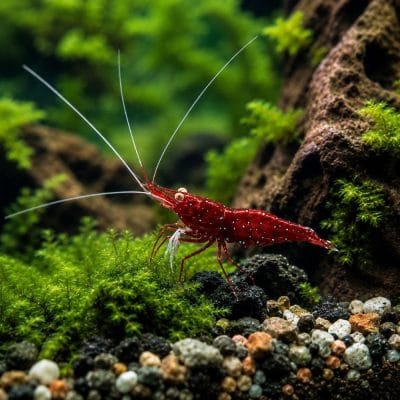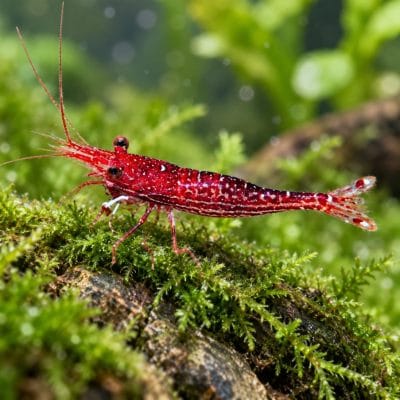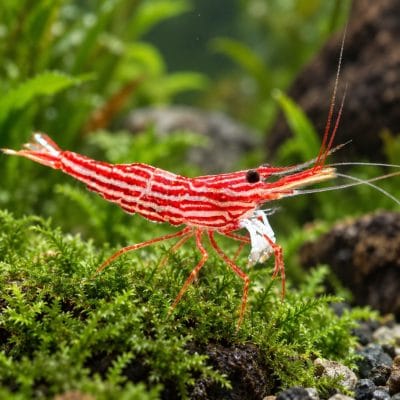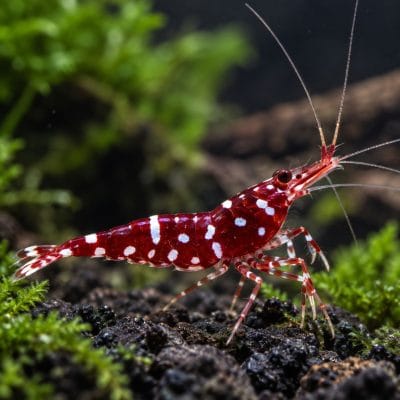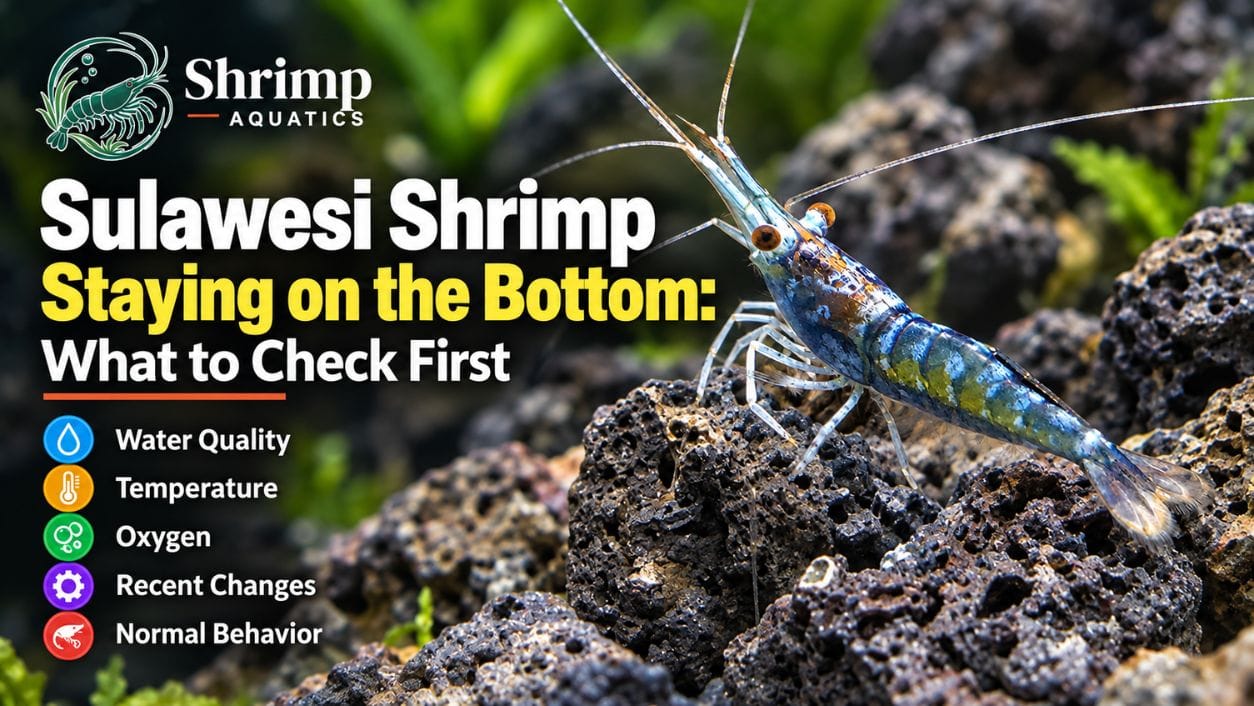
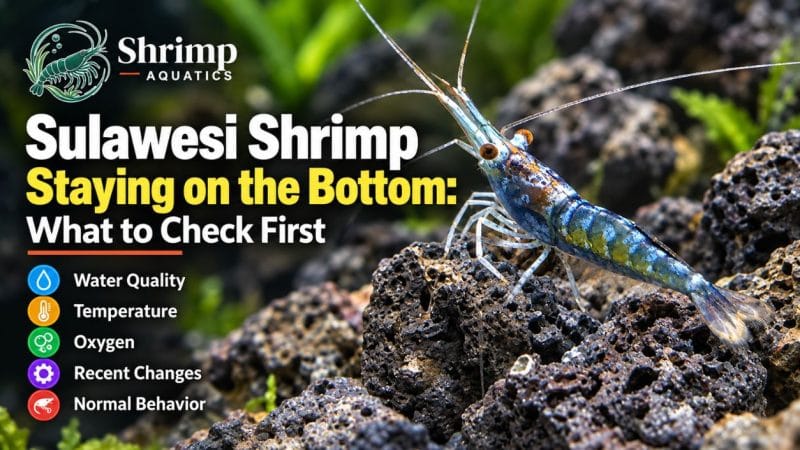
A Sulawesi shrimp sitting on the bottom is only fine if something on it is still moving. Grazing shrimp work their mouthparts constantly, sweep their antennae and fan their swimmerets, even when they haven’t crossed the rock in ten minutes. A shrimp that is genuinely motionless, legs tucked or splayed, antennae flat, is telling you the water changed. Check temperature, ammonia and oxygen first, in that order, and don’t fix anything until you have a reading.
How to tell a grazing Sulawesi shrimp from one that has stopped moving
Sit level with the glass and watch one animal for a full minute. You’re not looking for travel. Sulawesi shrimp will park on one patch of rock and work it, so a shrimp that hasn’t moved its body an inch may be perfectly busy. You’re looking for three smaller movements: the mouthparts scraping in a fast, almost mechanical rhythm, the antennae flicking and sweeping the water, and the swimmerets under the abdomen beating steadily.
All three running, and the animal is busy. All three stopped, or slowed to an occasional twitch, and the safe move is to treat it as a tank problem until your readings say otherwise. That’s the line we’d use at Shrimp Aquatics. It matters because both states look identical in a photograph, which is why asking the internet to judge a picture rarely helps.
Normal for this group
Parked on rock or sand with mouthparts working. Antennae sweeping. Swimmerets beating. Startles and backs away when your hand crosses the tank. Sits still and pale for a few hours after a molt, then returns to grazing.
Worth acting on today
Flat on the substrate with legs pulled under or splayed out. Antennae still. No swimmeret beat. No startle response when you tap the glass or move the light. Several animals in the same posture at the same time.
A colony that has gone out of sight is not the same problem as a colony sitting in the open doing nothing, and Sulawesi shrimp hiding is where that one starts. This page is about the shrimp you can see, doing nothing.
Whether one Sulawesi shrimp is down or the whole colony decides where you start
How many animals are actually affected? Count them before you touch anything. It’s the cheapest piece of diagnosis you’ll do all day, and it splits the problem cleanly.
One shrimp on the floor while the rest graze normally is almost never a water fault. Water reaches every animal in the tank at once. A single shrimp is far more likely to be mid-molt, freshly molted and soft, old, or injured. That branch is further down this page.
Several animals down at once, or a colony that went quiet over a few hours, points at something that reached all of them together. Temperature, dissolved gases, ammonia, or whatever you last added to the tank. Work the water first and leave the individual animals alone while you do it.
Test your Sulawesi tank before you change anything, because warm alkaline water makes the same ammonia reading worse
Take readings before you do a water change. We know you want to pour in fresh water and be done. But a change made now destroys the evidence and adds a second insult on top of the first, and ten minutes with a test kit costs you nothing.
Test in this order
Temperature, ammonia, nitrite, pH, KH, TDS. Temperature first because a failed heater is the fastest thing to confirm and the fastest to correct, and ammonia second because it is the one that turns lethal quietly in this kind of tank.
- Temperature, with a thermometer you trust. Not the dial on the heater. A stuck heater or a cold snap can take the tank out of the range we keep to without changing a single chemical reading, so this is the one you rule out first.
- Ammonia and nitrite. Any reading above zero on either is your answer, and in this tank a small number isn’t a small problem.
- pH and KH. These tell you whether the buffer that holds the tank up is still there, or whether it has been quietly falling.
- TDS. Compare it against what you last recorded, not against a target. The direction of travel is the useful part.
Why 0.25 ppm of ammonia is not the same number in a Sulawesi tank
Total ammonia in water sits in two forms, the ammonium ion and un-ionized ammonia, and the un-ionized form is the one that drives toxicity in aquatic animals. Which way the balance tips depends on pH and temperature. The ratio of un-ionized ammonia to ammonium rises about tenfold for every single pH unit, and roughly twofold for every 10 degrees Celsius of warming across the range these tanks sit in.1 Put those two together and a Sulawesi tank at pH 7.5-8.5 and 79-86°F (26-30°C) is holding a far larger share of its total as toxic ammonia than a soft, cool bee tank showing the identical test result.
That’s the honest reason these shrimp have a reputation for sudden collapses. Nothing exotic happens. The same waste a cherry tank absorbs becomes a real dose here. A colony that lies down together after a heavy feed, or after something died behind the rock, is usually reacting to exactly that.
How low oxygen in a warm tank shows up as shrimp that stop moving
Cold water can hold more dissolved oxygen than warm water, so oxygen falls as temperature rises.2 A tank kept at the top of 79-86°F (26-30°C) is already working with less headroom than a room-temperature tank, and anything that adds demand, a bloom, a warm night, a filter that slowed down, eats into what’s left. Does less oxygen actually mean a quieter shrimp? In farmed Pacific white shrimp monitored acoustically in production ponds, the shrimp-associated sound tracked dissolved oxygen in the same direction as it rose and fell.3 Those are marine penaeids in a pond, not lake Caridina in your tank, so read it as the direction of travel rather than a measurement of your colony.
So look at the surface. A still, oily film over the top is worth breaking up before you touch anything else in the tank. Adding air is safer than adding flow, and how much surface renewal a warm tank actually needs is covered in Sulawesi shrimp oxygen requirements.
| Difficulty | Advanced to expert |
|---|---|
| Temperature | 79-86°F (26-30°C) |
| pH | 7.5-8.5 |
| GH | 4-8 dGH |
| KH | 3-6 dKH |
| TDS | 150-250 ppm |
| Nitrate | Under 10 ppm as a working target |
| Substrate | Inert substrate and hardscape, never an active pH lowering soil |
Treat a reading outside those figures as a lead, not a verdict. A tank that has sat a little under the bottom of that pH band for a year is a different animal from one that dropped half a point last Tuesday. It’s the movement that puts shrimp on the floor, not the number by itself.
When your Sulawesi water tests clean, look at what changed in the last week
A clean set of readings isn’t an all clear. It means whatever hit the colony has already passed through the water, or it never showed up on a hobby test kit at all. So what did you do to this tank in the last seven days? Write down everything you added, replaced, cleaned or adjusted.
A mineral batch that was not finished before it went in
This is the one that catches careful keepers, because they did the work and still got it wrong. The two common Sulawesi salts behave completely differently. Sulawesi Mineral 7.5 almost totally dissolves within seconds and the water is ready for use immediately.4 Sulawesi Mineral 8.5 does not. Its maker says it will almost totally dissolve if CO2 is added over roughly 3-4 days at about one bubble per second, and that you then have to aerate the water with an air stone for at least three hours to expel the CO2 before you use it.5
Skip either half of that and you’re pouring in water still loaded with carbon dioxide and still carrying undissolved salt, which is exactly the state the maker tells you to clear before use. If the colony came down within an hour or two of new water going in, start with the batch and not with the tank. If you switched salts, changed brands or mixed in a hurry, start there too. Your replacement water gets mixed, dissolved, degassed and tested outside the tank, which is exactly what remineralizing RO water for Sulawesi shrimp is for.
Topping off with the wrong water, a little at a time
Evaporation concentrates dissolved solids in the water left behind.6 Water leaves as vapor, minerals don’t, so the tank climbs. Top off with your remineralized mix instead of plain RO and you’re adding a second load of minerals on top of the ones that never left. That’s how a tank creeps upward over a couple of months with nobody doing anything wrong on any single day. Shrimp handle the drift until a molt, and then they don’t.
Something that came in on your hands or in a bottle
Copper is worth naming because it turns up in plant fertilizers, snail treatments, fish medications and old plumbing. Elevated copper is toxic in aquatic environments and can adversely affect invertebrates, and how much harm a given amount does depends on water characteristics including pH, alkalinity, dissolved organic carbon and hardness.7 Did a whole colony go down within hours of a treatment, a new decoration, a fertilizer dose or a hand with soap or lotion on it? That timing is your evidence. No test kit is going to confirm it for you.
Why is one Sulawesi shrimp lying on its side while the rest graze?
Start with the molt, because it explains most single-animal cases. All crustaceans have to regularly cast the exoskeleton in order to grow, and mating only takes place between hard-shelled males and ripe females that have just completed the pre-mating molt and are therefore soft-shelled.8 A shrimp that’s just come out of her shell is soft, pale and slow. Lying still in a crevice is exactly what she should be doing. Leave her alone. Don’t net her, don’t move her, and don’t feed the tank heavily to cheer her up.
Look on the substrate for the cast shell. An intact empty shell nearby is the best news on this page. If instead the old shell has split at the neck and the shrimp cannot push free of it, you are looking at a failed molt rather than a tank fault, and pulling at it by hand is not a rescue.
Molt trouble sends you back to the water anyway, because the major source of calcium for crustacean exoskeleton calcification is exogenous, meaning the water the animal lives in.9 Stored reserves and food contribute less. So a colony whose GH and KH have been sliding is a colony that’ll start failing molts, and the first sign is often one shrimp stuck half out of a shell rather than a tank-wide event.
One more thing to check before you assume a molt. Look at the tail muscle against the light. Faded color is common and usually reversible. A chalky, opaque white block of muscle running through the abdomen is not the same thing: in the farmed freshwater prawn Macrobrachium rosenbergii, lethargy together with opaqueness of the abdominal muscle is a recorded clinical sign of white tail disease, with mortality reaching up to 100 per cent within four days.10 That is a different species under culture conditions and it is not a diagnosis of your shrimp. We mention it because opaque muscle plus a motionless animal is the combination that should move you from troubleshooting to isolating the animal and asking for qualified help.
One honest limitation, stated plainly. No study we could find measures lethargy, posture or recovery in any Sulawesi lake Caridina. Everything above is mechanism drawn from wider crustacean and water chemistry work, applied to the conditions these shrimp are kept in. That’s enough to tell you what to test. It isn’t enough to tell you what one shrimp’s odds are.
Correct a Sulawesi tank slowly, because the correction is what usually kills the colony
You have a reading and a probable cause. Now do less than you want to.
- Get air into the water first. An air stone or a raised outlet costs nothing, helps in almost every scenario on this page, and cannot shock anything.
- Stop feeding prepared food until the animals are grazing again. A mature tank already carries grazing surfaces they can use, and uneaten food here costs you more than it gives.
- Lift anything uneaten, and anything dead, before you do anything else. In water this warm, a body behind the rock is an ammonia source with a clock on it.
- Bring Sulawesi tank temperature back inside 79-86°F (26-30°C) gradually, and let the heater do it instead of adding hot water.
- Don’t do a large water change to reset the tank. A big unmatched change is a second shock landing on animals that have not absorbed the first.
- Don’t dose anything at a colony you have not diagnosed. Medications, buffers and pH adjusters are how a recoverable tank becomes a finished one.
- Don’t chase a number back to the middle of a range. Steady beats correct, every time, in this group.
If a water change really is justified, keep it small. Mix and test the replacement outside the tank, match temperature closely, and add it slowly over an hour or more rather than in one pour. The usual rule is to let the tank arrive at its old numbers over days, not to hit them this afternoon.
When a motionless Sulawesi colony needs qualified help, not another water change
Most keepers stay in the loop too long, testing and adjusting while the colony thins out. Stop and get a second opinion when you see any of these. Opaque white muscle in more than one animal. Deaths that continue for more than a few days after the water has read clean and stable. A colony that won’t resume grazing once temperature, ammonia and oxygen are all where they should be. The other warning signs of a failing colony are listed in common health problems in Sulawesi shrimp.
At that point the useful next step is a qualified aquatic veterinarian or an experienced local specialist who can look at the animals, not another round of test strips. Bring your numbers, including the ones from before you corrected anything. That record is worth more than any photograph.
References
10 Sources
- Aquatic Life Ambient Water Quality Criteria for Ammonia, Freshwater, U.S. Environmental Protection Agency, Office of Water, April 2013.
- Dissolved Oxygen and Water, U.S. Geological Survey, Water Science School, page updated August 24, 2026.
- Linking Dissolved Oxygen Fluctuations to Acoustic Activity in the Litopenaeus vannamei Under Operational Pond Conditions, Journal of Marine Science and Engineering 14, article 682, 2026.
- Sulawesi Mineral 7,5, Minerals and trace elements, SaltyShrimp, manufacturer product information page.
- Sulawesi Mineral 8,5, Minerals and trace elements, SaltyShrimp, manufacturer product information page.
- Chloride, Salinity, and Dissolved Solids, U.S. Geological Survey, Water Resources Mission Area, March 1, 2019.
- Supplementary Training Materials for Aquatic Life Criteria, Copper, Background, U.S. Environmental Protection Agency, Office of Water, page updated May 6, 2026.
- Farming freshwater prawns, biology chapter, Food and Agriculture Organization of the United Nations, FAO Fisheries Technical Paper 428.
- Biomineralizations: insights and prospects from crustaceans, Gilles Luquet, ZooKeys 176, 2012.
- White Tail Disease of Freshwater Prawn, Macrobrachium rosenbergii, abstract, Indian Journal of Virology 23, 2012.

Ready to get started?
Shop our Freshwater Shrimp collection
8 products available · Live Arrival Guarantee
Featured Sulawesi Shrimp
Sulawesi Orange Eyes White Sock
Caridina dennerli
Advanced · 79–86°F · pH 7.5–8.5
From $19.99View ProductSulawesi Red Line Blue Dot
Caridina sp. "Red Line Blue Dot"
Advanced · 79–86°F · pH 7.5–8.5
From $15.99View Product