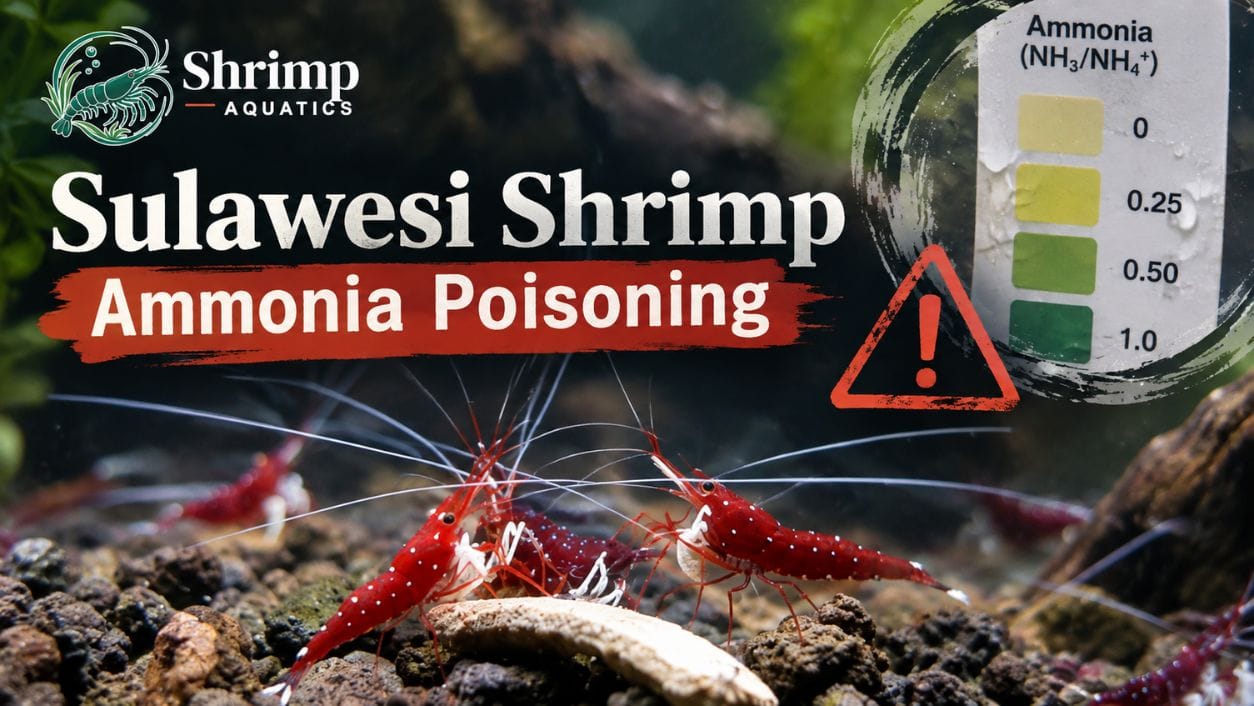
Ammonia poisoning punishes a Sulawesi tank harder than most. The warm alkaline water these shrimp need keeps far more of any ammonia in its toxic un-ionized form, so a number your kit can barely show is already a real dose. Test ammonia together with pH and temperature. Then stop whatever is feeding the tank, and correct the water slowly.
Test three things before you decide your Sulawesi shrimp have ammonia poisoning
Ammonia is not something you diagnose from the animals. You measure it. And you measure two other things in the same ten minutes, because on its own the ammonia number means very little here.
- Total ammonia, with a liquid reagent kit rather than a strip.
- pH, from the same water sample, at the same time of day.
- Temperature, read off a thermometer in the tank and not off the heater dial.
Write all three down together. A reading of 0.25 ppm means one thing in a cool Crystal Red tank at pH 6.5 and something very different at pH 8.2 in yours, and the next section is where that difference gets uncomfortable. If you can, test for Sulawesi shrimp nitrite poisoning in the same session too, because a tank producing ammonia is usually a tank whose filter is behind.
Erratic swimming and fading color point at several faults, not just ammonia
The signs keepers describe in an ammonia event are real, but none of them belongs to ammonia alone. Shrimp that dart around the glass and then go still, stop grazing, lose grip on the rock or turn pale are telling you something is wrong, not what. A mating response looks like the first of those. A mineral swing looks like the last. So is it the animals telling you, or the water? Sulawesi shrimp swimming erratically is worth separating from a water fault before you change anything. We’d rather you spent ten minutes on test kits than an hour reading behavior.
One sign that changes the urgency
A shrimp whose tail muscle has turned opaque and milky is not a color problem. That animal is past the point where a water correction helps it. Treat it as a signal to check the whole colony and the water immediately.
What a 0.25 ppm ammonia reading means at pH 8.0 in a Sulawesi tank
Total ammonia in water sits in two forms: the ammonium ion, which barely crosses a membrane, and un-ionized ammonia, which does and which is the form that drives toxicity. The split is set by pH and temperature. The ratio of un-ionized ammonia to ammonium rises about tenfold for every single pH unit. It also rises roughly twofold for each 10 degrees Celsius of warming between 0 and 30 degrees Celsius.1 Your kit doesn’t separate the two forms. It reports the total, and you have to do the rest.
| pH | At 79°F (26°C) | At 86°F (30°C) |
|---|---|---|
| 7.5 | 1.9% | 2.5% |
| 8.0 | 5.7% | 7.4% |
| 8.5 | 16% | 20% |
Now put your reading through it. At pH 8.0 and 86°F, that 0.25 ppm total ammonia is about 0.019 ppm of the un-ionized form. In a Crystal Red tank at 72°F (22°C) and pH 6.5, the same 0.25 ppm leaves about 0.0004 ppm. Same number on the card, roughly fifty times the dose. Push the Sulawesi tank to pH 8.5 and the gap widens again.
This is the part we’d most like you to take away, because it changes what counts as a bad reading. A faint yellow-green tinge on an ammonia card is often waved off in a cherry shrimp tank. In water held at pH 7.5-8.5 and 79-86°F (26-30°C), the same tinge is a working dose of the toxic form. And nobody can tell you where the line sits, because no study has published an ammonia tolerance figure for any Sulawesi lake Caridina. So the target is zero. Anything else is a fault to find rather than a level to live with.
Why warm alkaline water also stops a Sulawesi shrimp clearing its own ammonia
There’s a second half to this, and it explains why the animals go downhill faster than the number suggests. A shrimp gets rid of its own nitrogen waste as ammonia, across the gill, and that only works while there is less ammonia outside the animal than inside it. High external un-ionized ammonia reduces or reverses that diffusive gradient, and ammonia builds up in internal tissues and blood instead of leaving.1
The gill isn’t a passive membrane either. In crustaceans it handles ion regulation, acid-base balance and ammonia excretion at once. Ammonia leaves partly by diffusion and partly through active transport, including Rh channel proteins and the sodium pump. That export machinery can also be knocked out. Long exposure to elevated ambient ammonia caused a complete loss of the gill’s capacity to actively excrete it, along with reduced expression of the transporters that do the work.2 That research is on crustacean gills generally, not on Sulawesi Caridina, so read it as a mechanism and not as a timetable.
The practical consequence is simple. Getting the water back to zero doesn’t instantly reset the animal, and a colony that looks flat for days after a corrected reading is not necessarily failing again.
What to do in the first hour of a Sulawesi ammonia spike
Do the cheap, reversible things first. Every one of these can be done in the next few minutes and none of them can hurt.
- Stop feeding completely, including powders and biofilm boosters. Nothing goes in until the reading is back at zero.
- Siphon out anything visible: uneaten food, a dead shrimp, a dead snail, a collapsing leaf. One dead animal in a warm tank is enough to move the number.
- Increase surface movement gently so gas exchange improves. Warm water holds less dissolved oxygen than cold water does.3 A shrimp already struggling to move ammonia across its gills has none to spare.
- Check that the filter is actually running and that the intake isn’t blocked. A stalled sponge is the most common reason a stable tank suddenly reads.
- Dim the lights and leave the colony alone. Netting, rearranging hardscape and chasing individuals all add stress you don’t need.
- Retest in two to three hours. You want to know whether the number is climbing, holding or falling before you decide anything larger.
At Shrimp Aquatics, our Sulawesi systems use biological filtration together with a Kaldnes moving-bed filter, and we tune the outlet so the shrimp are not pushed around while grazing. The goal is high oxygen with gentle movement at shrimp level.
That’s the balance to aim for when you add aeration in an emergency. Turn the air up at the surface, not into the rockwork, so the colony can keep grazing while gas exchange improves.
How to bring ammonia down without shocking the colony a second time
Here’s where most colonies are actually lost. The instinct is a big water change, and in a soft-water cherry tank it’s often the right call. Not here. Sulawesi replacement water has to match on temperature, pH and mineral load, and a large volume of nearly-right water delivers a swing on top of an animal already in trouble.
- A 50% change with fresh mix that hasn’t been finished and matched.
- Adding buffer or mineral salt straight into the tank to “fix” a number.
- Dosing an ammonia binder blind and treating the next zero reading as proof the tank is fine.
- Adding a fish medication, an algaecide or anything copper-bearing while the colony is stressed.
What we’d do instead is smaller and slower. Prepare the replacement water outside the tank and finish it there. Bring it to the same temperature and pH as the display before any of it goes in, because mixing Sulawesi replacement water works the same way in an emergency as it does on a quiet Sunday. Then change 10% to 15%, delivered slowly, and retest. Repeat later in the day if the reading is still up. Dilution is the safe lever. Speed is not.
If you use a conditioner that binds ammonia
Follow the manufacturer’s own instructions for that product and dose only what the label supports. Binding is a holding measure while the filter catches up. Most kits will still show the ammonia that has been bound, so keep testing. Don’t assume the problem has gone.
Find what produced the ammonia before you call the tank fixed
A reading back at zero is not the end of it. Something made the ammonia, and if you don’t know what, you’ll meet it again. Work down this list in the order the causes actually turn up.
- Feeding. Food still sitting on the rock an hour later is the commonest cause. Overfeeding a Sulawesi tank costs more than the same habit does in a cool tank.
- A death you missed. Shrimp and snails decay quickly at these temperatures, and a rabbit snail hidden under rock can drive a reading on its own.
- Filter capacity. A cleaned, replaced or restarted filter, a power cut, or a sponge rinsed in tap water will all knock the bacteria back.
- Tank maturity. A tank that cycled but never grew a real grazing surface has very little reserve. Knowing how to mature a Sulawesi shrimp tank is what prevents the next spike.
- Stocking. A colony that has grown, or a batch of new Sulawesi shrimp added on top of an existing one, asks more of the same filter.
What if the tests keep coming back clean? If ammonia and nitrite both read zero on repeat tests and shrimp are still dying, ammonia is not your answer, and you should stop correcting for it. Slow losses in a steady, well-tested tank point somewhere else. Mineral drift, tank maturity and infection are the usual candidates, and each needs its own investigation rather than another water change. When shrimp are dying faster than you can test, or you’re being asked to medicate, ask a qualified aquatic vet or an experienced Sulawesi keeper to look at the whole system with you. If the reading is zero, work through the other causes in common health problems in Sulawesi shrimp.
References
3 Sources
- Aquatic Life Ambient Water Quality Criteria for Ammonia, Freshwater 2013, U.S. Environmental Protection Agency, Office of Water, April 2013.
- Multiple functions of the crustacean gill: osmotic/ionic regulation, acid-base balance, ammonia excretion, and bioaccumulation of toxic metals, Henry, Lucu, Onken and Weihrauch, Frontiers in Physiology, 2012.
- Dissolved Oxygen and Water, U.S. Geological Survey, Water Science School, updated August 24, 2026.
Ready to get started?
Shop our Sulawesi Shrimp collection
27 products available · Live Arrival Guarantee
Featured Sulawesi Shrimp
Sulawesi Red Line Blue Dot
Caridina sp. "Red Line Blue Dot"
Advanced · 79–86°F · pH 7.5–8.5
From $15.99View ProductSulawesi Orange Eyes Yellow Ghost
Caridina dennerli
Advanced · 79–86°F · pH 7.5–8.5
$120.00View Product