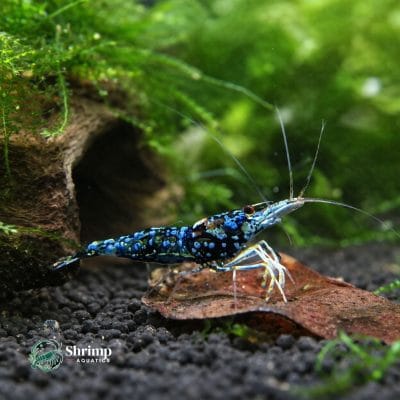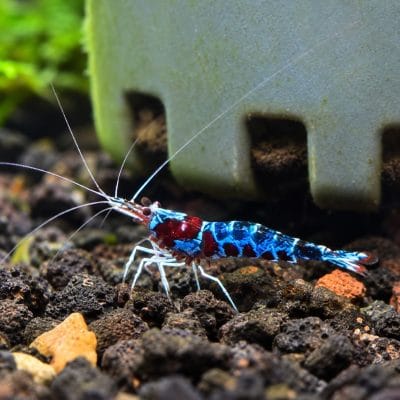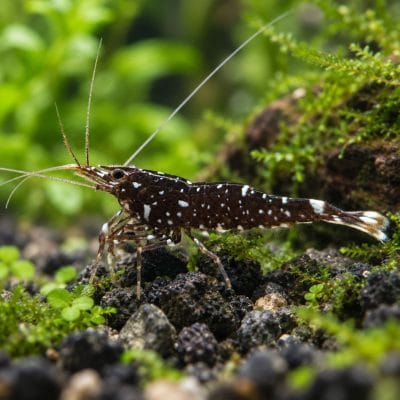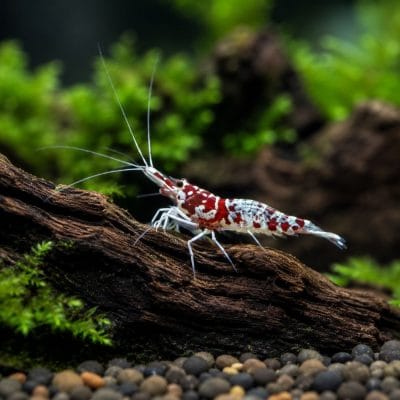
If food is still sitting on the rock an hour after you dropped it in, you’re feeding a Sulawesi tank more than it can use. Leftovers matter more here than in a Neocaridina or Bee tank. The warm, alkaline water these shrimp need turns a given ammonia reading into a much larger share of the toxic, un-ionized form. It also holds less oxygen at the moment the bacteria breaking that food down start demanding more. The fix is almost always to take the food out and stop feeding for a while, not to replace half the water.
How to tell whether your Sulawesi tank is overfed
Overfeeding rarely announces itself as a single event. It shows up as food that outlasts the meal, then as changes in the water, and only afterwards as changes in the shrimp. Work through what you can see and measure before you decide what’s happening.
- Food still on the rock, the substrate or in the dish an hour after you put it in.
- A haze in the water column that mechanical filtration doesn’t clear.
- A film or foam at the surface that reappears after you break it up.
- Ammonia or nitrite reading above zero on a liquid test kit, or nitrate sitting higher than your own usual figure for this tank.
- More small organisms than usual moving in the substrate and on the glass, which is worth reading alongside your test results.
- A single dead shrimp with normal water tests and a normally grazing colony isn’t by itself evidence of overfeeding.
Behavior belongs on this list as a prompt, not as a verdict. You already know what your colony normally does across a day. Shrimp that were working the rock and are now sitting still or crowded under shelter are a reason to test the water. They aren’t an answer about what the test will show. Start with the non-invasive checks. Test ammonia and nitrite and temperature, and note anything that changed in the last week. Read TDS, pH and hardness against your own records, and check how much surface movement the tank actually has.
Why the same leftover food is more dangerous in a warm, alkaline Sulawesi tank
Uneaten food is organic matter, and organic matter in water is bacterial food. Aerobic bacteria metabolize it and consume oxygen in the process, and the oxygen consumed is generally proportional to how much organic matter is present.1 Where the load is heavy enough, bacteria may consume oxygen faster than it can be replenished, leaving little or no dissolved oxygen for fish and invertebrates.1 The nitrogen in that food doesn’t disappear either. In a water body, nitrate is formed through the oxidation of other nitrogen forms including nitrite, ammonia and organic nitrogen compounds such as amino acids.2 So the protein in a wafer moves through the same sequence your test kit reads.
None of that’s unique to Sulawesi shrimp. What’s different is the water they’re kept in. These are the typical group reference values this page depends on.
| Temperature | 79-86°F (26-30°C) |
|---|---|
| pH | 7.5-8.5 |
| Nitrate | Aim for under 10 ppm; that is a target, not a tolerance limit |
The same ammonia reading means more at pH 7.5-8.5
Total ammonia in water is the sum of the ammonium ion and un-ionized ammonia, and the un-ionized form is the one that drives toxicity. The ratio of un-ionized ammonia to ammonium ion in fresh water increases roughly tenfold for each rise of a single pH unit. It rises roughly twofold for each 10 degrees Celsius rise in temperature from 0 to 30 degrees Celsius.3 A Bee or Crystal tank runs at pH 5.8-6.8, about two pH units below the Sulawesi range, and several degrees cooler. Applying those two relationships to that gap gives an un-ionized share on the order of a hundred times higher in the Sulawesi tank from pH alone. The temperature difference doubles it again. That’s a calculation derived from the published relationship, not a measured aquarium figure, but the direction and the scale aren’t in doubt.
The practical consequence is that a total ammonia reading you’d shrug at in a cool, acidic tank isn’t the same event here. It also explains why the damage is internal rather than cosmetic. High external un-ionized ammonia concentrations reduce or reverse diffusive gradients and cause ammonia to build up in internal tissues and blood.3 This is why the reading matters even when the shrimp still look normal.
Warm water holds less oxygen than the decomposing food is about to demand
The second half of the problem runs the other way. Cold water can hold more dissolved oxygen than warm water.4 So a tank held at 79-86°F (26-30°C) starts with less oxygen in reserve than a room-temperature shrimp tank. The bacteria working through the leftover food are drawing on that smaller reserve. A warm tank and a fresh organic load pull on the same supply from both ends. That’s why aeration is the first thing to add when something has gone wrong, and the last thing to assume is already sufficient.
What to do first when a Sulawesi tank has been overfed
The order matters more than the speed. Almost every way this goes badly involves a keeper reacting to a fouled tank with a change large enough to be its own emergency.
- Siphon out the food you can see. Use a narrow rigid tube and target the visible deposits rather than vacuuming through the substrate bed, which releases what has been sitting under it.
- Stop feeding. In an established tank with mature grazing surfaces the colony keeps eating while the system catches up, so there’s no cost to waiting.
- Add gentle extra aeration or surface movement. You’re raising oxygen and gas exchange, not creating current.
- Test ammonia, nitrite and nitrate, and write the numbers down. Repeat the same tests at the same time each day so you can see a direction.
- Only then consider water. Keep any replacement small relative to the tank, match its temperature, pH, GH and TDS to the tank before it goes in, and add it slowly.
At Shrimp Aquatics our Sulawesi systems use biological filtration together with a Kaldnes moving-bed filter, and we tune the outlet so the shrimp aren’t pushed around while grazing. The goal is high oxygen with gentle movement at shrimp level. That’s the shape to aim for when you add aeration during a problem. More gas exchange at the surface, not more flow through the rockwork where the colony is trying to feed.
Don’t chase the chemistry
Lowering pH does shift ammonia toward the less toxic ammonium, but forcing a sudden pH change downward is its own shock in a system held at pH 7.5-8.5. Trading one stressor for another rarely ends well. This guide gives no dose for any ammonia-binding conditioner or bacterial product, because invertebrate safety depends on the exact formulation, the concentration and your water chemistry. Where shrimp are already dying, a qualified aquatic veterinarian or an experienced local specialist is the right place for a dosing decision.
Why a large water change is the wrong reflex in a Sulawesi tank
In most freshwater tanks, a big water change is the fastest way to dilute a problem. In a Sulawesi tank it swaps a chemical stressor for a physical one. These shrimp are kept inside a narrow, deliberately stable mineral and pH window. A large volume of replacement water that’s even slightly off on temperature, pH or dissolved solids moves every one of those numbers at once. A smaller, carefully matched exchange leaves the colony fewer things to absorb. If you aren’t sure how much your tank can take, the safer answer is less water and more of it removed by siphon and by not feeding.
How often a Sulawesi colony actually needs prepared food
In a mature Sulawesi tank, the grazing surface is the food supply. Biofilm, aufwuchs and algae growing on inert rock and glass are what the colony works on all day, and prepared food only sits on top of that. That’s the whole reason a portion sized by habit and not by what actually gets eaten tends to sit here instead of disappearing. The grazing surfaces are the real food supply, which is why what Sulawesi shrimp eat starts with the rock, not the jar.
At Shrimp Aquatics, mature algae and biofilm do most of the feeding in our Sulawesi systems. We normally offer prepared food only about once a week and remove leftovers. Many of the shrimp in these systems show limited interest in it, and food that sits in warm water adds organic waste.
Shrimp that come out of systems run that way may ignore prepared food for a while after they arrive. So a new group of tank-bred Sulawesi shrimp leaving a wafer alone isn’t by itself a sign that something is wrong. Treat it as information, and don’t answer it with a bigger portion. The workable rule is to offer an amount the colony clears within about an hour, take out whatever is left, and let what actually gets eaten set the next portion. How often you need to feed Sulawesi shrimp at all depends on how many shrimp you have and how mature the grazing surface is. A young tank with a thin biofilm and a small colony may need nothing at all for a long time.
What a controlled Caridina dennerli feeding trial actually measured
Prepared food isn’t automatically the villain, and it’s worth being precise about that. In a 2025 rearing trial, Caridina dennerli starting at an average total length of 1.445 cm and weight of 0.022 g were kept in four combinations of feed and shelter. Over 30 days the commercial pellet groups gained 0.119 cm with Hydrilla shelter and 0.079 cm with stone, at survival of 72.727% and 40.909%. Over 37 days the bacterial starter groups gained 0.017 cm and 0.013 cm, at survival of 22.727% and 31.818%.5 Those figures describe one controlled setup that compared feed and shelter types, not feeding rates. They aren’t an expected result for a home tank or for shipped stock. What they do show is that withholding prepared food entirely isn’t obviously the cautious choice. The danger in a Sulawesi tank is food that isn’t eaten, not food that’s offered.
When your Sulawesi shrimp keep dying after the food is gone
If the leftovers are out, ammonia and nitrite read zero, and losses continue, feeding wasn’t the story. Continuing to treat it as a feeding problem costs you the time you need for the real one. Go back through the checks that don’t disturb the tank. Is the heater holding temperature, rather than just set to it? What changed in the week before the deaths? Read TDS, pH and hardness against your own logged figures, and check oxygenation and surface movement. Ask whether anything entered the room or the tank that could contaminate it, and watch how the colony as a whole is behaving, not just how one animal looks.
A care article can’t diagnose a dying colony, and nothing here is a substitute for someone looking at your actual tank. Where losses continue or the picture is unclear, a qualified aquatic veterinarian or an experienced local specialist is the right next step. You’re also welcome to email contact@shrimpaquatics.com with your pH, GH, KH, TDS, temperature, tank size, cycle status and current livestock. We’ll tell you what we’d check next.
References
5 Sources
- Biochemical Oxygen Demand (BOD) and Water, U.S. Geological Survey Water Science School, updated September 2, 2026.
- Nitrogen and Water, U.S. Geological Survey Water Science School, updated September 2, 2026.
- Aquatic Life Ambient Water Quality Criteria for Ammonia, Freshwater, U.S. Environmental Protection Agency, Office of Water, April 2013.
- Dissolved Oxygen and Water, U.S. Geological Survey Water Science School, updated August 24, 2026.
- Effect of Using Different Shelter and Feed Types on Growth and Survival Rate of Sulawesi Endemic Ornamental Shrimps (Caridina dennerli), Jurnal Ilmiah PLATAX 13(1): 191-204, 2025.
Ready to get started?
Shop our Sulawesi Shrimp collection
27 products available · Live Arrival Guarantee