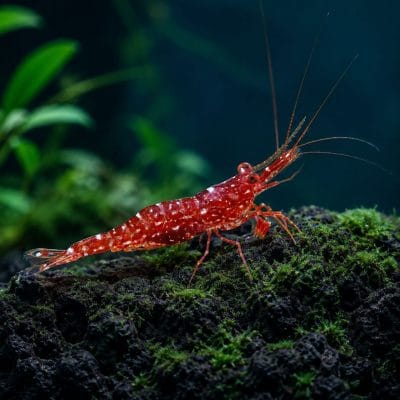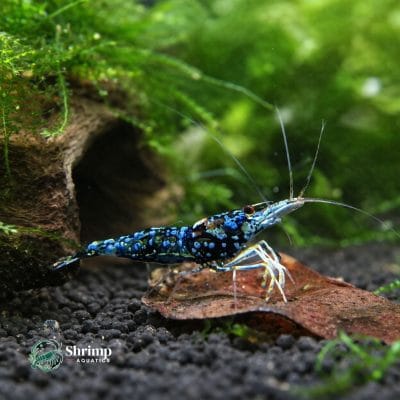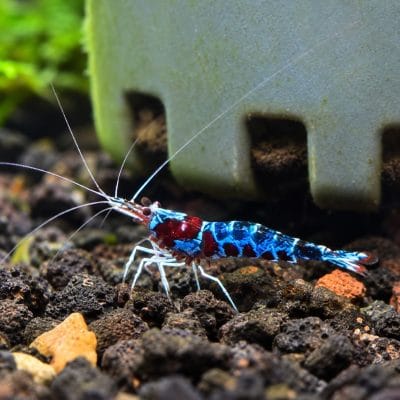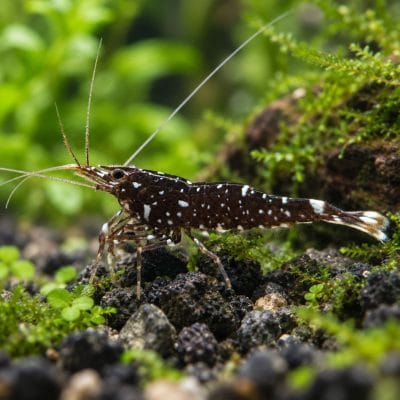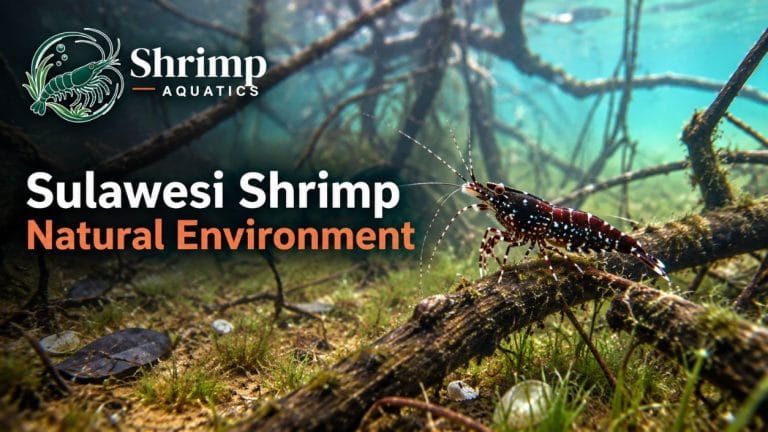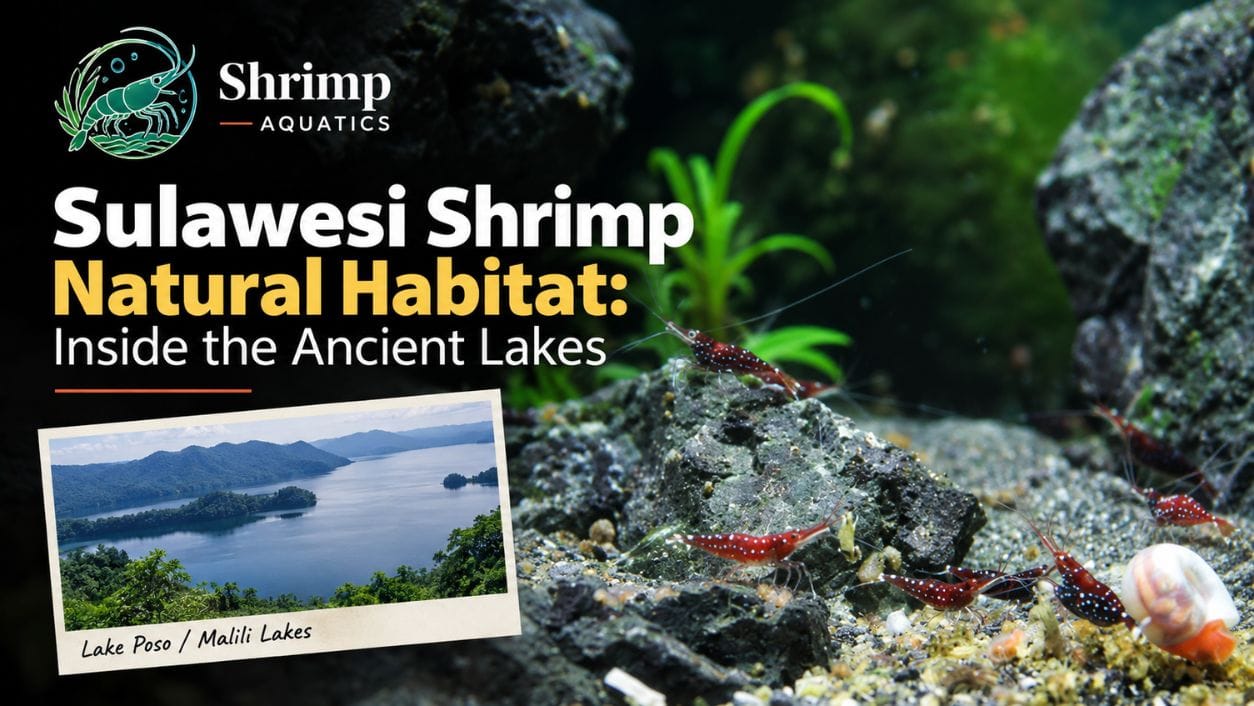
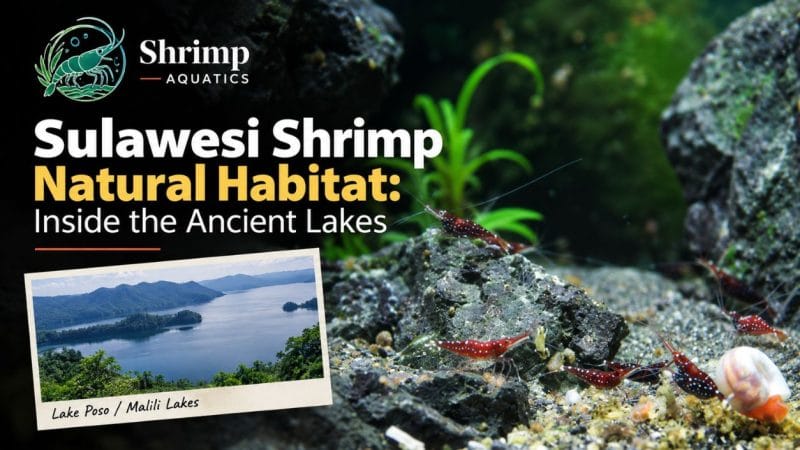
Sulawesi shrimp come from two ancient lake systems on one Indonesian island, Lake Poso and the Malili lakes. The water there is warm and carries very little dissolved mineral, yet it still sits on the alkaline side of neutral. The food is a thin film of algae and bacteria growing on rock, wood and fallen leaves. Nothing in it changes quickly, and that last part is what your tank has to copy.
Why these lakes stay alkaline on almost no hardness
The Malili system is a chain of five tectonic lakes, and Lake Towuti is the largest of them. It covers 560 km2 and reaches a maximum depth of 203 m. It sits in ophiolitic rock, surrounded by lateritic soils. Its water is weakly conductive at 210 µS/cm, it’s close to neutral, and its chemistry is dominated by magnesium and bicarbonate. Thermal stratification is weak, and below 130 m the lake is usually oxygen depleted. Primary production is expected to be limited, because iron oxides bind phosphorus and take it out of the water.1
That magnesium and bicarbonate detail is the one worth carrying home. Most fresh water gets both its hardness and its buffering from calcium carbonate, so soft normally means unbuffered and acidic. Here it doesn’t. The dissolved load stays low while there’s still carbonate in the water holding the pH up. That’s why a Sulawesi tank is built from pure water plus a mineral that brings carbonate with it, and not from hard tap water.
| Surface area | 560 km2 |
|---|---|
| Maximum depth | 203 m |
| Setting | Tectonic lake seated in ophiolitic rock, surrounded by lateritic soils |
| Conductivity | 210 µS/cm |
| Dominant chemistry | Magnesium and bicarbonate |
| Oxygen | Usually depleted below 130 m |
Lake Poso is a different basin. It’s an ancient lake system in its own right, and it carries an endemic flock of Caridina that isn’t shared with the Malili lakes at all. Eleven lacustrine Lake Poso shrimp species are now described, including one adapted to living in freshwater snail shells.2 It reads differently too. A 2021 survey of the Poso watershed found alkaline water in every zone it sampled, carrying 7.13 to 7.93 mg/L of dissolved oxygen, and classed the watershed as mesotrophic. Those figures pool river, lake and estuary stations and don’t describe the lake alone.3
So how much of this belongs in your aquarium? Almost none of it. You hold your own water at 79-86°F (26-30°C), pH 7.5-8.5, GH 4-8 dGH, KH 3-6 dKH and TDS 150-250 ppm, steady rather than accurate to a lake. The lake by lake numbers sit on where Sulawesi shrimp come from.
A Sulawesi shrimp can only use the top few meters of the lake
Look again at that oxygen figure. Most of a lake this deep is dead water as far as a shrimp is concerned. The habitat you’re actually interested in is a narrow rim around the edge.
The shrimp sit far shallower than the oxygen alone would allow. The cardinal shrimp, Caridina dennerli, was recorded from shallow water down to about 10 m, on and under small rocks and between boulders. Caridina profundicola was usually found between large boulders below 3 m.4 That’s a well lit, wave washed strip of stone, not a deep still basin.
If you’re choosing a tank for these shrimp, we’d take floor area over height every time. Depth buys you nothing the animal uses. It also makes the warm layer near the bottom harder to keep moving.
Which surfaces Sulawesi shrimp graze on in the wild
Species in these lakes divide up the bottom rather than the open water. Caridina dennerli and Caridina glaubrechti are hard substrate dwellers on rocks. C. glaubrechti sits mainly on smaller rocks in the shallows, and also on boulders in deeper water. Caridina holthuisi is a soft substrate dweller, found mainly under dead leaves and only sporadically on macrophytes.4 Ask which lake a species comes from and you have half the answer. Ask what it sits on and you have the rest.
The sponge dwellers of the Towuti outlet bay
Caridina spongicola takes the idea further than any of them. It lives on and in an undescribed freshwater sponge, restricted to part of the outlet bay of Lake Towuti at a depth of 3 to 5 m. One dissected sponge held 137 shrimp, and the mean across the fifteen examined was 28.73. The shrimp appear to use the sponge’s cavities as shelter and the diatoms collecting in it as food. Every other species in that Towuti group lives on rock.5
What you can copy from all this is the surface, not the species. Rock that does nothing to your water is the floor these animals evolved on, which is why inert substrate for a Sulawesi tank is the one part of the setup we wouldn’t improvise.
How little food an ancient lake actually offers
These aren’t rich lakes. Phosphorus is locked up by iron in Towuti and the Poso watershed only rates as mesotrophic, so there isn’t much growing in either, and what does grow, grows slowly. That’s the setting these shrimp adapted to, and it shows in how they feed.
The food is the film. Rock dwellers scrape it off stone and leaf litter dwellers work through the debris, while the sponge shrimp lives on diatoms that collect in its host.5 None of that arrives in a tank on stocking day. The grazing surface has to be grown first, and a settled colony then needs far less prepared food than most keepers offer. There’s more on that in how Sulawesi shrimp eat algae and biofilm in an aquarium.
Don’t feed a young tank like a lake
Warm, alkaline water punishes leftovers harder than cool water does, and a young system has no film to fall back on. If your rock is still bare, the answer is time and light, not another portion.
The habitat is disappearing, and that decides where your shrimp comes from
The cardinal shrimp was assessed for the IUCN Red List on 20 August 2018 as Critically Endangered under criterion A2e, carrying the Possibly Extinct in the Wild tag. Its population is decreasing, with a continuing decline in the area, extent and quality of its habitat. The threats listed against it are fishing and harvesting of aquatic resources, dams and water management, invasive non-native species, and industrial and agricultural effluent. The same assessment records that the species is traded internationally as a pet.6
Read that list again and you’ll notice it’s a habitat problem before it’s a shrimp problem. Silt, effluent and altered water levels all land on the same shallow rim the animal can’t leave. Several other lake species carry listings of their own, and endangered Sulawesi shrimp sets out where each one stands.
For a buyer the conclusion is short. At Shrimp Aquatics every line is tank-bred, so the animals in our Sulawesi shrimp tanks are generations away from Lake Matano. Ask any seller which lake a species comes from, and whether the stock was bred in captivity. If the answer is vague, buy somewhere else.
References
6 Sources
- Geomicrobiological Features of Ferruginous Sediments from Lake Towuti, Indonesia, Vuillemin A. and colleagues, Frontiers in Microbiology 7: 1007, 2016.
- Lake Poso’s shrimp fauna revisited: the description of five new species of the genus Caridina more than doubles the number of endemic lacustrine species (abstract), Klotz W., von Rintelen T., Wowor D., Lukhaup C. and von Rintelen K., ZooKeys 1009: 81-122, 2021.
- Trophic Status of Waters in Poso Watershed, Central Sulawesi (abstract), IOP Conference Series: Earth and Environmental Science 950, 012039, 2022.
- Radiation of endemic species flocks in ancient lakes: systematic revision of the freshwater shrimp Caridina from the ancient lakes of Sulawesi, Indonesia, von Rintelen T. and Cai Y., Raffles Bulletin of Zoology 57(2): 343-452, 2009.
- Freshwater shrimp-sponge association from an ancient lake, von Rintelen K., von Rintelen T., Meixner M., Luter C., Cai Y. and Glaubrecht M., Biology Letters 3(3): 262-264, 2007.
- Caridina dennerli, The IUCN Red List of Threatened Species 2018: e.T198055A109683594, von Rintelen K., IUCN, assessed 20 August 2018.
Ready to get started?
Shop our Sulawesi Shrimp collection
27 products available · Live Arrival Guarantee