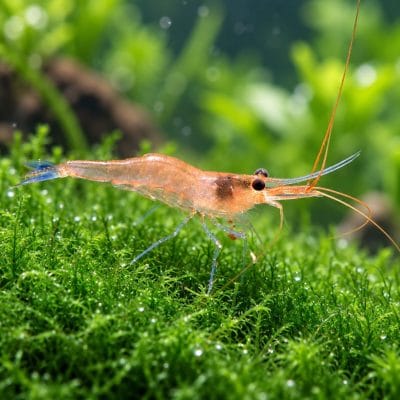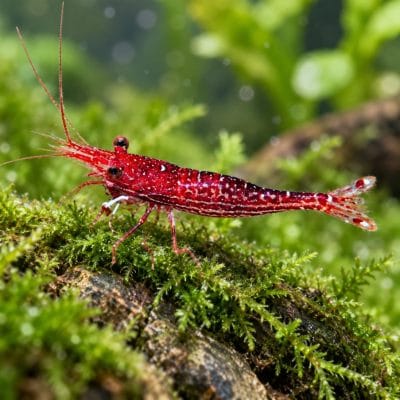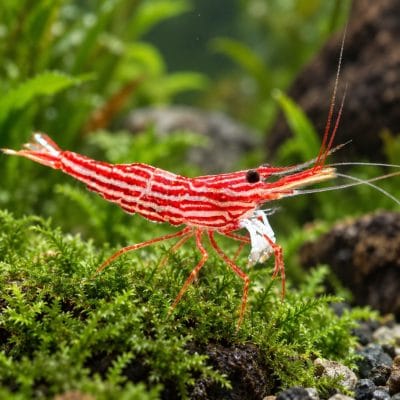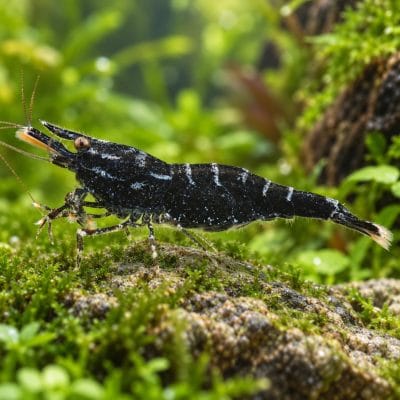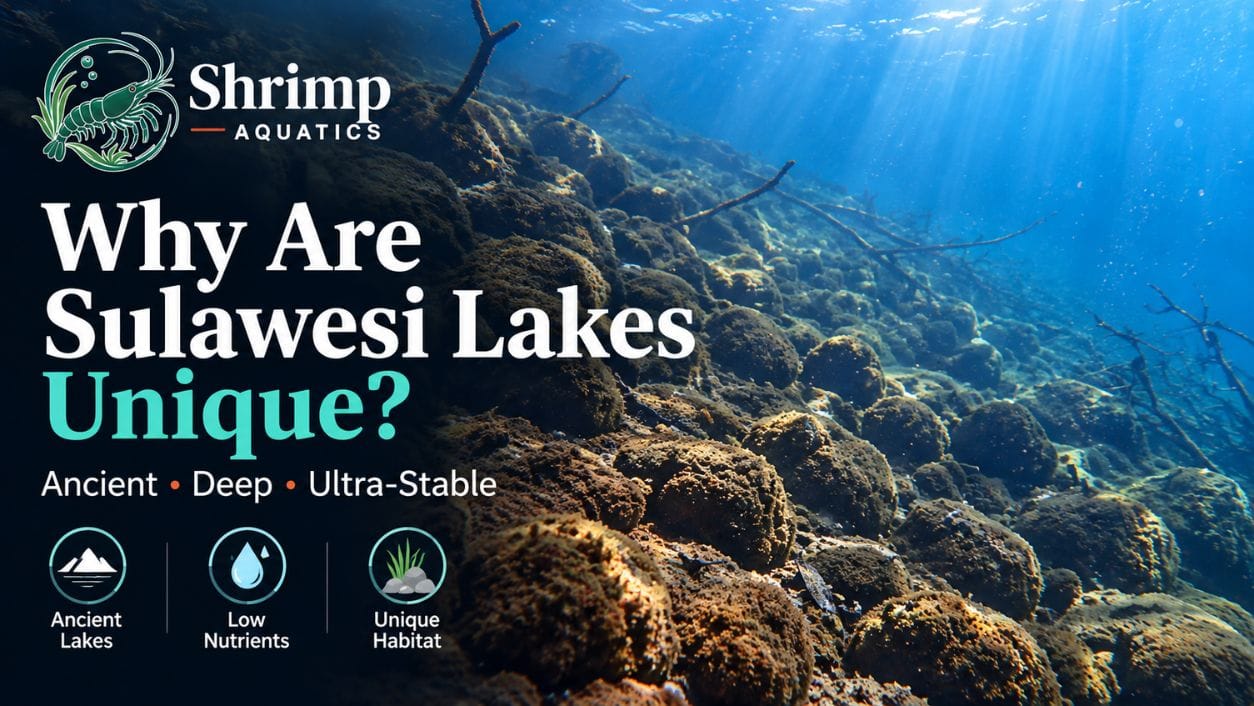
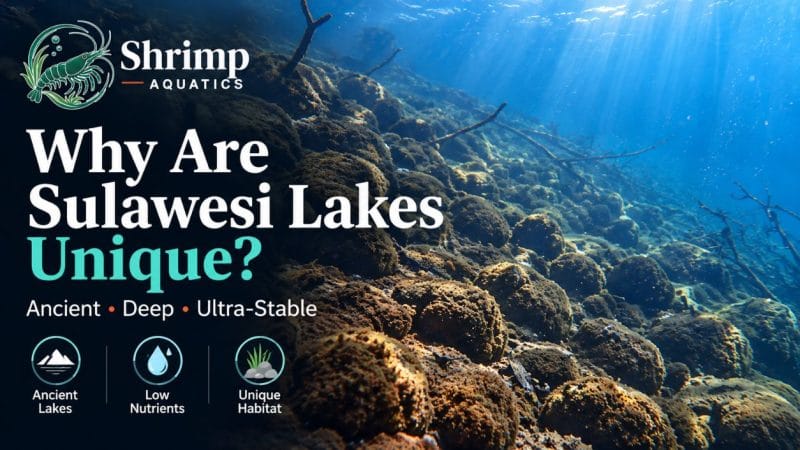
Sulawesi shrimp don’t come from a river or a pond. They come from two ancient lake systems on one Indonesian island, Lake Poso and the Malili chain.1 Those lakes have been cut off from everything else for over a million years. The water in them is warm, mildly alkaline and poor in nutrients, and it barely moves off those settings from one year to the next. That is what makes them unique, and it is also why these shrimp are so unforgiving. Nothing in their history ever asked them to survive a change.
How old are the Sulawesi lakes, and why does that age matter in your tank?
Old enough that the word barely helps. The Malili system is a chain of five tectonic lakes. They formed over roughly the past 1.5 million years, in small basins pulled apart along the Matano Fault. The catchment is the East Sulawesi Ophiolite, a slab of old ocean crust that ranks third largest in the world and sheds iron, chromium and other metals into the water. The same survey calls these lakes some of the least productive on Earth, and the home of endemic flocks of fish, snails, shrimp and crabs.2
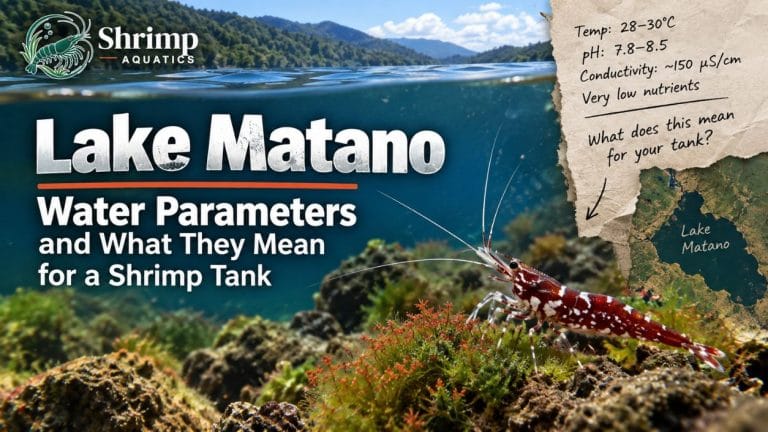
Lake Matano shows what that buys. It covers 164 km² and runs nearly 600 m deep, eighth deepest in the world. It is also permanently stratified. A pycnocline sits near 100 m, and oxygen is already undetectable at 120 m.3 A temperate lake turns over twice a year and resets itself. This one doesn’t, and hasn’t for a very long time.
Poso tells the same story at the surface. Water there was sampled across six zones of the watershed in March 2021 and came back warm and alkaline throughout.4 Warm, alkaline, steady. So the useful reading of all this age is a practical one. A lineage that has never met a cold snap, a flood or a nutrient pulse had no reason to evolve a tolerance for one. Stability is the thing you are actually reproducing. We’d rather see a tank held flat at one honest setting than nudged toward a better one. The Sulawesi shrimp care parameters and how to hold them steady have their own page. The numbers we keep to are below.
| Difficulty | Advanced to expert |
|---|---|
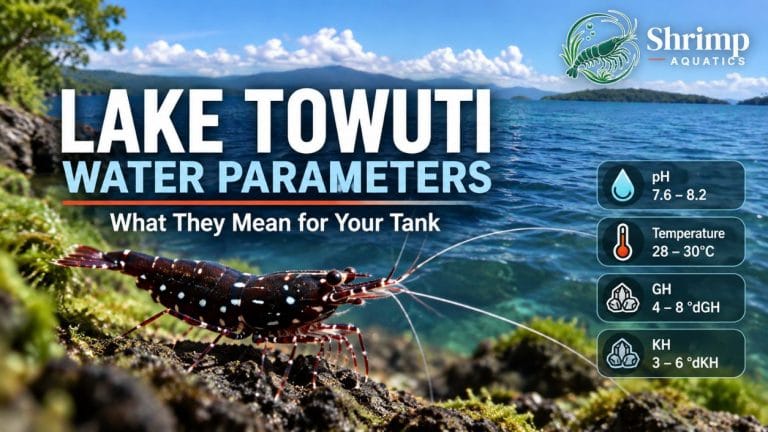
| Temperature | 79-86°F (26-30°C) |
| pH | 7.5-8.5 |
| GH | 4-8 dGH |
| KH | 3-6 dKH |
| TDS | 150-250 ppm |
| Nitrate | Under 10 ppm, a cautious ceiling rather than a tolerance limit |
| Substrate | Inert substrate and hardscape, never an active pH lowering soil |
Pick a point and stay there
Every value above is a band the group is kept in, not a route to travel across. Choosing 82°F and holding it beats drifting between the two ends. The same goes for pH and TDS. If a reading has moved, correct it over days.
Sulawesi lakes are close to empty of food, so the rock does the feeding
This is the part most care sheets get backwards. You’ll read that Sulawesi water is mineral rich. It isn’t, in any sense a shrimp can eat. Phosphorus limitation controls what grows in the sunlit layers of Lake Matano, the stratification there has held for centuries, and so little grows in that water that light still reaches the chemocline 100 m down.5 Clear water in a lake is not a feature. It’s a shortage.
So what does that leave the shrimp? A thin film. Biofilm and diatoms on clean rock, grazed all day, which is a slow constant way to eat. That habit comes into your tank with them, and it explains two things keepers learn the hard way. A young tank with bare glass and clean rock has nothing in it for them yet, however good the water tests. And prepared food is a supplement here, never a staple. Leftovers from overfeeding Sulawesi shrimp, sitting in warm alkaline water, are a waste problem, not a harmless extra. The detail on how Sulawesi shrimp eat algae and biofilm belongs on the feeding page. The usual rule is to lift whatever they haven’t finished within a few minutes.
Fifteen Sulawesi shrimp species evolved in one lake system, and almost none of them overlap
The Malili lakes hold a species flock of 15 colorful endemic atyid shrimp. Mitochondrial DNA points to two separate invasions from rivers. One radiated into 14 species, the other produced a single one, and most of those species turn out to be habitat specialists.6 Lake Poso ran its own version of the same experiment.
Two practical things follow. A trade name is not a species, and the lake behind a line tells you more than its color does. That is why where Sulawesi shrimp lines come from is worth checking before you order. The second is about expectations. A tank holding three or four lines is a collection, not a reconstruction of anything. Those animals evolved apart, on different surfaces, in different basins. That’s fine, we keep them that way too. Just give them the clean hard surfaces a scraper evolved to work over, and don’t expect a mixed tank to behave like one natural community.
What is damaging the Sulawesi lakes now, and what it should change about where you buy
Sulawesi lake ecosystems are not a stable curiosity any more. A 2022 survey of Lake Poso recorded 17 fish species clearly or most likely not native to it, and watched introduced golden cichlids chase endemic gobies, ricefishes and shrimps.7 A conservation review of the Malili lakes names invasive alien species as the principal threat to their endemic aquatic life, the hybrid flowerhorn cichlid above all, alongside nickel mining and the dams built for power.8
So what should a keeper do with that? Not much hand wringing. One clear buying decision. Ask where the animals were bred, not where the species is from. Those are different questions, and only one of them is about the tank in front of you. Check the species name on a listing, not the trade name, because assessments of wild populations are made species by species, and the IUCN status of endangered Sulawesi shrimp is set out that way. At Shrimp Aquatics every animal is bred by us rather than collected from the wild. Our tank-bred Sulawesi shrimp are raised in water held at the settings above, so what arrives has never known anything else. That is the honest advantage of captive stock. It doesn’t save a lake. It does mean the shrimp in the bag grew up in the conditions you’re being asked to reproduce.
References
8 Sources
- The species flocks of lacustrine gastropods: Tylomelania on Sulawesi as models in speciation and adaptive radiation (abstract), Hydrobiologia 615, Springer, 2008.
- The Towuti Drilling Project: paleoenvironments, biological evolution, and geomicrobiology of a tropical Pacific lake, Scientific Drilling 21, 2016.
- Biogeochemistry of manganese in ferruginous Lake Matano, Indonesia, Biogeosciences, 2011.
- Trophic Status of Waters in Poso Watershed, Central Sulawesi (abstract), IOP Conference Series: Earth and Environmental Science 950, 2022.
- Photoferrotrophy: Remains of an Ancient Photosynthesis in Modern Environments, Frontiers in Microbiology, 2017.
- Adaptive radiation and ecological diversification of Sulawesi’s ancient lake shrimps (abstract), Evolution 64(11), 2010.
- More non-native fish species than natives, and an invasion of Malawi cichlids, in ancient Lake Poso, Sulawesi, Indonesia, Aquatic Invasions 17(1), 2022.
- Wallace’s Dreamponds: Conserving Sulawesi’s Ancient Lakes, Shoal (Synchronicity Earth).
Ready to get started?
Shop our Sulawesi Shrimp collection
27 products available · Live Arrival Guarantee
Featured Sulawesi Shrimp
Sulawesi Red Line Blue Dot
Caridina sp. "Red Line Blue Dot"
Advanced · 79–86°F · pH 7.5–8.5
From $15.99View Product