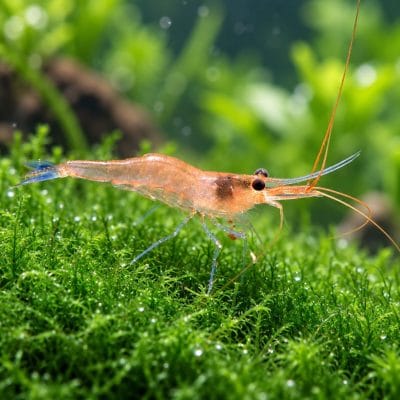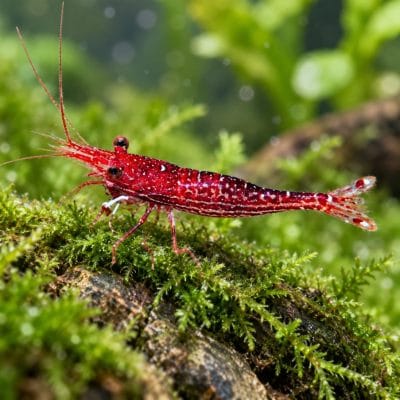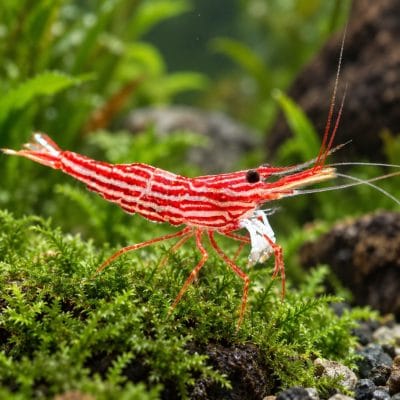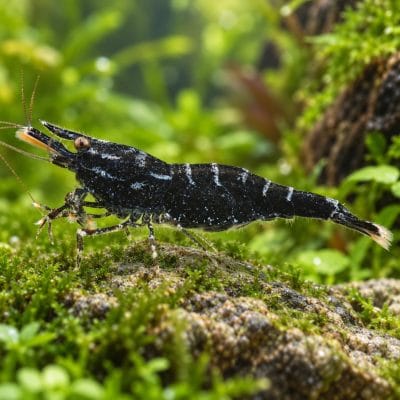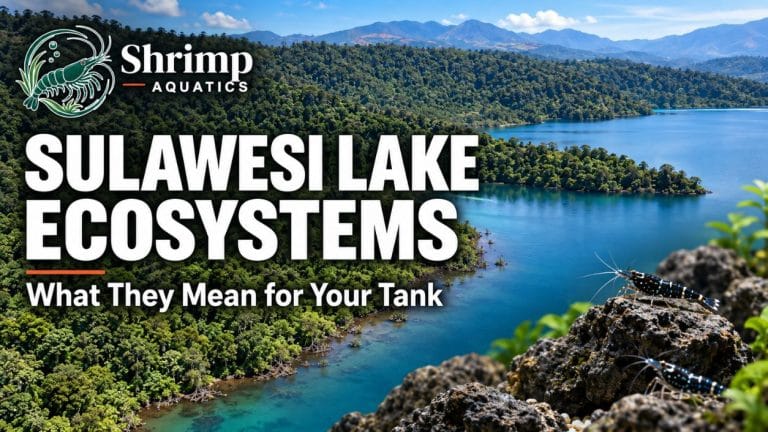
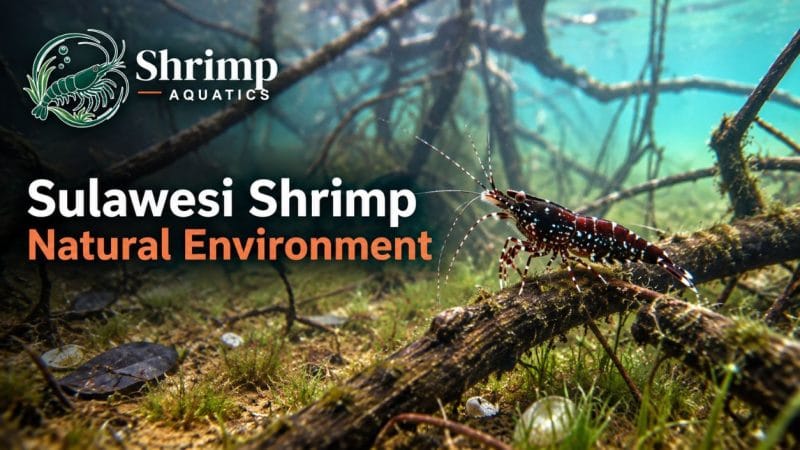
Sulawesi shrimp come from a handful of ancient lakes on one Indonesian island, and the part of those lakes they actually occupy is small: a sunlit band of rock, sand and sunken wood close to shore. The water there is warm all year, mildly alkaline, very low in dissolved minerals and very low in nutrients. That last point does most of the work in a home tank. It means almost everything these shrimp evolved to eat grows on stone.
Sulawesi lake water is warm, mildly alkaline and very dilute
Most alkaline freshwater is also mineral rich. These lakes break that assumption. They sit in catchments of ophiolitic rock and weathered lateritic soils, which deliver iron in quantity and almost no sulfate. The water ends up reading alkaline on a pH pen while carrying very little dissolved material. Here’s what the three lakes actually measure, study by study.
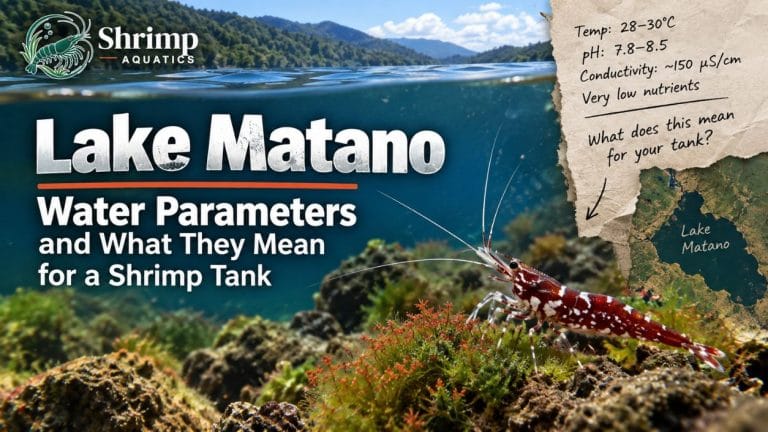
Lake Matano is the deepest. Its basin covers 164 km², it’s nearly 600 m deep, and it’s between one and four million years old. It’s permanently stratified by weak thermal and salinity gradients. Oxygen sits near atmospheric saturation at the surface and is undetectable at 120 m.1
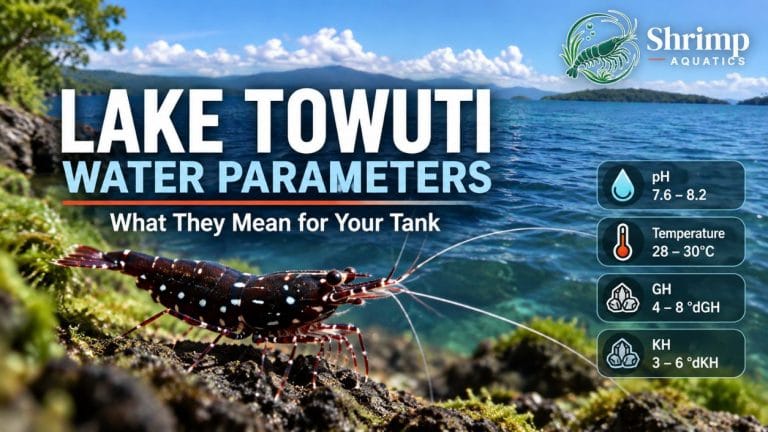
Lake Towuti is the largest at 560 km², and 203 m deep. It’s also the one lake with a full surface chemistry published. Surface water sits at 82 to 84°F (28 to 29°C). The lake is weakly conductive at about 210 microsiemens per centimeter and close to pH 7.8, and it’s usually oxygen depleted below 130 m. Its catchment delivers abundant iron oxyhydroxides and very little sulfate, and productivity is expected to be limited because those iron oxides scavenge phosphorus.2
Lake Poso sits apart from the other two. It’s at 485 m above sea level, covers 364 km² and reaches around 400 m deep. Mean annual temperature there is about 77 to 79°F (25 to 26°C). It’s an oligotrophic lake where phosphorus is the limiting nutrient. Surface concentrations sit at or below 0.01 micromolar dissolved phosphorus and 13 micromolar dissolved nitrogen, and oxygen falls to zero near 90 m.3
One number we’re deliberately not giving you is a pH for Lake Poso. The 2024 study above works at a surface pH near 7. A watershed survey published readings running from 9.15 to 10.21, across sampling zones that take in rivers and estuaries as well as the lake.4 Those two pictures can’t both describe the water a shrimp sits in. Averaging them would produce a tidy number nobody has measured.
| Measure | Lake Matano | Lake Towuti | Lake Poso |
|---|---|---|---|
| Surface area | Basin 164 km² | 560 km² | 364 km² |
| Maximum depth | Nearly 600 m | 203 m | Around 400 m |
| Depth where oxygen runs out | 120 m | Below 130 m | Near 90 m |
| Water temperature | Not in the study we opened | Surface 82 to 84°F (28 to 29°C) | Mean annual 77 to 79°F (25 to 26°C) |
| Surface pH | Not in the study we opened | pH 7.8 | Published figures disagree |
None of these are tank targets. Working out which water to mix is a different job from reading a lake. If that’s what you came for, start from which lake your Sulawesi shrimp come from and take the tank numbers from there.
Why Sulawesi shrimp never leave the top few meters
Look at the table again. Matano is nearly 600 m deep with no oxygen past 120 m. Towuti runs out below 130 m, Poso near 90 m. Everything under those depths is permanently anoxic, so nothing that needs dissolved oxygen can live down there. What looks like an enormous body of water is, for a grazing invertebrate, a thin rim around the edge.
The top of that rim is squeezed too. Light has to reach the bottom before a grazing film will grow, which pins the shrimp to the shallows. Shallow tropical water is warm water, and warmth costs oxygen: cold water holds more dissolved oxygen than warm water does.5 So the band these animals occupy is shallow, bright and wave washed. In oxygen terms it’s already working near the top of what warm water can carry.
What this means for your tank
A Sulawesi tank is a warm tank, so it starts with less oxygen in it than a cool one. That’s why keepers who do well with these shrimp treat aeration as part of the build rather than an afterthought. It’s also why crowding and poor circulation bite harder here than they do in a cherry shrimp tank.
The Sulawesi shoreline is rock, wood and sand, not a planted tank
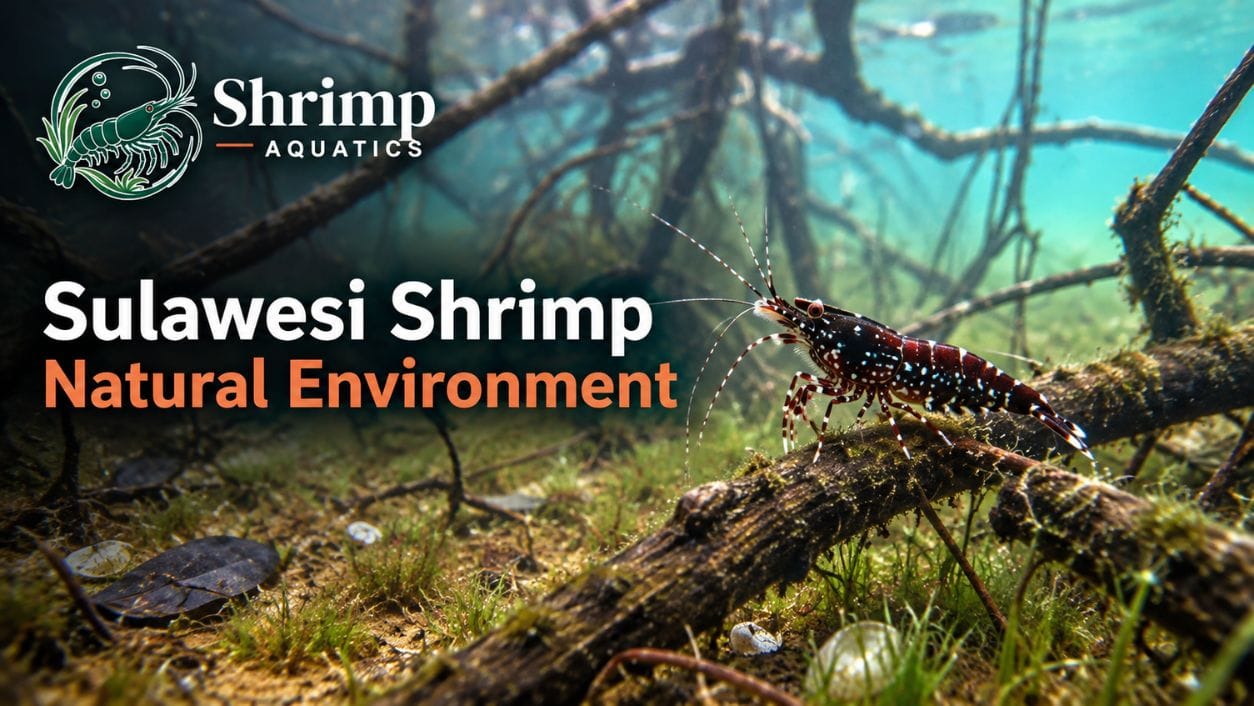
The systematic revision that described most of these species records where each one was collected, and the list is short on plants. Shrimp were taken on gravel in shallow water, on boulders in deeper water, on rocks, between large boulders below 3 m, on wood, and under leaf litter. One species was found on freshwater sponges in the outlet bay of Lake Towuti, where Caridina spongicola fits into the sponge’s cavities. That same work recognizes 21 species from these ancient lakes, 15 from the Malili lakes and six from Lake Poso. It treats shallow as above about 3 m and deeper as below it.6
So picture a hard bottom with structure in it: angular rock, piles of it, sunken timber, patches of sand and leaf litter in between. Different species sit in different parts of that. It’s how a dozen close relatives share one shoreline, and it’s worth knowing before you lay out a tank. A bare glass bottom with one ornament on it isn’t a small version of this.
Why the food in a Sulawesi lake grows on rock instead of in the water
This is the part most care sheets skip, and it’s the part that changes what you do. In both lake systems, iron washing in from the catchment binds phosphorus and carries it out of the sunlit water. Open water production gets throttled before it starts. There’s almost no plankton bloom to eat and very little vascular plant material either. What’s left is a benthic film. Work on Lake Matano’s littoral zone is built around exactly that, a benthic diatom community sampled straight off the lake bottom.7
We should be straight about a limit here. We couldn’t find a published gut content or stable isotope study for any of the lake Caridina. Nobody can tell you the proportions of what they eat in the wild. What’s documented is where they were found and what these lakes produce. Both point the same way, and it matches how Sulawesi shrimp actually eat algae and biofilm in a tank. But documented habitat isn’t the same thing as a measured diet.
Mining runoff keeps resetting the Lake Matano shoreline
The habitat isn’t sitting still. Around Soroako on Lake Matano, decades of nickel mining, logging, farming and town growth have changed what happens on the lake bed. The study of that benthic diatom community found the main effect was a higher frequency of runoff and siltation events. Those events reset the community to an earlier successional state, with lower species richness and diversity near the town and more early successional taxa in the disturbed areas. Nutrients were undetectable in the field, so the stress was physical rather than enrichment.7
Read that back into the section above and the consequence is plain. Silt on the rock is silt on the food. Silt in the crevices is shelter gone. That’s what makes the state of these shorelines the strongest practical argument we know for tank-bred stock over wild collected animals.
Which parts of the Sulawesi habitat are worth copying at home
You can’t reproduce a 600 m lake, and you don’t need to. So which parts actually carry the shrimp, and which are scenery?
- Warmth that doesn’t move. The Towuti catchment sits under an annual average air temperature of 26°C, and a tank that holds one steady reading beats a tank that wanders through a wider band.
- Alkaline water that’s still low in dissolved minerals. That pairing is the real signature of the habitat, and it’s why we’d build the water from RO plus a Sulawesi mineral rather than a hard water salt.
- Hard, inert rock for a Sulawesi tank with gaps in it, plus some sand and wood. Structure is habitat here, not decoration.
- A grazing film that’s already established before the shrimp arrive. In the lake that film is the food supply, and it took a very long time to get there.
- Oxygen, on purpose. Warm water starts at a disadvantage and a stocked tank only adds to it.
- The exact lake readings. They’re measurements of one place on one set of days, and for one of the three lakes the published pH figures flatly disagree.
- The scale. Depth, fetch and wave action are what keep silt off the rock out there. In a tank that job is yours, and it’s called Sulawesi shrimp tank maintenance.
The range we keep to for Sulawesi shrimp is 79-86°F (26-30°C), pH 7.5-8.5, 4-8 dGH, 3-6 dKH, TDS 150-250 ppm and nitrate under 10 ppm. Put that over an inert substrate, in a mature tank that already grows biofilm. These are advanced to expert animals, and nothing in the habitat above makes that easier. For the build itself, step by step, go to the Sulawesi biotope aquarium and come back here when you want to know why each step is there.
At Shrimp Aquatics, most of our Sulawesi systems currently run at TDS 150 ppm, GH 6-7 dGH and pH 7.5. We say so because the lake figures above sit lower than that. Nobody should be chasing a lake number down to a level their own tank can’t hold steady. Steady beats authentic here.
One last thing the habitat explains. Warm alkaline water is the worst case for ammonia. The share of total ammonia present in the un-ionized form rises about ten-fold for each pH unit, and roughly two-fold for each ten degree Celsius rise in temperature across the range the criteria cover.8 In the lake that never matters, because nothing is decaying on the rock. In a tank with leftover food sitting in it, it matters a great deal.
If the water still sounds like something you can hold steady for a year, the tank-bred Sulawesi shrimp we raise never had to live in a silted lake. If it doesn’t, that’s a useful answer too, and a cheaper one.
References
8 Sources
- Biogeochemistry of manganese in ferruginous Lake Matano, Indonesia, Biogeosciences 8: 2977-2991, 2011.
- Geomicrobiological Features of Ferruginous Sediments from Lake Towuti, Indonesia, Frontiers in Microbiology, 2016.
- Biogeochemical cycling of trace elements and nutrients in ferruginous waters: constraints from a deep oligotrophic ancient lake (published version, PDF), Limnology and Oceanography, 2024.
- Trophic Status of Waters in Poso Watershed, Central Sulawesi (abstract), IOP Conference Series: Earth and Environmental Science 950: 012039, 2022.
- Dissolved Oxygen and Water, U.S. Geological Survey Water Science School.
- Radiation of endemic species flocks in ancient lakes: systematic revision of the freshwater shrimp Caridina from the ancient lakes of Sulawesi, Indonesia (PDF), Raffles Bulletin of Zoology 57(2): 343-452, 2009.
- Effects of Long-Term Anthropogenic Disturbance on the Benthic Episammic Diatom Community of an Ancient, Tropical Lake (repository copy, PDF), Bulletin of Environmental Contamination and Toxicology, 2017.
- Aquatic Life Ambient Water Quality Criteria for Ammonia, Freshwater (PDF), U.S. Environmental Protection Agency, Office of Water, April 2013.
Ready to get started?
Shop our Sulawesi Shrimp collection
27 products available · Live Arrival Guarantee
Featured Sulawesi Shrimp
Sulawesi Red Line Blue Dot
Caridina sp. "Red Line Blue Dot"
Advanced · 79–86°F · pH 7.5–8.5
From $15.99View Product