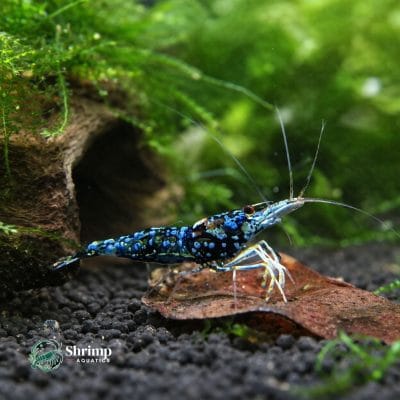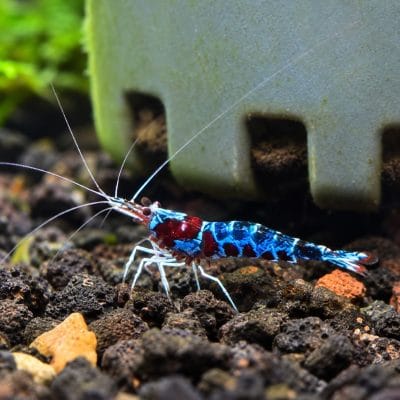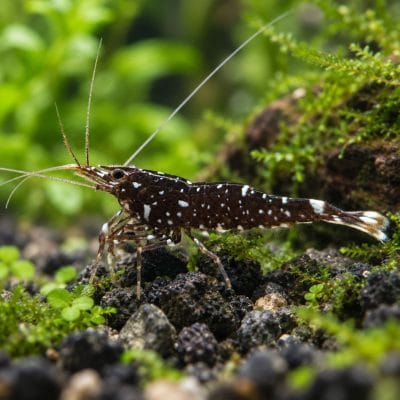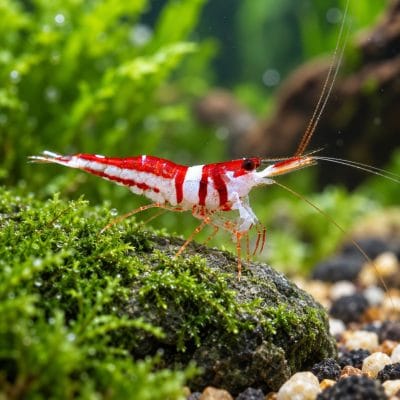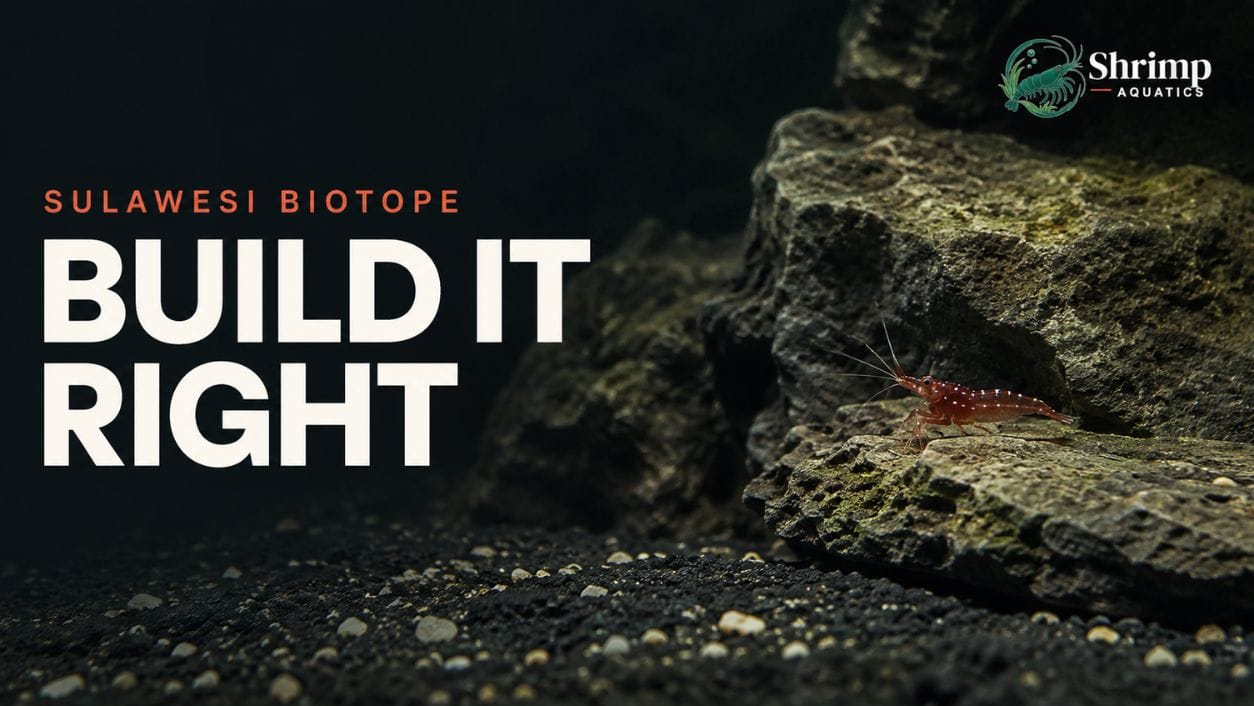
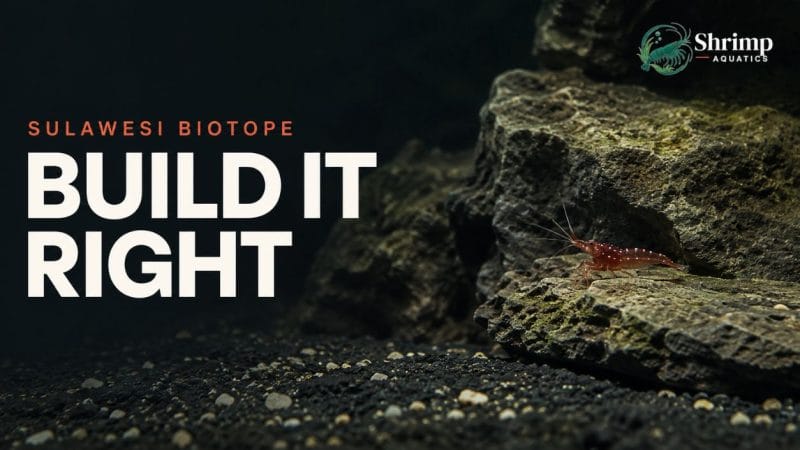
A Sulawesi biotope is a warm, alkaline, rock and biofilm tank built on remineralized RO water and then left alone long enough to mature. The order of the build matters more than the scape. Mix the water first. Set inert rock and sand. Hold 79-86°F (26-30°C) and pH 7.5-8.5 steady. Grow the grazing surfaces, and stock only after the tank has run clean for weeks. These are advanced to expert animals, and most first-year losses happen because shrimp went into a tank that was still settling.
The warm alkaline band a Sulawesi biotope has to hold
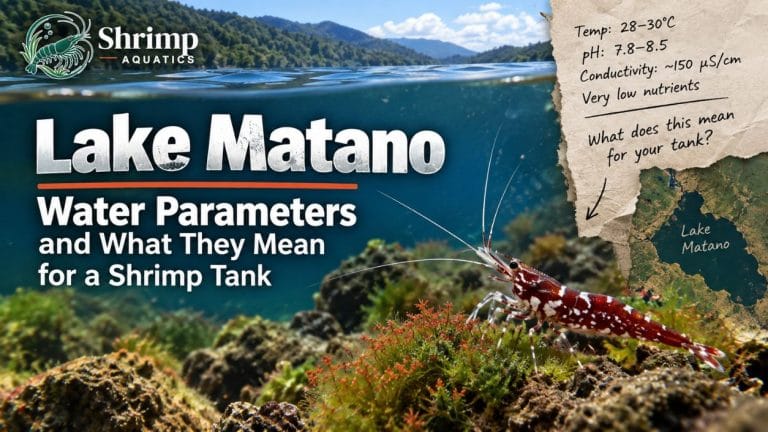
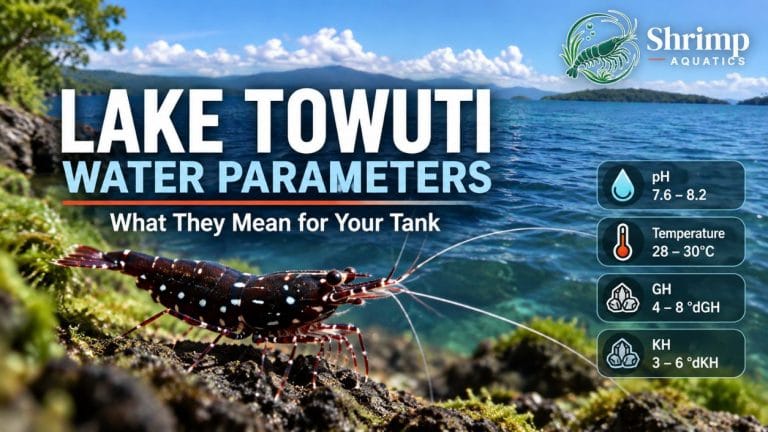
Every decision in this build serves one goal, which is holding a narrow set of numbers steady for months at a time. Sulawesi lake Caridina come from tectonic lakes whose water barely moves through the year. Lake Towuti sits at roughly 82°F (28°C) all year with only weak thermal layering.1 Lake Matano is studied partly because its seasonal temperature variability is so small.2 Nothing in that Sulawesi natural environment prepares these shrimp for the daily swings a normal community tank tolerates. That stillness is what this build copies from where Sulawesi shrimp come from.
| Difficulty | Advanced to expert |
|---|---|
| Temperature | 79-86°F (26-30°C) |
| pH | 7.5-8.5 |
| GH | 4-8 dGH |
| KH | 3-6 dKH |
| TDS | 150-250 ppm |
| Nitrate | Aim for under 10 ppm |
| Substrate | Inert substrate and hardscape |
| Tank | Mature, stable system with established grazing surfaces |
The carbonate hardness line is the one people skip, and it’s the one holding the rest together. Alkalinity is the water’s capacity to neutralize acids and keep a fairly stable pH.3 It comes from dissolved bicarbonates, carbonates and hydroxides.3 Let KH slide toward zero and the pH stops resisting anything: feeding, respiration and a bit of decay will walk it down overnight. A Sulawesi tank that reads pH 8.2 on almost no carbonate hardness is about to move.
Tank size and heaters that keep a Sulawesi biotope from drifting
Small volumes swing faster than large ones, and this is a group that pays for swings. A tank in the range of 15-30 gallons (57-114 L) is a reasonable working size. It’s big enough that an evening of evaporation or a heater cycling on doesn’t move the readings much, and small enough that a water change stays cheap in prepared water. Below about 10 gallons (38 L) you’re asking a beginner-difficulty volume to run an expert-difficulty chemistry.
Heating deserves more thought than it usually gets. The band runs 79-86°F (26-30°C), which means a stuck heater has very little room above it before the tank leaves the range entirely. An external controller with its own probe, set to hold the middle of the band, gives you a second opinion on the heater’s own thermostat. It also gives you a way to notice a failure while the shrimp are still fine. Check the reading against a separate thermometer when you set it up, not after something goes wrong.
Before you buy anything
This tank is a standing commitment to prepared water. If you can’t reliably get RO water, or you wouldn’t want to mix and test every batch that goes into the tank, stop here. A Neocaridina setup will make you a happier keeper and the shrimp a healthier colony.
Why this tank starts with RO water and a Sulawesi mineral
You aren’t adjusting your tap water toward the target, you’re building the water from nothing. Start with RO water at 0 ppm TDS and add a mineral made for Sulawesi conditions. That’s the only practical way to land inside 4-8 dGH, 3-6 dKH and 150-250 ppm at the same time. Soft-water Bee and Crystal salts are designed to do the opposite job and won’t get you there.
Mineral content isn’t only about the numbers on the meter. In crustaceans the calcium used to build the new exoskeleton comes mainly from the surrounding water, with stored reserves and diet contributing less.4 A colony that molts well is drinking its shell out of the tank, which is why GH and KH are husbandry, not decoration.
Choosing between Sulawesi Mineral 7.5 and 8.5
The two common products aren’t grades of the same thing, they’re two different water profiles. Sulawesi Mineral 7.5 dissolves almost totally within seconds in water outside the aquarium and needs no special equipment.5 It buffers the pH at around 7.5 and raises carbonate and total hardness at a ratio of KH/dH = 0.42/1.0.5 The manufacturer names Lake Matano, Poso and Towuti species, and points Lake Towuti shrimp such as Caridina woltereckae toward the 8.5 product instead.5 Sulawesi Mineral 8.5 raises hardness at a KH/dH ratio of 0.78/1.0.6 The manufacturer states that less finicky Sulawesi shrimp such as Caridina dennerli have been kept and bred with either product.6
So the practical rule is to match the mineral to the line you’re actually buying rather than to the highest number on the shelf. Ask the seller what the stock is currently kept in and prepare that, then leave it alone. A shrimp moved from a 7.5 system into a freshly mixed 8.5 system is being asked to absorb a chemistry change on the same day it absorbs a shipping journey.
Dissolving an 8.5 mineral without a cloudy tank
The higher-alkalinity product doesn’t simply stir in, and this is where most first batches go wrong. It will almost totally dissolve only if CO2 is added for a few days.6 At a regular CO2 quantity of about one bubble per second, the salt dissolves totally in approximately 3-4 days.6 The water must then be aerated with an air stone for at least three hours to expel the CO2 before use.6 Skip the aeration step and you’re pouring carbonated water into the tank, which is why the pH sometimes reads low right after a change and climbs later.
- Mix outside the aquarium, in a dedicated container you’ll use for nothing else.
- Add the mineral to RO water at the manufacturer’s current stated dose and follow the product’s own instructions.
- For the 8.5 product, run CO2 at about one bubble per second until the water is clear, which takes approximately 3-4 days.6
- Aerate with an air stone for at least three hours to drive the CO2 back out.6
- Bring the batch to tank temperature, then test pH, GH and TDS on the finished water before any of it goes near livestock.
Test the batch, not the recipe. Dose charts assume a starting water and a scoop that match theirs. The only number that matters is the one your own meter reads on the water you’re about to use.
Choosing substrate and rock that hold the pH and grow biofilm
Use an inert substrate and inert hardscape. Active shrimp soils are engineered to strip carbonate hardness and drag the pH down into the high fives. That’s the correct behavior for a Crystal Red tank and a slow disaster in this one. Plain quartz sand, inert dark gravel or a fine inert volcanic sand all work; the choice is aesthetic as long as it doesn’t touch the chemistry.
Wood and botanicals belong to the same warning. Driftwood, catappa leaves and alder cones all release organic acids. In a system whose entire safety margin is its buffer, that’s a slow leak in the wrong direction. Leave them out rather than trying to balance them.
Rock is where the biotope actually lives. Pile porous hardscape rock with real gaps in it. That way there’s far more grazing surface than floor area, and a molting shrimp always has somewhere dark to be soft in private. Build the pile so it’s stable without leaning on the glass, and leave the top surfaces open to light. Those are the ones that will grow the film the colony eats.
- Inert sand or gravel that doesn’t move GH, KH or pH
- Porous rock stacked with crevices and overhangs, not a decorative single stone
- Open, lit rock surfaces for algae and biofilm to establish
- No active shrimp soil, driftwood, catappa leaves or other acidifying botanicals
- No sharp compacted layout that leaves molting shrimp exposed
Getting oxygen into warm water without pushing the shrimp around
Warm water is the reason aeration isn’t optional here. Cold water can hold more dissolved oxygen than warm water.7 So a tank running at the top of the Sulawesi band carries less oxygen at saturation than the same tank would at Neocaridina temperatures, while the animals and the filter bacteria in it are working faster. The fix is surface movement and air, not a stronger pump aimed across the rock: shrimp that spend their day bracing against flow aren’t grazing.
In practice that means three things. Run more biological media than the bioload strictly needs. Break the surface continuously with an air stone or an outflow aimed along the waterline. Then check what the flow is doing down at rock level rather than at the outlet. If the shrimp are all sitting in the lee of the same stone, the tank is telling you where the current is.
Whatever filter you choose, guard the intake. Sponge prefilters or a sponge filter on its own keep shrimplets out of impellers and add another colonized surface at the same time. That’s a fair trade in a tank whose whole point is colonized surfaces.
Why waste is more dangerous in a warm alkaline tank
This is the part that catches keepers who have run soft-water shrimp for years. Total ammonia in water sits in a balance between the ammonium ion and un-ionized ammonia, and it’s the un-ionized form that drives ammonia toxicity. That balance isn’t fixed. The ratio of un-ionized ammonia to ammonium ion in fresh water increases by ten-fold for each rise of a single pH unit, and by approximately two-fold for each 10 degree Celsius rise in temperature across the 0 to 30 degree Celsius range.8 High external un-ionized ammonia reduces or reverses diffusive gradients, so ammonia builds up in internal tissues and blood.8
Read that against the two tanks side by side. A Crystal Red tank at pH 6.2 and a Sulawesi tank at pH 8.2 can show the same total ammonia on the same test kit. The warm alkaline tank is a far more hostile place to be a shrimp. That’s the real argument for a long maturation, restrained feeding and a stocking pace that lets the filter catch up. It’s also why “the reading is only a little above zero” isn’t a reassuring sentence in this tank.
How long to mature a Sulawesi tank before the shrimp arrive
Is a cycled tank a mature Sulawesi shrimp tank? No. Processing ammonia is the minimum. What this colony also needs is the film on the rock it will spend all day eating, and that arrives on its own schedule after the filter is already working.
At Shrimp Aquatics, we don’t rush a new Sulawesi tank. With a powdered bacterial starter, our normal minimum is 3-4 weeks. With a liquid or live culture, the process may reach the same checkpoint in 2-3 weeks. During the early cycle we normally run the light for 8-10 hours a day so algae and biofilm can establish on the rock and glass, and in these systems that natural growth is the main grazing base. The calendar doesn’t decide when shrimp go in. We wait for 0 ammonia and nitrite, stable temperature and chemistry, an established biological filter and visible grazing surfaces before stocking.
What tells you the tank is ready
- Ammonia and nitrite both read 0 on a fresh test
- Nitrate is low and not climbing between tests
- Temperature, pH, GH, KH and TDS repeat across several days without correction
- The rock has visibly changed color where the light hits it
- Don’t treat a number of weeks on its own as proof that a tank is ready
Which shrimp and snails belong in a Sulawesi biotope
Stock this tank as an invertebrate system. Start with one species and a modest number. A first colony is also your test of whether the water you built is holding, and a single line makes that answer readable. Buying tank-bred Sulawesi shrimp also means the animals arriving have spent their lives in prepared aquarium water. That removes one whole category of transition from the first week.
Among the best snails for Sulawesi shrimp, rabbit snails are the natural companion, and they’re biotope-correct rather than merely tolerated. Tylomelania is an endemic assemblage restricted to the same two ancient lake systems the shrimp come from, Lake Poso and the Malili lakes.9 They’re also unusual breeders. The genus broods embryos internally in a uterine brood pouch with heavy maternal investment and releases juveniles that are already shelled.10 So there’s no clutch of eggs to manage and no larval stage in the tank. Watch their shells for pitting or thin new growth, since low mineral availability or an unsuitable pH shows up on a snail before it shows up on a shrimp.
Why endemic fish don’t belong in a shrimp biotope
The lakes hold a genuinely interesting fish fauna, and a display built around it is a good project. It’s a different project. Fish that fit the warm alkaline water still eat shrimplets. An active mid-water species keeps a shy grazing colony in the rock instead of out on it, which quietly costs you both feeding time and the colony’s growth. If you want the fish, give them their own tank.
Arrival day and getting shrimp out of the bag
Follow the instructions supplied with your specific order, because packing method, transit time and species all change the right answer. For eligible long-distance Shrimp Aquatics shipments arriving in a sealed transport bag, our current protocol to acclimate new Sulawesi shrimp is to equalize temperature and then transfer them across. No shipping water goes into the aquarium. Have the tank at temperature and the lights off before the box is opened, and leave the colony alone for the rest of the day.
Feeding a rock-grazing colony without fouling warm water
The tank you spent weeks maturing is the feeder. Prepared food is a supplement to that, and in warm water an uneaten portion becomes a waste problem quickly, for exactly the reason described above.
At Shrimp Aquatics, in our Sulawesi systems, mature algae and biofilm do most of the feeding. We normally offer prepared food only about once a week and remove leftovers, both because many of the shrimp in these systems show limited interest in it and because food that sits in warm water adds organic waste and can raise ammonia, nitrite and nitrate as it breaks down.
Watch the animals rather than the schedule. A colony that’s out on the rock working the surfaces all day is fed. A colony that swarms a pellet within seconds is telling you the grazing base has thinned, and that’s a lighting and maturity problem. Adding more food to an immature system doesn’t substitute for the film that hasn’t grown yet.
Top-offs and water changes that don’t move the mineral level
Two routines protect everything above, and both are about not moving the numbers. Evaporation concentrates dissolved solids in the water that stays behind.11 So what leaves the tank as vapor has to be replaced with pure RO water at 0 ppm. Top off with remineralized water and the mineral content climbs week after week, invisibly, until a colony that molted normally for months stops doing so.
Water changes are the opposite job and use the opposite water. Keep them small and regular. Prepare the replacement in advance so it matches the tank on temperature, pH, GH and TDS before it goes in, and add it slowly. A matched 10% change moves nothing the shrimp can feel. An unmatched 30% change is the shock you were trying to avoid.
Keep one measurement honest
Test the replacement water and the tank on the same meter before every change, and write both down. A drifting Sulawesi tank almost never announces itself. It shows up as a slow TDS climb in a notebook long before it shows up as a failed molt.
References
11 Sources
- Geomicrobiological Features of Ferruginous Sediments from Lake Towuti, Indonesia, Frontiers in Microbiology 7:1007, 2016.
- The biogeochemistry of tropical lakes: A case study from Lake Matano, Indonesia (repository record and abstract), Limnology and Oceanography 53(1):319-331, 2008.
- Alkalinity and Water, U.S. Geological Survey Water Science School, updated August 24, 2026.
- Biomineralizations: insights and prospects from crustaceans, ZooKeys 176:103-121, 2012.
- Sulawesi Mineral 7,5, Minerals and trace elements, SaltyShrimp (Garnelenhaus), product technical page.
- Sulawesi Mineral 8,5, Minerals and trace elements, SaltyShrimp (Garnelenhaus), product technical page.
- Dissolved Oxygen and Water, U.S. Geological Survey Water Science School, updated August 24, 2026.
- Aquatic Life Ambient Water Quality Criteria for Ammonia, Freshwater, U.S. Environmental Protection Agency, Office of Water, April 2013.
- The species flocks of lacustrine gastropods: Tylomelania on Sulawesi as models in speciation and adaptive radiation (abstract), Hydrobiologia 615:181-199, 2008.
- Anatomy of an adaptive radiation: a unique reproductive strategy in the endemic freshwater gastropod Tylomelania on Sulawesi, Indonesia (abstract), Biological Journal of the Linnean Society 85(4):513-542, 2005.
- Chloride, Salinity, and Dissolved Solids, U.S. Geological Survey Water Resources Mission Area, March 1, 2019.
Ready to get started?
Shop our Sulawesi Shrimp collection
27 products available · Live Arrival Guarantee