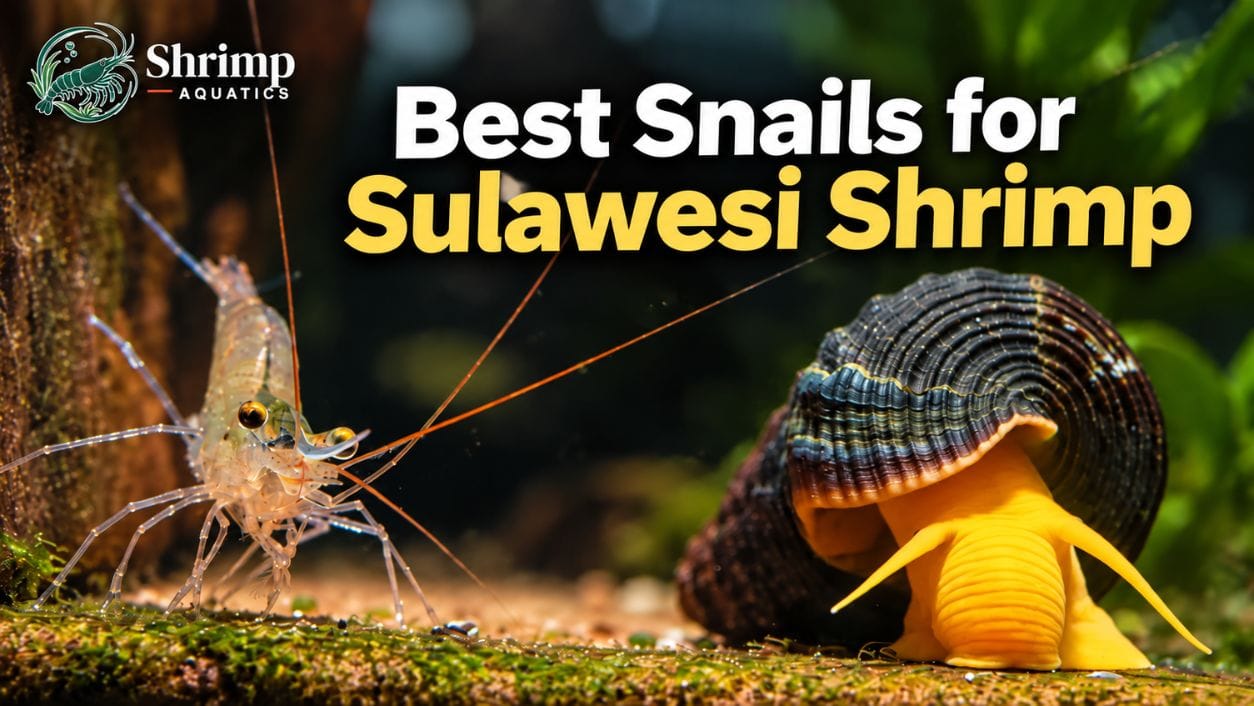
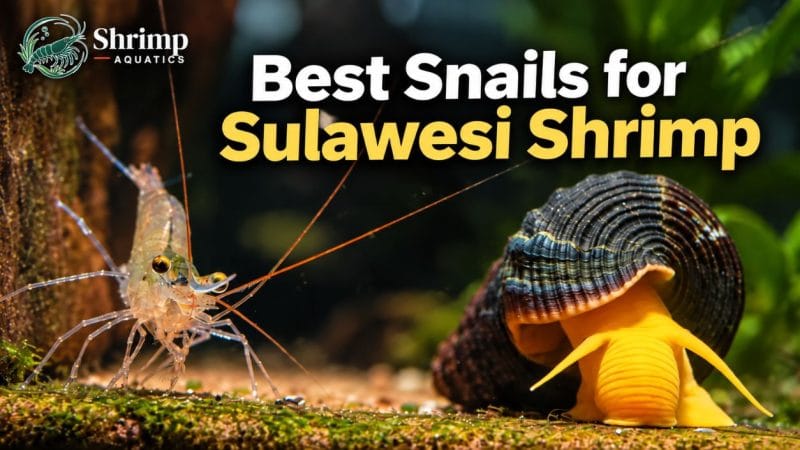
If you want a snail in a Sulawesi shrimp tank, start with the Sulawesi rabbit snails, Tylomelania. They come from the same lakes, they hold the same warm alkaline water, and they don’t breed into a plague. A nerite or two can join them for the glass. Almost everything else on the shelf fails on one of three counts. It can’t hold 79-86°F (26-30°C) for years, it eats the biofilm your shrimp live on, or it adds more waste than a warm alkaline tank can forgive.
Set the tank to the shrimp, then see which snails fit
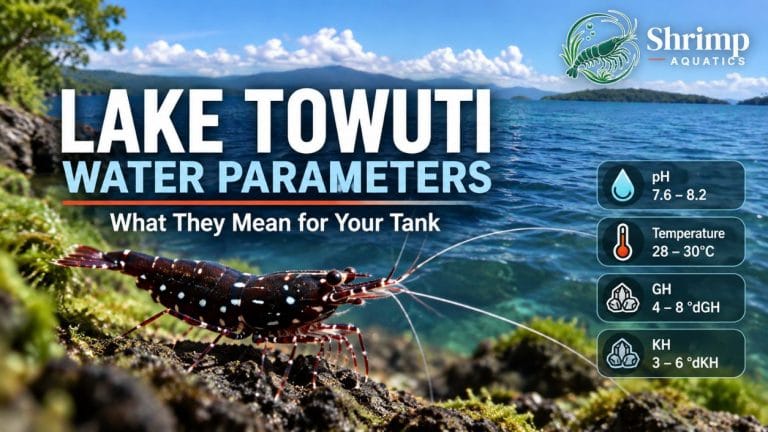
The water isn’t negotiable, and it isn’t a compromise between two animals. You build the tank for the shrimp, then ask which snail can live in it. Every Sulawesi shrimp species we sell is kept to the same range: 79-86°F (26-30°C), pH 7.5-8.5, GH 4-8 dGH, KH 3-6 dKH and TDS 150-250 ppm, with nitrate under 10 ppm. If you’re still building that water, the detail sits in our guide to Sulawesi shrimp care parameters, and it’s worth settling before any snail goes in.
Now put the snail ranges next to it. This is where most of the candidates fall out.
| Parameter | Sulawesi shrimp | Sulawesi rabbit snails | Most other common aquarium snails |
|---|---|---|---|
| Temperature | 79-86°F (26-30°C) | roughly 76-84°F (24-29°C) | roughly 68-78°F (20-26°C) |
| pH | 7.5-8.5 | neutral to alkaline suits most species, verify the species | neutral to alkaline suits most species, verify the species |
| GH | 4-8 dGH | needs adequate minerals, no single safe figure | needs adequate minerals, no single safe figure |
| Where that leaves you | the tank is set here | overlaps the shrimp from about 79-84°F (26-29°C) | the top of their range is the bottom of yours |
Read the bottom row twice, because it’s the whole answer. A rabbit snail and a Sulawesi shrimp share a real band of about 79-84°F (26-29°C). You can pick a set point that suits both and hold it there for years. Most other snails top out around where your tank starts. They won’t die on the first warm afternoon, but you’d be running them at the ceiling of their range permanently, and a permanent ceiling is not a home.
Why the Sulawesi rabbit snail is the one snail from this water
Rabbit snails are the genus Tylomelania, and they aren’t a general tropical snail that happens to cope. The genus is restricted to the same two ancient lake systems your shrimp came from: Lake Poso, and the Malili lakes, which include Danau Matano, Mahalona and Towuti.1 Warm alkaline water isn’t something they tolerate. It’s the only water they have ever had.
The second reason is reproduction, and it’s the one that keeps keepers sane. Tylomelania holds its eggs and embryos inside the oviduct, which is modified into a uterine brood pouch, and feeds them from a large albumin gland. The juveniles it releases are already shelled. In some species they’re almost 2 cm long at birth, the largest known for any live-bearing gastropod.2 One big finished snail at a time is the opposite of an egg-laying snail’s strategy. You will not wake up to a hundred of them on the glass.
They aren’t free, though. A snail that big eats, and it produces waste in a tank you’re deliberately keeping clean. The bigger species can also shift loose rock while your shrimp are grazing on it. The size class you buy matters more than the color does. We’ve worked the stocking limit, the feeding routine and the waste cost through in a guide to keeping rabbit snails with Sulawesi shrimp. The short version is that one or two is a decision, not a default. For the snail on its own, Sulawesi rabbit snail care covers the water and the grazing surface it needs.
What a nerite adds that a rabbit snail cannot
Nerites do one job well, and nothing else in this tank is doing it. They take hard diatom and green film off the glass and off smooth surfaces. Rabbit snails work the substrate and the softer growth instead. Your Sulawesi shrimp eat algae and biofilm off rock, and that grazing surface is the food supply you spent weeks growing, so you want it left alone.
The reproduction question answers itself here too. Nerite eggs may be laid in fresh water, but development generally needs different salinity conditions depending on the species, so a freshwater tank doesn’t produce a second generation. What it does produce is small hard white egg capsules stuck to your rock. They’re cosmetic and they’re permanent. If that will bother you every time you look at the tank, that’s a reason to skip nerites rather than a reason to scrape.
The real limit is competition. A nerite eats the same microbial film your shrimp do, just in a place your shrimp use less. One or two in a small tank is a cleaner pane of glass. Six is a grazing crew stripping surfaces you grew for the shrimp. We’d start with one, watch the rock for a month, and add a second only if the film is clearly outrunning both of them.
Is a Malaysian trumpet snail worth it under an inert Sulawesi bed?
Sometimes, and only if you keep sand. Melanoides tuberculata lives in the top layer of the sediment as well as on it, so it keeps a fine bed turned over rather than letting it pack down.3 On the inert sand or fine crushed lava substrate a Sulawesi tank normally uses, that’s a real function. On bare glass or coarse rock, there is nothing for it to do.
Temperature is not the objection. Its optimum range is given as 18-32°C, which covers a Sulawesi tank comfortably.3 The objection is what happens when you feed. This snail can breed parthenogenically, meaning embryos develop without fertilization. It has also been imported through the aquarium trade and established in waterbodies across more than a dozen US states.3 A population like that tracks the food supply, not your intentions. In a tank where prepared food is occasional and biofilm does most of the feeding, a small group stays small. Start dosing powdered food into the substrate and you’ll be netting trumpet snails out for months.
Two practical consequences. Never release one anywhere but your own tank, and keep feeding light enough that the population has no reason to climb. If you already overfeed, this snail will tell on you.
The snails we would keep out of a Sulawesi shrimp tank
Start with the mechanism, because it explains all three refusals. Total ammonia in water splits between the ammonium ion and un-ionized ammonia, and the un-ionized form is the one that drives toxicity. That share rises about 10-fold for every pH unit, and roughly two-fold for every 10 degrees Celsius.4 Your tank sits at pH 7.5-8.5 and 79-86°F (26-30°C), which is the warm alkaline corner of that relationship. Warm water also holds less dissolved oxygen than cool water does.5 So a snail that is unremarkable in a room-temperature community tank is a bigger waste load here, in water with less oxygen to process it.
No assassin snails
Assassin snails prey on other snails, so they will work through your rabbit snails and nerites given time. They also share the tank with shrimp that are soft and immobile for hours after every molt. We wouldn’t take that risk with a colony this expensive, and no snail is safe to describe as shrimp-safe or plant-safe without species context.
Mystery snails and other apple snails are the next common suggestion, and the answer is no. They’re big-bodied, heavy-feeding animals from a completely different water. Adding one here puts the largest waste producer on the shelf into the system least able to absorb it. If you want a large showy snail, that’s what the rabbit snail is for.
Then there are the ones you didn’t choose. Ramshorn, bladder and pond snails ride in on plants. Most common aquarium snails do fine in neutral to alkaline, mineral-rich water, so your chemistry is not going to stop them. Food is what stops them. A Sulawesi tank fed lightly enough for the shrimp rarely grows a hitchhiker plague, and if yours has, the snails are a symptom. Fix the feeding. Don’t reach for a chemical snail treatment, because the things that kill snails have a poor record around shrimp.
How to protect a snail’s shell without pushing GH past the shrimp’s range
Here is the tension nobody sells you on. Low mineral availability or an unsuitable pH can contribute to shell erosion, and Sulawesi water is deliberately mineral-lean at GH 4-8 dGH. So a keeper watching a spire go chalky reaches for something to raise hardness.
Don’t. That number belongs to the shrimp. Raising GH to make a shell look better moves the water your whole colony is built on. A slowly eroding shell tip is a much smaller problem than a mineral shift across a warm tank. There is also no single GH threshold that works for every snail species, so there’s no target to chase even if you wanted one.
What we’d actually do is simpler. Stabilize your Sulawesi water with GH and KH held inside the published range instead of letting them drift up with top-offs. Keep your snail count low enough that the tank isn’t fighting its own waste. Then judge a shell over months. If a shell keeps deteriorating in water that’s holding steady in range, that’s a question for a review of the whole tank, not for a hardness additive.
What to ask a seller before you buy a Sulawesi snail
Rabbit snails are still collected from the wild, and the lakes they come from are under pressure. Tylomelania gemmifera reaches the hobby as an orange rabbit snail. It was assessed as Endangered on 9 July 2018 under criteria A2e+3e; B1ab(iii,v)+2ab(iii,v), with a decreasing population, and the assessment records the species in international pet and display-animal trade.6 That’s a reason to ask where an animal came from, not a reason to avoid the group.
So ask these before you pay.
- Is this snail tank-bred, or collected? Bred stock is already living in a closed system at the temperature you keep.
- Which species or which lake, not just the trade color? Size at adulthood follows the species, and size is your waste budget.
- What water is it in right now, so you know how far it has to move to reach yours?
- How is it shipped, and how long is it in the bag? A snail that arrives cold has been out of its range for the whole trip.
- Don’t accept “Sulawesi snail” with no species and no origin. That’s the answer that hides a wild-collected animal.
Our own Sulawesi snails are bred by Shrimp Aquatics rather than collected from the wild. That’s worth asking about whoever you buy from, because it decides whether the animal has ever seen a glass box before it reaches yours.
References
6 Sources
- The species flocks of lacustrine gastropods: Tylomelania on Sulawesi as models in speciation and adaptive radiation (abstract), Hydrobiologia 615: 181-199, Springer, 2008.
- Anatomy of an adaptive radiation: a unique reproductive strategy in the endemic freshwater gastropod Tylomelania (Cerithioidea: Pachychilidae) on Sulawesi, Indonesia, and its biogeographical implications (abstract), Biological Journal of the Linnean Society 85(4): 513-542, 2005.
- Melanoides tuberculata (Muller, 1774) species profile, U.S. Geological Survey Nonindigenous Aquatic Species Database, revised 24 May 2019.
- Aquatic Life Ambient Water Quality Criteria for Ammonia, Freshwater, U.S. Environmental Protection Agency, Office of Water, April 2013.
- Dissolved Oxygen and Water, U.S. Geological Survey Water Science School.
- Tylomelania gemmifera, The IUCN Red List of Threatened Species 2019: e.T109686316A109686343, assessed 9 July 2018.
Ready to get started?
Shop our Sulawesi Shrimp collection
27 products available · Live Arrival Guarantee
Featured Sulawesi Shrimp
Sulawesi Orange Eyes White Sock
Caridina dennerli
Advanced · 79–86°F · pH 7.5–8.5
From $19.99View Product