Stabilizing a Sulawesi tank isn’t about hitting a perfect number. It’s about choosing one workable point inside the group’s warm, alkaline range and then removing every process that quietly moves the water away from it. In practice that means four jobs: prepare and finish replacement water outside the tank, replace evaporation with pure RO water only, protect carbonate hardness against the acid your filter produces, and keep gas exchange running so carbon dioxide doesn’t drag pH down overnight. The animals cope with a wide band far better than they cope with a band they’re dragged across.
Which numbers drift in a Sulawesi shrimp tank, and how far is too far
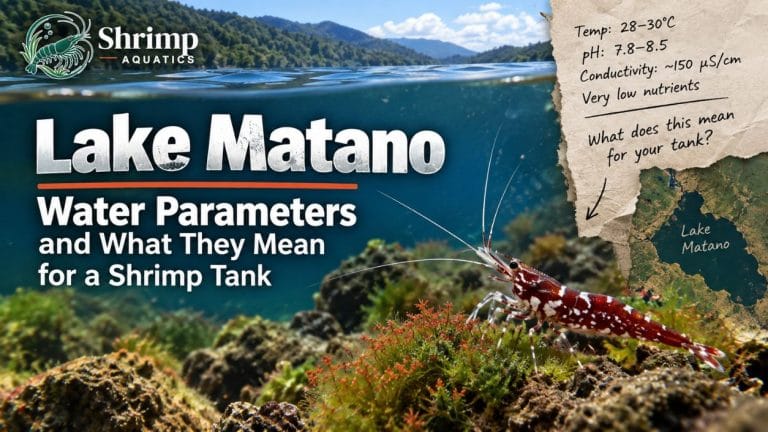
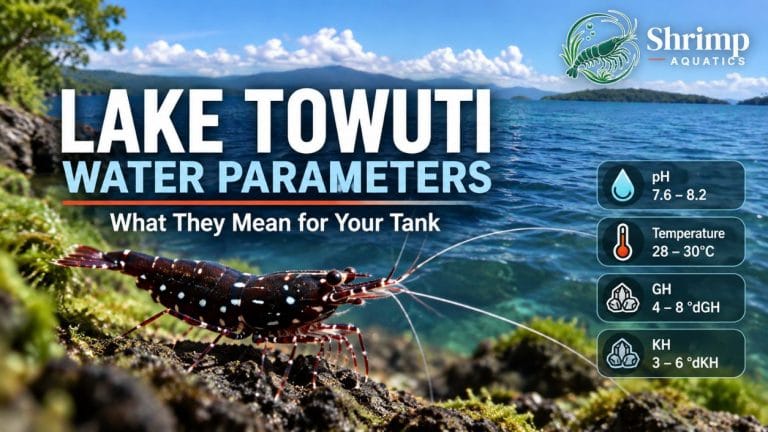
Sulawesi lake Caridina come from water that barely moves. Lake Towuti’s surface water is reported at about 82°F (28°C) throughout the year, with only weak thermal stratification.1 Lake Matano water parameters have been studied specifically because the seasonal temperature variability of the lake is minimal.2 That’s the environment the group is built for, and it’s why a tank that reads perfectly today and differently next Thursday is harder on the animals than a tank that reads slightly off but never changes.
Start from the typical group range, then narrow it to a single working point of your own.
| Temperature | 79-86°F (26-30°C) |
|---|---|
| pH | 7.5-8.5 |
| GH | 4-8 dGH |
| KH | 3-6 dKH |
| TDS | 150-250 ppm |
| Nitrate | Aim for under 10 ppm |
Three of those move on their own once a tank is running. KH falls, because biological filtration consumes it. TDS and GH rise, because evaporation leaves minerals behind. Temperature swings with the room. pH isn’t really a fifth problem; it’s mostly the visible symptom of the first one. General hardness deserves particular attention. In crustaceans generally, the major source of the calcium used to build the exoskeleton is exogenous, meaning the water the animal lives in, with stored reserves and diet contributing less.3 Hardness that wanders is therefore wandering underneath every molt the colony takes.
At Shrimp Aquatics, most of our Sulawesi systems currently run at TDS 150 ppm, GH 6-7 dGH and pH 7.5. That’s one point inside the range, not a recommendation to sit at the bottom of it. The useful part is the method: choose your point, write it on the tank, and treat it as the specification every future batch of water has to meet.
Mix and finish Sulawesi replacement water outside the tank
Every stability problem that isn’t evaporation starts with water that went into the tank before it was finished. Source water is prepared in a separate vessel, brought to your setpoint, checked, and only then used. Choosing Sulawesi Mineral 7.5 or 8.5 decides how much work that vessel does.
A 7.5-type Sulawesi remineralizer is the simple case. SaltyShrimp’s Sulawesi Mineral 7.5 is described as dissolving almost totally within seconds in water outside the aquarium, ready for use immediately, buffering pH at around 7.5 and raising carbonate and general hardness together at a ratio of KH/dH 0.42/1.0.4 An 8.5-type product is a different job. The same manufacturer’s Sulawesi Mineral 8.5 needs CO2 added for approximately 3-4 days at a regular quantity of about one bubble per second to dissolve fully, and the water then has to be aerated with an air stone for at least three hours afterwards to expel that carbon dioxide before use; it raises carbonate and general hardness at a ratio of KH/dH 0.78/1.0.5
That aeration step isn’t optional housekeeping; the manufacturer’s own instruction is to expel the carbon dioxide before the water is used. A batch that goes in while it’s still saturated is water the tank has to absorb, and the readings you took on it aren’t the readings it will settle at.
- Fill the mixing vessel with RO or RO/DI water and nothing else.
- Add the remineralizer your species needs, following that product’s own current instructions.
- Dissolve it completely. With a 7.5-type salt that’s immediate; with an 8.5-type salt it’s a multi-day carbon dioxide process, and cloudiness means it isn’t finished.
- Aerate afterwards if you used carbon dioxide, until the pH has climbed and settled.
- Test the finished batch for pH, GH and TDS. Test the batch, not the bag.
- Bring it to tank temperature before it touches the tank.
At Shrimp Aquatics we start our Sulawesi systems with RO water rather than tap water, then use Sulawesi Mineral 7.5 to prepare the water for our current tank targets before shrimp are introduced, and we test the finished pH, GH and TDS before the water goes into a tank. Testing the finished batch is the step most keepers skip, and it’s the one that catches a bad mix while it’s still in a bucket.
Top off evaporation with pure RO water, or TDS creeps past your target
Warm tanks with continuous surface movement lose water quickly, and only the water leaves. Evaporation concentrates dissolved solids in what remains.6 Replace that loss with remineralized water and you’re adding minerals to a tank that never lost any, so GH and TDS climb week after week while every individual top-up looks harmless.
The most common slow failure
Top-off water is pure RO or RO/DI, with no minerals added. Remineralized water is for water changes, where you removed minerals and are putting them back. Using one for the other is the single easiest way to walk a Sulawesi tank out of its range without ever making an obvious mistake.
Mark the water line on the glass so the tank is refilled to the same point every time, and read TDS on a schedule, not by eye. A drift of a few ppm a week is invisible in the moment and unmistakable in a month.
Why pH slides down between Sulawesi water changes, and how to keep KH from running out
Carbonate hardness is what stops pH moving. Alkalinity is the buffering capacity of the water, its ability to neutralize acid and hold a fairly stable pH, and it comes from dissolved bicarbonates, carbonates and hydroxides.7 While KH is present, acid gets absorbed. When it’s spent, pH has nothing left to lean on and moves fast.
The acid arrives from your own filter. Nitrification is an acid-producing reaction: the standard engineering figure for the alkalinity it destroys is about 7.14 parts of alkalinity as calcium carbonate for every part of ammonia nitrogen oxidized, and the process is described as consuming alkalinity and lowering pH.8 A Sulawesi tank runs at a KH of only 3-6 dKH, which is a modest reserve. Nothing is wrong when pH edges down between water changes; that’s the reserve being spent as designed. The problem is only ever that it wasn’t replaced.
Two common choices make that drain faster than it needs to be. Active, pH-lowering aquasoils are sold to pull a tank in the acidic direction, which is the opposite of what this water asks for, and natural driftwood isn’t an inert material either. The Sulawesi setup calls for inert substrate and inert hardscape, and inert rock does the same decorative job without working against your buffer.
The routine fix is the water change, which is how the reserve is topped back up. Some keepers also run a small quantity of a carbonate-based material such as crushed coral inside the filter as a passive hedge, on the principle that it dissolves when acid is present. If you do that, add a little, then watch GH and TDS for several weeks before adding more, because the same dissolution that protects KH also pushes hardness upward and you’ve just built a slow drift in the opposite direction.
Keep the surface moving so overnight carbon dioxide doesn’t pull pH down
Cold water can hold more dissolved oxygen than warm water.9 A tank held at 79-86°F (26-30°C) therefore starts with less oxygen available than a room-temperature shrimp tank, while everything living in it’s respiring faster. The same gas exchange that brings oxygen in carries carbon dioxide out, and that second half is what protects your pH.
Photosynthesis and aerobic respiration are the two primary causes of daily variation in dissolved oxygen and pH in surface water: photosynthesis produces oxygen during the day, while algal, microbial and plant respiration consumes oxygen and releases carbon dioxide during the night.10 A closed tank does the same thing in miniature. If surface movement is weak, that overnight carbon dioxide has nowhere to go and pH sags before dawn, then recovers once the lights come back. A tank that tests fine every evening and is losing shrimp overnight is often doing exactly this, and a reading taken after dinner will never show it.
Continuous, gentle surface agitation solves both halves at once. An air-driven sponge filter, or a dedicated air stone alongside whatever filtration you run, keeps the surface broken without pushing grazing shrimp around. Aim the return so the film at the top is always moving and the shrimp on the rock aren’t.
How to run a water change without undoing the stability you built
A water change on this group has one purpose: export nitrate, dissolved organics and metabolic acid, and put carbonate hardness back. It isn’t the moment to adjust chemistry. If the tank has drifted, fix that deliberately over several changes.
Three things make a change safe here. The replacement water is already at your setpoint, tested, fully dissolved and degassed. It’s at tank temperature. And it goes in slowly enough that the tank never experiences a step change, which for a colony tuned to constant conditions means a drip line or repeated small additions. Small and frequent beats large and occasional, every time, because the size of the change is the size of the shock. Small and frequent beats large and occasional, the rule behind Sulawesi shrimp water changes.
Two habits are worth keeping. Don’t change water and clean the filter in the same session, since one removes buffer and the other disturbs the bacteria that depend on it. And test the tank before the change, so you know what you were correcting.
No water-change schedule has been published for these species
Exact percentages and intervals circulate widely on care sheets, but none of them rests on a measurement in Sulawesi species. Set your own interval from what your tank actually does: track nitrate and KH between changes, and change often enough that neither reaches the point where you’re correcting instead of maintaining.
When a number has already drifted, correct it slower than it moved
Drift takes weeks. Corrections attempted in an afternoon are, from the animals’ point of view, a much larger event than the drift ever was. Work out what moved, then walk it back over a comparable timescale.
| What you see | Usual cause | What to do |
|---|---|---|
| pH sliding down over weeks, KH falling with it | Nitrification spending the carbonate reserve faster than water changes replace it | Return to a regular change schedule with fully prepared water and check whether an active substrate or wood is adding to the drain |
| TDS and GH climbing, pH steady | Evaporation replaced with mineralized water instead of pure RO | Switch top-off to pure RO immediately, then bring TDS back down gradually through ordinary water changes rather than a large dilution |
| pH lowest in the early morning, recovering during the day | Overnight carbon dioxide buildup from insufficient gas exchange | Add continuous surface agitation that runs day and night, and retest at dawn rather than in the evening |
| Cloudy water and fine dust settling on sponges after a change | Mineral salt that never fully dissolved before the water was used | Dissolve the next batch completely in the mixing vessel, degas it, and siphon settled residue out during maintenance |
| Any detectable ammonia or nitrite | Biofilter disruption, decomposing food or an overloaded system | Stop feeding, increase aeration, and export waste through prepared, matched water rather than through a chemical fix |
That last row is the one Sulawesi water makes unforgiving. Total ammonia in fresh water splits between the ammonium ion and un-ionized ammonia, and un-ionized ammonia is the toxic form; the ratio between them rises about ten-fold for each single rise of one pH unit, and rises again as temperature goes up.11 Applying that relationship, the same total ammonia reading two pH units higher carries on the order of a hundred times more of the toxic form, which is roughly the gap between a soft-water Caridina tank and this one before the warm end of the range is even counted. A reading a soft-water keeper could shrug at isn’t one you can shrug at here, which is why export and aeration come first and nothing is dosed into the tank in a hurry.
Some situations are beyond a water-chemistry correction. Persistent losses with no parameter explanation, visible tissue damage or a suspected contaminant are worth a qualified aquatic veterinarian or a local specialist before another round of adjustments.
Deciding whether the tank is steady enough to add Sulawesi shrimp
Stability is a track record, not a reading. The question isn’t whether the tank is at your setpoint this morning; it’s whether it has stayed there without you intervening.
- Ammonia and nitrite have read zero on an established biological filter, not merely on a calendar.
- Temperature, pH, KH, GH and TDS have each held their setpoint across repeated tests over consecutive weeks.
- You’ve run at least one full water change with prepared water and the tank didn’t move afterwards.
- Grazing surfaces have developed on the rock and glass, so there’s something to eat on arrival.
- A tank that hits the numbers only on the day you adjust it is being steered. Stable water holds those numbers between adjustments.
Once that’s true, the water is doing the work for you. Stock chosen for the same water meets less of a change on arrival, which is worth weighing when you compare our tank-bred Sulawesi shrimp lines against animals moved out of a different water profile, and it’s worth asking any seller what their systems actually run at. If you want a second opinion on your own readings before you order, send your pH, GH, KH, TDS, temperature, tank size and cycle status to contact@shrimpaquatics.com and we will tell you honestly whether the tank is ready.
References
11 Sources
- Geomicrobiological Features of Ferruginous Sediments from Lake Towuti, Indonesia, Frontiers in Microbiology, 2016.
- The biogeochemistry of tropical lakes: A case study from Lake Matano, Indonesia, repository record and abstract, Limnology and Oceanography, 2008.
- Biomineralizations: insights and prospects from crustaceans, ZooKeys, 2012.
- SALTYSHRIMP – Sulawesi Mineral 7,5, SaltyShrimp product information page, no revision date shown.
- SALTYSHRIMP – Sulawesi Mineral 8,5, SaltyShrimp product information page, no revision date shown.
- Chloride, Salinity, and Dissolved Solids, U.S. Geological Survey, March 1, 2019.
- Alkalinity and Water, U.S. Geological Survey Water Science School, updated August 24, 2026.
- Long Island Sound Nitrogen Removal Training Program, Module 4: Fixed Film Operational Strategies, SUNY Farmingdale, published by the New York State Department of Environmental Conservation, February 1997.
- Dissolved Oxygen and Water, U.S. Geological Survey Water Science School, updated August 24, 2026.
- Diurnal variations in water quality at surface-water-quality stations, U.S. Geological Survey New Jersey Water Science Center, June 29, 2022.
- Aquatic Life Ambient Water Quality Criteria for Ammonia, Freshwater 2013, U.S. Environmental Protection Agency, Office of Water, April 2013.
Ready to get started?
Shop our Sulawesi Shrimp collection
27 products available · Live Arrival Guarantee
Featured Sulawesi Shrimp
Sulawesi Red Line Blue Dot
Caridina sp. "Red Line Blue Dot"
Advanced · 79–86°F · pH 7.5–8.5
From $15.99View Product