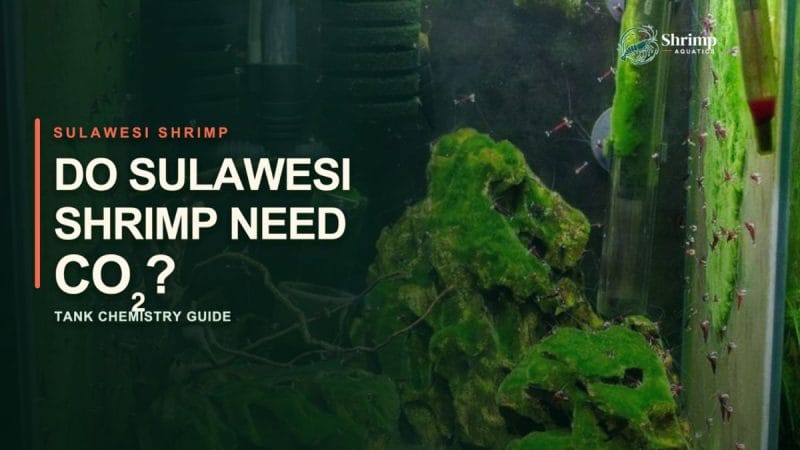
No. Sulawesi shrimp don’t need CO2, and a pressurized CO2 system doesn’t belong on a Sulawesi display tank. The group is kept at pH 7.5-8.5 with KH 3-6 dKH, and injected CO2 pulls against both of those numbers at once. The reason CO2 keeps coming up in Sulawesi keeping at all is a preparation step that happens outside the aquarium, in a mixing container. That water is aerated before it reaches the shrimp.
Why CO2 injection works against the alkaline water Sulawesi shrimp need
Carbon dioxide isn’t a nutrient as far as the shrimp are concerned. Once it dissolves in water it reacts with water molecules to form carbonic acid, and the lower the resulting pH, the higher the acidity of the water. The same body of acidification research adds the consequence that matters for an animal with a mineral skeleton. As water becomes more acidic, carbonate is less available for animals to build shells and skeletons.1 Those measurements come from seawater, so read them as the direction the chemistry moves and not as a measured threshold for Caridina. The mechanism itself is why an injected tank runs a daily pH cycle instead of a flat line.
A Sulawesi tank is built to do the opposite. The group is kept at pH 7.5-8.5 on a carbonate base of 3-6 dKH, and that carbonate content isn’t decoration. Alkalinity is the water’s capacity to neutralize acids and hold a fairly stable pH. It comes chiefly from the bicarbonates, carbonates and hydroxides dissolved in the water. Water with high alkalinity changes less in acidity when an acid is introduced.2 Injecting CO2 into a tank whose KH sits at 3-6 dKH means asking a modest buffer to absorb an acid load on a timer. That happens every day, for as long as the system runs. You’re spending the one property that keeps the tank stable in order to grow plants the shrimp don’t eat.
The mineral side of the tank matters here for a second reason. The major source of calcium a crustacean uses to calcify its new exoskeleton is exogenous, meaning the water it lives in, and stored reserves and food contribute less.3 That’s general crustacean biology and wasn’t measured in Sulawesi shrimp, but the practical reading is simple enough. The water is the mineral supply these shrimp draw on after every molt, and a daily acid cycle isn’t the condition you want that supply held in.
Don’t run this experiment on a stocked tank
No published study gives a safe dissolved CO2 concentration for Sulawesi Caridina, so there’s no number to aim below. Treat CO2 injection and liquid carbon additives as off the table for this group.
A warm Sulawesi tank has less oxygen headroom to give away
The second cost is oxygen, and it’s specific to how warm this group is kept. Cold water can hold more dissolved oxygen than warm water.4 A tank held at 79-86°F (26-30°C) is therefore working with less dissolved oxygen at saturation than the room-temperature Neocaridina tank most CO2 advice is written for. That’s before any livestock, biofilm or bacteria have taken their share.
This is also why the usual workaround doesn’t really solve anything. Keepers who inject CO2 on a planted tank often add surface agitation at night to protect the fish. On a Sulawesi tank you’re then running an airstone to undo a gas you paid to add. The system was never short of carbon in the first place. Strong aeration and gentle flow at shrimp level is the right target for these tanks on its own. Adding CO2 first, then aerating it back out, is a loop with no reader benefit at either end.
The CO2 step on a Sulawesi mineral package happens outside the tank
So why does CO2 keep coming up at all? Here’s where the confusion starts, and it’s a fair one. Some Sulawesi remineralizers really do carry a CO2 instruction on the package. SaltyShrimp Sulawesi Mineral 8.5 needs additional measures to dissolve fully. The manufacturer states that on a regular CO2 quantity of about one bubble per second the salt dissolves almost totally in approximately 3-4 days.5 Read that in context: the salt is being dissolved in a bucket or a mixing barrel of RO water, not in an aquarium with shrimp in it.
The same instruction carries its own safety step, and it’s the part that gets dropped when the advice is repeated secondhand.
Aerate the mixed water before it goes near the shrimp
The manufacturer’s instruction is to aerate the water afterwards for at least three hours with an air stone in order to expel the CO2.5 Water that has just finished dissolving is still carrying the gas you used to dissolve it. Aerate first, then check pH, GH and TDS on the finished water, then match temperature and add it slowly.
Sulawesi Mineral 7.5 dissolves without CO2 at all
If the CO2 step is the reason you’re reading this page, you can remove it. SaltyShrimp Sulawesi Mineral 7.5 almost totally dissolves within seconds when added to water outside the aquarium, with no CO2 and no special equipment. It buffers the pH at around 7.5.6 That lands at the bottom of the 7.5-8.5 window, which is a real difference worth knowing before you choose. It’s still a working Sulawesi preparation that never involves a gas cylinder.
At Shrimp Aquatics, we start our Sulawesi systems with RO water rather than tap water. We then use Sulawesi Mineral 7.5 to prepare the water for our current tank targets before shrimp are introduced. We test the finished pH, GH and TDS before the water goes into a tank.
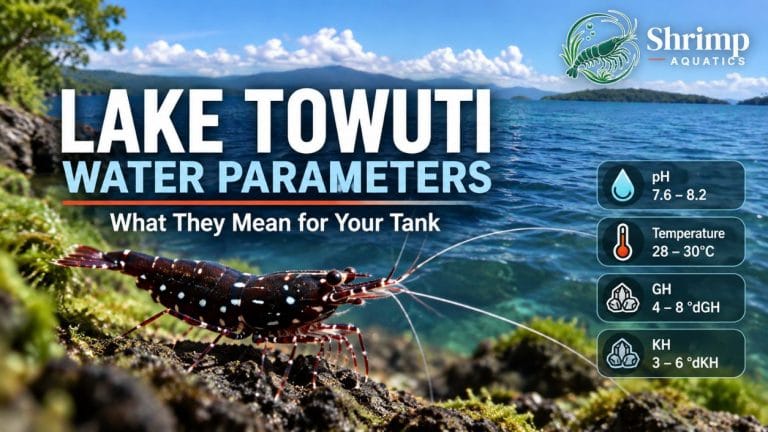
Whichever product you use, follow its current instructions for dose and mixing. Judge the batch by the finished pH, GH and TDS you measure. Your target for a Sulawesi tank is pH 7.5-8.5, GH 4-8 dGH and KH 3-6 dKH.
Can you keep plants in a Sulawesi tank without CO2?
Usually the CO2 question is really a plant question, so it’s worth answering directly. Yes, but the list of aquatic plants for a Sulawesi tank is short and the layout is different from an aquascape. Carpeting species and red stem plants depend on light, CO2, nutrients and the specific species, so a warm alkaline tank with low nutrients isn’t the place to attempt them.
Slow, undemanding epiphytes are the ones that work. Java fern, Anubias and Java moss are common low tech candidates. The rhizomes of Anubias and Java fern should sit above the substrate, attached to rock or wood. Don’t bury them. Attaching them to the hardscape suits this tank twice over, because the rock surfaces are also where biofilm and algae develop. Mature biofilm and aufwuchs are the grazing resource that matters most to Sulawesi shrimp. A tank that looks sparse to an aquascaper can be a well fed tank to the animals in it.
Requirements still vary by species and by your source water, so treat any plant as a candidate to test. Quarantine or rinse plants from unknown systems, which may carry pesticides, pests or treatments that are risky to shrimp.
If Sulawesi shrimp are already in a CO2 injected tank, turn the gas off first
Turning CO2 off raises pH, so the change itself is a change, and this group is sensitive to sudden pH changes and to rapid movement in hardness, TDS and temperature. Shut the gas off at once instead of tapering it over weeks, because every extra day is another acid cycle. Stop dosing liquid carbon at the same time, and let the tank settle while you watch pH, KH, GH and TDS for a few days. Keep water changes small and matched to the tank while it stabilizes.
The harder problem is usually the substrate rather than the gas. An active, pH lowering aquasoil is doing the same job as the CO2 and doesn’t switch off. An inert substrate and hardscape is the default for a Sulawesi setup for exactly that reason. A tank built on active soil is a soft water tank that needs rebuilding, whichever shrimp you put in it.
If you’d rather leave the planted tank as it is, the cleaner route is a separate tank run without gas. It’s easier to hold at pH 7.5-8.5 than a converted high tech system. It’s also the kind of system our tank-bred Sulawesi shrimp are already living in before they ship.
References
6 Sources
- Understanding the Science of Ocean and Coastal Acidification, U.S. Environmental Protection Agency, updated August 24, 2026.
- Alkalinity and Water, U.S. Geological Survey Water Science School, updated August 24, 2026.
- Biomineralizations: insights and prospects from crustaceans, Gilles Luquet, ZooKeys 176, 2012.
- Dissolved Oxygen and Water, U.S. Geological Survey Water Science School, updated August 24, 2026.
- Sulawesi Mineral 8,5, Minerals and trace elements, SaltyShrimp (Garnelenhaus), product technical page, no revision date shown.
- Sulawesi Mineral 7,5, Minerals and trace elements, SaltyShrimp (Garnelenhaus), product technical page, no revision date shown.
Ready to get started?
Shop our Sulawesi Shrimp collection
27 products available · Live Arrival Guarantee
Featured Sulawesi Shrimp
Sulawesi Red Line Blue Dot
Caridina sp. "Red Line Blue Dot"
Advanced · 79–86°F · pH 7.5–8.5
From $15.99View Product