
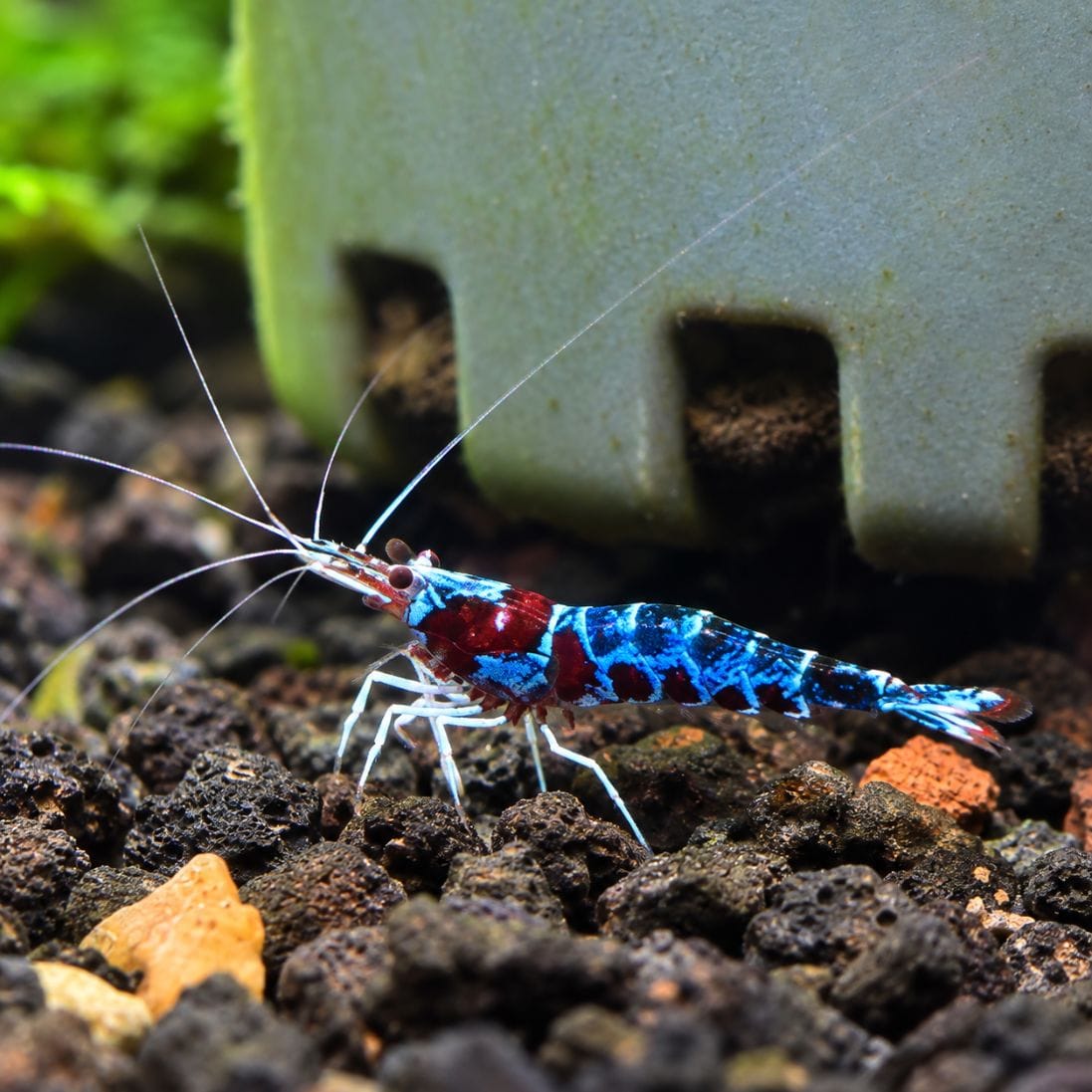
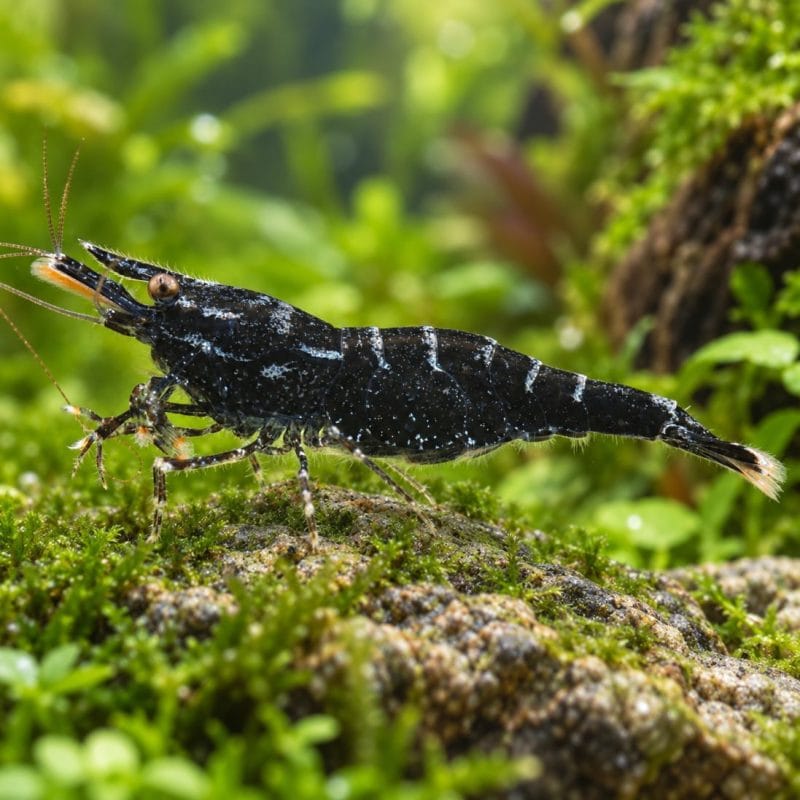
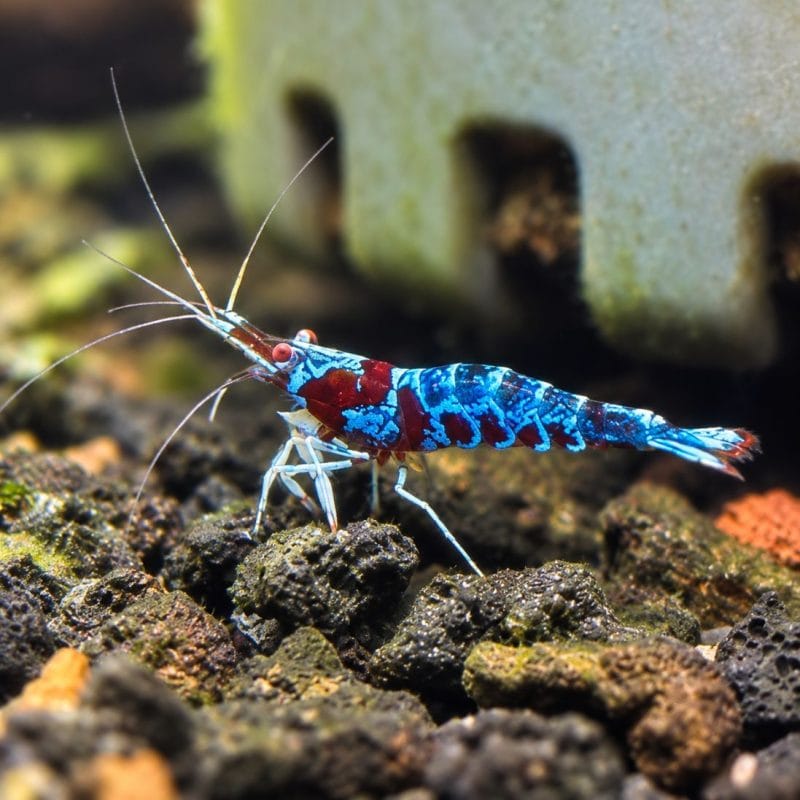
The Sulawesi Blue Sky is a blue color line of the cardinal shrimp, Caridina dennerli, a species that lives in the wild only in Lake Matano, Sulawesi, Indonesia. Ours are tank-bred by Shrimp Aquatics, not collected from the wild. They are lovely animals and expert-level ones. Before you order, answer one question: does your tank already hold warm, alkaline water you can keep steady?
Can your tank hold the warm alkaline water a Blue Sky needs?
These are the numbers we keep to for every Sulawesi lake species we sell. Treat them as a band to sit inside and hold, not a target to chase. Drift does more damage here than a reading that sits slightly off center.
| Difficulty | Advanced to expert |
|---|---|
| Temperature | 79-86°F (26-30°C) |
| pH | 7.5-8.5 |
| GH | 4-8 dGH |
| KH | 3-6 dKH |
| TDS | 150-250 ppm |
| Nitrate | Under 10 ppm |
| Substrate and rock | Inert only, with plenty of grazing surface |
| Tank | Mature and stable, with algae and biofilm already growing |
| Behavior | Peaceful and often shy |
Test your water before you order
If your KH sits below 3 dKH, or your heater can’t hold the tank inside 79-86°F (26-30°C) through the night, sort that out first and order later. You can’t rebuild warm alkaline water in a hurry with shrimp already swimming in it.
At Shrimp Aquatics, most of our Sulawesi systems currently run at TDS 150 ppm, GH 6-7 dGH and pH 7.5. If your own tank sits higher in the range, that’s fine. Just plan to bring the shrimp across to your numbers slowly instead of in one step.
Check these five things before your Blue Sky shrimp arrive
- Ammonia and nitrite both read 0 on a test you ran yourself, on a filter that has been working for weeks.
- Rock and glass carry visible algae and biofilm. That grazing surface is what the colony lives on day to day.
- One heater holds a single set point inside the range, and the room doesn’t drag the tank down overnight.
- Replacement water is mixed from RO water and a Sulawesi mineral outside the tank, then tested before it goes in.
- No active buffering soil. A bee shrimp soil pulls pH down where these shrimp need it held up.
Every line in our Sulawesi shrimp range wants that same water. If this list doesn’t describe your tank yet, swapping to a different Sulawesi line won’t rescue the order. Not sure? Email contact@shrimpaquatics.com with your pH, GH, KH, TDS, temperature, tank size and cycle status, and we’ll tell you honestly whether to wait.
Who can share a tank with Blue Sky shrimp?
Other Sulawesi lake shrimp and Tylomelania rabbit snails are the easy answer, because they want the same warm alkaline water and the same mature rock. Bee and Taiwan Bee Caridina are a no. Their soft, acidic water and this tank cannot both exist, whatever the genus says. Fish are the harder call. Even one sold as shrimp safe will take shrimplets, and in a tank this shy it keeps the adults off the open rock.
Several trade names in this group turn out to be the same species under different marketing, which matters if you plan to breed, and the types of Sulawesi shrimp page sorts out which name is which.
What Blue Sky shrimp eat in a mature tank
Most of the feeding is done by the tank. Biofilm, diatoms and soft algae on rock and glass are what they graze all day, which is why we ask for a matured tank and not simply a cycled one. Prepared food is occasional. The usual rule is a small pinch of a fine powdered or biofilm style food, offered sparingly, with anything left lifted out. Warm water breaks leftovers down fast, and that waste is the part that costs you.
How to settle Blue Sky shrimp on arrival day
Follow the instructions that come with your box first, because packing method, transit time and the species can all change the call. Shrimp Aquatics’ current shipment protocol is to equalize temperature with the bag still sealed, then move the shrimp across with a net or by direct transfer, and never to pour transport water into the aquarium.
After that, leave them be. Keep the lights low on the first day, skip feeding, and let them find the rock on their own. Shy behavior in the first week is normal for these shrimp, and a shrimp you can’t see is not automatically a shrimp in trouble.






There are no reviews yet.