
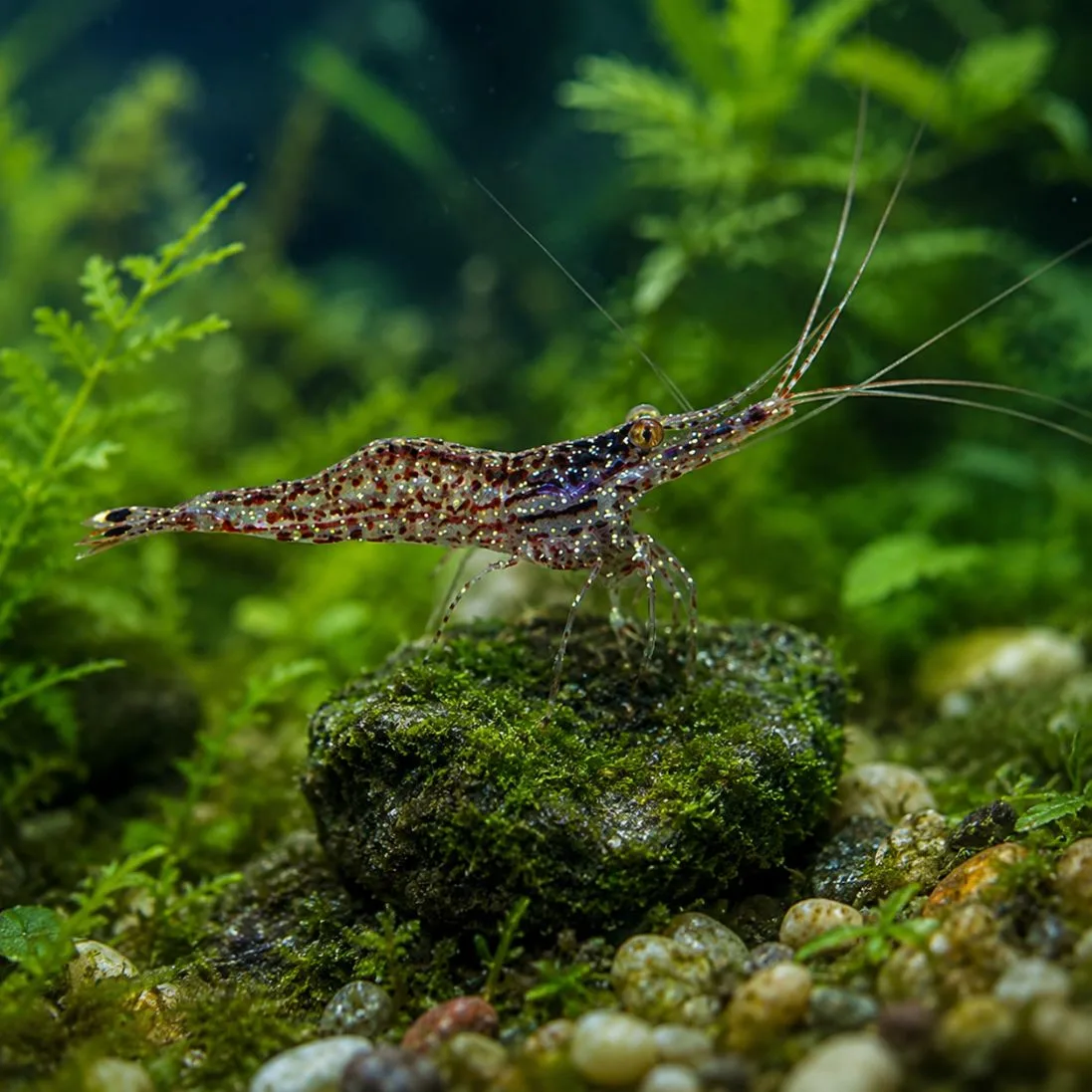
The White Orchid is a small hard substrate shrimp from Lake Poso in Central Sulawesi, and it suits a keeper who already runs a mature, warm, alkaline tank with plenty of bare stone to graze. If your tank is new, or set up for soft water Caridina, build the Sulawesi side first and order once the rock has grown in.
Which shrimp the White Orchid name refers to
White Orchid is the aquarium trade name for Caridina poso, a hard substrate dweller from Lake Poso. The species was described in 2021, and the described material came from three localities inside that one lake, which is the whole of its natural range. Orchid is a trade label rather than a group of related shrimp, so read the scientific name on any listing you compare this one against.
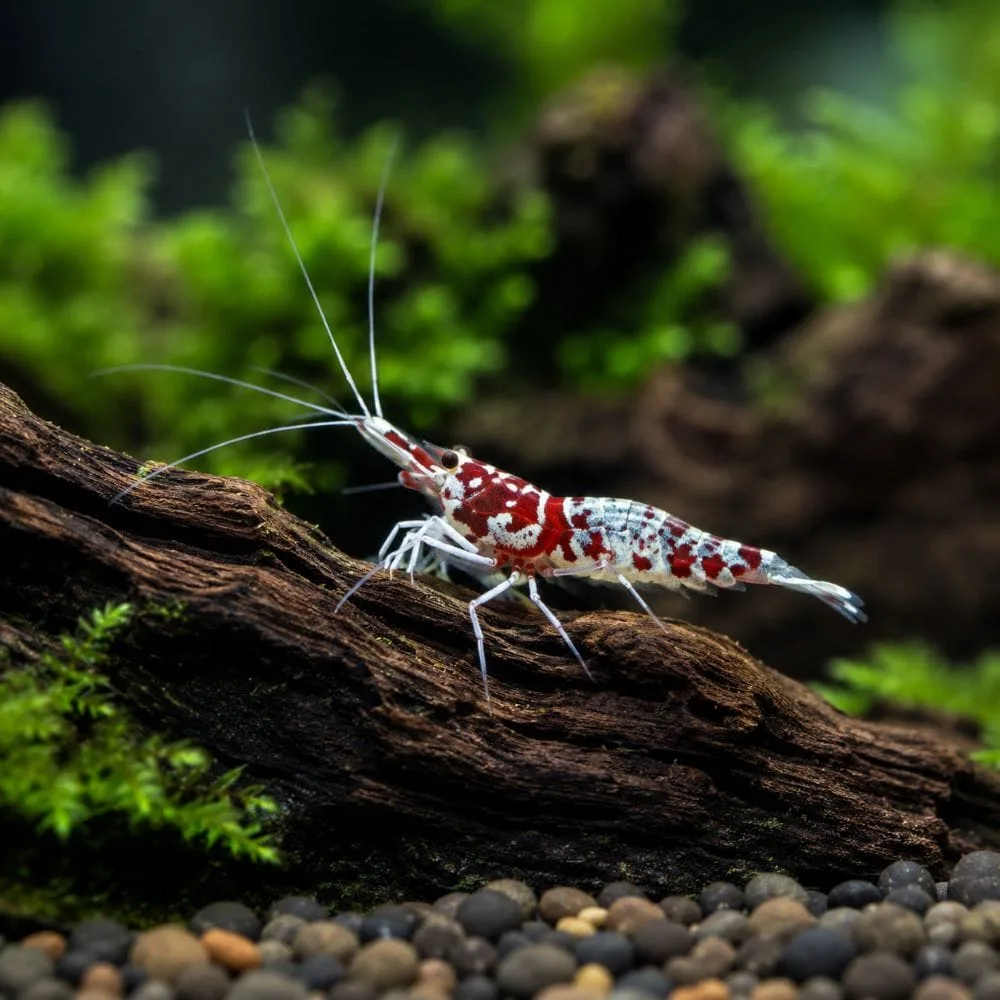
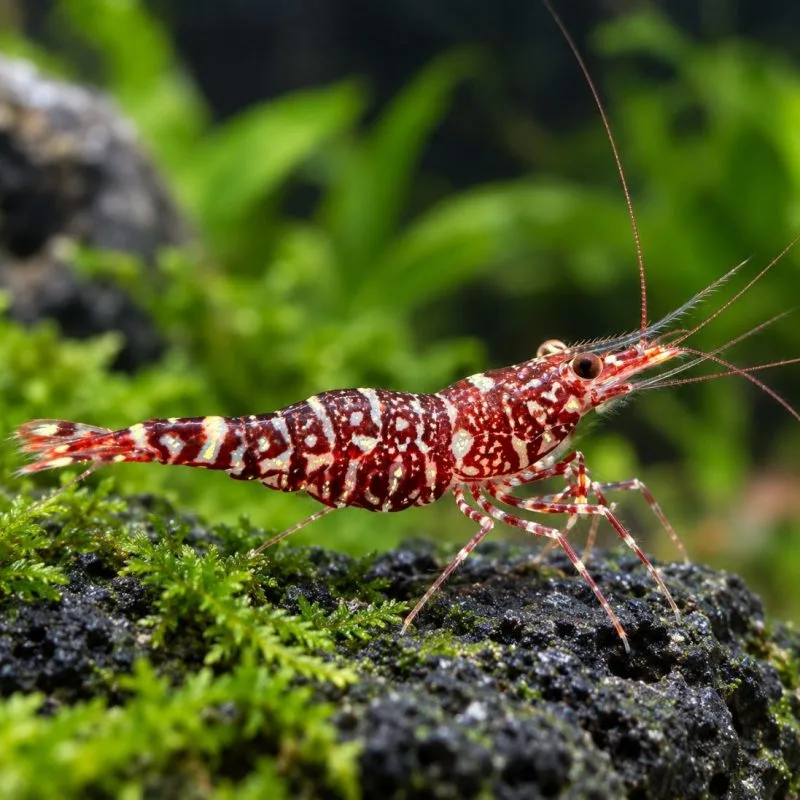
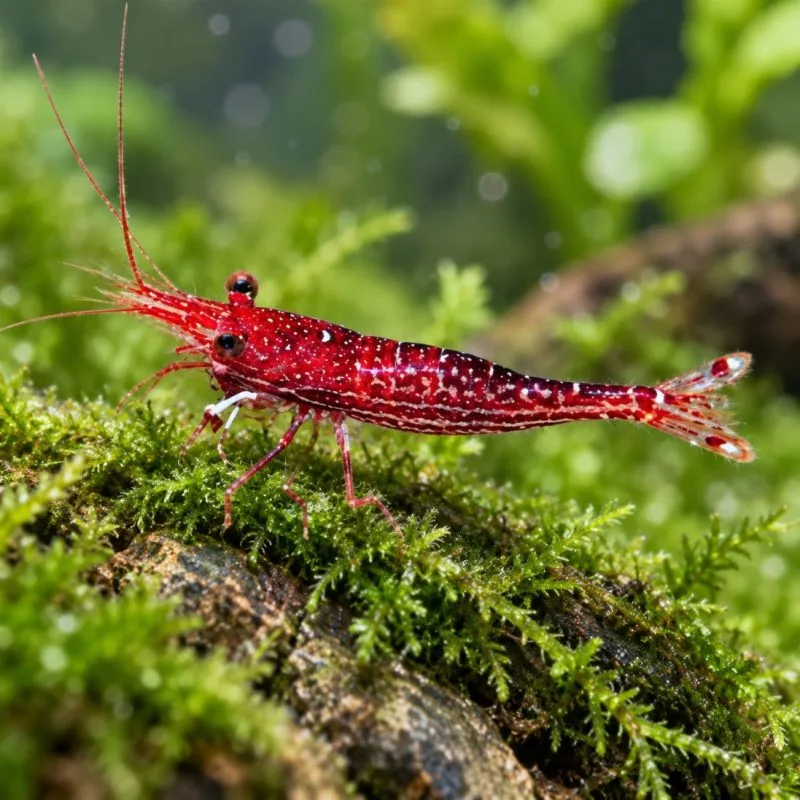
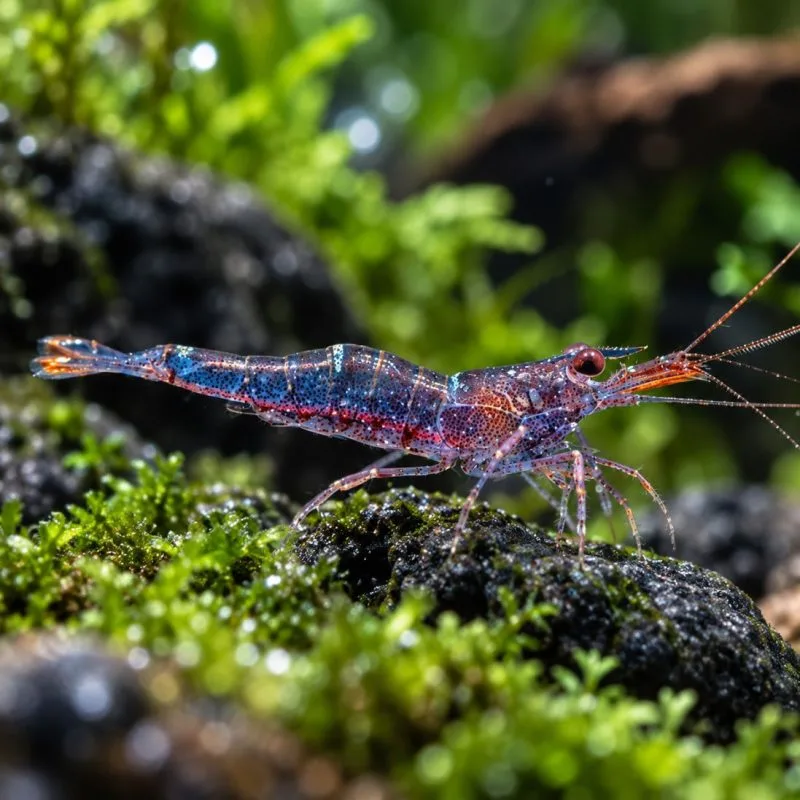
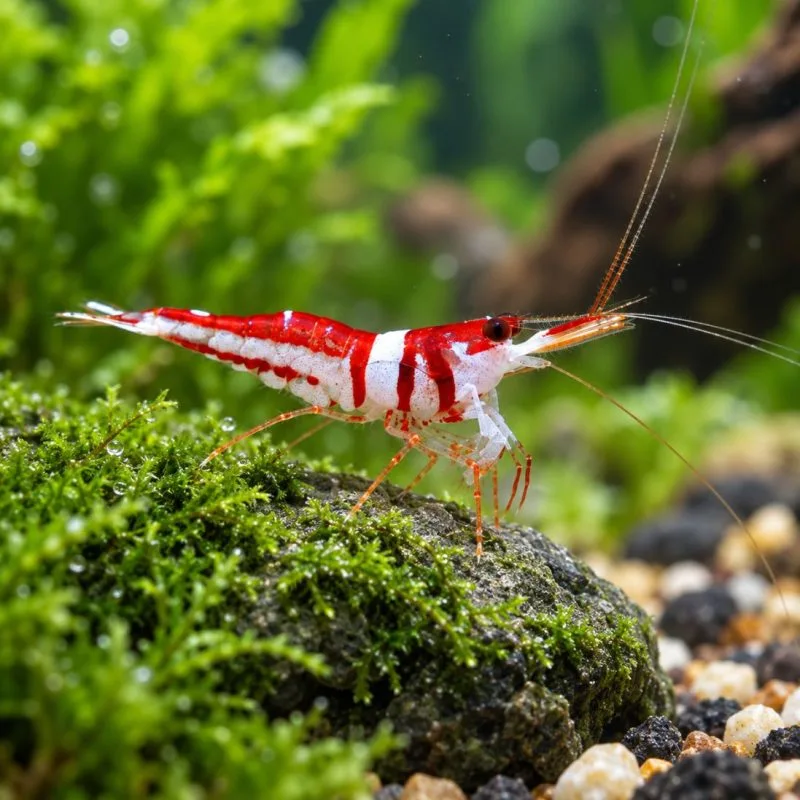
Live animals are mottled with reddish and white dots arranged in rows, with dark red antennae and white claws with red fingertips, and each side of the tail fan carries a black and white blotch. That tail fan mark is the quickest check against the two other long nosed Lake Poso species, since Caridina ensifera shows a dark red spot in the same place and Caridina caerulea, the Blue Leg Poso, an elongate blue blotch.
It is small even for a Sulawesi shrimp. Across 36 examined specimens the carapace, meaning the front shell section rather than the whole animal, measured 2.6-3.8 mm, against 3.5-5.3 mm in Caridina ensifera. Plan for a tank where you can still pick an animal that size out against dark stone, and guard any pump intake.
In the lake it lives in packs of debris made of small to medium sized stones close to the shore, and it was never found on soft substrates such as dead leaves, wood or water plants. That single sentence decides most of your hardscape and most of your feeding, which is why the tank below looks so bare compared with a planted Neocaridina setup.
Broods are small. The two egg carrying females measured in the original description held 5 and 9 eggs, each about 1 mm long. Those were wild animals and a sample of two, so treat it as a warning about pace rather than a number for your tank. This is not a shrimp that fills a tank in a season, and we cannot promise that a group will breed for you at all.
The shrimp we ship are bred by Shrimp Aquatics, not collected from the wild. That is worth knowing here, because the authors of the description recommend placing the newly described Lake Poso shrimp in the same IUCN category and criterion as the lake’s earlier described species, which were assessed as Vulnerable under criterion D2.
Can you hold 79-86°F (26-30°C) and pH 7.5-8.5 steadily?
| Difficulty | Advanced to expert |
|---|---|
| Temperature | 79-86°F (26-30°C) |
| pH | 7.5-8.5 |
| GH | 4-8 dGH |
| KH | 3-6 dKH |
| TDS | 150-250 ppm |
| Nitrate | Under 10 ppm |
| Substrate | Inert sand and rock, no active pH lowering soil |
| Tank | Mature and stable, with established grazing surfaces |
| Behavior | Peaceful and often shy |
These are typical Sulawesi reference ranges rather than survival limits, and what decides whether this shrimp settles is less where you sit inside each band than how little the readings move from week to week. Warm alkaline water is straightforward to hold once it is built and quick to lose, so plan on RO water remineralized with a Sulawesi mineral product rather than tap water. Tap chemistry varies by supply and by season, and you cannot reliably hold a target you cannot reproduce when you mix the next batch.
At Shrimp Aquatics, most of our Sulawesi systems currently run at TDS 150 ppm, GH 6-7 dGH and pH 7.5.
Those numbers sit at the lower end of the group range, and they are what your shrimp will have been living in before they are packed. If you aim there rather than at the middle of the bands, the change at your end on arrival day stays small.
Warm water carries less oxygen
Cold water can hold more dissolved oxygen than warm water, so a tank sitting at the top of this temperature range has less room for error than the same tank at 79°F (26°C). Give the surface real movement, and keep the flow gentle at the level where the shrimp actually graze.
What a White Orchid tank needs before the shrimp arrive
Almost everything that goes wrong with this species goes wrong before the shrimp are in the box. Work down the list, and if a line is not true yet, wait rather than order.
- A fully cycled tank reading 0 ammonia and 0 nitrite, with an established biological filter. Time on the calendar does not prove a tank is cycled.
- Visible algae and biofilm on the hardscape, not clean new stone. The grazing surface is the food supply, and it takes months rather than days.
- Stacked stone with crevices, matching the rock piles the species occupies in the lake.
- Inert sand and inert rock, so the substrate is not working against your pH and carbonate hardness.
- Active shrimp soils, which are built to pull pH down for the opposite kind of Caridina.
- Heavy wood and leaf litter loads, which belong to a different sort of shrimp tank.
- A heater that holds the range without swinging, plus a thermometer you read rather than trust.
Who can share a tank with these shrimp
For a shrimp this small, the honest answer is that a species tank is the version that works. White Orchids are peaceful and often shy, and a fish that behaves around adult shrimp will still take shrimplets, so no fish is safe for a colony you are trying to grow. If you want fish anyway, the water narrows the field before temperament does, because whatever you choose has to be genuinely comfortable in the range above rather than merely able to survive it.
Sulawesi Tylomelania snails are the usual companions and share the warm alkaline requirement, though many of them are kept a little cooler than the top of this range, so check the individual snail listing before you combine them. Bee and Crystal Caridina are not an option in the same water, whatever the shared genus suggests.
What mixing White Orchids with other Sulawesi species risks
Sulawesi Keepers, a nonprofit conservation organization, reports from keeper experience that Sulawesi shrimp species can interbreed in aquariums, at a low chance for any given pairing, and names crossings such as Yellow Ring (Caridina spinata) with White Socks (Caridina dennerli). That is keeper observation rather than a controlled study, and Caridina poso is not among the pairings they document, so a mixed Lake Poso tank is an open question rather than a measured risk. Their own recommendation, made on conservation grounds, is to keep species in separate tanks.
If you want a second line, a second tank is the safer route, and every Sulawesi shrimp line we keep wants the same water, so the duplicate setup is less work than it sounds.
How much you actually feed a White Orchid colony
Mature biofilm, aufwuchs and algae on the rock do most of the feeding in a system like this, and prepared food is a supplement rather than the main course. Acceptance varies by species, tank and food, so watch whether an offering is actually eaten and take out whatever is left within a few hours.
Restraint is a water quality decision as much as a feeding one. The nitrate target here is under 10 ppm, which leaves little headroom for food breaking down in warm water. Feeding more also does not make up for a tank that is not mature yet. The grazing surfaces have to be there first, and no amount of powdered food substitutes for them.
What to do on the day your White Orchids arrive
Order for a week when you can be home for the delivery, and have the tank at temperature and tested before the shrimp are dispatched rather than on the day they land. When the box arrives, bring the sealed bag up to tank temperature before anything else, because a sudden temperature change is its own shock, then follow the acclimation instructions supplied with your order. Packing method, transit time and species all change what the right approach is, so the sheet in the box beats a general routine. Do not pour transport water into your aquarium.
Give them a dim, quiet first day and hold off on feeding until you see them grazing. If you are not certain your water is ready, email contact@shrimpaquatics.com with your pH, GH, KH, TDS, temperature, tank size, cycle status and current livestock before you order, and we will tell you plainly whether to wait.

There are no reviews yet.