
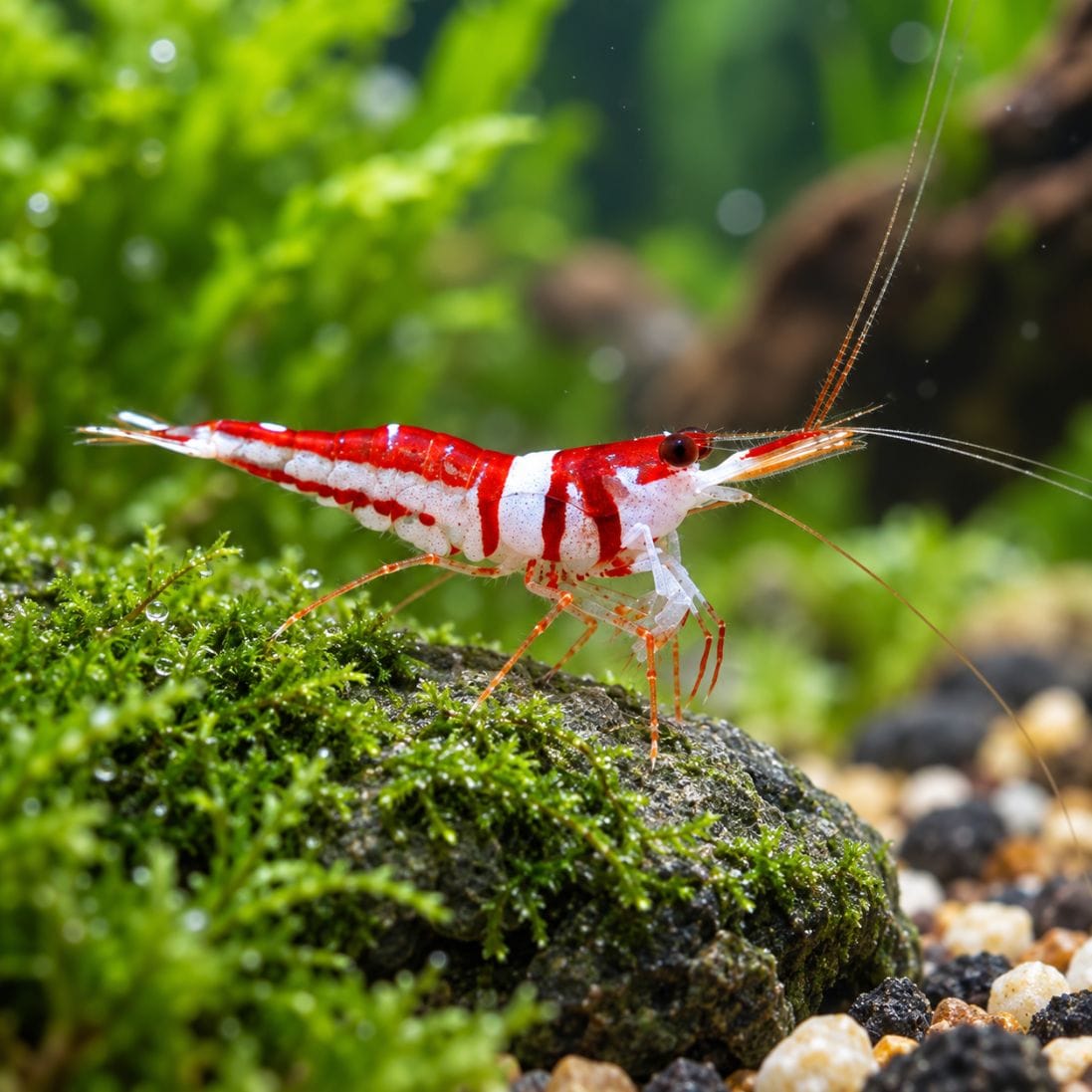
The Sulawesi Harlequin (Caridina woltereckae) is a small rock grazer from Lake Towuti in Indonesia, banded in deep red and white. It’s advanced to expert livestock. Ours is tank-bred by Shrimp Aquatics, and that doesn’t soften what the species asks of your water.
What you get when you order a Sulawesi Harlequin
Every Harlequin we ship is tank-bred by Shrimp Aquatics, not collected from the wild. Adults carry three bold crimson bands over a white body, and the legs and antennae are ringed in the same red and white. They graze rock almost constantly, hide in crevices by day and come out as the light drops. In a tank of open sand and plants, you’ll barely see them.
One thing to check before you compare listings anywhere. The name Harlequin also gets used for a smaller sponge dwelling relative from the same lake, sold under the same trade name. If a listing doesn’t say Caridina woltereckae, ask which shrimp it is.
The water a Sulawesi Harlequin needs from day one
| Difficulty | Advanced to expert |
|---|---|
| Temperature | 79-86°F (26-30°C) |
| pH | 7.5-8.5 |
| GH | 4-8 dGH |
| KH | 3-6 dKH |
| TDS | 150-250 ppm |
| Nitrate | Hold under 10 ppm |
| Substrate | Inert sand and rock, never an active soil |
| Diet | Biofilm, diatoms and algae grazed off hard surfaces |
| Behavior | Peaceful and shy, most active in low light |
Holding Sulawesi shrimp water parameters steady matters more than hitting a perfect number. A tank that drifts every week is harder on these shrimp than one sitting at the wrong end of the range and staying there.
Test your own water before you order
Measure temperature, pH, GH, KH and TDS on the tank they’re going into, not the tank you’re planning. If a reading sits outside the range above, or you’re still mixing water, order once the tank is holding.
At Shrimp Aquatics, most of our Sulawesi systems currently run at TDS 150 ppm, GH 6-7 dGH and pH 7.5. You don’t have to copy that, and a tank sitting higher in the range is fine. The closer your water is to ours, the less these shrimp have to adjust in their first week.
Is your tank mature enough for a Sulawesi Harlequin?
- Ammonia and nitrite both read 0, on a filter that has been carrying a load.
- Rock and glass carry visible biofilm and a brown diatom film. A clean new tank is a starving tank for a grazer.
- Temperature holds inside 79-86°F (26-30°C) overnight and through a warm afternoon.
- KH sits at 3-6 dKH, so pH isn’t sliding between water changes.
- Replacement water is mixed outside the tank from RO plus a Sulawesi mineral, then tested before it goes in.
- Substrate and hardscape are inert, with no soil, driftwood or crushed coral moving your chemistry around.
If one of those is still a no, wait. A calendar doesn’t prove a tank is ready, and the usual way people lose a first Sulawesi order is stocking a tank that cycled but never matured.
What can share a tank with Sulawesi Harlequins
The safest tankmates are other Sulawesi lake species kept in the same warm, alkaline water, so start a stocking list with the rest of our Sulawesi shrimp lines rather than a mixed community. Bee and Crystal Caridina aren’t an option here, because the soft, acidic water they need is the opposite of this tank. Neocaridina sit below this temperature range, so a cherry colony held at Sulawesi heat is outside the water it suits, and it competes for the same grazing surfaces. Fish are a judgment call on adult size and feeding position, and none of them are safe around shrimplets.
The first week after your Sulawesi Harlequins arrive
Follow the instructions packed with your order first, since packing method and transit time change the decision. The usual approach is to equalize temperature with the bag still sealed, then move the shrimp across without letting shipping water into the tank. Keep the lights low, skip feeding on arrival day and leave them alone.
After that, biofilm does most of the feeding. Prepared food stays occasional and small, and anything uneaten comes back out within a few minutes rather than sitting on the rock. We’d rather underfeed a Sulawesi tank than clean up after one.
Give the colony a couple of weeks before you judge it. Shrimp that graze in the open, molt cleanly and hold their color are telling you the tank is working, and that’s when it’s worth adding more.






There are no reviews yet.