

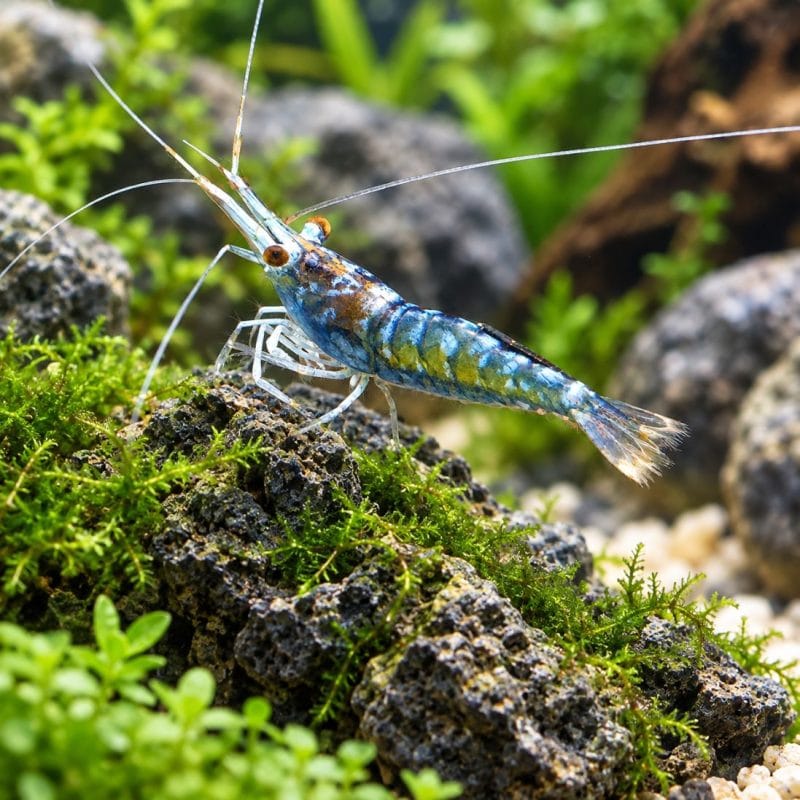
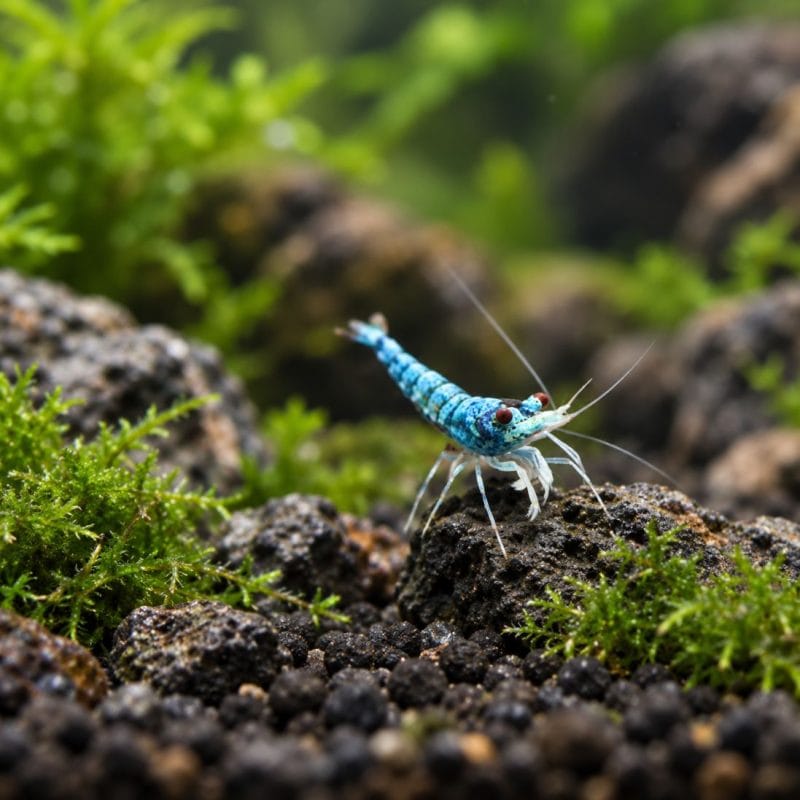
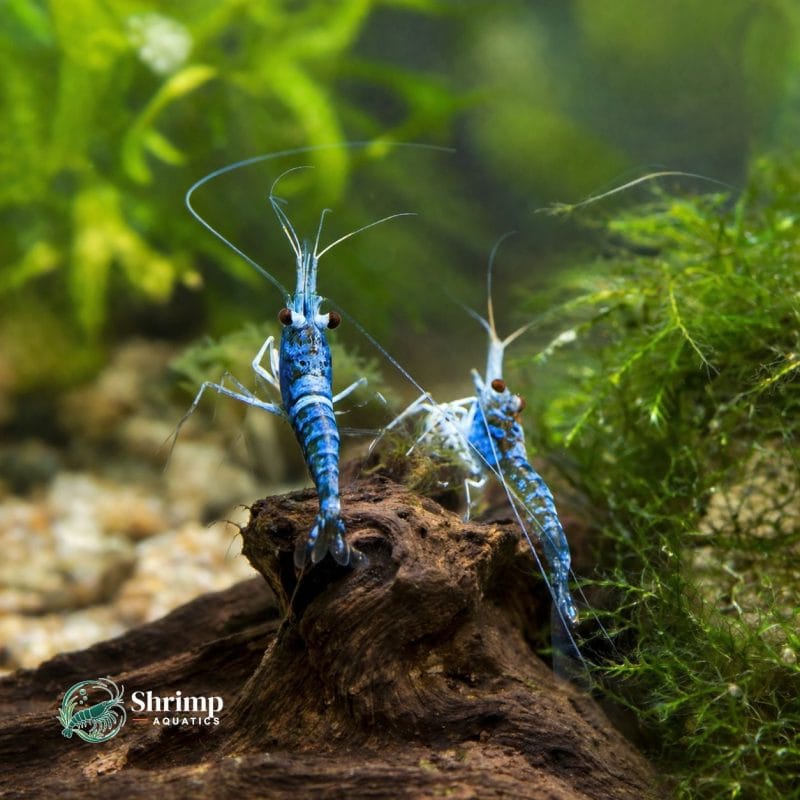
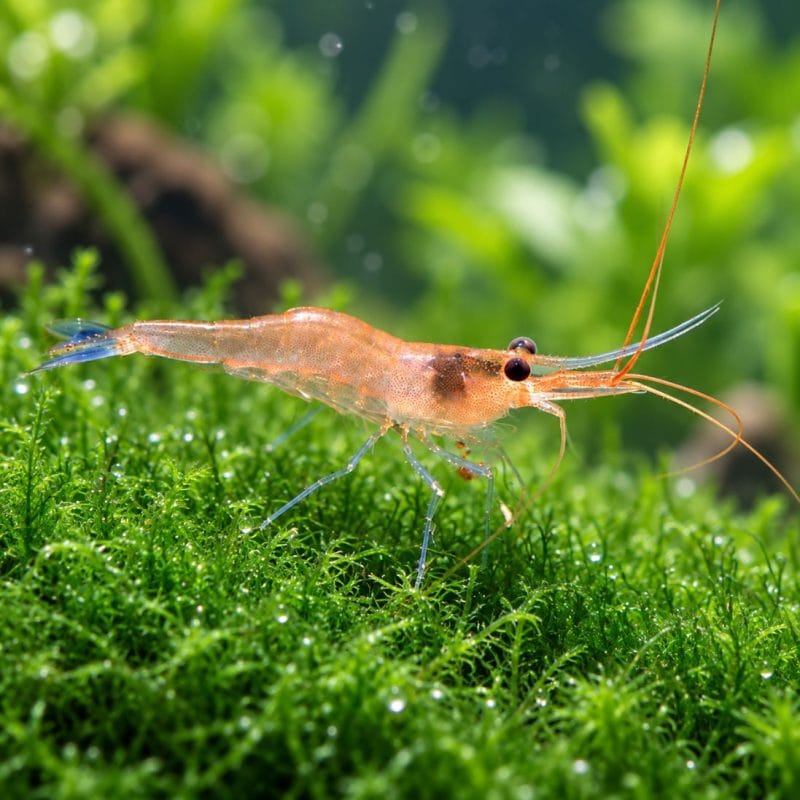
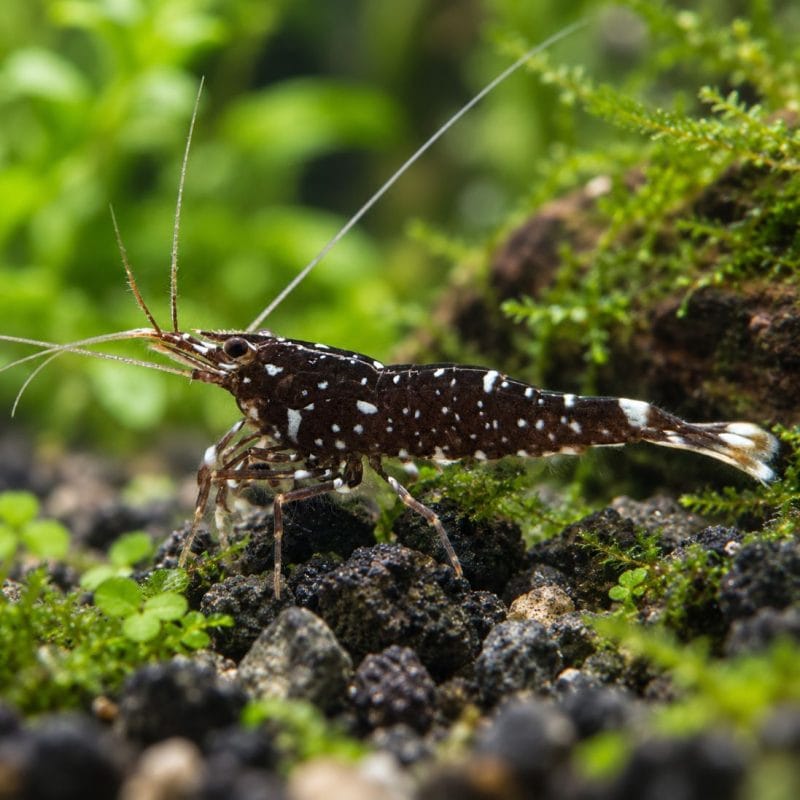
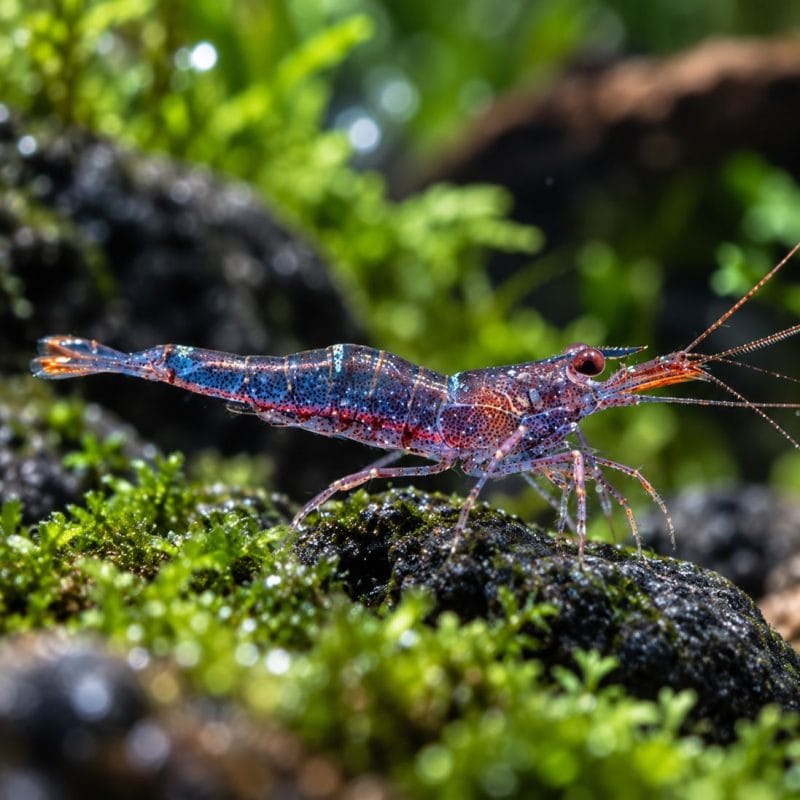
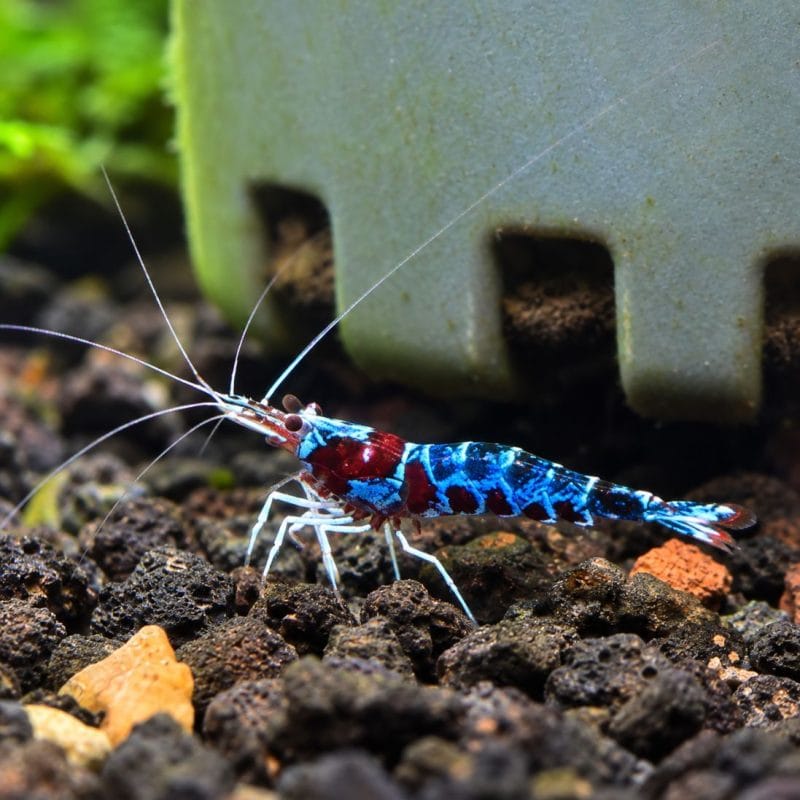
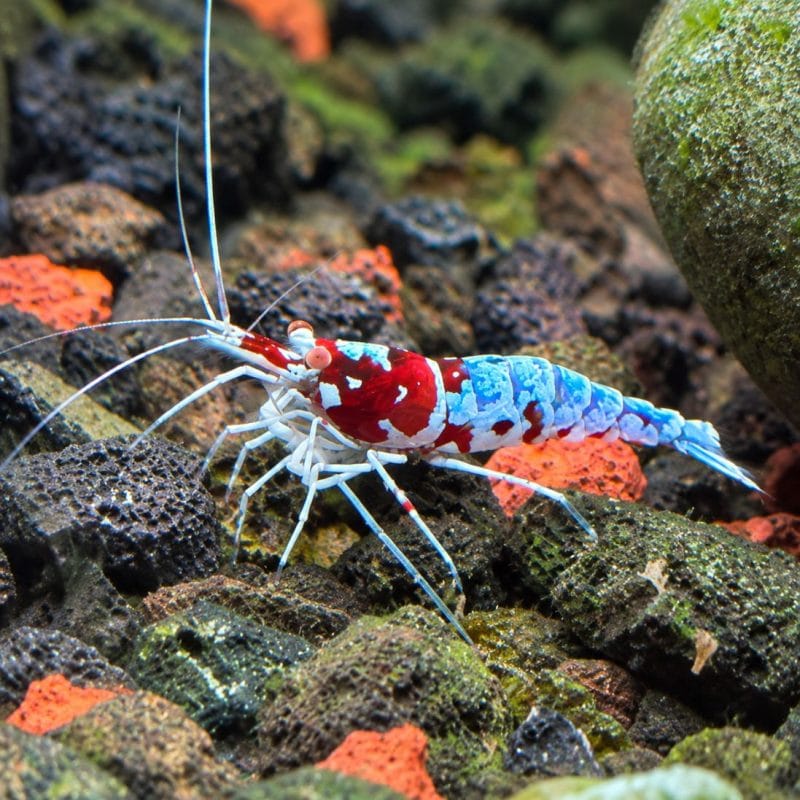
Sulawesi Blue Ghost is a captive-bred blue color line of Sulawesi lake Caridina (Caridina dennerli), tank-bred by Shrimp Aquatics and not collected from the wild. It belongs in a mature, warm, alkaline shrimp tank that is already running at Sulawesi values, and it stays an advanced to expert animal no matter how settled your other shrimp are.
Check your tank against Blue Ghost water targets before you order
Your water decides this purchase. Two numbers you will not find in the Quick Reference on this page matter just as much as the ones you will: KH 3-6 dKH, which is what keeps the pH from sliding, and nitrate held under 10 ppm. A steady value inside the range is worth more than a perfect number that moves, so test your own tank over a few days rather than once.
- Your heater holds the tank inside 79-86°F (26-30°C) all year, including the warmest afternoon of the week.
- pH stays inside 7.5-8.5 and does not fall overnight.
- KH sits inside 3-6 dKH, so the pH has something holding it up.
- TDS sits inside 150-250 ppm and stays flat week to week instead of creeping up from top-offs.
- Ammonia and nitrite read 0 ppm and nitrate stays under 10 ppm.
If your numbers sit outside those ranges, fix the tank before you order rather than after the shrimp land. Our Sulawesi shrimp care parameters guide covers building the water from RO, holding KH up and stopping mineral creep from top-offs. If you would rather have a second opinion first, email contact@shrimpaquatics.com with your pH, GH, KH, TDS, temperature, tank size, cycle status and current livestock, and we will tell you honestly whether this line fits.
Blue Ghost needs grazing surfaces, not just the right numbers
A tank can test perfectly and still be too young for this line. Blue Ghost grazes almost continuously, and what it grazes is the algae and biofilm already growing on rock, hardscape and glass. In our Sulawesi systems, mature algae and biofilm do most of the feeding. We offer prepared food only about once a week and remove the leftovers, because food that sits in warm water adds organic waste and can raise ammonia, nitrite and nitrate as it breaks down.
- Ammonia and nitrite read 0 ppm and the biological filter is established, not just recently seeded.
- Rock and hardscape carry visible algae and biofilm rather than bare, scrubbed surfaces.
- The substrate is inert. Active, pH-lowering aquasoil works against every target above.
- The water surface actually moves, because warm alkaline water holds less oxygen. Our guide on whether Sulawesi shrimp need an air stone or just a filter shows how to check yours.
Do not rush a young tank Adding food or aeration does not mature a tank. If the system is new, wait for stable chemistry, 0 ammonia, 0 nitrite and visible grazing surfaces before you place the order.
Which tankmates and Sulawesi lines can share a Blue Ghost tank
Give Blue Ghost its own Sulawesi tank if line purity matters to you. In our Sulawesi systems we treat White Sock, Blue Ghost, Yellow Ghost and Oiran as lines that may cross when kept together. The offspring we have observed have not shown the same obvious color fading that we have seen after uncontrolled mixing in some Neocaridina or Bee/Crystal Caridina lines, but a mixed tank still means you no longer control what the blue line produces.
| What you already keep | Can it share the tank | What to watch |
|---|---|---|
| A Sulawesi-only tank at matching parameters | Yes | The simplest way to keep the line clean and the grazing surfaces uncontested. |
| Other named Sulawesi shrimp lines | With a trade-off | Water fits, but White Sock, Yellow Ghost and Oiran may cross with Blue Ghost when kept together. |
| Sulawesi snails such as Tylomelania | With a trade-off | Parameters overlap, but snails graze the same surfaces. Watch total stocking and how fast the biofilm is cleared. |
| A few Neocaridina | With a trade-off | The Neocaridina reference range is 65-78°F (18-26°C), so the overlap with a Sulawesi tank is narrow. See the note below before you try it. |
| Bee, Crystal or Taiwan Bee Caridina | No | They need soft, acidic, cooler water. One tank can’t meet both sets of water needs. |
| Fish | No | Fish described as generally shrimp-safe can still eat shrimplets and sometimes adults. Leave them out of a colony you want to grow. |
One more check before you add shrimp to an existing tank: if you have dosed it with a fish medication recently, read the actual formulation. Copper and some fish medications can harm shrimp and snails, and a product being sold for a planted community tank is not evidence that it is safe for invertebrates.
How many Blue Ghost shrimp to order for a colony
Blue Ghost is peaceful and often shy, and how much you see of it depends heavily on the environment. If a colony is the goal rather than a display pair, order a group. We build our own Sulawesi breeding groups from ten shrimp, which is a useful benchmark for a starting group in a tank that is already mature. If you are still deciding which line to start with, our Sulawesi shrimp collection shows what else is currently available at the same water targets.
The male-to-female split we use in our own breeding groups
When we can sex the shrimp with reasonable confidence, we usually build a Sulawesi breeding group with either 2 males to 8 females or 3 males to 7 females. We use a female-heavy group to reduce mating pressure on newly molted females, which are still soft and vulnerable, and we confirm sex from several visible cues rather than one. Juveniles are difficult to sex, so we do not promise the sex or the sex ratio of a shipped group unless that exact stock has been verified.
Settling a Blue Ghost order into your tank on arrival
Open the parcel as soon as it arrives and work from the instructions supplied with your order, because the packing method, the transit time and the species in the bag all change the right call. Shrimp Aquatics’ current shipment protocol for eligible long-distance orders arriving in a sealed transport bag is to equalize temperature first, then transfer the shrimp without adding shipping water to the aquarium.
- Keep the bag sealed and let it come to tank temperature before you open it.
- Follow the instructions supplied with your order. They are written for the packing method used for that shipment.
- Transfer the shrimp into the tank and leave the transport water out.
- For the first week, test ammonia, nitrite, temperature and TDS and change as little as possible in the tank.
Never do this Do not pour transport water into your aquarium, and do not top the tank up with remineralized water to replace evaporation, which drives GH, KH and TDS upward week after week.
If overnight temperatures at your destination are cold, or you are unsure what your country allows for live invertebrates, ask us before you order rather than after the parcel is booked.




There are no reviews yet.