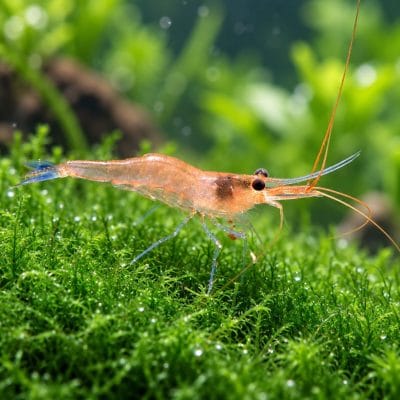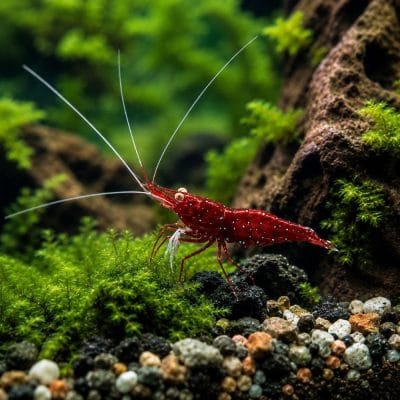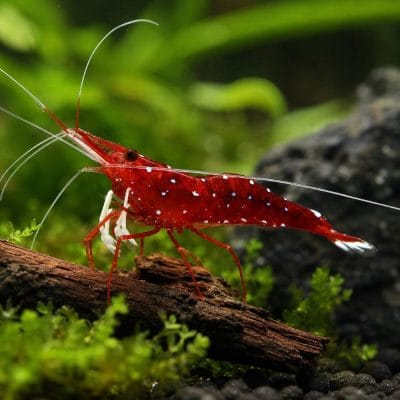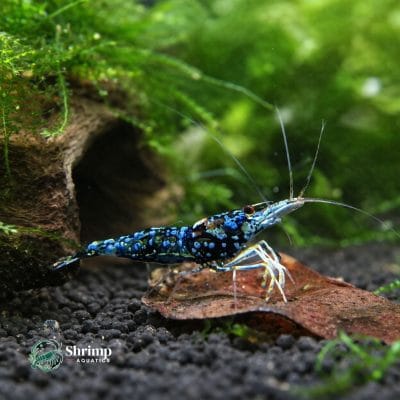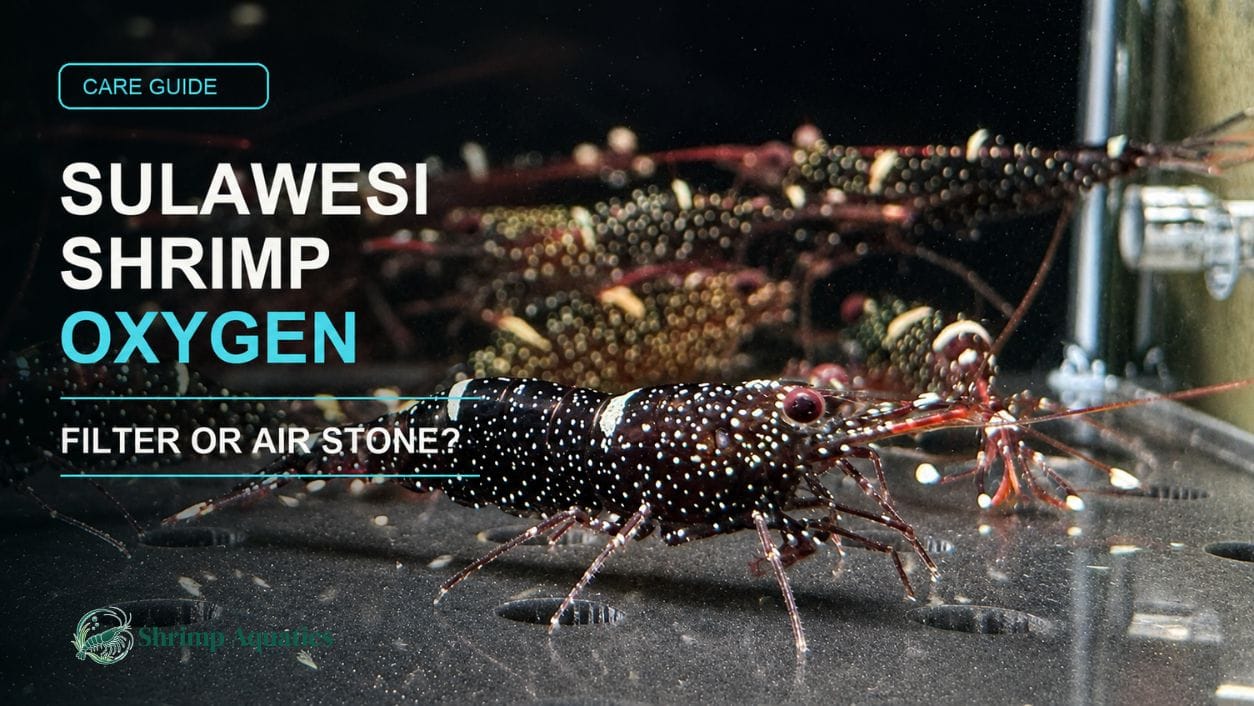

A filter is enough for Sulawesi shrimp when it keeps the water surface moving. Filters driven by an air pump, airlift undergravel plates and trickle systems already do that, so a separate air stone is optional. A sealed canister filter with a submerged return usually leaves the surface flat, and that setup does need an air stone or a spray bar at the waterline. This guide covers the lake-system Caridina group sold as Sulawesi shrimp, including Cardinal, Oiran, White Sock and Blue Leg lines.
- Surface agitation
- Movement of the top film of water, where oxygen actually enters and carbon dioxide leaves. This is what you’re buying when you aerate.
- Flow
- How fast water moves through the tank. Strong flow at shrimp level doesn’t prove good gas exchange, and a fast pump with a submerged outlet can leave the surface completely still.
Why Warm, Alkaline Sulawesi Tanks Run Closer to the Oxygen Limit
Most shrimp keepers can be relaxed about aeration because their tanks sit cool and near neutral. A Sulawesi tank gives up that margin twice over. The typical reference range for this group is 79-86°F (26-30°C) at pH 7.5-8.5, which is warmer and more alkaline than almost anything else in the freshwater shrimp hobby. Both of those numbers work against you at the same time, and that’s the real reason aeration gets discussed so much for these animals.
Warm Water Holds Less Oxygen at Every Point in the Sulawesi Range
The ceiling on dissolved oxygen falls as water warms. At sea level, fresh water saturates at roughly 8.1 mg/L at 79°F (26°C) and only about 7.6 mg/L at 86°F (30°C).1 Those are ceilings, not readings. They’re the most your tank could hold if gas exchange were perfect and nothing in the tank were consuming oxygen, which is never the case.
Running at the warm end of the range therefore costs you oxygen headroom before a single shrimp has taken a breath. It doesn’t mean you should keep the tank cool. It means the same interruption in gas exchange has less slack to absorb at 86°F (30°C) than it would in a cooler tank.
Alkaline Sulawesi Water Turns Ordinary Ammonia Into a Faster Problem
Ammonia in water sits in two forms: ionized ammonium, which is comparatively mild, and un-ionized ammonia, which is roughly a hundred times more toxic. The split between them is set mostly by pH and temperature, and the toxic share climbs as both rise.2 Read against the published fraction table, water at pH 7.5 and 79°F (26°C) holds close to 2 percent of its total ammonia in the toxic form. The same total ammonia at pH 8.5 and 86°F (30°C) holds close to 20 percent.2
That’s the same tank, the same test kit reading, and roughly ten times the toxic exposure depending on where in the accepted range you sit. It’s why a small feeding mistake behaves differently here than in a Neocaridina tank, and why the biofilter has to keep working without pause.
A Sulawesi Biofilter Competes With the Shrimp for the Same Oxygen
Nitrification is an aerobic process. The bacteria that convert ammonia to nitrite and nitrite to nitrate need oxygen and alkalinity to function, and if oxygen isn’t sufficient they slow down or die off, which lets ammonia and nitrite climb.2 Published aquaculture guidance treats a drop below 5 mg/L as the point where low oxygen begins limiting that conversion.2
The warm alkaline water itself is set by the Sulawesi shrimp care parameters; this page is about what that water does to oxygen.
So aeration in a Sulawesi tank isn’t only about the shrimp breathing. It protects the process that keeps the water non-toxic in exactly the conditions where ammonia is most dangerous. A tank that loses gas exchange loses both at once, which is why the failure tends to look sudden.
Before you change anything
None of this substitutes for a fully cycled, mature Sulawesi shrimp tank. Stock only when ammonia and nitrite read 0 and the system has been stable, with established grazing surfaces. Adding aeration to an immature tank doesn’t make it ready.
Does Your Sponge, HOB or Canister Filter Aerate a Sulawesi Tank Enough?
Air stones and filters aren’t really competing products. A rising bubble stream transfers some oxygen directly and, just as importantly, carries water up so it turns over at the surface, which is how diffused aeration systems are designed to work.3 Any filter that produces the same effect is doing the air stone’s job. What follows is a reading of each common design against that single test, so match your equipment to the row rather than to the general reputation of the category.
| Filter type | Does it move water to the surface? | Separate air stone needed? | Watch for |
|---|---|---|---|
| Sponge or Matten, driven by air pump | Yes, the air pump is the drive and the outlet breaks the surface | Optional, useful only as a backup | Air pump failure takes filtration and aeration together |
| Undergravel plate on an airlift | Yes, the airlift column vents at the surface | Optional | Substrate clogging reduces the lift over time |
| Trickle or wet-dry tower | Yes, water falls through air before returning | Not usually | Pump intake needs a guard for shrimplets |
| Hang on back | Only while the return actually falls onto the surface | Situational | Topping the tank up too high drowns the fall and stops the exchange |
| Canister, submerged return | No, the loop is sealed and the surface stays flat | Yes, unless you fit a spray bar at the waterline | Strong flow here can hide the fact that gas exchange is poor |
| Internal powerhead, submerged outlet | No, unless aimed to ripple the surface | Yes, unless the outlet is redirected | Aiming it upward can push shrimp off grazing surfaces |
There’s an honest limit to that table. It reflects how each design moves water and where it puts the return, and no published study compares these filter types specifically in Sulawesi shrimp systems. Treat it as a starting verdict that the next section asks you to confirm in your own tank.
The setup that fails quietly
A canister filter with the outlet pointed sideways below the waterline is the combination that catches keepers out. The tank looks busy, the shrimp are being pushed around, and the surface hasn’t moved all week. Strong current and good oxygenation aren’t the same thing.
At Shrimp Aquatics, our Sulawesi systems use biological filtration together with a Kaldnes moving-bed filter. The combination gives us strong aeration and active biological media, but we tune the outlet so the shrimp aren’t pushed around while grazing. The goal is high oxygen with gentle movement at shrimp level. Tank size, bioload, media volume and pump output still change what works for you.
Which filter for Sulawesi shrimp suits your colony is a separate question from whether it aerates enough, and the two answers don’t always agree.
Test Your Own Sulawesi Tank Instead of Trusting the Filter Label
Filter categories are a shortcut. Two keepers running the same model can get opposite results depending on water level, outlet angle and how much surface film has built up. Check the tank in front of you, and check it after any change to the hardscape, water level or filter media.
- Look along the surface at eye level. You want continuous visible ripple, not a mirror.
- Measure dissolved oxygen with a test kit or meter rather than inferring it from flow.
- Test ammonia and nitrite at the same time. A stalling biofilter and low oxygen usually appear together.
- Check the surface for an oily protein film, which blocks gas exchange even when a pump is running.
- Repeat the check on the warmest afternoon of the week, when the ceiling is at its lowest.
- Don’t judge oxygen by how fast the shrimp are moving. Reduced grazing and lethargy are late signals, and low oxygen changes respiratory metabolism in freshwater decapods well before behavior makes it obvious.4
If the surface is flat and the reading is low, change one thing at a time. Raise the outlet, fit a spray bar above the waterline, or add an air stone, then measure again after the tank has settled. Sulawesi shrimp respond poorly to abrupt change, so avoid rebuilding the whole filtration system in a single afternoon.
Add a Backup Air Stone Even When Your Sulawesi Filter Is Enough
Adequate under normal running conditions isn’t the same as safe when something stops. Because the oxygen ceiling is already low at these temperatures and the biofilter’s ammonia conversion depends on oxygen, a Sulawesi tank has less time in hand after a failure than a cooler tank does. Many experienced keepers run a second, independent source of aeration for that reason alone.
Your filter alone is enough if
It’s driven by an air pump, or it returns water through a visible fall or an airlift, the surface ripples continuously, and your dissolved oxygen reading holds up on a warm afternoon.
Add an air stone now if
You run a sealed canister or a submerged powerhead outlet, the surface is flat or filmed over, or your dissolved oxygen reading sits low while ammonia or nitrite is creeping up.
Add one anyway if
Your area has power cuts, your aeration and filtration share a single air pump, or the tank runs at the top of the temperature range. A second air source on a separate pump costs little and removes the single point of failure. Battery backup pumps exist for this; check the current runtime rating on the specific model rather than assuming it covers a long outage.
A surface film deserves its own mention. Mature Sulawesi tanks are meant to grow biofilm and algae, and that same productivity can leave a protein layer sitting across the top of the water. A bubble stream breaking through that layer keeps the exchange open in a way that a smooth horizontal current won’t.
Aeration is one part of building a stable tank, and the beginner guide to keeping Sulawesi shrimp puts it beside heating, hardscape and filtration where it belongs.
The decision at the end of all this is narrow and practical. Look at your surface, measure your oxygen, and match the result to your filter type. If the filter is already moving water across the air boundary, you don’t need an air stone to keep Sulawesi shrimp. If it isn’t, no amount of flow rate or media volume will make up for it, and adding aeration is the correction to make before you add livestock.
Settle the aeration question before you order tank-bred Sulawesi shrimp, because a tank that runs close to its oxygen limit shows it first in the newest arrivals.
References
4 Sources
- DOTABLES: Dissolved oxygen solubility tables, U.S. Geological Survey, accessed July 20, 2026.
- Ammonia in Aquatic Systems (FA16/FA031), University of Florida IFAS Extension, revised May 13, 2024, accessed July 20, 2026.
- The Role of Aeration in Pond Management (FA6/FA021), University of Florida IFAS Extension, revised September 16, 2024, accessed July 20, 2026.
- Respiratory Metabolism Responses of Chinese Mitten Crab, Eriocheir sinensis and Chinese Grass Shrimp, Palaemonetes sinensis, Subjected to Environmental Hypoxia Stress, Frontiers in Physiology, 2018, accessed July 20, 2026.
Ready to get started?
Shop our Sulawesi Shrimp collection
27 products available · Live Arrival Guarantee
Featured Sulawesi Shrimp
Sulawesi Orange Eyes White Sock
Caridina dennerli
Advanced · 79–86°F · pH 7.5–8.5
From $19.99View Product