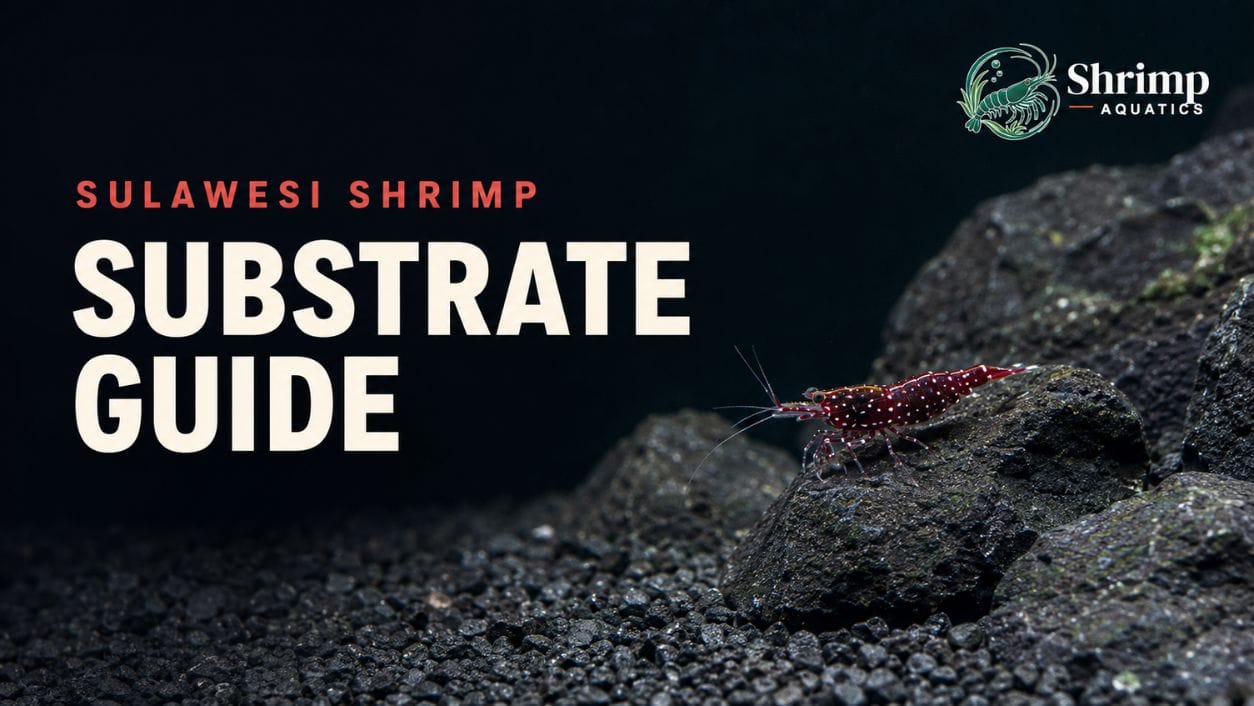
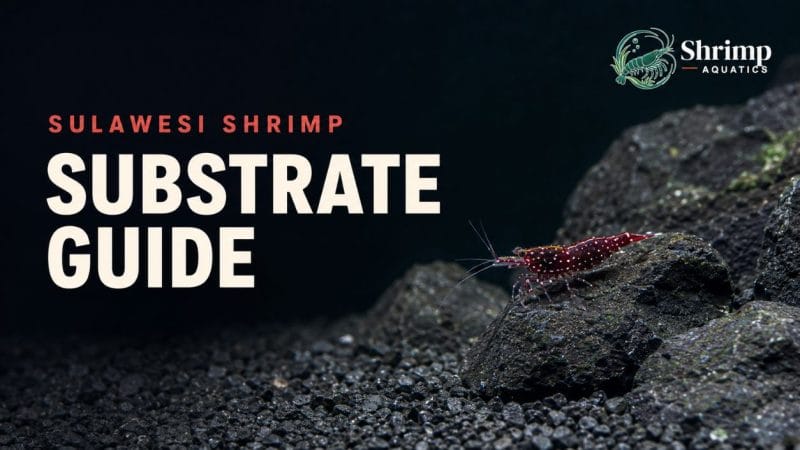
In a Sulawesi tank the water sets the parameters and the substrate stays out of it. The right bed is inert, dark, coarse enough to stay open and thin enough to siphon. That means crushed lava rock or basalt gravel for most tanks, and inert sand where you want a smooth floor. The two beds that cause most losses are the ones sold as helpful, an active bee shrimp soil and a crushed coral or aragonite layer. Both move numbers you’ve already set.
Sulawesi shrimp are lake Caridina from the Malili and Poso systems, and they’re kept in warm, mildly alkaline, moderately mineralized water. Those values come out of a bottle, not out of the gravel. A Sulawesi shrimp mineral supplement dissolves into RO water within seconds and buffers the pH at around 7.5. It raises carbonate and total hardness together at a fixed ratio of KH to dH of 0.42 to 1.0.1 So the mix you make is the mix you get. Carbonate hardness is the buffering capacity of the water, its ability to neutralize acid and hold a fairly stable pH. It depends on dissolved bicarbonates, carbonates and hydroxides being present in the water column.2 Once you’ve paid for that control, a substrate that adds or removes those same ions is working against you.
| Difficulty | Advanced to expert |
|---|---|
| Temperature | 79-86°F (26-30°C) |
| pH | 7.5-8.5 |
| GH | 4-8 dGH |
| KH | 3-6 dKH |
| TDS | 150-250 ppm |
| Nitrate | Aim for under 10 ppm |
| Substrate | Inert substrate and hardscape; an active pH lowering substrate isn’t the default setup |
How do you read the substrate row? As a filter rather than a recommendation. Anything you put on the bottom either leaves that table alone or it doesn’t, and everything below is an application of that one test.
Bee shrimp soil will pull a Sulawesi tank into the wrong water
This is the mistake that ends colonies in the first month, and it usually arrives with good intentions, because the shop shelf labels the bag as shrimp substrate. Active shrimp soils are engineered products with a stated chemical job. Dennerle recommends its Shrimp King Active Soil for bee shrimp such as Crystal Red, Red Bee and Tiger Bee. Its own product information states that the soil lowers the pH value and stabilizes it in the slightly acidic range of about 6.0-6.5 for those bee shrimp. It reduces carbonate hardness for the same bee shrimp to roughly 0-2 dKH, depending on the source water.3 The same page describes it as a natural ion exchanger and as suited to species that love soft, slightly acidic water. That’s the water Bee and Crystal Caridina need, pH 5.8-6.8 with KH 0-2 dKH, and every part of it points away from the Sulawesi table above.
The soil doesn’t fail in your tank. It succeeds, at the job it was built for. You mix water to pH 7.5-8.5 with KH 3-6 dKH, then pour it over a bed whose function is to consume carbonate and release acidity. The buffer you paid for is spent holding the substrate off. What the shrimp experience isn’t a stable number at all but a slow drift, and drift is the thing this group tolerates worst.
Don’t test this with animals in the tank
Any product sold as an active soil, a buffering soil, or a soil for Crystal Red, Tiger Bee or Taiwan Bee shrimp belongs in this category. Read the bag rather than the shelf label: if it says it buffers, softens, lowers pH or suits Caridina, it means the other Caridina.
Can crushed coral or aragonite hold a Sulawesi tank alkaline?
Many care sheets, including pages ranking today for this exact question, recommend crushed coral or aragonite sand for the opposite reason. It pushes pH up, and Sulawesi shrimp want it up. The logic is sound and the execution isn’t, because a carbonate bed is a source with no dial on it.
Water hardness is the amount of dissolved calcium and magnesium in the water. Water picks those minerals up by dissolving them out of the rock and soil it moves through.4 A calcium carbonate bed sitting in your tank is that process, running continuously, in a closed volume of 10 or 20 gallons. It doesn’t stop when GH reaches 8 dGH. You can’t mix to a target and hold it, because whatever you mix is then modified by the floor. The only way to find out by how much is to keep testing and keep chasing. In a group that wants TDS 150-250 ppm and GH 4-8 dGH held steady, a floor that always pushes one direction is a permanent argument with your own water change.
The usual counter argument is that the shrimp need the calcium to molt, so a calcium substrate must help. The calcium goes in through the water either way. For crustaceans the major source of calcium used for exoskeleton calcification is exogenous, meaning the water the animal lives in, with stored premolt reserves and diet contributing less.5 Your mineral salt already delivers calcium as part of GH. Adding a second, uncontrolled source doesn’t make the first one work better.
Lava gravel, inert sand and bare bottom compared for a Sulawesi tank
Once chemistry is off the table, the remaining choice is a practical one about grazing surface, traction and how easy the floor is to keep clean. All three options below are chemically acceptable, so pick by how you actually run the tank.
Why crushed lava rock is the low-risk default
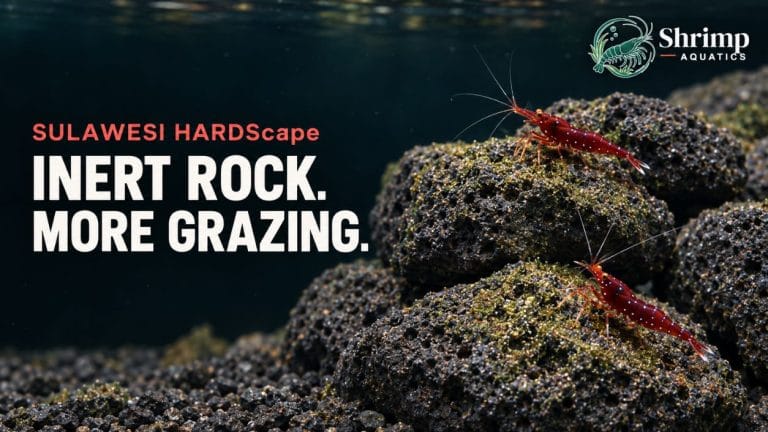
Crushed lava rock and basalt gravel are inert, so the mix you made is the mix that stays. They’re also rough and full of open pores, so biofilm and algae have somewhere to settle. That grazing layer is most of what these shrimp eat between feedings. Dark grain has a second, more practical advantage: waste and shed shells are still visible against it, and a molt you can see is a molt you can count.
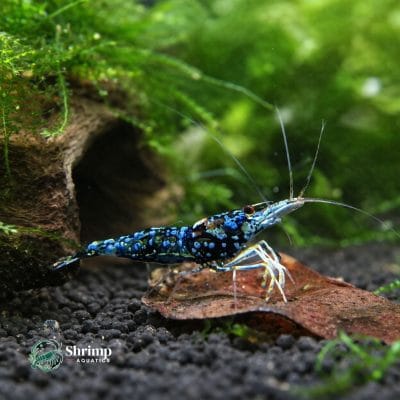
At Shrimp Aquatics, we commonly use Sula Sand Volcanic Rock in our Sulawesi systems. It’s inert and has worked well in tanks where we need pH to remain steady. In our Blue Ghost, Yellow Ghost, White Ghost and Oiran systems, we’ve also seen color remain more consistent as the shrimp mature.
Color has several inputs, including lighting, genetics, nutrition, water chemistry, age and stress. Treat a dark inert bed as one of them.
Rinse any volcanic gravel in RO water until the water runs clear before it goes in. Crushed rock carries fine dust from processing, and that dust is the one thing about this substrate worth handling deliberately.
When inert sand is the better floor
Sand sold as inert, such as washed quartz pool filter sand, leaves your water alone in the same way. It suits a keeper who wants a flat, easily read floor and siphons it regularly. Check what you’re buying first, because a carbonate sand sold beside it belongs in the previous section. The trade is that fine, smooth grain packs down, so a sand floor rewards frequent light siphoning. It also shows every piece of waste. That’s a feature if you’re watching the tank and a nuisance if you aren’t.
Skip pale, bright sands. They make waste harder to spot against a light background and they wash out the contrast that these lines are kept for.
What a bare bottom really costs the shrimp
Breeders run bare glass for a reason: nothing accumulates where you can’t see it, and a siphon reaches every square inch of the floor. If you’re running a grow out tank you check twice a day, that hygiene is worth more than any substrate benefit.
For a display colony it’s a harder sell. Bare glass gives no grazing surface at all, so the entire food supply moves onto hardscape, filter media and what you add. A shrimp that grazes for a living now depends on you not overfeeding Sulawesi shrimp in a warm tank. Rock, ceramic media and a mature sponge can carry that load, but you have to supply the surface deliberately instead of getting it from the floor.
Set the bed up before the animals arrive. Every line of tank-bred Sulawesi shrimp we stock is rated advanced or expert, and rebuilding a floor is far harder once a colony is grazing on it.
Keep a Sulawesi bed thin enough to siphon the whole floor
Depth causes more Sulawesi substrate failures than material does. A deep bed traps fine waste below the layer you can reach. In this group that matters more than it would in a cool, soft water tank. The reason is what warm alkaline water does to the ammonia that waste produces. Total ammonia in water splits between the ammonium ion and un-ionized ammonia, and it’s the un-ionized form that drives toxicity. The ratio of un-ionized ammonia to ammonium ion in fresh water increases roughly 10-fold for each rise of a single pH unit. It rises about two-fold for each 10 degrees Celsius rise in temperature from 0 to 30 degrees Celsius.6 That relationship is derived for the freshwater assemblage the EPA studied, not for shrimp, and it sets no threshold for any Caridina. The direction is the point. The same total ammonia reading means something harsher in a Sulawesi tank at pH 8.2 and 84°F than in a Bee shrimp tank at pH 6.5 and 70°F.
So the working rule is a question you can answer by looking. Lay the bed so that you can see the glass through it in places. A siphon should reach the bottom everywhere, and nothing on the floor should be hidden from you. If you have to disturb the bed deeply to clean it, it’s too deep for this tank.
- Every part of the floor is reachable with a siphon without digging.
- Grain is coarse enough that it doesn’t pack into a solid layer.
- Waste and shed shells stay visible on top.
- A planted style deep bed built for root feeders.
- Fine silt or very fine sand that compacts and slows flow through the bed.
- Large cobbles with gaps that swallow waste you can’t reach.
Changing the substrate under a stocked Sulawesi colony without a crash
If you already have soil or crushed coral under a living colony, the substrate isn’t your most urgent problem. Stability is. Pulling a bed out of a stocked tank stirs up everything it has trapped, disturbs the bacteria living on it and changes several things at once. That’s the pattern these shrimp handle worst.
- Test first and write the numbers down. Confirm ammonia and nitrite are at zero and record pH, GH, KH, TDS and temperature so you know which way the current bed is pushing.
- Set up the new bed in a separate cycled tank rather than rebuilding the occupied one, and give it time to grow visible grazing surface before anything moves.
- Match the new tank’s water to the readings you took, not to a chart, so the shrimp meet the same chemistry they’re living in now.
- Move the animals, along with a mature sponge or established rock, once the new system holds those readings steady on its own.
- Correct the water chemistry afterwards, slowly, in the new tank. Fixing chemistry and moving house on the same day is two shocks, not one.
If a separate tank isn’t possible, the fallback is to remove an old carbonate or soil bed in stages over several weeks. Test between each stage. It’s slower and it’s still the safer version of the same job.
References
6 Sources
- Sulawesi Mineral 7,5, Minerals and trace elements, SaltyShrimp (Garnelenhaus), product information page, no revision date shown.
- Alkalinity and Water, U.S. Geological Survey Water Science School, updated August 24, 2026.
- Shrimp King Active Soil, Dennerle, product information page.
- Hardness of Water, U.S. Geological Survey Water Science School, updated August 24, 2026.
- Biomineralizations: insights and prospects from crustaceans, ZooKeys 176, 2012.
- Aquatic Life Ambient Water Quality Criteria for Ammonia, Freshwater (2013), U.S. Environmental Protection Agency, Office of Water, April 2013.
Ready to get started?
Shop our Sulawesi Shrimp collection
27 products available · Live Arrival Guarantee
Featured Sulawesi Shrimp
Sulawesi Red Line Blue Dot
Caridina sp. "Red Line Blue Dot"
Advanced · 79–86°F · pH 7.5–8.5
From $15.99View Product