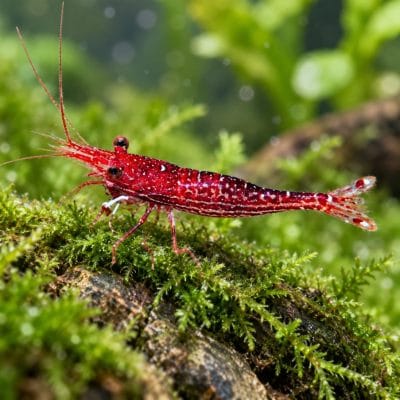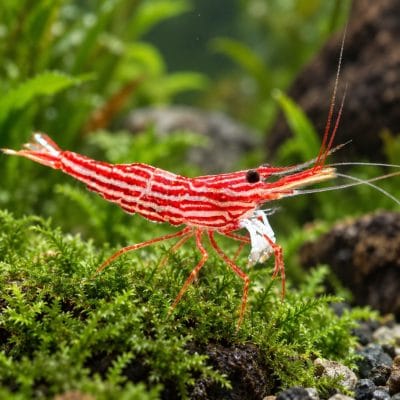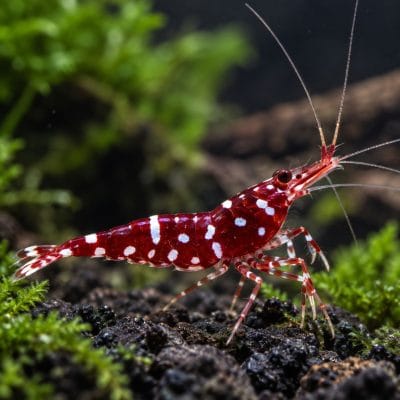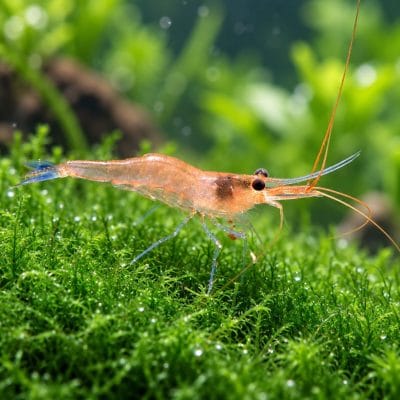
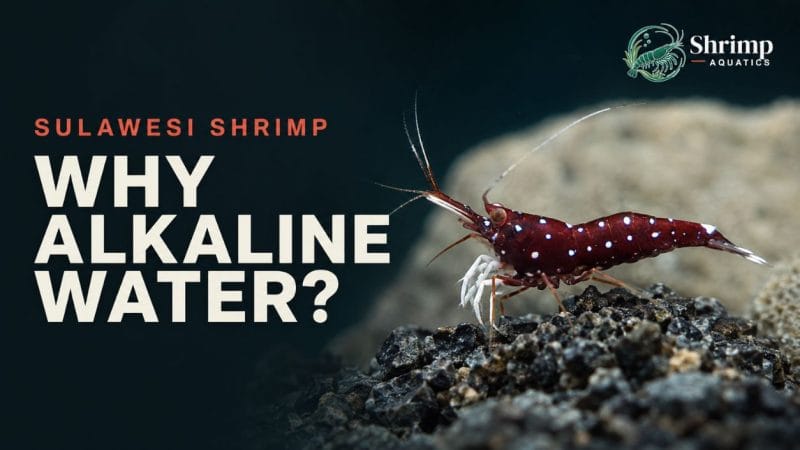
Sulawesi shrimp need alkaline water because it’s the water they evolved in, and because nothing in a closed aquarium replaces it. The lake-system Caridina sold under this name come from two ancient lake systems on one Indonesian island, Lake Poso and the Malili lakes, and from nowhere else.1 In a home tank the useful part of that answer isn’t the pH number itself but what holds it up: a carbonate reserve that keeps pH from sliding downward between water changes, in water that stays surprisingly low in dissolved minerals.
It’s worth being straight about the evidence first. No published study has measured how a Sulawesi Caridina responds to a change in pH, so nobody can tell you exactly what happens to your shrimp when the water turns acidic and call it a measured finding. What’s documented is where these shrimp live, what that water measures, and how water chemistry behaves for crustaceans in general. That’s enough to explain the requirement and to run the tank well, and it’s where this guide stays.
How alkaline is the water Sulawesi shrimp actually come from?
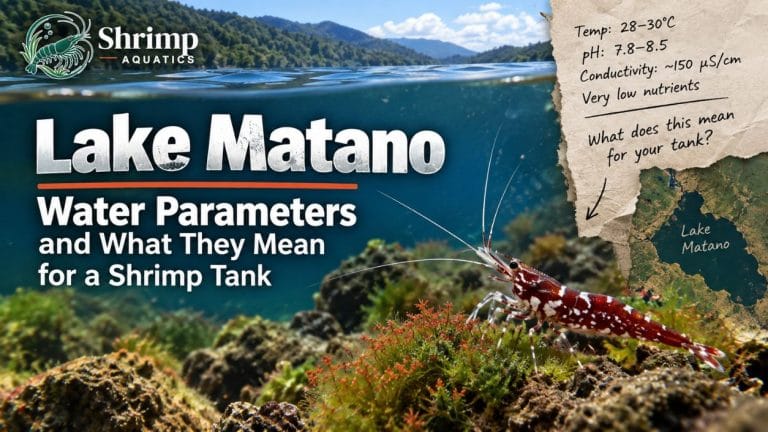
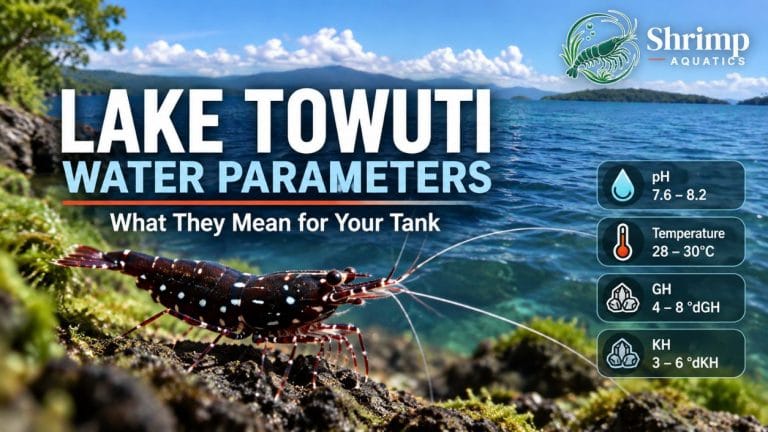
Less alkaline than the hobby usually assumes, and much more dilute. Lake Towuti, one of the Malili lakes, has surface water described as circumneutral at about pH 7.8, a conductivity of only 210 microsiemens per centimeter, and a chemistry dominated by magnesium and bicarbonate.2 That’s a lake with a mineral profile most keepers would call soft, sitting at a pH most keepers associate with hard water.
That combination is the whole difficulty of the group, and it’s why two opposite mistakes both fail. Build the tank on an active soil and you get the low mineral content but lose the pH. Build it on hard tap water, crushed coral or limestone hardscape rock and you get the pH but overshoot the mineral content badly. Neither reproduces a lake that’s alkaline and dilute at the same time, which is exactly why Sulawesi water is prepared rather than found.
What alkaline, mineral-bearing water does for a Sulawesi shrimp at every molt
Growth in a shrimp happens only at a molt. All freshwater prawns, like other crustaceans, have to regularly cast the exoskeleton in order to grow.3 Every increase in size is a discarded shell and a new one that has to harden, and that rebuild is where the water stops being background and becomes a supply line.
Across crustaceans, the major source of the calcium used for exoskeleton calcification is exogenous: the water the animal lives in. Stored premolt reserves and food, including a consumed molt, contribute less.4 Both of those are crustacean-level findings, not measurements on Sulawesi Caridina, so read them as the mechanism. They’re the reason GH is treated as a live number on this tank instead of something set once at fill.
The second job the water does is less biological and more immediate: it keeps the tank from moving. That’s the part a keeper controls week to week, and it’s measured with the wrong test kit almost every time.
KH, not pH, is the number that holds a Sulawesi tank steady
Alkalinity is the buffering capacity of a water body, a measure of its ability to neutralize acids and so maintain a fairly stable pH. It isn’t a chemical in the water but a property of the water, dependent on what’s dissolved in it, chiefly bicarbonates and carbonates.5 Water with high alkalinity experiences less of a change in its own acidity when acid is introduced into it.5 Your KH test kit is the aquarium measure of that reserve. That reserve is KH, and pH quietly depends on it, the subject of Sulawesi shrimp KH and alkalinity.
So pH tells you where the water is standing right now, and KH tells you whether it will still be standing there next week. A Sulawesi tank reading pH 8.0 with almost no carbonate hardness left isn’t a stable tank. It’s a tank that hasn’t drifted yet. This is also why pH-up products and buffer additives disappoint when used to raise pH for Sulawesi shrimp: they move the reading without building the reserve, and the reading comes back down.
| pH | 7.5-8.5 |
|---|---|
| Carbonate hardness (KH) | 3-6 dKH |
| General hardness (GH) | 4-8 dGH |
| TDS | 150-250 ppm |
| Temperature | 79-86°F (26-30°C) |
| Nitrate | Aim for under 10 ppm; that’s a target, not a tolerance limit |
These are typical ranges for the group rather than survival limits, and an individual species or line can carry a narrower verified range. Where a listing states its own numbers, those are the ones to match.
Why other Caridina care sheets tell you to use soft, acidic water
Other Caridina care sheets call for soft, acidic water because they’re written for Bee and Crystal shrimp, which share the genus name with Sulawesi shrimp but not their water. Caridina is a large genus, and the lines that made it famous in the hobby are the soft-water ones. Bee and Crystal shrimp are kept at pH 5.8-6.8, KH 0-2 dKH, GH 4-6 dGH, TDS 100-150 ppm and 60-72°F (15.5-22°C), normally over an active substrate chosen precisely because it pulls pH down and holds it there.
That’s the opposite water in every column, and the substrate is where the confusion turns into a real problem.
Don’t build a Sulawesi tank on an active substrate
An active shrimp soil is engineered to lower pH and consume carbonate hardness. In a Sulawesi tank it works directly against the reserve you’re trying to hold, and adding minerals on top of it doesn’t remove that pull. Inert substrate and inert hardscape are the default for this group.
At Shrimp Aquatics we commonly use Sula Sand Volcanic Rock in our Sulawesi systems because it’s inert and has worked well in tanks where we need pH to remain steady.
The distinction matters at the point of purchase as much as at setup. If your shrimp came from a Sulawesi shrimp listing, a Crystal Red care sheet is describing the opposite water, not a stricter version of yours.
Warm alkaline water makes ammonia more dangerous in a Sulawesi tank
The cost of alkaline water in a Sulawesi tank is ammonia: the same ammonia reading is more toxic at high pH and temperature. In fresh water, total ammonia sits in two forms, the ammonium ion and un-ionized ammonia, and it’s the un-ionized form that drives toxicity. The ratio of un-ionized ammonia to ammonium ion in fresh water increases by 10-fold for each rise of a single pH unit, and by approximately two-fold for each 10 degree Celsius rise in temperature between 0 and 30 degrees Celsius.6 High external un-ionized ammonia concentrations reduce or reverse diffusive gradients and cause the buildup of ammonia in internal tissues and blood.6 Those criteria were derived for the freshwater assemblage the EPA assessed, not for shrimp, and they set no aquarium threshold. The direction of the relationship is what you use.
Read your ammonia result against your pH
A total ammonia figure that would be a minor problem in a cool, slightly acidic tank isn’t the same figure at pH 8.2 and 86°F. On this group, ammonia and nitrite belong at zero before any shrimp goes in, and the system has to be mature enough to keep them there.
That’s the practical trade. The same warm, alkaline water that suits these shrimp is also less forgiving of uneaten food, a heavy stocking level or a filter that hasn’t fully established, which is why the group is kept in mature systems with grazing surfaces already grown in and fed sparingly. A cycled tank here means ammonia 0 and nitrite 0 with an established biological filter and visible biofilm, not a number of weeks marked off on a calendar.
How to hold pH and KH steady in a Sulawesi tank
Keeping pH and KH steady in a Sulawesi tank after you’ve prepared the water comes down to three habits.
Prepare new water with a mineral built for this water. A Sulawesi remineralizer has to add carbonate hardness alongside general hardness, which isn’t what a soft-water product is designed to do. SaltyShrimp states that its Sulawesi Mineral 8.5 raises carbonate and total hardness at a ratio of KH per degree of total hardness of 0.78 to 1.0.7 A mineral sold for Bee and Crystal tanks is formulated for water that carries almost no carbonate hardness at all, so it won’t build the reserve this group runs on. Follow the current manufacturer instructions for whichever product you use, and test the finished pH, GH, KH and TDS before that water goes anywhere near shrimp.
Top off evaporation with RO water alone. As a physical matter, evaporation concentrates the dissolved solids left behind in the water that remains.8 Water leaves the tank and minerals don’t, so a tank topped off with prepared mineral water sees its TDS climb week after week while the water level looks perfectly correct.
Change water in small, matched volumes. Match the replacement water to the tank on temperature, pH, KH, GH and TDS before it goes in, because an unmatched change is itself the swing you were trying to avoid. Small and frequent beats large and occasional on a tank whose whole requirement is stability.
- Test KH on a schedule rather than only when something looks wrong. It’s the number that moves first.
- Track TDS between water changes. A steady climb usually points at top-off water, not a chemistry problem.
- Keep substrate, rock and hardscape inert, so nothing in the tank is quietly working against the buffer.
- Recheck the finished parameters of prepared water every time, not only when you open a new bag of mineral.
- Don’t chase a pH reading with buffers or pH-up products while KH is falling. Rebuild the reserve and the reading follows.
If you track one number on this tank, track KH. pH is the symptom you’ll notice and the one every care sheet argues about, but carbonate hardness is the thing that actually moves, and a Sulawesi tank that holds its KH between water changes is a tank whose pH stops being interesting.
References
8 Sources
- Radiation of endemic species flocks in ancient lakes: systematic revision of the freshwater shrimp Caridina from the ancient lakes of Sulawesi, Indonesia, with the description of eight new species, Raffles Bulletin of Zoology 57(2): 343-452, Lee Kong Chian Natural History Museum, 2009.
- Geomicrobiological Features of Ferruginous Sediments from Lake Towuti, Indonesia, Frontiers in Microbiology 7: 1007, 2016.
- Farming freshwater prawns. A manual for the culture of the giant river prawn (Macrobrachium rosenbergii), Chapter 1 Biology, Food and Agriculture Organization of the United Nations, FAO Fisheries Technical Paper T428.
- Biomineralizations: insights and prospects from crustaceans, ZooKeys 176: 103-121, 2012.
- Alkalinity and Water, U.S. Geological Survey Water Science School, updated August 24, 2026.
- Aquatic Life Ambient Water Quality Criteria for Ammonia, Freshwater 2013, U.S. Environmental Protection Agency, Office of Water, April 2013.
- Sulawesi Mineral 8,5, minerals and trace elements, SaltyShrimp product technical page, copyright 2018.
- Chloride, Salinity, and Dissolved Solids, U.S. Geological Survey Water Resources Mission Area, March 1, 2019.
Ready to get started?
Shop our Sulawesi Shrimp collection
27 products available · Live Arrival Guarantee
Featured Sulawesi Shrimp
Sulawesi Red Line Blue Dot
Caridina sp. "Red Line Blue Dot"
Advanced · 79–86°F · pH 7.5–8.5
From $15.99View Product