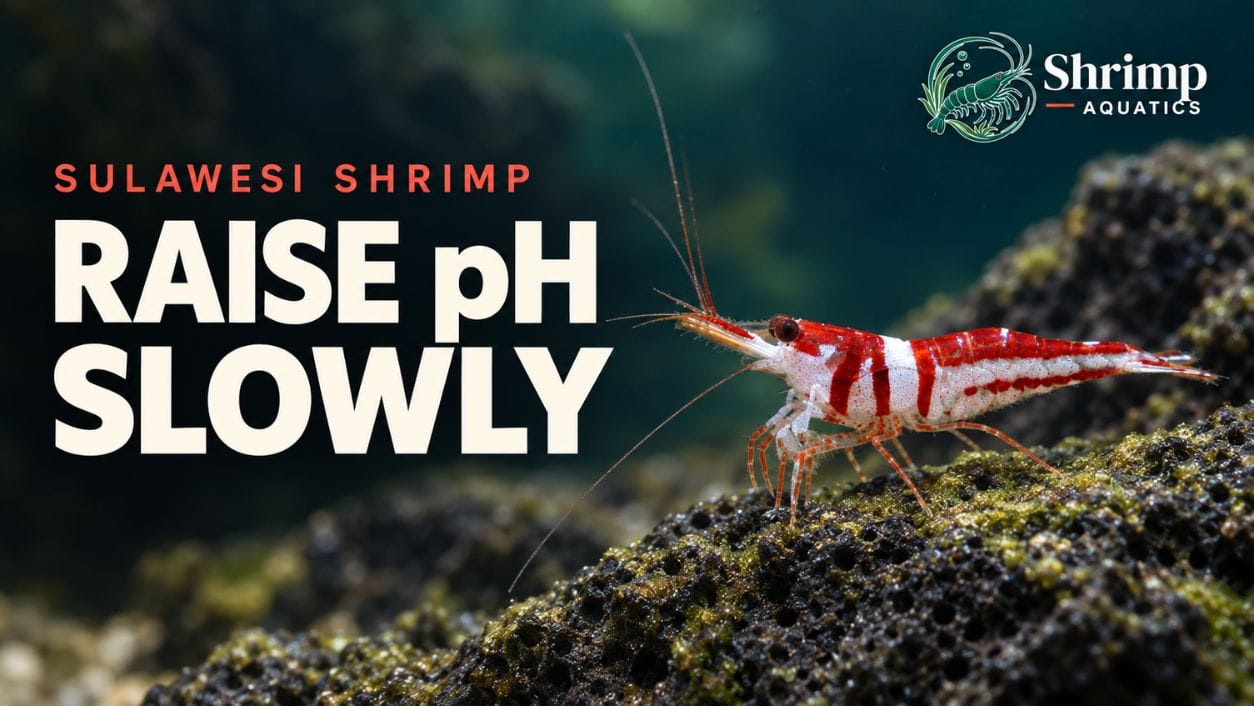
You raise pH for Sulawesi shrimp by rebuilding the water outside the tank and exchanging it in slowly, not by dosing the running tank. Mix RO water with a Sulawesi mineral salt that buffers to the target, test the finished batch, and let several small water changes carry the tank up to pH 7.5-8.5. Sulawesi shrimp, the lake Caridina of the Malili lakes and Lake Poso, react to the speed of a chemistry change more than to the reading itself. So the slow route is the safe one.
Find out why the pH in your Sulawesi tank fell
pH in a Sulawesi tank sits where the carbonate buffer puts it. Alkalinity is the water’s capacity to neutralize acids and hold a fairly stable pH.1 It isn’t a substance in its own right but a property that comes from dissolved bicarbonates, carbonates and hydroxides.1 That’s the practical reason to reach for the KH test before the pH test. If KH and alkalinity have fallen out of the 3-6 dKH band, the low pH is the symptom and the buffer is the cause. Push the pH up on its own and it will slide back, because nothing in the water is holding it. pH follows KH, not the other way round, which is the heart of Sulawesi shrimp KH and alkalinity.
So which is it in your tank? Three checks usually separate the cases. Measure KH and GH on the same water sample you measured pH on, because a tank that has drifted low on carbonate has often drifted low on general hardness too. Check what has been going into the tank. A stretch of topping off with mineral water, a stretch of no water changes at all, or replacement water mixed to a different recipe will each move the number. Then check the test itself, since an old liquid reagent or an uncalibrated probe produces exactly the alarming reading that sends people looking for a chemical fix.
If KH is inside the band and pH still reads low, the buffer isn’t the problem. The answer is in what you’re adding to the tank rather than in a bottle of pH adjuster. If KH is low, the rest of this guide is the fix, because rebuilding the water rebuilds both at once.
Why a fast pH rise is riskier for Sulawesi shrimp than the low reading
Total ammonia in water partitions between the ammonium ion and un-ionized ammonia, and the un-ionized form is the one that drives toxicity. High external un-ionized ammonia reduces or reverses diffusive gradients and causes ammonia to build up in internal tissues and blood. The ratio of un-ionized ammonia to ammonium ion in fresh water increases by 10-fold for each rise of a single pH unit.2 It rises by approximately two-fold for each 10 degree Celsius rise in temperature across the span that document covers, 32 to 86 degrees Fahrenheit (0 to 30 degrees Celsius).2 That relationship is an EPA freshwater criteria document and it sets no aquarium threshold for shrimp, but the direction is what matters to you.
Read it against the tank you’re running. A Sulawesi system sits at 79-86°F (26-30°C) and, once it’s where you want it, at pH 7.5-8.5. The same total ammonia number that a cool, acidic Caridina tank shrugs off is a different proposition in that water. A pH rise you drive deliberately moves the split in the wrong direction while you’re doing it. No safe ammonia concentration has been established for Sulawesi shrimp, so the target is zero.
Do this before anything else
Confirm ammonia and nitrite at 0 with a fresh test kit. If either reads above zero, that’s a filter and maturity problem and it comes first. Raising pH on top of a measurable ammonia reading makes a bad situation worse.
The second constraint is speed. Sulawesi shrimp handle a slow change far better than a correct one delivered quickly. So plan on carrying the tank up over weeks with repeated small exchanges. Every method below is judged on that as much as on where it lands the number.
Crushed coral, active soil and pH-up products all miss what a Sulawesi tank needs
These three come up on every forum thread about raising pH. It’s worth being specific about why each one is the wrong tool here.
Crushed coral keeps dissolving after you’ve stopped wanting it to
Water hardness is the amount of dissolved calcium and magnesium in the water, and water picks those minerals up as it moves through soil and rock and carries them along with it.3 Crushed coral, aragonite sand and limestone in a filter chamber are that mechanism installed inside your aquarium and left running. It does raise carbonate hardness, and it raises general hardness with it, on the tank’s schedule rather than yours. There’s no published dissolution rate for a Sulawesi aquarium, so you can’t predict where GH lands, only measure where it has gone. In a group whose range is 4-8 dGH and 150-250 ppm TDS, a source of hardness you can’t switch off is the opposite of what the tank needs. Pulling the media back out doesn’t remove what has already dissolved.
Bee shrimp soils pull the pH the other way
Active buffering substrates are engineered to hold water down in the pH 5.8-6.8 range that Bee and Crystal Caridina need, and they do that job well. In a Sulawesi tank they work against every other thing you’re doing. A Sulawesi setup uses inert substrate and inert hardscape. An active pH-lowering soil isn’t a default that happens to be unhelpful here. It’s a direct conflict with the water these shrimp need. If one is already in the tank, that’s a rebuild, not a dosing problem.
A pH-up dose moves the number without moving the water
Liquid pH adjusters and kitchen alkalizers change the reading in the display tank, quickly, in a system holding animals. They also change one property of the water in isolation, while the shrimp are living in the whole ionic package: carbonate hardness, general hardness and total dissolved solids together. A Sulawesi mineral salt raises carbonate and total hardness in a fixed relationship to each other, which is the behavior you actually want. And it does it in a bucket, where a mistake costs you a batch of water instead of a colony.
Mix Sulawesi replacement water outside the tank and buffer it to pH 7.5-8.5
Start from RO water, so the only minerals in the batch are the ones you put there. Then choose the salt by which end of the band you’re aiming at, because the two common Sulawesi products behave very differently in preparation.
Sulawesi Mineral 7.5 is added to water outside the aquarium, dissolves almost totally within seconds, and the water is ready for use immediately. It buffers the pH at around 7.5 and raises carbonate and total hardness at a ratio of KH/°dH = 0.42/1.0. The manufacturer’s stated dosage is a slightly heaped measuring spoon, around 3.5 g, to 15 litres, giving a hardness of around 6 °dH and a conductance of around 270 +/- 40 µS.4 Treat that as the maker’s figure and verify the finished batch on your own kit.
Sulawesi Mineral 8.5 targets the upper half of the band and asks for a different workflow. It will almost totally dissolve only if CO2 is added for a few days, taking approximately 3-4 days at a regular CO2 quantity of about one bubble per second.5 The water must then be aerated with an air stone for at least three hours to expel the CO2 before it’s used.5 It raises carbonate and total hardness at a ratio of KH/°dH = 0.78/1.0.5 The manufacturer notes that less finicky Sulawesi shrimp such as the cardinal shrimp (Caridina dennerli) have been kept and bred with positive outcomes on both Sulawesi Mineral 7.5 and Sulawesi Mineral 8.5.5 Reaching the top of the range is therefore a multi-day preparation with equipment attached. It isn’t the only way to land inside the band.
| pH | 7.5-8.5 |
|---|---|
| KH | 3-6 dKH |
| GH | 4-8 dGH |
| TDS | 150-250 ppm |
| Temperature | 79-86°F (26-30°C), matched to the tank |
At Shrimp Aquatics, we start our Sulawesi systems with RO water rather than tap water, then use Sulawesi Mineral 7.5 to prepare the water for our current tank targets before shrimp are introduced. We test the finished pH, GH and TDS before the water goes into a tank. Most of our Sulawesi systems currently run at TDS 150 ppm, GH 6-7 dGH and pH 7.5. If you’ve been treating pH 8.5 as the number to chase, that’s worth knowing before you commit to a CO2 reactor. The lower end of the range is a working target, and the test on the finished batch matters more than which end you picked.
Raise your Sulawesi tank slowly with small drip-fed water changes
With prepared water in hand, the move is repetition, in small volumes. Each exchange brings the tank a short step toward the band, and the shrimp experience a small change several times instead of one large one.
- Record the starting point: pH, KH, GH, TDS and temperature in the tank, plus a confirmed 0 ammonia and 0 nitrite.
- Mix a batch of replacement water, let it finish, then test it. Match its temperature to the tank before it goes anywhere near the shrimp.
- Siphon out a small part of the tank volume and return the prepared water slowly, so the tank never sees a step change in one spot.
- Leave it alone and retest the tank the following day. Write the numbers down; the trend across exchanges is what tells you whether the plan is working.
- Repeat at your normal water change frequency for Sulawesi shrimp until pH holds inside 7.5-8.5 on its own and KH sits in the 3-6 dKH band without help.
Don’t chase the number
If a test after an exchange still reads low, the answer is the next scheduled exchange, not a second one the same day or a stronger mix. A tank that arrives at pH 7.5 slowly is in better shape than one that reaches 8.5 in a weekend. Stop and reassess if the shrimp go still, stop grazing or gather at the surface.
Keep pH steady once your Sulawesi tank is back in range
Holding the band is a different job from reaching it, and it’s mostly about what you replace.
- Top off evaporation with plain RO water. Evaporation concentrates dissolved solids in the water that remains.6 So what leaves the tank between water changes is water, not minerals. Replacing it with remineralized water walks TDS up past the 150-250 ppm band.
- Watch KH first. Carbonate hardness is the property that holds the number, so a KH drifting down is your early warning; a pH that has already moved is the late one.
- Mix every batch to the same recipe and test it every time, including the ones you’ve made a hundred times.
- Don’t correct a drift with a dose to the display tank. The fix is the same prepared water that got you here.
Once the tank has held 7.5-8.5 by itself across several weeks of ordinary maintenance, the water is doing its job and you can think about what lives in it. That stability is the actual prerequisite for adding Sulawesi shrimp, far more than any single reading on the day they arrive. A colony judges your tank over months and not over one test.
References
6 Sources
- Alkalinity and Water, U.S. Geological Survey Water Science School, updated August 24, 2026.
- Aquatic Life Ambient Water Quality Criteria for Ammonia, Freshwater (2013), U.S. Environmental Protection Agency, Office of Water, April 2013.
- Hardness of Water, U.S. Geological Survey Water Science School, updated August 24, 2026.
- Sulawesi Mineral 7,5, Minerals and trace elements, SaltyShrimp (Garnelenhaus), manufacturer product information page.
- Sulawesi Mineral 8,5, Minerals and trace elements, SaltyShrimp (Garnelenhaus), manufacturer product information page.
- Chloride, Salinity, and Dissolved Solids, U.S. Geological Survey Water Resources Mission Area, March 1, 2019.
Ready to get started?
Shop our Sulawesi Shrimp collection
27 products available · Live Arrival Guarantee