No water change interval has ever been measured or published for Sulawesi shrimp, the lake endemic Caridina species from Sulawesi’s ancient lakes. Every figure in circulation, from 10% a month to 30% a week, comes from keeper practice. What actually decides the interval in your tank is what your test kit shows. Nitrate climbing toward the under 10 ppm nitrate target. TDS drifting off the tank’s own baseline. KH slipping toward the bottom of 3-6 dKH. When none of those is moving, a change on the calendar isn’t what keeps the tank stable, and the routine that does is a pure RO top off.
Which readings tell you a Sulawesi tank is due for a change
What is a water change actually for? Two jobs. It exports what has accumulated since the last one, and it puts back the carbonate and mineral content that the tank has been spending. Both jobs have a measurable signal, so you can stop guessing at an interval and read one instead. Each change has two jobs, exporting waste and putting minerals back, which is the case made in Sulawesi shrimp water changes.
Nitrate is the accumulation signal. The nitrate target we keep to for this group is under 10 ppm, as a working target. A reading walking toward it between tests is the clearest sign the tank is producing more than it’s processing. TDS is the drift signal, and it matters in both directions. Rising TDS with a stable water level usually means minerals are concentrating. Falling TDS in a tank you haven’t topped off with RO usually means the mineral content is being consumed.
KH is the one worth watching most closely, because it fails quietly. Alkalinity is the buffering capacity of the water, a property produced by dissolved bicarbonates, carbonates and hydroxides.1 Water with high alkalinity experiences less change in its own acidity when acid is introduced.1 In practice that means KH is spent before pH moves. By the time a Sulawesi tank’s pH has dropped out of 7.5-8.5, the buffer that was protecting it went first. A KH test taken weekly will show you that coming.
There’s also a reason the accumulation signal deserves more respect in this water than in a cool acidic shrimp tank. Total ammonia in fresh water partitions between the ammonium ion and un-ionized ammonia.2 The ratio of un-ionized ammonia to ammonium ion increases by 10 fold for each rise of a single pH unit, and by approximately two fold for each 10 degree Celsius rise in temperature from 0-30 degrees Celsius.2 A Sulawesi tank runs at pH 7.5-8.5 and 79-86°F (26-30°C). So the same total ammonia number on a test card represents a much larger un-ionized share here than it would in a cooler, acidic soft water shrimp tank. High external un-ionized ammonia concentrations reduce or reverse diffusive gradients and cause ammonia to build up in internal tissues.2 That’s the argument for exporting waste promptly, and equally the argument against a change large enough to disturb the filter that’s processing it.
| Temperature | 79-86°F (26-30°C) |
|---|---|
| pH | 7.5-8.5 |
| GH | 4-8 dGH |
| KH | 3-6 dKH |
| TDS | 150-250 ppm |
| Nitrate | Aim for under 10 ppm; that is a target, not a tolerance limit |
These are typical reference ranges for the group, so use them to catch an obvious error and then treat your own tank’s settled numbers as the baseline you defend. A tank stocked in the last few weeks has no history to compare against. So if you’ve just added tank-bred Sulawesi shrimp, spend the first month recording readings before you commit to any interval at all.
Why the published Sulawesi water change schedules disagree with each other
If the advice you’ve read felt inconsistent, that’s because it is. The guides that rank for this question publish schedules that don’t overlap, and none of them shows a measurement behind the number.
| Where the figure appears | Published schedule | Evidence shown |
|---|---|---|
| A specialist hobbyist article on shrimp water changes | 10% every two weeks as a starting plan | None |
| A retailer’s Sulawesi care guide | Around 20% weekly | None |
| A long form keeper blog on change frequency | 20% a month, or 10% twice across a fortnight | None |
| Regional practice summaries circulating in keeper literature | 10-15% weekly to bi-weekly, 20-30% weekly, 20-33% every two to three weeks, or 10-20% monthly | None |
The spread runs from 10% a month to 30% a week, a threefold difference in weekly turnover, and the pages disagree without ever acknowledging each other. That’s what an unmeasured number looks like when it’s copied between sites. None of it is dishonest, and much of it works in the tank it came from. But a schedule isn’t transferable. The bioload, the maturity of the grazing surfaces, the feeding rate, the water volume and the evaporation rate all differ, and those are the variables the schedule was silently fitted to.
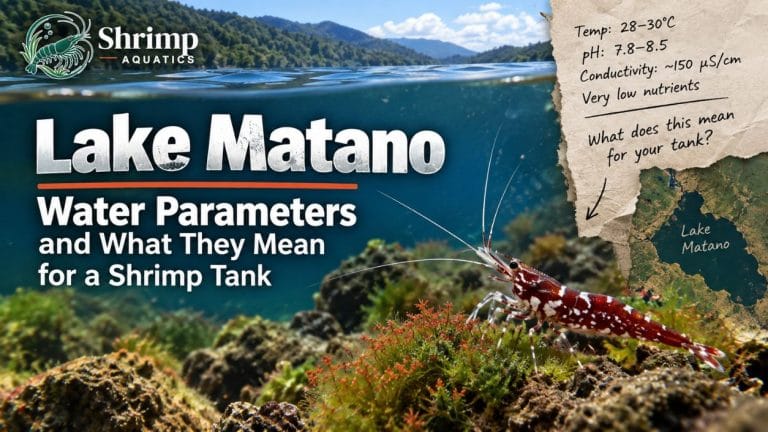
There’s one thing Sulawesi lake ecosystems genuinely tell you, which is why stability is the constraint worth designing around. Lake Matano is studied in part for how its minimal seasonal temperature variability affects biogeochemical cycling.3 These are animals from a system that doesn’t swing. That argues for small, well matched, unhurried changes over any particular number. It’s also the reason a keeper who changes 10% a month with matched water often does better than one who changes 30% a week with water that’s close enough.
Evaporation in a warm Sulawesi tank needs RO water, not a small water change
This is the single most common way a stable Sulawesi tank is walked out of range. It’s a confusion between two different jobs, not a mistake of timing. A tank held at 79-86°F (26-30°C) with the surface agitation these systems need evaporates quickly. Evaporation removes water while leaving dissolved solids behind, concentrating them in what remains.4 The minerals don’t leave with the vapor.
So topping the tank back up with remineralized water adds a second dose of minerals to a volume that already holds the first. Do that for a few weeks and TDS and GH climb past 150-250 ppm and 4-8 dGH without a single water change having taken place. The keeper looking for the cause will be examining their change schedule rather than their top off jug.
Replace evaporative loss with pure RO or deionized water, which carries essentially no mineral content and restores the volume without touching the ionic content. Do it as the level drops, before a large deficit builds, since the point is to keep TDS from moving at all. A partial water change is the separate job. It removes a portion of the old water along with what has accumulated in it, and replaces that portion with water remineralized to your targets.
Match the replacement water to the tank before any of it goes in
Matching is the part of the procedure that decides whether the change is safe, and it’s worth more attention than the percentage. Prepare and test the water outside the aquarium, then compare it against the tank rather than against a published range.
- Temperature matched to the tank’s own point inside 79-86°F (26-30°C), measured with the same thermometer
- pH matched inside 7.5-8.5, after the water has finished gassing off and settled
- GH inside 4-8 dGH and KH inside 3-6 dKH
- TDS matched to the tank’s own settled baseline inside 150-250 ppm, not to the middle of the range
- Volume small enough that a miss on any of the above can’t move the tank far
Mineral content deserves the extra check because the water isn’t only a diluent here. The major source of calcium used for crustacean exoskeleton calcification is exogenous, meaning the water the animal lives in.5 Food, including consumed exuviae, represents a minor contribution to cuticle calcification.5 Replacement water that’s short on mineral content is therefore not merely moving a number on a meter. That’s a good reason to test the finished water.
At Shrimp Aquatics, we start our Sulawesi systems with RO water rather than tap water, then use Sulawesi Mineral 7.5 to prepare the water for our current tank targets before shrimp are introduced. We test the finished pH, GH and TDS before the water goes into a tank.
Sulawesi mineral salts need dissolving time your schedule has to allow for
Which salt you use changes how far ahead you have to start, and this is a practical reason a fixed weekly calendar breaks down. SaltyShrimp Sulawesi Mineral 7.5 almost totally dissolves within seconds, and the water is ready for use immediately.6 It buffers the pH at around 7.5 and raises carbonate and total hardness at a ratio of KH/°dH = 0.42/1.0.6 Water prepared with it can be made on the day.
Sulawesi Mineral 8.5 doesn’t behave that way. The manufacturer’s instruction is to add it to water outside the aquarium and dissolve it with CO2.7 At a regular CO2 quantity of about one bubble per second, that takes approximately 3-4 days, after which the water must be aerated with an air stone for at least three hours to expel the CO2.7 It raises carbonate and total hardness at a ratio of KH/°dH = 0.78/1.0.7 A change using that salt is a batch you start most of a week ahead. A keeper who hasn’t started it is better off topping off and waiting than mixing something faster and pouring it in.
Follow the current instructions for the product you actually hold, and verify the finished pH, GH and TDS by test. Undissolved carbonate sitting at the bottom of the mixing container is mineral that never reached your water.
Removing and returning the water without losing shrimplets
Newly released Sulawesi shrimplets are very small and stay close to the rock and biofilm they graze on, which puts them exactly where a siphon tip goes. Two habits deal with almost all of that risk.
- Widen the intake. Fitting a cut bottle section or a foam sleeve over the siphon end spreads the same flow over a larger opening. That lowers the velocity at the mouth of the tube while still lifting mulm.
- Siphon into a pale bucket and let it stand for a few minutes before you discard it. Anything alive in there is visible against the light bottom, and it goes back.
- Take the water from the open substrate and around the hardscape rather than from inside crevices, where shrimp shelter and molt.
- Return the prepared water slowly, through an airline with a valve or a drip container. That way it mixes as it arrives instead of forming a pocket of different chemistry beside the shrimp.
- Check the tank’s temperature and TDS partway through the refill. If either is moving while the line runs, the rate is too fast or the water wasn’t matched, and the fix is to slow down or stop.
That last check is more useful than any published drip rate, because it measures the thing the rate was supposed to protect. A change that leaves the meter where it started was slow enough, whatever the clock said.
When to pause water changes on a Sulawesi tank and top off only
Some days the right amount to change is none, and recognizing those days is part of the routine.
Don’t change water today
If you can’t match temperature, pH, KH, GH and TDS in the replacement water, top off with RO and wait. An unmatched change moves every one of those values at once, which is the disturbance the change was meant to prevent. A nitrate reading sitting a little above the under 10 ppm target for another day or two is the smaller of the two problems.
Pause as well after a change that went badly. If the colony turned lethargic, moved erratically, molted at odd times or you found Sulawesi shrimp dying after a water change in the days since your last one, stop changing water. Keep the volume steady with RO top offs, and test before you intervene again. Repeating an unmatched change while looking for the cause of the first one is how a single bad batch becomes a pattern. Nothing on this page identifies a cause for a specific loss. If deaths continue once your parameters check out and hold, that’s a health question. Ask a local specialist, or email your full readings, tank size, cycle status and stocking to contact@shrimpaquatics.com before you change anything else.
Once the tank is settled again, come back through the same door you left by. Take a full set of readings, treat them as the new baseline, and let the next reading that moves decide when the next change happens.
References
7 Sources
- Alkalinity and Water, U.S. Geological Survey Water Science School, updated August 24, 2026.
- Aquatic Life Ambient Water Quality Criteria for Ammonia, Freshwater, U.S. Environmental Protection Agency, Office of Water, April 2013.
- The biogeochemistry of tropical lakes: A case study from Lake Matano, Indonesia, Crowe et al., Limnology and Oceanography 53(1), 2008, repository record and abstract.
- Chloride, Salinity, and Dissolved Solids, U.S. Geological Survey Water Resources Mission Area, March 1, 2019.
- Biomineralizations: insights and prospects from crustaceans, Gilles Luquet, ZooKeys 176, 2012.
- Sulawesi Mineral 7,5, Minerals and trace elements, SaltyShrimp, manufacturer product information page.
- Sulawesi Mineral 8,5, Minerals and trace elements, SaltyShrimp, manufacturer product information page.
Ready to get started?
Shop our Sulawesi Shrimp collection
27 products available · Live Arrival Guarantee
Featured Sulawesi Shrimp
Sulawesi Red Line Blue Dot
Caridina sp. "Red Line Blue Dot"
Advanced · 79–86°F · pH 7.5–8.5
From $15.99View Product