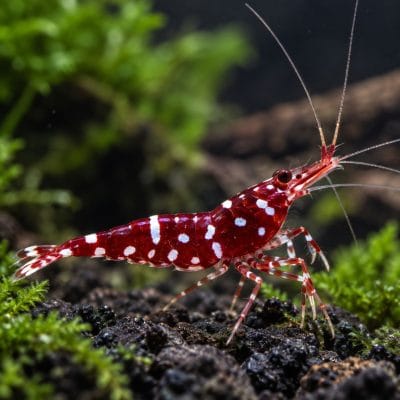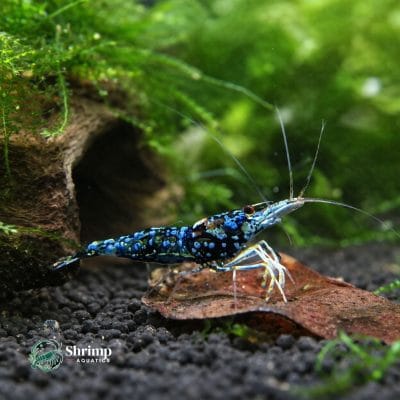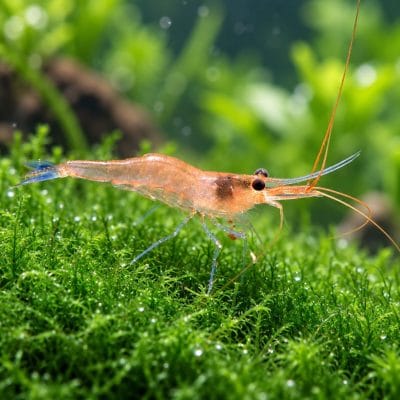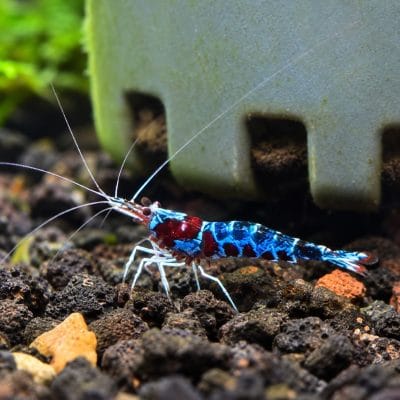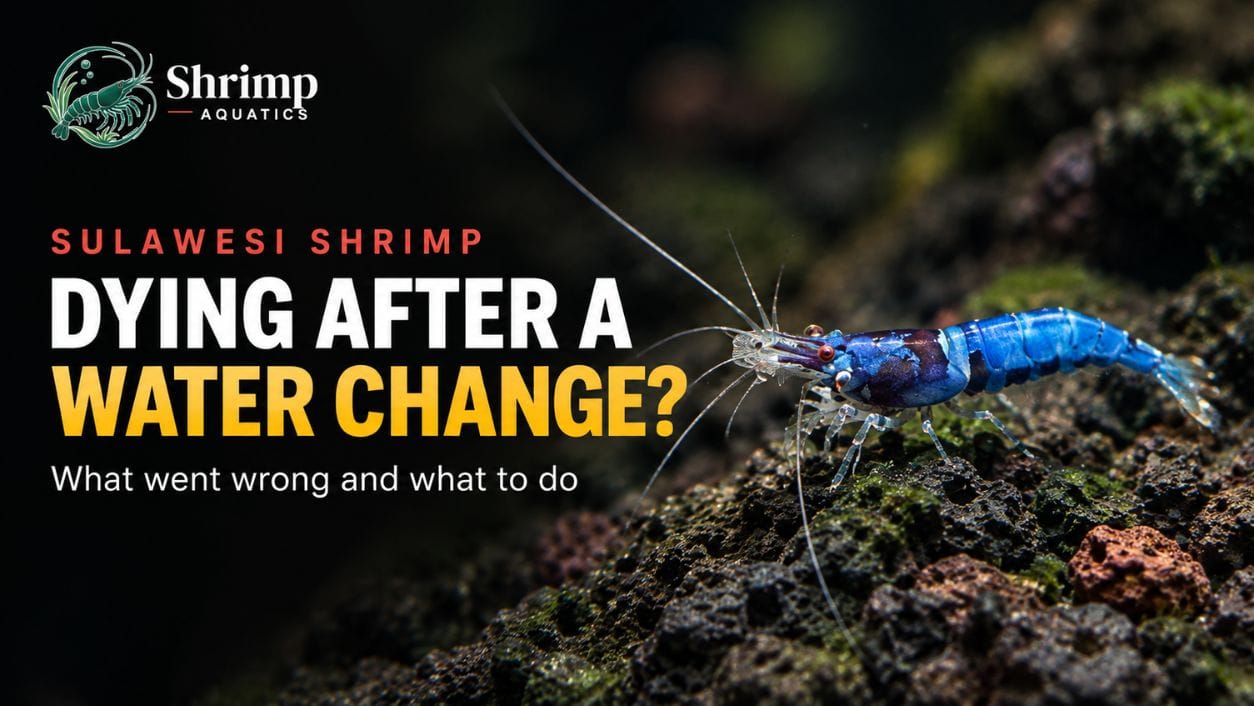
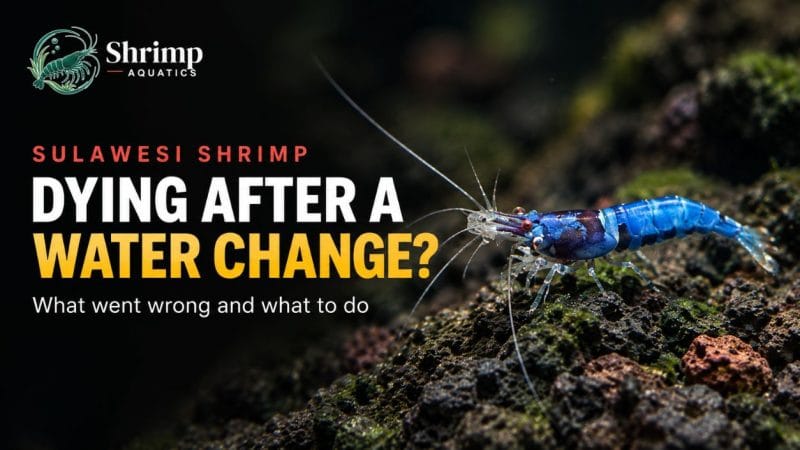
If your Sulawesi shrimp started dying in the hours or days after a water change, the change itself is the most likely cause, and it’s almost always the difference between the new water and the tank water, or something the change stirred up. The single most important thing to do now is stop changing water until you know what moved.
First, stop doing the things that make a Sulawesi crash worse
The instinct after finding dead shrimp is to change more water. In a Sulawesi tank that’s the worst available move, because a second batch of replacement water that differs from the tank in the same way repeats exactly the event that caused the losses. Leave the water alone until you’ve readings.
- Increase surface agitation or add an air stone. Gentle extra aeration costs nothing and helps whether the problem is dissolved gas, oxygen or waste.
- Don’t perform another water change, and don’t add fresh mineral salt to the tank to correct a reading.
- Don’t vacuum the substrate, rinse the filter or move hardscape. Disturbing settled waste while the colony is already stressed adds a second insult.
- Don’t dose a medication. Nothing in a post-water-change crash is treated with medication, and many products are unsafe for invertebrates.
- Remove dead shrimp as you find them, and leave shed shells where they are.
- Write down what you actually did during the change: how much water, from which container, mixed when, and whether the substrate or filter was touched.
That last step matters more than it sounds. Most keepers can’t reconstruct the change three days later, and the difference between a batch mixed that morning and a batch that sat in a bucket for a week is often the whole answer.
How soon after the change did your Sulawesi shrimp start dying?
The clock is useful, but not in the way most care sheets suggest. The timing on its own can’t tell you what happened. What it does tell you is which readings are still worth taking, because the evidence disappears at different speeds. Temperature equalizes within an hour. A gas that came in dissolved is gone by morning. Ammonia from disturbed substrate is measurable for a while but falls once the filter catches up. If deaths began within the first hour, drop everything and measure now; if they began on day three, the readings that would have identified the change are already gone and you’re looking at the tank as it stands.
| What to measure | How long it stays informative | What you do with it |
|---|---|---|
| Tank temperature and the temperature of any replacement water still in the container | Under an hour in the tank; indefinitely in a separate container | Compare the two. A container standing in a cool room can be far below a tank held at 79-86°F (26-30°C). |
| TDS of the tank and of the leftover replacement water | Days, if the container is still standing | Compare the two numbers rather than checking either against a published range. |
| pH and KH of both | Hours for water that was carrying dissolved gas, days otherwise | A batch that reads well below the tank is usually gas that was never driven off. |
| Ammonia and nitrite in the tank | Hours to a day or two | Any reading above zero is a finding on its own, and it matters more here than in a cooler, softer tank. |
| What the replacement water was made from and treated with | Permanent, if you wrote it down | Source, mineral product, mixing date and any conditioner used. |
Keep the leftover replacement water. It’s the only physical evidence of what went into the tank, and a keeper who tips it down the drain before testing has thrown away the answer.
Failed molts and newly arrived Sulawesi shrimp look like water change deaths
Not every loss that follows a water change was caused by it. Two situations produce the same picture and are worth ruling out before you rebuild your whole maintenance routine.
The first is molting. All crustaceans have to cast the exoskeleton in order to grow,1 and the calcium for the new shell comes mainly from the water the animal lives in rather than from its food.2 A shrimp that dies part way out of its old shell, or one found beside a shell that split but didn’t open, is a molt that failed. That can follow a water change, but it also happens in tanks nobody touched, and it points at the mineral content of your water. If molt failures are the pattern, GH and KH are what to look at, and a dedicated molting guide will take you further than this page.
The second is a colony that hasn’t settled yet. Shrimp that arrived within the last two or three weeks are still recovering from shipping and from a change of water chemistry far larger than any water change you’ll ever perform, and Sulawesi shrimp dying after introduction is common enough that a water change on day ten is often a coincidence. That doesn’t make the change harmless, but it does change what you conclude from it.
A single old shrimp dying alone, with the rest of the colony grazing normally, is also not a water change event. Look for a pattern across the colony before you treat one death as a signal.
Why warm alkaline water punishes a water change mistake harder
Sulawesi Caridina come from lakes that barely move. In Lake Towuti, one of the Malili lakes, water temperature is reported at approximately 28 degrees Celsius, around 82°F, throughout the year.3 A tank that reproduces those conditions inherits two chemical consequences that a Neocaridina tank doesn’t, and both of them decide what you should do after a bad change.
The first is ammonia. Total ammonia in water exists as the ammonium ion and as un-ionized ammonia, and the split between them depends on pH and temperature: the ratio of un-ionized ammonia to ammonium ion in fresh water increases by 10-fold for each rise of a single pH unit, and by approximately two-fold for each 10 degrees Celsius rise in temperature from 0-30 degrees Celsius.4 High external un-ionized ammonia reduces or reverses the diffusive gradients that let an animal excrete ammonia, so it builds up in internal tissues and blood.4 The practical consequence is that a tank held at pH 7.5-8.5 and 79-86°F (26-30°C) converts more of any given total ammonia reading into the damaging form than a cool, acidic Caridina tank does. The reading on your test kit is the same number; what it means for the animals isn’t.
That’s why disturbing settled waste during a water change matters so much more here, and why the correct response to an ammonia reading in this tank is aeration and patience rather than a large corrective change.
The second is oxygen. Cold water can hold more dissolved oxygen than warm water,5 so a tank run at the top of the Sulawesi band is already working with less oxygen in the water than a room-temperature tank, before you add a stressed colony breathing harder. Extra surface movement is close to free and is one of the few interventions that can’t make things worse.
Carbonate hardness is the third piece, and it’s the one that keeps the first two from moving. Alkalinity is the water’s capacity to neutralize acids and maintain a fairly stable pH, and it depends on dissolved bicarbonates, carbonates and hydroxides; water with high alkalinity experiences less change in its own acidity when acidic water is introduced.6 A Sulawesi tank sitting at KH 3-6 dKH has a real but modest buffer. Replacement water with no carbonate content in it doesn’t just dilute the tank, it spends that buffer, and pH follows.
Mixing Sulawesi replacement water that isn’t itself the hazard
A surprising share of post-water-change losses are caused by the replacement water itself. Two preparation faults account for most of them.
The first is tap water. Chloramines are disinfectants used to treat drinking water, and they’re most commonly formed when ammonia is added to chlorine, which is how many systems keep a residual disinfectant in the pipes.7 For a warm alkaline tank that’s a poor starting material even after conditioning, because the ammonia half of the compound doesn’t vanish when the chlorine is dealt with, and this is the tank least able to absorb it. Reverse osmosis water remineralized to your own target is the practical baseline for this group, and it’s also the only way to know what’s actually in the water.
The second is the mineral product itself.
If your mineral salt needs CO2 to dissolve
Sulawesi Mineral 7.5 and 8.5 aren’t interchangeable in how they’re prepared. SaltyShrimp Sulawesi Mineral 8.5 will almost totally dissolve if CO2 is added for a few days, and at a regular CO2 quantity of one bubble per second the salt dissolves totally in approximately 3-4 days; the manufacturer then instructs that if you use CO2 to dissolve the mineral salt, you must aerate the water afterward for at least three hours with an air stone in order to expel the CO2.8 Water that skipped that aeration step is carrying dissolved gas, and pouring it into a tank is a chemical event, not a water change.
Check this before you blame anything else
If your last batch was dissolved with CO2 and went into the tank the same day, test the pH of what’s left in the container. Water that reads well below your tank was never degassed, and the aeration step is the fix, not a smaller water change.
SaltyShrimp Sulawesi Mineral 7.5 behaves differently: it will almost totally dissolve within seconds, the water is ready for use immediately, it buffers the pH at around 7.5, and it raises carbonate and total hardness at a ratio of KH/dH = 0.42/1.0.9 That buffering point sits at the bottom end of the Sulawesi pH range, so check the finished pH of the mixed water against your tank instead of assuming the product lands you where the tank already sits.
Whichever product you use, the target is your own tank, not a label. These are the typical group ranges to sanity check the mixed water against.
| Temperature | 79-86°F (26-30°C) |
|---|---|
| pH | 7.5-8.5 |
| GH | 4-8 dGH |
| KH | 3-6 dKH |
| TDS | 150-250 ppm |
| Nitrate | Aim for under 10 ppm |
Read that table as a sanity check, not as a destination. A colony living happily at TDS 170 ppm doesn’t benefit from water mixed to 240 ppm just because both numbers sit inside the range. The number you’re matching is the one your own tank reads today.
At Shrimp Aquatics, we start our Sulawesi systems with RO water rather than tap water, then use Sulawesi Mineral 7.5 to prepare the water for our current tank targets before our Sulawesi shrimp are introduced. We test the finished pH, GH and TDS before the water goes into a tank.
Testing the finished batch is the habit worth copying. A scoop measured by eye, a mineral that has absorbed moisture, or a batch mixed in a hurry all produce water that is nothing like the last batch, and the tank is the wrong place to discover it.
How to run the next Sulawesi water change so the colony barely notices it
Match the new water to the tank as closely as you can. Nobody has measured how large a TDS, temperature or pH difference a Sulawesi Caridina will survive, and every threshold you’ll read on care sheets, including the confident ones with decimal points, comes from hobby consensus. That sounds unhelpful, but it points at the right method: instead of aiming at a permitted difference, aim at no measurable difference at all.
- Mix the batch a day ahead in a dedicated container, and let it circulate. Water that has stood with a pump or air stone running has finished whatever it was going to do before it reaches the shrimp.
- Bring the container to tank temperature with a heater, and confirm it with the same thermometer you use on the tank.
- Measure TDS and pH in both the tank and the container. Adjust the container until the readings match the tank, and note that adjusting means remixing, not dosing the tank.
- Take out a volume small enough that the tank’s own readings don’t move when you put the new water back. If you can’t check that, the volume was too large to be checking by feel.
- Return the water slowly, through airline tubing or by refilling over a long period, and put it in at the far end of the tank from the substrate.
- Measure the tank again once it has mixed, and write both sets of readings down. Two or three logged changes tell you more about your own system than any care sheet.
Two habits do most of the damage in this group, and neither of them is the water change itself. One is treating a change as a correction: if a reading has drifted, the temptation is to fix it with a large volume of differently mixed water, which delivers the drift and the correction as a single shock. Drift is corrected over several small changes or not at all. The other is combining maintenance jobs. A water change, a filter rinse and a substrate clean on the same afternoon means that when something goes wrong you have no way of knowing which one did it. Treat a change as a habit rather than an emergency correction, the approach behind Sulawesi shrimp water changes.
Topping off evaporation isn’t a water change
A warm tank evaporates quickly, and what leaves is water alone. Evaporation concentrates dissolved solids in the water that remains,10 so every top-off performed with mineralized water adds minerals to a tank that never lost any. TDS climbs slowly, the keeper sees a number that no longer matches the batch they mix, and the eventual correction becomes a large water change into a colony that has quietly adapted to something else.
Top off with pure RO water, not with prepared mineral water, and add it slowly. If your TDS has crept well above what you mix to, that’s a drift to walk back over several small changes rather than to reset in an afternoon.
When to stop intervening and let the tank settle
Once you’ve taken your readings, restored aeration and stopped changing water, most of what remains is waiting. A colony that has taken an osmotic or chemical hit doesn’t recover faster because you keep acting on it, and each additional intervention is another change in a tank whose whole problem is change. If ammonia or nitrite is reading above zero, the answer is aeration, no feeding for a few days, and time for the filter, with any water change kept small and matched.
Expect the losses to continue for a little while after the cause is gone. Shrimp that were damaged during the event can die over the following days, which doesn’t mean your correction failed. What tells you the tank has stabilized is behavior: shrimp back on the rock and glass grazing steadily, and no new deaths appearing among animals that weren’t affected.
If deaths continue for more than a few days after the readings have come back to where they should be, the water change was probably not the whole story, and the tank’s maturity, feeding or stocking is the next place to look. If you’re unsure, send your pH, GH, KH, TDS, temperature, tank size, cycle status and current livestock to contact@shrimpaquatics.com and describe what the change involved. A description of the routine is usually more diagnostic than the readings on their own. A slow trickle of losses past that point is a different pattern, Sulawesi shrimp dying gradually.
References
10 Sources
- Farming freshwater prawns: a manual for the culture of the giant river prawn (Macrobrachium rosenbergii), Chapter 1, Biology, Food and Agriculture Organization of the United Nations, FAO Fisheries Technical Papers No. T428.
- Biomineralizations: insights and prospects from crustaceans, Gilles Luquet, ZooKeys 176, 2012.
- Geomicrobiological Features of Ferruginous Sediments from Lake Towuti, Indonesia, Frontiers in Microbiology 7, article 1007, 2016.
- Aquatic Life Ambient Water Quality Criteria for Ammonia, Freshwater, U.S. Environmental Protection Agency, Office of Water, April 2013.
- Dissolved Oxygen and Water, U.S. Geological Survey, Water Science School, updated August 24, 2026.
- Alkalinity and Water, U.S. Geological Survey, Water Science School, updated August 24, 2026.
- Basic Information about Chloramines and Drinking Water Disinfection, U.S. Environmental Protection Agency, updated November 25, 2025.
- Sulawesi Mineral 8,5, minerals and trace elements, SaltyShrimp, product technical page.
- Sulawesi Mineral 7,5, minerals and trace elements, SaltyShrimp, product technical page.
- Chloride, Salinity, and Dissolved Solids, U.S. Geological Survey, Water Resources Mission Area, March 1, 2019.
Ready to get started?
Shop our Sulawesi Shrimp collection
27 products available · Live Arrival Guarantee