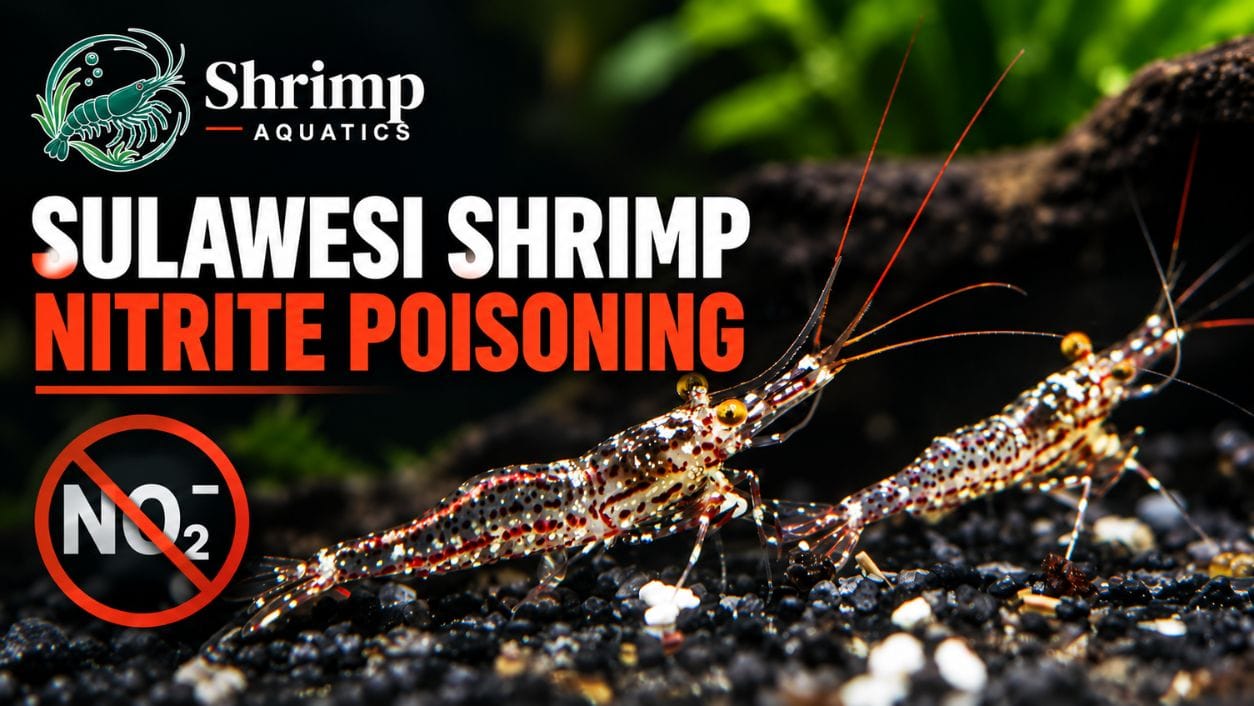
If your kit is showing any nitrite at all in a Sulawesi tank, treat it as an emergency today. It isn’t a number to keep an eye on. Nobody has published a nitrite tolerance for any Sulawesi lake Caridina, so the working target is undetectable, and the figures you’ll find on general aquarium pages were measured on other animals in water nothing like yours. Most of the damage keepers do in the next few hours comes from correcting too hard, not from the nitrite.
What to Do in the First Hour After a Sulawesi Tank Tests Positive for Nitrite
In the first hour after a nitrite reading, work through the steps below in order: each one removes waste or adds oxygen. None of it moves your water chemistry, which is what you want while you still don’t know where the nitrite came from.
- Stop feeding. Not a smaller portion, none at all, until the reading is back to zero.
- Siphon out anything that’s breaking down. Leftover food, a dead shrimp or snail, a rotting leaf. If you can’t see the whole tank floor, move the rock rather than guess.
- Check that the filter is actually moving water. A stalled pump, a blocked sponge, or a filter you rinsed clean last week: those are the three usual reasons nitrite turns up in a tank that was fine.
- Add aeration, gently. It’s the one thing that helps and can’t make the chemistry worse.
- Retest. Test your replacement water and your source water separately too. A kit that reads nitrite in a freshly mixed bucket is telling you something very different from a kit that reads it only in the tank.
- Don’t change a large volume of water yet. Don’t add salt, and don’t start a medication.
Get More Oxygen Into the Water Before You Touch Anything Else
Nitrite crosses the gills on the same route the shrimp uses to take up chloride, and once it’s in the hemolymph it lowers that hemolymph’s oxygen affinity.1 So an animal swimming in fully oxygenated water can still be short of oxygen in its tissues. That’s why a shrimp with a nitrite problem hangs at the surface or sits in the filter outflow. It’s looking for oxygen it can’t carry.
Your tank starts this fight with less margin than a cool one. Cold water holds more dissolved oxygen than warm water,2 and these shrimp are kept warm. There’s simply less oxygen in there to begin with. So raise the surface movement and the aeration, and do it without turning the tank into a washing machine.
At Shrimp Aquatics, our Sulawesi systems run biological filtration together with a Kaldnes moving-bed filter, and we tune the outlet so the shrimp aren’t pushed around while grazing. The goal is high oxygen with gentle movement at shrimp level.
An air stone under a sponge filter gets you there. So does a second air line broken over the surface. Cranking a powerhead doesn’t, and a colony already short of oxygen doesn’t need to fight the current as well.
Sulawesi Shrimp Behavior Alone Cannot Tell You Nitrite Is the Problem
Can you read nitrite off the shrimp? No. A colony that stops grazing, climbs the glass, gathers at the outflow or sits out in the open when it normally hides is telling you something in the water is wrong. It isn’t telling you which thing. Ammonia does that. A temperature swing does that. A mineral batch that went in half dissolved does that. So does nitrite.
The test is the diagnosis. Use a liquid kit rather than strips, read it in daylight against white, and write the number down with the time. The direction it moves over the next day matters more than the first reading. No nitrite test in the house? Treat the tank as though the reading were positive and do the first hour anyway. Stopping feeding and adding air costs you nothing if you turn out to be wrong.
Don’t medicate on a guess
None of those signs are specific enough to justify a treatment, and several products aimed at fish will hurt invertebrates. If the animals look structurally wrong, not just distressed, work through the checks on common health problems in Sulawesi shrimp before anything goes into the tank.
Why the Published Nitrite Safe Levels Do Not Apply to Your Sulawesi Tank
Published nitrite safe levels come from other crustaceans tested in their own water, and none of them was measured on a Sulawesi shrimp. In the Amazon river prawn, the 96 hour median lethal nitrite concentration came out at 1.49 mg/L for postlarvae, 2.36 mg/L for juveniles and 2.34 mg/L for adults. The authors proposed safe levels of 0.1 mg/L for postlarvae and 0.2 mg/L for juveniles and adults.3 That’s a freshwater prawn, tested in its own water, at its own life stages.
Two things stop you carrying a number like that across. The first is the water it was measured in. Nitrite and chloride compete for the same way in, which is the route described above, so how much an animal takes up moves with the chloride around it. Your tank is reverse osmosis water rebuilt with a mineral salt chosen for hardness and alkalinity. You’ve no reason to assume it carries whatever protection those trials had.
The second is that safe levels of this kind get read too generously. A review of nitrogenous waste in decapod crustaceans concluded that the theoretical safe values traditionally used to predict toxicity thresholds substantially underestimate the effect on growth and physiological condition.4 An animal sitting well under a published limit can still be paying for it.
So there’s no honest number to give you except zero. Undetectable is the target. A reading of 0.25 mg/L in a Sulawesi tank isn’t a mild reading. It’s a filter that has stopped finishing its job.
How to Bring Nitrite Down Without Shocking a Sulawesi Colony
Bring nitrite down with small, repeated water changes. Diluting it means replacing water, and these shrimp handle a slow change far better than a sudden one. A half tank change is the standard emergency move in a fish tank. In a Sulawesi tank it swaps one problem for a worse one. The usual rule is to keep any single change small and slow, and to let repeated small changes do the work over a day or two.
Mix the replacement water outside the tank. Let the mineral dissolve properly, and test it before any of it goes near the shrimp. It has to land on the same numbers the tank is already holding.
| Temperature | 79-86°F (26-30°C), matched to whatever the tank is holding now |
|---|---|
| pH | pH 7.5-8.5 |
| GH | 4-8 dGH |
| KH | 3-6 dKH |
| TDS | 150-250 ppm |
| Nitrate | Under 10 ppm |
| Ammonia and nitrite | Undetectable, every reading |
Add the new water slowly, by drip or by ladle, over hours rather than minutes. If you’re unsure how to size and deliver a change on this tank, the usual water change schedule doesn’t get more aggressive just because there’s an emergency on.
Aquarium Salt Is the Standard Nitrite Treatment and the Wrong One Here
Adding chloride to block nitrite uptake is genuine, established practice in fish farming, and it works on the same competition described above. The problem is the dose, and what the addition does to your total dissolved solids while the colony is already stressed. You’d be raising one number to fix another, in an animal that reacts badly to both of them moving. We wouldn’t do it on our own tanks without a specialist telling us the amount, and we’re not going to publish one here.
What a Nitrite Binder Buys You in a Warm Sulawesi Tank
Conditioners sold to detoxify nitrite buy time, not a cure, and the time is short. Two rules stop them making things worse. Dose the label amount for your actual water volume and no more: doubling up is a habit that comes across from fish keeping, and these products draw on dissolved oxygen you haven’t got spare. And keep the aeration running the whole time. If you’re dosing again on day three, the binder isn’t the thing that needs your attention.
Where the Nitrite Came From: Why a Warm Alkaline Biofilter Stalls at the Nitrite Step
A warm alkaline biofilter stalls at the nitrite step because this water produces more free ammonia, and free ammonia shuts down the bacteria that turn nitrite into nitrate. The share sitting in the un-ionized form rises about tenfold for every whole pH unit, and roughly twofold for every 10 degrees Celsius, and it’s that un-ionized form that drives ammonia toxicity.5 Your tank sits high on both scales. The same scrap of waste makes more free ammonia here than it would in a cool neutral tank.
Now look at what that does to your filter. A biofilter works in two stages: one group of bacteria turns ammonia into nitrite, a second turns that nitrite into nitrate.6 Free ammonia shuts the second group down at far lower levels than the first. In nitrification research, nitrite oxidizers of the Nitrospira group were inhibited at 0.04-0.08 mg of free ammonia nitrogen per liter, while the Nitrobacter group tolerated 30-50 mg/L before inhibition.6 Those figures come from wastewater reactors, not aquariums, so read them as the direction of the effect and not as a threshold for your tank.
Nitrite showing up therefore means stage one is running and stage two isn’t keeping up. A nitrite reading is a filter symptom before it’s a shrimp symptom. That’s why it so often follows a death you missed, a heavy feed or a filter clean. If food is still sitting out an hour after it went in, start with overfeeding a Sulawesi tank, because that’s the version of this you can fix today.
Getting a Sulawesi Tank Back to an Undetectable Nitrite Reading
Test at the same time each day and keep the numbers written down. What you want to see is nitrite falling while nitrate creeps up, because that’s stage two catching up. Nitrite that holds flat for several days with no feeding means there’s still a source in the tank you haven’t found.
- Keep feeding suspended until you’ve had two clear readings in a row, then restart with a fraction of what you were offering.
- Leave the filter media alone. Rinsing it now removes the bacteria you’re waiting on.
- Keep the extra aeration running for several days after the reading clears.
- Don’t add a new mineral brand, raise the temperature or rescape while the tank is recovering.
- Don’t restock with new Sulawesi shrimp, even to replace losses, until the tank has been steady for weeks.
If this is a tank you set up recently, the honest answer may be that it was stocked before it was finished. Warm alkaline water settles more slowly than most, and the readiness checks for Sulawesi shrimp tank cycling time are worth rereading before the next attempt. And if shrimp keep dying after the nitrite has cleared, or you’re losing animals faster than you can test, that’s the point to bring in a qualified aquatic veterinarian or an aquaculture specialist.
References
6 Sources
- Molecular Characterization of Anion Exchanger 2 in Litopenaeus vannamei and Its Role in Nitrite Stress, International Journal of Molecular Sciences 26: 964, 2025.
- Dissolved Oxygen and Water, U.S. Geological Survey Water Science School, updated August 24, 2026.
- Acute Toxicity of Nitrite to Various Life Stages of the Amazon River Prawn, Macrobrachium amazonicum, Heller, 1862, abstract, Bulletin of Environmental Contamination and Toxicology 97: 619-625, 2016.
- Toxic effects of ammonia, nitrite, and nitrate to decapod crustaceans: a review on factors influencing their toxicity, physiological consequences, and coping mechanisms, abstract, Reviews in Fisheries Science 21(1): 1-21, 2013.
- Aquatic Life Ambient Water Quality Criteria for Ammonia, Freshwater, U.S. Environmental Protection Agency, Office of Water, April 2013.
- Analysis of Free Ammonia Inhibition of Nitrite Oxidizing Bacteria Using a Dissolved Oxygen Respirometer, Environmental Engineering Research 13(3): 125-130, 2008.
Ready to get started?
Shop our Sulawesi Shrimp collection
27 products available · Live Arrival Guarantee
Featured Sulawesi Shrimp
Sulawesi Orange Eyes White Sock
Caridina dennerli
Advanced · 79–86°F · pH 7.5–8.5
From $19.99View ProductSulawesi Red Line Blue Dot
Caridina sp. "Red Line Blue Dot"
Advanced · 79–86°F · pH 7.5–8.5
From $15.99View Product