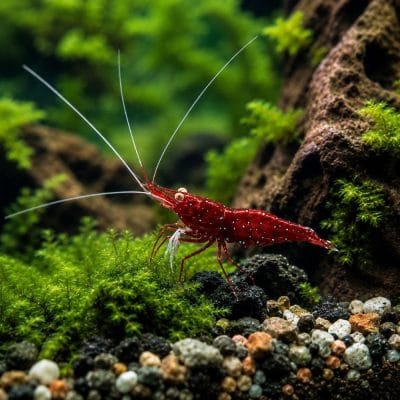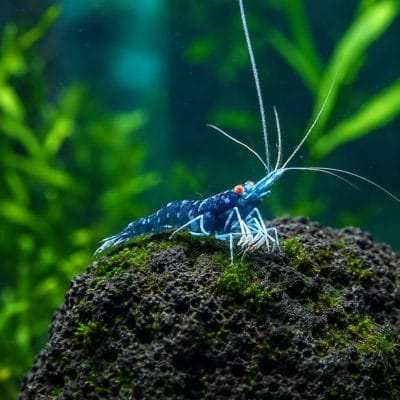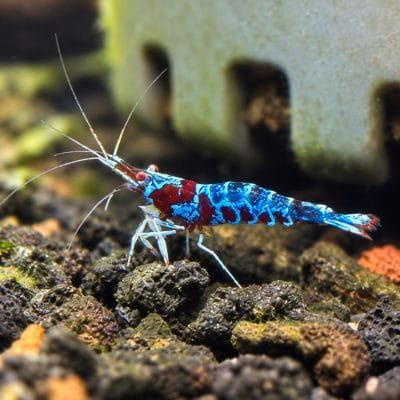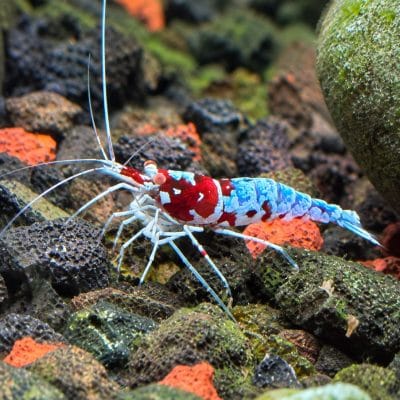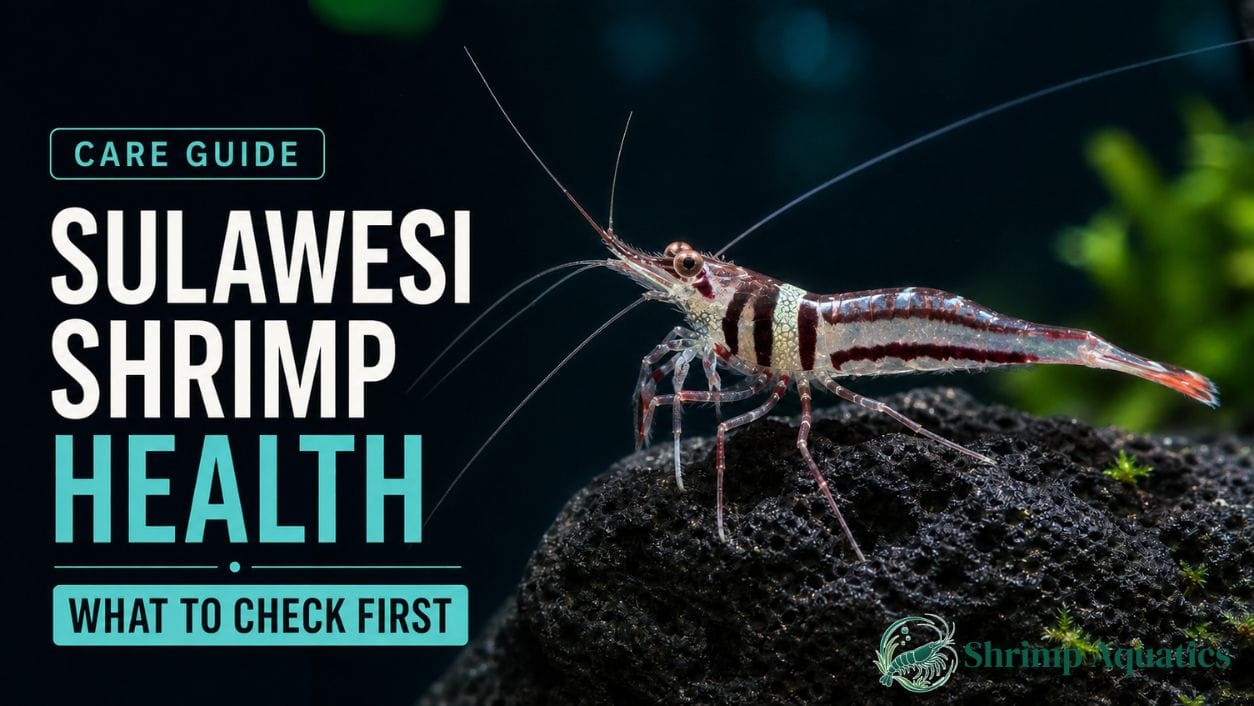

Sulawesi shrimp (Caridina spp. from the Malili lakes, such as Caridina dennerli, the Cardinal) are advanced specialists. Most of their health problems trace back to water quality and recent changes rather than a specific disease. This guide groups the plausible causes by urgency and by how well each is understood, starting with the checks that solve the most cases. It shows when to stop treating and call for qualified help. It doesn’t replace a diagnosis from a qualified aquatic veterinarian or aquaculture specialist.
Test the Water and Review Recent Changes Before Treating Sulawesi Shrimp
When your shrimp look sick, show signs of Sulawesi shrimp stress or start dying, the highest-value first step is a full water test and an honest review of what changed in the tank recently. These shrimp evolved in warm, alkaline, remarkably stable lakes, so small swings that other shrimp shrug off can push them into stress and immunosuppression. Water problems are also the best-evidenced and most fixable category, which is why they come first. Reaching for a medication before you’ve tested the water usually adds a second stressor to the first. A shrimp that stops moving after a change like this needs the temperature, ammonia and oxygen checks for Sulawesi shrimp staying on the bottom.
Confirm the tank is fully cycled with an established biological filter, then measure against the reference targets below. Treat these as typical Sulawesi group ranges to check for obvious errors, not as guaranteed survival limits; verify the needs of your specific species or stock. An unfinished biofilter is the usual reason, and any detectable reading is an emergency under Sulawesi shrimp nitrite poisoning.
| Temperature | 79-86°F (26-30°C) |
|---|---|
| pH | 7.5-8.5 (some subgroups tolerate higher; verify by species) |
| GH | 4-8 dGH |
| KH | 3-6 dKH |
| TDS | 150-250 ppm |
| Ammonia and nitrite | 0 ppm each, always |
| Nitrate | Aim for under 10 ppm; not a proven safe threshold |
Alongside the numbers, walk back through the recent past. A single overlooked event often explains a sudden loss, like Sulawesi shrimp that died overnight, because in the warm, alkaline Sulawesi environment a small mistake escalates quickly. Check whether any of these happened in the last one to two weeks:
- A large or fast water change, or a top-off with mineralized tap water instead of prepared remineralized water.
- A skipped or inconsistent remineralization step, causing GH, KH or TDS to drift.
- A swing in Sulawesi tank temperature from a failing heater, room air conditioning or a heat wave.
- Aggressive filter cleaning, a filter that ran dry, or heavy substrate disturbance.
- Don’t assume the water is fine because it looks clear; confirm with a liquid test kit.
- Don’t add livestock or medication to a tank showing any measurable ammonia or nitrite.
If a parameter is off
Correct it slowly. Sudden moves to fix a bad reading can shock the colony as badly as the original problem. Make gradual, drip-based changes toward the target ranges and keep observing before doing anything more invasive. If shrimp start swimming laps instead of grazing after a rough correction, see Sulawesi shrimp swimming erratically and check who is doing it.
Why a White Ring or Failed Molt Calls for Water Correction, Not Medication
Molting is the most dangerous routine event in a shrimp’s life, and failed molts are among the most common causes of sudden loss in Sulawesi tanks. The clearest warning sign is the white ring. That’s a visible white gap at the joint between the head section and the abdomen. The old shell has split there, but the shrimp can’t finish shedding it. What’s the difference between a healthy split and a white ring? Understanding the two terms helps you respond correctly. Keepers searching for this problem often call it a Sulawesi shrimp exposed neck.
- Healthy molt split
- A clean separation the shrimp exits within minutes, leaving an empty cast shell (exuvia). Finding intact molts is normal and good.
- White ring of a failed molt
- A persistent white band at the body joint that doesn’t progress to a successful exit. Once it’s visible, that individual usually can’t be saved.
Because the failed molt is mechanical and already advanced by the time you see the ring, the useful response isn’t medication. It’s to protect the rest of the colony by stabilizing the conditions that support molting. General hardness supplies the minerals shrimp use to build each new shell, so a GH that’s too low or that swings suddenly is the usual culprit. Unstable TDS or temperature can trigger a premature molt before the new shell is ready. If several shrimp show the ring over days, treat it as a tank-wide stability signal. A GH that swings is also behind many cases of a Sulawesi shrimp failed molt.
- Keep GH stable within the reference range and remineralize with the same product and ratio every time.
- Make water changes small and gradual so hardness and TDS don’t drop suddenly.
- Leave intact cast shells in the tank for a day; shrimp often eat them to recover minerals.
- Don’t try to peel or physically help a shrimp out of a stuck shell; this almost always causes fatal injury.
A molt that fails is a water question first, and how often Sulawesi shrimp molt matters less than whether each molt completes.
Identify White Fuzz, Crowns or Worms on Sulawesi Shrimp Before Treating
Imported Sulawesi shrimp commonly arrive carrying hitchhiking organisms, and several of them look alike to the naked eye while responding to completely different actions. This is the section where guessing does the most harm, because a treatment aimed at one organism often does nothing to another and still stresses the shrimp. Confirm what you’re dealing with, ideally under magnification or with a specialist’s help, before you medicate.
Stalked ciliates such as Vorticella and Zoothamnium: fuzzy growth, often on gills
Ciliate epibionts have been documented directly on Sulawesi Caridina from the Malili lake system, where they attach across the body surface, appendages and gills.1 To the eye they appear as fine white or grayish fuzz, most often on the head, rostrum and legs, and they’re frequently mistaken for fungus. They feed on bacteria in the water rather than on the shrimp, so a light population on an otherwise healthy animal is a water-quality signal more than a disease. The real danger is heavy colonization over the gills, which can obstruct gas exchange and suffocate the shrimp. That risk is higher in the warm, lower-oxygen water Sulawesi species need.1 Improving water quality and oxygenation is the first lever; any dip or treatment is a specialist decision.
Scutariella japonica: a small white worm or crown near the head
Scutariella japonica is a small temnocephalid flatworm that lives on ornamental freshwater shrimp and typically attaches near the rostrum and head. A heavy infestation can look like a white crown.2 Literature is divided on whether it’s a harmless commensal or a true parasite, but large populations are associated with host stress, oxygen-deficiency signs and molting problems.2 A light load in clean water often causes little harm. A heavy load in organically rich water needs a considered treatment plan. The eggs it leaves in the gill area survive a single surface treatment.
Leech-like worms and free-living flatworms
Two other groups get lumped in here and should be told apart. Small segmented worms that move in an inchworm fashion on the legs and underside are reported as ectosymbionts that can damage the host. Planaria are free-living flatworms with a triangular head that hunt shrimplets and weakened adults and arrive on plants or substrate. Because published, shrimp-specific evidence for these two is thinner than for the ciliates and Scutariella above, confirm the identification before acting and see the treatment-safety notes below.
Before any dip or medication
Many worm and flatworm treatments are lethal to snails, including the Tylomelania snails often kept with Sulawesi shrimp, and some residues persist in substrate for months. Confirm the target organism, check the exact product against invertebrate and snail safety, and follow current product-specific directions or a qualified specialist.
When Shell Lesions, Milky Bodies or Cottony Growth Need More Than Water Correction
Bacterial and fungal-type problems in dwarf shrimp are almost always secondary. Pathogens are normal residents of the aquarium, and they take hold when stress, injury or deteriorating water quality lower the shrimp’s defenses. The general shrimp-disease literature describes that process across species.3 The high temperatures Sulawesi shrimp require also speed bacterial growth, so water correction is usually the foundation of any response. A colony under that pressure often stops grazing in the open, so judge Sulawesi shrimp hiding by grazing, not by head count.
Three visible patterns are worth distinguishing:
- Shell lesions (shell or rust disease): pitted rusty-brown, orange or black eroded spots on the carapace, often near the legs or an old injury. They are caused by shell-degrading bacteria that can eventually breach the tissue underneath.3 Correcting water quality and reducing organic load is the first step; a spreading or deepening lesion is an escalation point.
- Milky or opaque body (possible internal infection): normally translucent muscle turning white or opaque, sometimes with reddish discoloration, can indicate an advanced internal bacterial infection. It spreads quickly and is often already terminal for that individual.3 The priority becomes the rest of the colony and the underlying water conditions.
- Cottony white growth (water mold): a dense, hair-like white or gray mass, unlike the finer ciliate fuzz above, usually appears on shrimp that are already dying from severe stress or injury. These molds act as opportunists on failing tissue.3 It signals a deeper problem to find, not just a surface to treat.
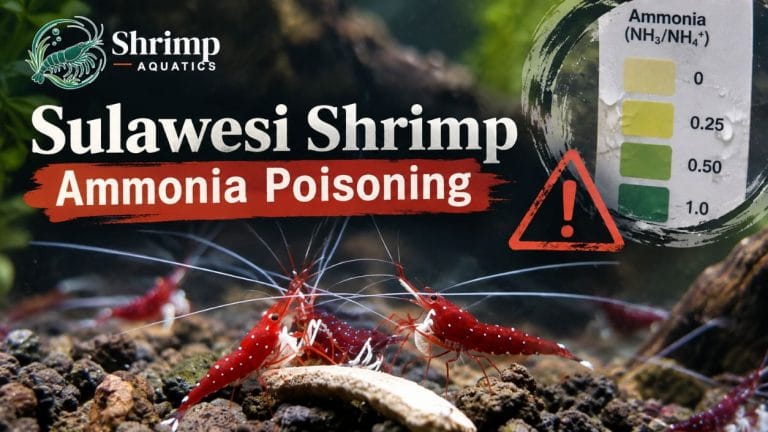
Across all three, avoid the reflex to dose the display tank with fish medications. Copper and malachite green are dangerous to invertebrates, and broad-spectrum antibiotics can wipe out the biological filter. In a high-pH Sulawesi tank that triggers a fast, lethal ammonia spike. If you believe a specific treatment is warranted, that’s a decision for a qualified aquatic veterinarian or aquaculture specialist working from a product- and species-appropriate source. Wiping out the biological filter this way is a direct route to Sulawesi shrimp ammonia poisoning.
Red Flags That Call for a Qualified Aquatic Veterinarian or Aquaculture Specialist
Some situations are beyond what a hobbyist should manage alone, either because the animal risk is high and uncertain or because there’s a risk to people. Treat the following as signals to get qualified help. Losing one or two shrimp a day with no clear cause is its own pattern, Sulawesi shrimp dying gradually.
- Rapid colony die-off, where a large share of the shrimp decline within hours to a few days.
- Milky or opaque bodies, or reddish or pink discoloration spreading through the body, suggesting systemic infection.
- Shell lesions that keep spreading or deepen despite corrected, stable water.
- Suspected disease in high-value or breeding stock where you’re considering medication and want an accurate diagnosis first.
- Any skin infection in a person who handles the tank.
Human health note
Some aquarium bacteria, including Mycobacterium marinum, can infect people through cuts or scrapes exposed to tank water, producing slow-healing skin nodules known as fish tank granuloma. Invasive disease is more likely in people with weakened immune systems.4 Cover any broken skin, and use waterproof gloves when working in a tank that’s experiencing a die-off. Wash thoroughly afterward, and see a doctor for a wound that won’t heal, mentioning your aquarium contact.
Viruses are a common worry but a low practical risk here. The well-documented, high-impact shrimp viruses are concentrated in farmed marine and brackish shrimp rather than freshwater ornamentals, and their emergence and spread are tied to aquaculture systems.5 Dwarf shrimp in a closed, remineralized freshwater aquarium sit at low baseline risk, which rises mainly if you introduce unquarantined wild stock or feed contaminated marine crustacean tissue. Sensible quarantine matters more than virus-specific treatment for a home keeper.
Prevent Repeat Sulawesi Shrimp Losses With Stable Water, Mature Biofilm and Quarantine
To keep Sulawesi shrimp healthy, prevention is far more reliable than cure, because once systemic failure begins the success rate of any treatment is low. Three habits prevent most of the problems above. Steady water also keeps shrimp from fading, the tank side cause behind most Sulawesi shrimp losing color.
- Hold water conditions steady within the ranges above, remineralizing consistently and changing water in small amounts, since stability protects both molting and immune function.
- Mature your Sulawesi shrimp tank before stocking and keep grazing surfaces rich. A well-aged tank with abundant biofilm, aufwuchs and algae feeds the shrimp and reduces starvation-linked weakness; don’t rush new arrivals into an immature tank.
- Quarantine and observe new shrimp, plants and hardscape so hitchhiking organisms and imported stress don’t enter an established colony unseen.
If you’re receiving a Shrimp Aquatics shipment, follow the acclimation instructions included with that specific order rather than a generic method. The right approach depends on the packing, transit time and species involved. When you’re unsure whether your setup fits this group, it’s fair and often kinder to the animals to hold off until the tank and your routine are ready.
Not sure your water fits?
You can email contact@shrimpaquatics.com with your pH, GH, KH, TDS, temperature, tank size, cycle status and current livestock, and ask for suitability guidance before adding Sulawesi shrimp.
References
5 Sources
- Protozoan ciliate epibionts on the freshwater shrimp Caridina from the Malili lake system on Sulawesi (Indonesia), Journal of Natural History, 2006.
- First report of Scutariella japonica, a temnocephalid epibiont, on introduced ornamental freshwater shrimp in European waters, Knowledge and Management of Aquatic Ecosystems, 2021.
- Handbook of Shrimp Diseases, S. K. Johnson, Texas A&M Sea Grant / NOAA, 1995.
- Invasive Mycobacterium marinum Infections, Emerging Infectious Diseases, U.S. Centers for Disease Control and Prevention, 2003.
- Viral disease emergence in shrimp aquaculture: origins, impact and the effectiveness of health management strategies, Reviews in Aquaculture (PMC), 2020.
Ready to get started?
Shop our Sulawesi Shrimp collection
27 products available · Live Arrival Guarantee
Featured Sulawesi Shrimp
Sulawesi Orange Eyes White Sock
Caridina dennerli
Advanced · 79–86°F · pH 7.5–8.5
From $19.99View Product