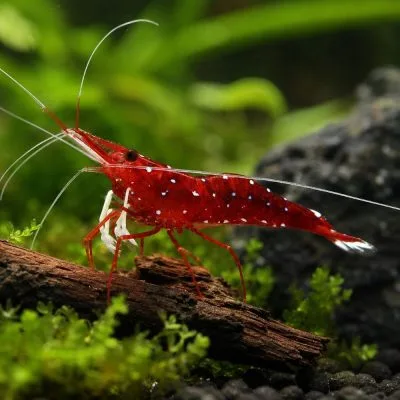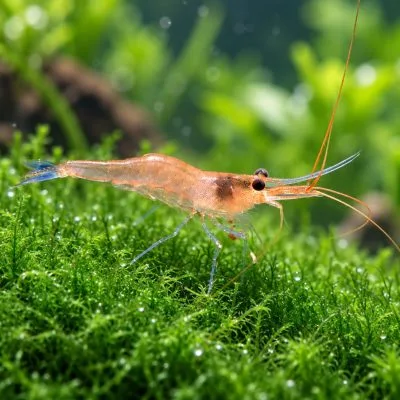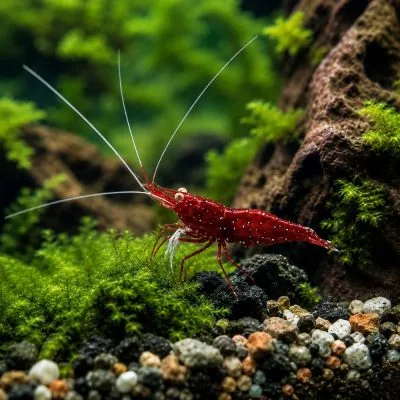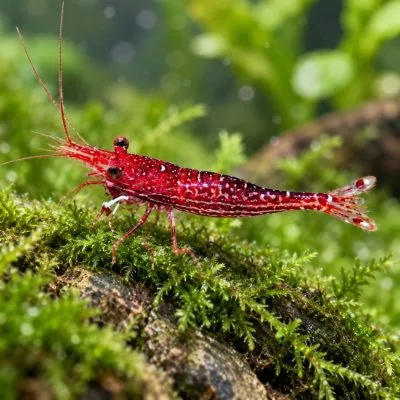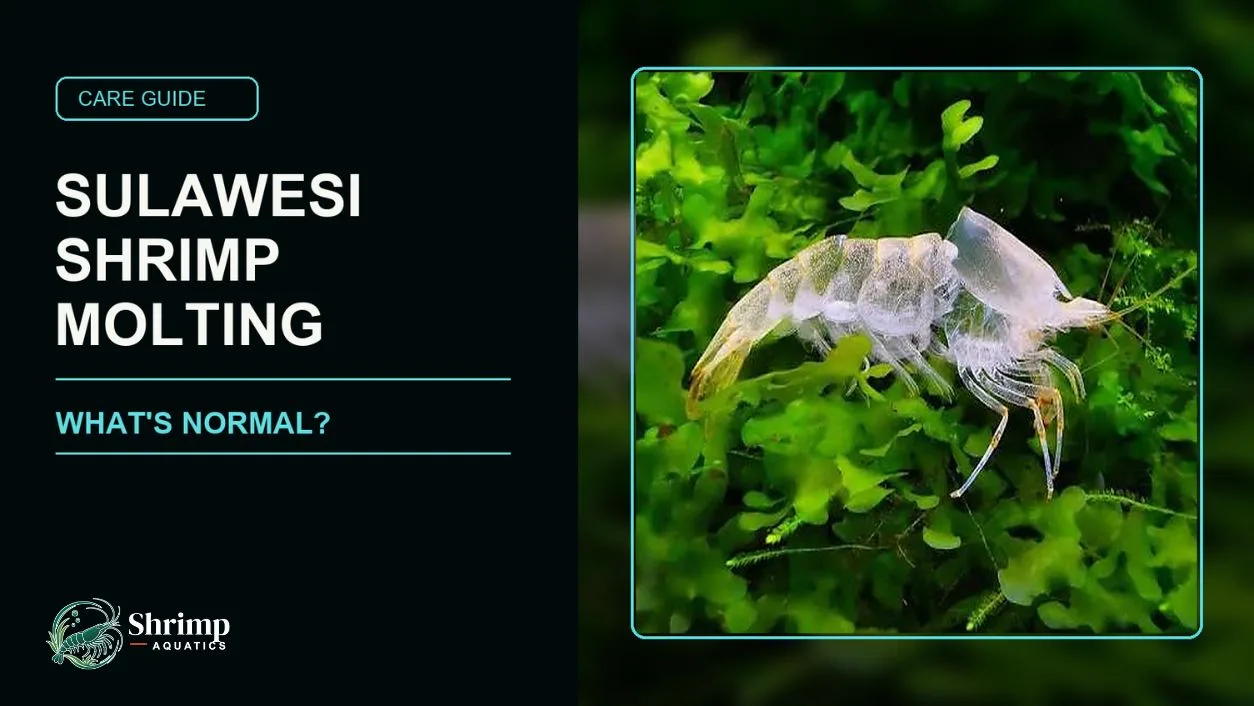
There were three shed shells on the sand last week and none this week, and you’d like to know which week was the normal one. Adult cardinal, Sulawesi White Sock and blue leg shrimp are thought to molt roughly every one to two weeks, and young ones more often, but that interval is a keeper’s estimate, not a timing. In our tanks, young Sulawesi shrimp molt more often than adults, and a water change often sets off a round of molts. The shrimp closest to them that have been timed in a laboratory cycle in days, not weeks, and both body size and temperature move that interval. A Sulawesi tank runs warm, at 79-86°F (26-30°C), above the conditions in those studies. So for a full grown Sulawesi shrimp, use one to two weeks to sanity check what you see. It isn’t a schedule your tank owes you.
Why the molting numbers you find for Sulawesi shrimp disagree
They’re quoted without a species, a body size or a temperature, and a molt interval depends on all three. Molting is growth. A crustacean can’t get larger inside a rigid shell, so it has to cast the old one to add size.1 That makes a molt interval a property of one animal at one size in one set of conditions. Almost every shrimp molting article ignores that and repeats the same pair of figures anyway: an adult molts every three to four weeks, a juvenile every one to two weeks. Those numbers aren’t so much wrong as unattached. They name no species, no temperature and no body size, and the pages repeating them cite nothing.
When molt cycles are actually timed under controlled conditions, the intervals come out shorter and they move with the animal. Here’s what’s been measured in shrimp close enough to be worth comparing, and what’s missing.
| Shrimp timed | Conditions | Measured cycle | What it supports |
|---|---|---|---|
| Cherry shrimp, Neocaridina davidi, adult males2 | Daily imaging through one complete cycle at 73°F (23°C) | About 10 days between consecutive molts | A dwarf freshwater shrimp of similar size cycles on a scale of days at room temperature |
| Atlantic ditch shrimp, Palaemon varians3 | Constant laboratory temperature below the Sulawesi range, individuals 2.1-4.0 mm | 6-12 days, mean 8.7 days, with the smallest cycling in 6-8 days and those over 4 mm in 10-12 | The interval lengthens as an individual shrimp grows |
| Sulawesi lake Caridina | No published timing | Not measured | Any Sulawesi figure is inference from related species plus keeper reports |
That gap is the whole answer to the question. Nobody has timed a Sulawesi shrimp, the measured relatives cycle faster than the figure the hobby repeats, and warmth pushes the interval down further still. So the useful question is whether the molts you’re getting are going well, and how often they come matters much less.
What actually changes the gap between molts in a Sulawesi tank
Body size, temperature and food do most of the work, because anything that changes how fast a shrimp grows changes how often it sheds. Molting is how a shrimp adds size, so the three are worth taking one at a time.
Small growing shrimp shed far more often than full grown adults
In the measured relatives, the molt cycle tracked body size closely, and the smallest animals came round fastest.3 That’s why a colony holding shrimplets produces far more shed shells than its adult count would suggest. Most of what you find belongs to the youngest animals, and the mature shrimp you’re actually watching are the ones shedding least often. If your colony has bred recently, expect the shell count to rise without anything having changed in the water.
Warmer water inside 79-86°F (26-30°C) shortens the interval
Temperature is the reason a Sulawesi tank shouldn’t be read against cool water shrimp advice at all. Across many crustaceans, temperature acts on both the intermolt period and the growth added at each molt, and crabs raised warm cycled faster while gaining less per molt.4 The direction is the same in a dwarf shrimp, where the warmest of three rearing temperatures in cherry shrimp sped things up but cost the females their eggs.5
Faster isn’t automatically better. For a Sulawesi tank, that argues for picking a stable point inside 79-86°F (26-30°C) and holding it. Don’t push the top of the range to make the colony cycle faster. If your room temperature swings, settling whether Sulawesi shrimp need a heater matters more than any molt schedule. A tank that drifts a few degrees a day is moving the interval in both directions.
Feeding more doesn’t buy you faster molts
Growth in these tanks is fed by the grazing surface, not by the food dish. It’s worth saying because more food is the usual reaction to a colony that’s gone quiet.
At Shrimp Aquatics, mature algae and biofilm do most of the feeding in our Sulawesi systems. We normally offer prepared food only about once a week and remove leftovers. Many of the shrimp in these systems show limited interest in it. Food that sits in warm water adds organic waste and can raise ammonia, nitrite and nitrate as it breaks down.
Heavier feeding buys waste before it buys growth, and in warm alkaline water that bill arrives quickly. A mature grazing surface is what supports the steady growth molting depends on.
Growth is the point of each molt, which is why the time Sulawesi shrimp take to reach breeding size is a question about molts, not months.
Counting shed shells in a Sulawesi tank tells you less than you think
A shell count tells you little, because most sheds end up where you’ll never see them. A shed exoskeleton is thin, translucent and light enough to drift behind rock, under leaf litter or against an intake. Most Sulawesi tanks have enough hardscape that you aren’t seeing most of what happens in them. Shrimp that have just molted are soft and stay in cover, which is exactly when they’re hardest to count. A week with no shells on view means very little on its own, so you can stop playing detective with the sand.
So what should you watch instead? Shrimp that are visibly larger over a month, and animals grazing in the open, not sitting still in the rock. Check that nobody is caught part way out of an old shell. There’s one place the molt cycle does deserve tracking. In most shrimps, mating takes place at the female’s premating molt, and males mate with a female that’s just molted while she’s still soft.6 Her molt is a breeding event as much as a growth step, which is why breeding Sulawesi shrimp is built around protecting it.
When several shrimp molt right after a water change
Clusters of molts in the hours after a large water change get reported constantly, and they worry keepers more than anything else about molting. We see it in our own tanks too, and some keepers use it on purpose, changing water to trigger molts and push growth. A change big enough to do that is also a sudden shift in temperature, TDS and hardness, which is exactly what a Sulawesi tank handles worst, so the change itself is what deserves your attention. Any replacement volume large enough to move TDS, GH, KH or pH is a swing the colony has to absorb, whatever it does to molting. Test the tank, build the replacement water to those readings and confirm them before anything goes in. That habit is what makes Sulawesi shrimp water changes safe in a specialist tank.
Give a molting Sulawesi shrimp water that can harden a new shell
Keep the minerals steady, because the calcium a crustacean puts into a new exoskeleton comes mainly from the water it lives in.7 Food, including the shed shell the animal eats afterward, is a minor contribution whatever the animal’s way of life. For you, that puts the weight on the tank’s mineral content.
| GH | 4-8 dGH |
|---|---|
| KH | 3-6 dKH |
| TDS | 150-250 ppm |
Where you sit inside those bands matters less than whether you stay there. A shrimp with a soft new shell is drawing minerals from the water at the moment a swing is hardest to absorb. The rest of the range, including temperature and nitrate, belongs with your Sulawesi shrimp care parameters as a whole.
Leave the shed shell where it falls
Shrimp commonly eat the old shell after molting, though on the evidence above it isn’t where most of their calcium comes from.7 There’s nothing to gain by taking it out, and reaching into a tank where a soft shrimp is hiding costs more than the shell is worth. Remove it only if it’s still lying untouched days later in a tank you’re already watching for water quality reasons.
When a Sulawesi shrimp molt is worth acting on
Act when a molt fails to complete, not when it seems early or late. Frequency itself is rarely the problem. A failed molt looks like a shrimp stuck part way out of the old shell, or a Sulawesi shrimp showing an exposed neck, a white gap at the joint between carapace and abdomen. Treat both as a water and mineral question, and check the tank before you reach for any treatment. The observable checks and what to expect from them are set out under common health problems in Sulawesi shrimp.
The pattern worth investigating is a colony that’s stopped molting altogether: no shells for weeks and no visible size gain over the same stretch. Before you change anything, confirm the basics.
- Ammonia and nitrite both read 0.
- Temperature holds steady inside 79-86°F (26-30°C) across the whole day, not only when you happen to test.
- GH, KH and TDS read what they read before your last water change.
- Nothing new went in during the past week: plants, a new food, a treatment, or top off water made with anything other than pure water.
- Don’t dose a mineral supplement to force a molt, and don’t medicate a shrimp that has already failed one.
Before you treat
There’s nothing you can safely dose at home to fix a molt that has already gone wrong. Treating the whole tank exposes every other shrimp in it to the medication. Correct the water first and leave that animal alone. Take repeated losses or spreading lesions to a qualified aquatic veterinarian or aquaculture specialist.
What the research says about how often Sulawesi shrimp molt
None of the timed studies is on Sulawesi Caridina, so read them for direction, not days. The table above gives the two molt timings. Beyond those, laboratory and field work across many crustaceans shows temperature acting on both the intermolt period and the growth added at each molt. Lesser blue crabs raised warm cycled faster while gaining less per molt, and ended up smaller at each stage.4
The cherry shrimp temperature study is the one that tempers the urge to run warm. Reared at three temperatures, cherry shrimp took 21 days to incubate their eggs at the coolest setting and 12 days at the warmest. The middle temperature gave the best survival, growth and reproduction overall, and every female that matured and mated at the warmest setting lost her eggs.5
On calcium, crustaceans do store some during premolt, reaching around 60 percent in one amphipod that has been studied closely.7 The same review still names the surrounding water as the main source for a new shell, with food a minor contribution.
References
7 Sources
- Farming freshwater prawns, biology chapter, FAO Fisheries Technical Paper 428, Food and Agriculture Organization of the United Nations.
- Characterization of the molt cycle of the cherry shrimp, Neocaridina davidi, Kelleher and Mykles, Colorado State University, Society for Integrative and Comparative Biology meeting abstract.
- Moult cycle and setal development of the Atlantic ditch shrimp Palaemon varians Leach, 1814, Journal of Crustacean Biology 44(4), 2024.
- Elevated temperature induces a decrease in intermolt period and growth per molt in the lesser blue crab Callinectes similis, abstract, Journal of Crustacean Biology 39(1), 2019.
- Effect of temperature on biochemical composition, growth and reproduction of the ornamental red cherry shrimp Neocaridina heteropoda heteropoda, PLOS ONE, 2015.
- Mating behavior and strategies, Raymond T. Bauer, University of Louisiana at Lafayette research page.
- Biomineralizations: insights and prospects from crustaceans, ZooKeys 176, 2012.
Ready to get started?
Shop our Sulawesi Shrimp collection
27 products available · Live Arrival Guarantee
Featured Sulawesi Shrimp
Sulawesi Orange Eyes White Sock
Caridina dennerli
Advanced · 79-86°F · pH 7.5-8.5
From $19.99View ProductSulawesi Red Line Blue Dot
Caridina sp. "Red Line Blue Dot"
Advanced · 79-86°F · pH 7.5-8.5
From $15.99View Product