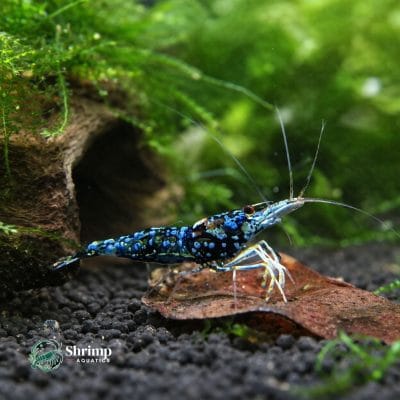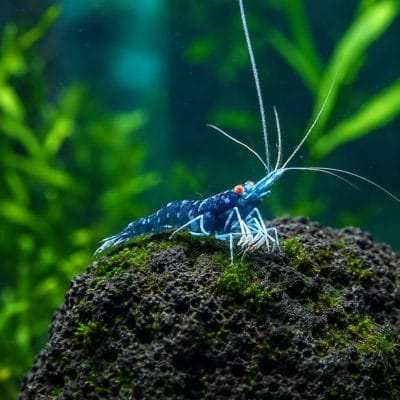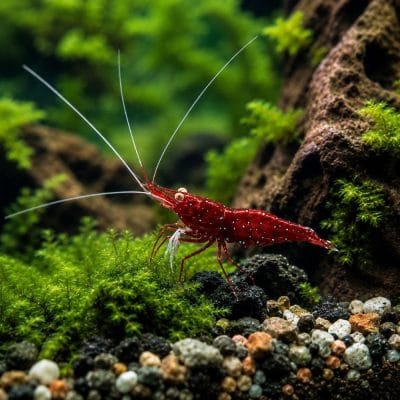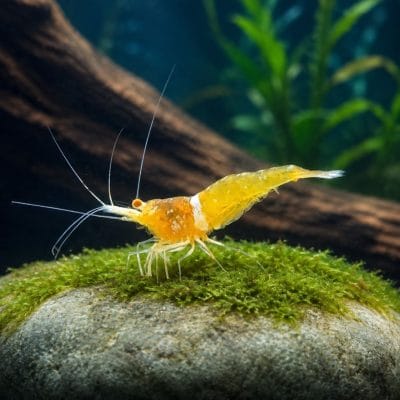

You don’t make Sulawesi shrimp breed. You build a mature, warm, alkaline tank, put a female-heavy group of one line into it, and then hold everything still long enough for molting females to mate on their own schedule. The hard part isn’t technique. It’s leaving a working tank alone.
Is Your Sulawesi Tank Mature Enough to Support a Brood?
A tank that keeps adult Sulawesi shrimp alive isn’t automatically a tank that can raise their young. Adults can wait for the next feeding. Newly released shrimplets can’t, because they graze whatever is already growing on the rock and glass around them from the moment they appear. Mature biofilm, aufwuchs and algae are the resources that feed them, and supplemental food doesn’t compensate for a system that hasn’t grown those surfaces yet.
A cycled tank isn’t yet a mature one, and the weeks of grazing growth in between, the part of keeping Sulawesi shrimp most beginners rush, are what a brood will actually eat. This is why the real work starts well before any shrimp goes in, and why moving a colony into a freshly filled tank puts you back at the beginning. That grazing layer is the whole subject of how to raise Sulawesi shrimplets once the brood actually appears.
Before you build a breeding group, confirm all of the following in the tank the group will live in.
- Ammonia and nitrite read 0 ppm and the biological filter is established. A calendar alone doesn’t prove a tank is cycled.
- Rock, glass and hardscape carry visible biofilm and algae, not just clear water.
- Substrate and hardscape are inert. An active pH lowering soil works against the alkaline water this group needs and shouldn’t be the default Sulawesi setup.
- Temperature holds without swinging across the day, including overnight and during warm afternoons.
- Don’t start a breeding group in a tank you’re still adjusting, still rescaping or still deciding about.
How to Sex Mature Sulawesi Shrimp Before You Build a Group
At Shrimp Aquatics we sex mature Sulawesi shrimp by combining three cues, and we treat no single cue as conclusive on its own, especially in juveniles or deeply pigmented shrimp. Work in good light, look at the animal from the side and from below, and check the same shrimp more than once before you count it.
| Cue | Mature female | Mature male |
|---|---|---|
| Lower abdomen and brood space | Deeper and rounder, with the abdominal plates extending farther downward to create more brood space near the tail | Slimmer through the abdomen, with a flatter and narrower underside |
| Ovarian saddle | A yellow or darker patch in the cephalothorax behind the head when visible, which is the strongest female cue | Doesn’t form an ovarian saddle |
| Upper central antenna pair | Often around one third of body length in our lines | Often around one half of body length in our lines |
For the antenna comparison, use only the two upper central antennae. Don’t count the two lower central appendages or the long pair extending to the sides. Pigmentation, age and reproductive stage can all hide a saddle, so a shrimp with no visible saddle isn’t therefore a male.
Read this before you count your group
Don’t sex juveniles, don’t decide from antenna length alone and don’t treat a missing saddle as proof of a male. If you can’t sex a shrimp with reasonable confidence, leave it out of the count, and rebuild the ratio once it matures.
If the group you already have is male heavy, the usual correction is to remove male Sulawesi shrimp, and the reason is the freshly molted female rather than the numbers.
Build a Female-Heavy Sulawesi Breeding Group
Mating in these animals is tied to the molt rather than to a season or a feeding routine. In shrimps generally, mating takes place at the female’s premating molt, and in pure-search species males don’t guard females approaching a molt but instead encounter just-molted receptive females, with recognition and mating occurring within seconds or a few minutes.1 The short window of premating attractiveness is what limits harassment of the female, which can result in her injury or even death.1 A soft, newly molted female is the moment signs Sulawesi shrimp are mating actually show up.
That mechanism is the reason group composition matters more than group size. A soft, freshly molted female surrounded by too many males is the one animal in the tank least able to escape attention.
At Shrimp Aquatics
When we can sex the shrimp with reasonable confidence, we usually build a Sulawesi breeding group with either 2 males to 8 females or 3 males to 7 females. We use a female-heavy group to reduce mating pressure on newly molted females, which are still soft and vulnerable. We confirm sex from multiple visible cues before setting the ratio.
If your shrimp are too young to sex, buy a larger group and let the ratio settle as they mature. Rebuilding the ratio once they’re readable costs nothing but patience.
Keep One Sulawesi Line per Breeding Tank
The second composition decision is which lines share the tank. Housing several named lines together is fine for a display colony, but it removes your control over what the offspring look like.
In our Sulawesi systems
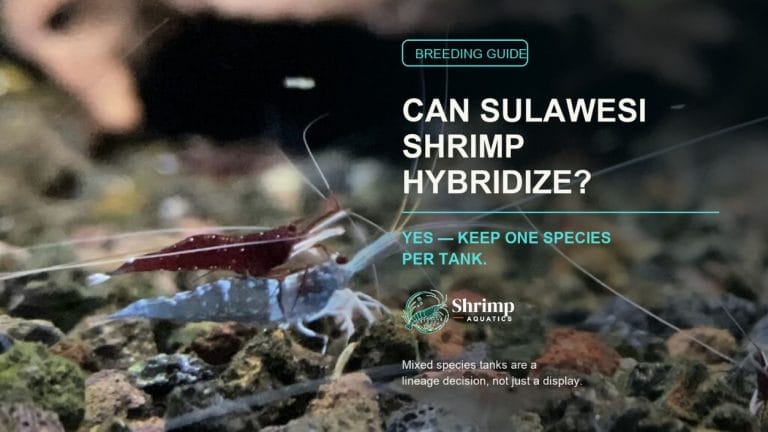
We haven’t seen routine crossing among unrelated Sulawesi species, but we treat White Sock, Blue Ghost, Yellow Ghost and Oiran as lines that may cross when kept together. The offspring we’ve observed haven’t shown the same obvious color fading that we’ve seen after uncontrolled mixing in some Neocaridina or Bee and Crystal Caridina lines. Lines that cross like this are exactly the case examined in can Sulawesi shrimp crossbreed.
If the point of the tank is to produce a line you can identify, keep it to one line. If the point is a mixed colony you enjoy looking at, mix them knowingly and accept that later generations may not match what you started with.
Hold the Water Steady Through Every Sulawesi Molt
Because mating happens at the molt, anything that disrupts molting also disrupts reproduction. The hardness in the water is directly involved: in crustaceans, the major source of the calcium used to calcify a new exoskeleton is exogenous, meaning it comes from the surrounding water, while stored premolt reserves and diet contribute less.2 A colony held at a steady mineral level is drawing on a supply that doesn’t move under it.
These are the targets for Sulawesi lake Caridina. Land inside them and then stop moving.
| Temperature | 79-86°F (26-30°C) |
|---|---|
| pH | 7.5-8.5 |
| GH | 4-8 dGH |
| KH | 3-6 dKH |
| TDS | 150-250 ppm |
| Nitrate | Aim for under 10 ppm |
| Ammonia and nitrite | 0 ppm |
| Substrate | Inert substrate and hardscape |
Hitting those numbers once is the easy part. Holding Sulawesi shrimp water parameters steady through months of evaporation and top-offs is what decides whether anything hatches. A warm tank loses water to evaporation, and evaporation concentrates the dissolved solids left behind.3 Replace the evaporated volume with pure RO so the mineral level stays where you set it, and treat a slowly climbing TDS reading as a change in the shrimp’s environment, not a measurement quirk.
When real Sulawesi shrimp water changes are warranted, matching the replacement water to the tank you already have matters more than aiming at the middle of a published range. The shrimp respond to movement in the numbers, not to the numbers themselves.
Because mating happens at the molt, how often Sulawesi shrimp molt sets the rhythm of the whole project, and it’s measured in days rather than weeks.
What to Do When a Sulawesi Female Goes Berried
A berried female carries the clutch on her pleopods, under the abdomen, which is where published brood counts are taken from wild animals.4 New keepers often confuse this with a female showing only an ovarian saddle, and telling the two apart saves a month of waiting for eggs that were never fertilized. A saddle sits behind the head. A clutch sits under the tail. A saddle mistaken for a clutch is the same confusion behind Sulawesi shrimp eggs not hatching reports.
Expect a small brood. In the taxonomic revision of the Sulawesi lake species, seven wild-caught Caridina dennerli females carried 8-14 eggs each, and the per-species counts recorded in the same work ranged much more widely across the rest of the group.4 That spread is the reason no single group figure is worth quoting, and why the published counts of eggs per brood, species by species, are more useful than an average. No single number fits every line, which is why how many eggs a female Sulawesi shrimp carries per brood varies by species.
The useful action is inaction
Once a female is carrying, the tank should get quieter, not busier. Skip the rescape, skip the equipment swap and skip any correction that wasn’t already overdue. Every adjustment is a change in conditions, and the whole point of the preceding months was to stop making them. Every rescape and correction you skip while a female is carrying lowers the risk of Sulawesi shrimp dropping eggs.
Getting Sulawesi Shrimplets Through Their First Weeks
The young are on their own from the moment they leave the eggs, and what actually emerges at Sulawesi shrimp egg hatching time shapes how you handle the following weeks. Your work here was done earlier, when you grew the grazing layer, so the temptation now is to help in ways that make things worse.
The strongest of those temptations is food. A warm alkaline tank punishes leftovers harder than a cool acidic one does, because the fraction of total ammonia present as the toxic un-ionized form rises about tenfold for each rise of a single pH unit and roughly doubles for each rise of ten degrees Celsius.5 A Sulawesi tank sits at the unfavorable end of both scales at once, so uneaten food does more damage here than the same amount would in a Bee Caridina tank. Prepared food stays a supplement on top of the grazing layer, and how little of what Sulawesi shrimp eat has to come from you surprises most keepers.
- Increasing feeding because shrimplets have appeared, which adds organic load to the exact water the shrimplets are least able to tolerate.
- Running an unguarded intake. Intake guards or sponge filtration can reduce shrimplet loss, and fitting one after the fact means catching shrimp you can’t see.
- Siphoning hard around biofilm covered surfaces during the weeks when shrimplets are grazing on them.
- Adding new livestock to a tank that has just started producing young, which changes competition for grazing surfaces and total stocking at the worst moment.
- Counting the colony daily. Young Sulawesi shrimp stay hidden, and an absence of sightings isn’t an absence of shrimp.
How Long Before You Can Judge a Sulawesi Breeding Project?
This group doesn’t give you a fast answer, so judge it on stages, not dates. Each stage below only becomes readable once the one before it’s holding, and none of them arrives on a schedule you can set.
- Settling in The group feeds, grazes in the open and molts without losses. Success at this stage looks like nothing happening, which is exactly what you want.
- First saddles Mature females start showing ovarian saddles. This is the first real signal that the conditions are acceptable, and it arrives before any clutch does.
- First berried female A clutch appears under the abdomen and stays there. Carrying to term matters more than the count, so resist the urge to check her under a bright light every evening.
- First shrimplets You’ll usually notice them well after they arrived, grazing on the same surfaces as the adults. Don’t change the feeding routine to celebrate.
- The trend Judge the colony on whether it’s slowly growing. Broods are small, so a single good month proves as little as a single quiet one.
If saddles never appear, or clutches appear and disappear, stop changing variables and work out why your Sulawesi shrimp are not breeding before you correct anything. Changing several things at once in a Sulawesi tank usually costs more time than the original problem did.
If you’re building the group from scratch, start it with tank-bred Sulawesi shrimp from one source, so you know which lines you’re putting together before the first saddle appears.
How long the young take to get there’s the next question; Sulawesi shrimp reach breeding size on the shrimp’s schedule, and the signs are on the female, not on the calendar.
References
5 Sources
- Mating Behavior and Strategies, research page by Raymond T. Bauer, University of Louisiana at Lafayette, accessed 2026-08-08.
- Biomineralizations: insights and prospects from crustaceans, Gilles Luquet, ZooKeys 176, 2012, open access copy at PubMed Central.
- Chloride, Salinity, and Dissolved Solids, U.S. Geological Survey, Water Resources Mission Area, updated March 1, 2019.
- Radiation of endemic species flocks in ancient lakes: systematic revision of the freshwater shrimp Caridina from the ancient lakes of Sulawesi, Indonesia, with the description of eight new species, Raffles Bulletin of Zoology 57(2), 2009, publisher archive PDF.
- Aquatic Life Ambient Water Quality Criteria for Ammonia, Freshwater, U.S. Environmental Protection Agency, Office of Water, April 2013.
Ready to get started?
Shop our Sulawesi Shrimp collection
27 products available · Live Arrival Guarantee
Featured Sulawesi Shrimp
Sulawesi Orange Eyes White Sock
Caridina dennerli
Advanced · 79–86°F · pH 7.5–8.5
From $19.99View ProductSulawesi Orange Eyes Yellow Ghost
Caridina dennerli
Advanced · 79–86°F · pH 7.5–8.5
$120.00View Product