Raising Sulawesi shrimplets is mostly work you finish before they exist. What decides whether a brood comes through? How mature the grazing surfaces are when it hatches, how steady the warm alkaline water stays afterwards, and how little you change once the shrimplets are out. Nothing you add later substitutes for a tank that was already feeding itself. The most common way to lose a brood is to start feeding and fiddling because you can finally see babies.
Sulawesi shrimplets hatch ready to graze, so skip the larval setup
Sulawesi lake shrimp (Caridina spp.) carry few eggs and large ones. In the 2009 systematic revision of the group, ovigerous Caridina dennerli females were recorded carrying 8-14 eggs each across 7 females. Those eggs measured 1.0-1.2 x 0.5-0.7 mm against an examined adult carapace length of 1.5-3.4 mm.1 Other species in the same revision run higher, and the spread across the group is wide enough that no single brood figure describes it. The shape of the strategy is consistent: a small number of very large eggs for the size of the animal carrying them.
That’s the egg pattern that goes with abbreviated or direct development in freshwater shrimps generally. Most completely freshwater species spawn large embryos with either direct or abbreviated larval development. The hatching stage is either a postlarva, so the planktonic environment is avoided completely, or a few nonfeeding larval stages. Amphidromous species take the opposite route, spawning many small eggs that hatch at a much less advanced stage.2 That’s a caridean-level pattern, and no published description of one was available for this guide. Treat it as the direction the biology points.
The practical consequence is the part that changes what you buy. You aren’t raising larvae. There’s no window in which the shrimplets need something the adults don’t, and no food you can add that the tank wasn’t already making. They need the water the adults need, held steadier, and a surface that’s already producing something to eat on the day they arrive. That surface, not a food jar, is what answers what baby Sulawesi shrimp eat, and it has to be there before the brood hatches.
Set the tank up before the Sulawesi brood hatches, not after
A tank that has just finished cycling and a tank that’s ready for shrimplets are two different things, and only one of them shows up on a test kit. Zero ammonia and zero nitrite tell you the filter works. They tell you nothing about whether there’s anything on the rock to eat. Food in a dish is food a very small animal has to find and cross open ground to reach. Food already growing on the rock is food that’s where the animal already is. Only one of those is something you control.
Use the brooding weeks for that rather than for shopping. Keep the tank inside the group range the whole time.
| Difficulty | Advanced to expert |
|---|---|
| Temperature | 79-86°F (26-30°C) |
| pH | 7.5-8.5 |
| GH | 4-8 dGH |
| KH | 3-6 dKH |
| TDS | 150-250 ppm |
| Nitrate | Aim for under 10 ppm |
| Substrate | Inert substrate and hardscape, never an active pH-lowering soil |
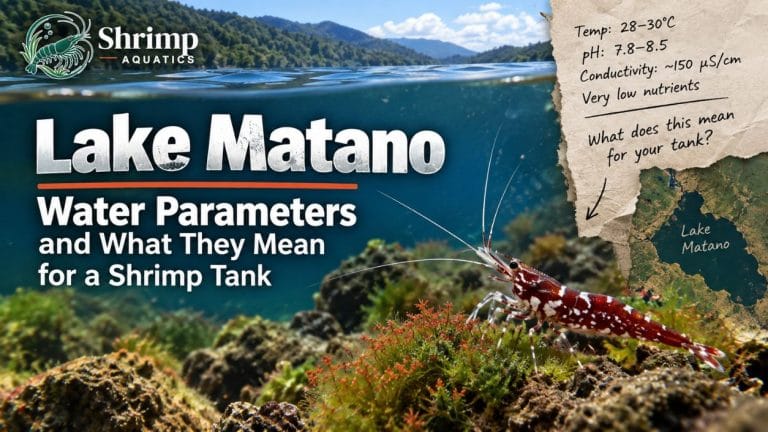
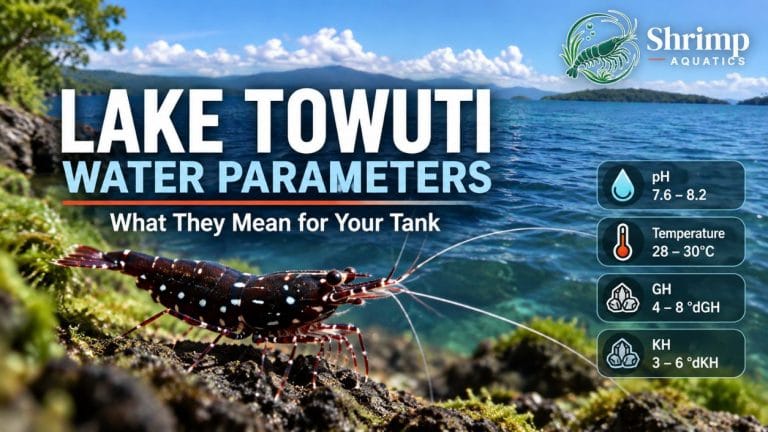
Hold those steady rather than hunting for a better point inside them. Lake Towuti, one of the Malili lakes this group comes from, sits at roughly 82°F (28°C) year round, in a tropical climate whose monthly air temperatures barely move.3 These are animals shaped by sameness rather than by an optimum. A tank parked anywhere inside the band and left alone will do better than a tank being nudged toward a number somebody published.
A rearing tank also has no fish in it. Species described as generally lower risk with adult shrimp will still take shrimplets, and there’s no stocking level at which that stops being true. If you want recruitment from a group, the fish come out before the brood is due, not after you notice the count dropping.
Timing the group matters as much as timing the tank. Adding shrimp during a rearing window means repeated acclimation events and bioload steps in a tank whose entire job is to stay unchanged. Bring in the tank-bred Sulawesi shrimp you want as one order. Let the group settle before you start expecting broods from it. Getting that timing right before the group even goes in is the core of how to breed Sulawesi shrimp.
Before you count on a brood surviving, the tank should pass all of the following.
- Ammonia and nitrite read zero on two tests a week apart, with the tank stocked and being fed normally.
- Visible biofilm and soft algae have colonized the rock and the glass, not just the filter.
- pH and TDS read the same across two weeks with no correction from you.
- The heater holds the temperature inside the band with no daily swing you can measure.
- Hardscape is porous and stacked so there are sheltered surfaces a shrimplet can graze without crossing open ground.
- Not ready: a tank running a few weeks on a bacterial starter with clean glass and nothing growing on the stone yet.
Build the grazing surface Sulawesi shrimplets actually eat from
The rock is the food supply, so treat surface area as a stocking decision. Porous, inert hardscape rock stacked into a structure with light reaching most of it gives you far more grazeable area per litre than a flat layout. It also gives the shrimplets somewhere to sit while they use it. A moderate photoperiod is part of the same job, since part of what you’re growing is algal.
What you shouldn’t do is bury that surface. Deep substrate beds and heavy vacuuming work against each other and both work against the shrimplets, because the film you’re removing when you clean is the thing they eat. Keep the substrate shallow and inert, and leave the rock alone.
Plant cover outperformed bare stone in the only controlled trial
A 2025 rearing trial reared Caridina dennerli from an average starting total length of 1.445 cm under four combinations of feed and shelter. The pellet groups ran for 30 days and the bacterial starter groups for 37 days. Commercial pellets with plant cover produced both the highest growth and the highest survival of the four.4
| Feed and shelter | Trial length | Average total length gained | Survival |
|---|---|---|---|
| Commercial pellets with Hydrilla | 30 days | 0.119 cm | 72.7% |
| Commercial pellets with stone | 30 days | 0.079 cm | 40.9% |
| Bacterial starter with stone | 37 days | 0.013 cm | 31.8% |
| Bacterial starter with Hydrilla | 37 days | 0.017 cm | 22.7% |
Read that carefully before you act on it. The trial started with juveniles already over a centimetre long, not with hatchlings, and it varied feed and shelter, not water. Its survival percentages describe that setup and aren’t a rate to expect at home. What transfers is the comparison itself: living, finely divided cover beat bare stone on both measures, which is the same lesson as the biofilm one from a different angle. The species the trial used isn’t the point, and it isn’t sold everywhere, so check whether the plant you choose is permitted where you live before ordering it. A dense fine-leaved moss does the same job in a warm alkaline tank and is easier to source.
Why feeding more after a hatch is what kills Sulawesi shrimplets
Every tank turns uneaten food into ammonia. What’s different about a Sulawesi tank is what that ammonia then becomes. Total ammonia in water sits in equilibrium between the ammonium ion and un-ionized ammonia, and the un-ionized form is the one that drives toxicity in aquatic animals. The ratio of un-ionized ammonia to ammonium ion in fresh water increases roughly ten-fold for each rise of a single pH unit. It rises about two-fold for each 10 degrees Celsius of warming between 0 and 30 degrees Celsius. High external un-ionized concentrations reduce or reverse diffusive gradients so that ammonia builds up in internal tissues and blood.5 Those relationships were derived for freshwater aquatic life as a whole and not specifically for Caridina, so use them for the chemistry and not as a threshold for your shrimp.
Now put the Sulawesi water into that relationship. This group is kept warm and alkaline by requirement, not by preference. That means the same milligram of waste is doing more damage in your tank than the identical test reading would do in a cool, acidic one. That’s the whole reason a Sulawesi rearing tank is unforgiving about food, and it’s why the instinct to start feeding the moment you see shrimplets works against you.
At Shrimp Aquatics, mature algae and biofilm do most of the feeding in our Sulawesi systems. We normally offer prepared food only about once a week and remove leftovers. Many of the shrimp in these systems show limited interest in it. Food that sits in warm water adds organic waste and can raise ammonia, nitrite and nitrate as it breaks down.
During a rearing window, feed the tank you had before the hatch rather than a bigger one. If you want to target the shrimplets, target the surface instead of the water column. A very small amount of a fine powdered food placed onto the rock with a pipette lands where they already are. Anything still sitting there hours later was too much. If you can’t tell how much organic load a product adds, that’s a reason to skip it during a rearing window. Halving the dose doesn’t fix that.
Aerate a warm Sulawesi tank without pushing shrimplets around
Warm water is thin water where oxygen is concerned. Cold water can hold more dissolved oxygen than warm water.6 So a tank running near the top of the Sulawesi band starts with less oxygen headroom than a cool shrimp tank at the same level of aeration. That’s before you add the extra biological demand of a warm, mature, heavily colonized system. Oxygen is therefore not a detail on this page. It’s one of the two things you’re actively managing.
The awkward part is that the obvious way to add oxygen is more flow, and flow is what a newly hatched shrimplet handles worst. The resolution is to separate the two. Get the gas exchange from surface movement and from filter media with air passing through it. Then aim the return so that the water at rock level is barely moving.
At Shrimp Aquatics, our Sulawesi systems use biological filtration together with a Kaldnes moving-bed filter. The combination gives us strong aeration and active biological media, but we tune the outlet so the shrimp aren’t pushed around while grazing. The goal is high oxygen with gentle movement at shrimp level.
Whatever filter you run, the intake has to stop being a hazard before the brood is due. A sponge over the intake, or sponge filtration on its own, removes the suction risk and adds grazing surface at the same time. Fit it in advance: the week you notice shrimplets is a week you don’t want to be reaching into the tank rearranging hardware.
Change and top off a Sulawesi rearing tank without shocking the shrimplets
Two different water jobs get confused here, and mixing them up is a slow way to ruin a stable tank. Topping off replaces water that evaporated. A water change replaces water that’s still there. They call for different water.
Evaporation leaves the dissolved solids behind, concentrating them in the water that remains. That’s the mechanism the US Geological Survey describes for shallow groundwater in arid regions.7 The same physics runs a warm aquarium upward in TDS week by week. Top-off water is therefore pure RO or RO/DI, never remineralized water, or the tank climbs out of its own range while every individual top-off looks harmless. Small and frequent beats large and weekly, which is the one argument for an automatic top-off unit on a tank you’re trying to keep boring.
For the water changes themselves, change less, change slower and match before you pour. Alkalinity is what makes that possible. It’s the buffering capacity of a water body, its ability to neutralize acids and so maintain a fairly stable pH. It comes from the bicarbonates, carbonates and hydroxides present in the water.8 Let KH drift down and pH stops holding, which in this group is the parameter you can least afford to have moving. The test of a good water change isn’t its size. It’s that pH and TDS read the same afterwards as before. So measure both on the replacement water first, and add it slowly enough that the tank never registers the difference.
Prepare replacement water outside the tank
Mineral choice is a rearing decision, not just a setup one, because it determines what your replacement water can safely be. Sulawesi Mineral 8.5 doesn’t simply stir into RO water. The manufacturer states that it will almost totally dissolve if CO2 is added for a few days. At a regular quantity of about one bubble per second that takes approximately 3-4 days. The water must then be aerated with an air stone for at least three hours afterwards to expel the CO2.9
Never let CO2 charged mineral water reach the tank
Water that’s still carrying dissolved CO2 is acidic and hasn’t reached its final pH. Adding it to a tank holding shrimplets undoes the one thing you were protecting. Complete the aeration step in the mixing vessel, then measure pH, GH and TDS on the finished water before any of it goes near the aquarium.
The 7.5 grade of the same range avoids that step. The manufacturer states that it will almost totally dissolve within seconds and the water is ready for use immediately. It buffers the pH at around 7.5.10 Note where that sits. It buffers at the bottom endpoint of the group range. So choosing Sulawesi Mineral 7.5 or 8.5 is really choosing which end of the band your tank will live at. That’s a decision to make before a brood is due.
Getting the mineral content right matters more during a rearing window than at any other time. The major source of calcium used for crustacean exoskeleton calcification is exogenous, meaning the water the animal lives in, with food and stored reserves contributing less.11 A growing shrimp is therefore building its next shell out of your GH. Hardness that quietly drifts down over the weeks a brood is growing isn’t a cosmetic problem.
Everything else about maintenance in this period is subtraction. Don’t vacuum the substrate, don’t scrub the rock, don’t net anything out and don’t rearrange the layout to see better. Each of those removes grazing surface, releases trapped organics into warm alkaline water, or both.
Raising the temperature won’t grow Sulawesi shrimplets faster
This is the lever almost everyone reaches for, so it’s worth closing off properly. Growth in these animals isn’t continuous. All freshwater prawns, like other crustaceans, have to regularly cast the exoskeleton in order to grow,12 so size arrives in steps at each molt and in nothing between them. Warming a tank shortens the interval between those steps, which is where the idea comes from.
What the crustacean work actually reports is that the step gets smaller as well. Previous laboratory and field experiments suggest that temperature affects both intermolt period and growth per molt in many crustaceans. Lesser blue crabs reared at elevated temperatures showed a decreased intermolt period together with decreased growth per molt, ending up smaller at each instar. The authors add the conditional that if the pattern continued through the pubertal molt, elevated temperatures would result in a smaller size at maturity.13 That’s a crab and not a Caridina, and the size at maturity line is the authors’ conditional and wasn’t measured. Take it as the direction the effect runs.
Set against that direction you have the oxygen cost above and, at the top of the band, less margin for any mistake in feeding. The measured growth increments from the trial earlier on this page are the scale you’re working at either way. Pick a point inside 79-86°F (26-30°C) that your heater can hold without swinging, and then stop touching it. Patience is the only accelerant with no cost attached.
How to read the first weeks after a Sulawesi hatch
Expect to see almost nothing at first, and treat that as no information either way. A structured, well grazed layout hides a very small animal effectively. The temptation to lift a rock and check is the most destructive thing you can do in this period, and it tells you less than the test kit already does.
What you should be reading is the tank, not the shrimp. Ammonia and nitrite staying at zero, pH and TDS flat week to week, and film regrowing on any surface you disturbed all matter. Adults behaving the way they did last week matter too. All of that is more useful than any headcount you could make. If the cause of a problem sits at system level it will show on the test kit, and the adults are the animals you can actually watch for a change.
Some loss is normal, and a single body tells you nothing on its own. What distinguishes ordinary attrition from a failing tank is coincidence. Several losses in a short window, or losses that arrive alongside a measurement that moved, or alongside a change in adult behavior. In that case the correction is to the measurement, made slowly, not to the shrimp. There’s no published survival figure for home-reared Sulawesi broods to benchmark yourself against. The only measured percentages available belong to the controlled trial above, on larger juveniles, in a setup that isn’t yours. A single missing shrimplet means little, but a cluster of losses is the pattern why baby Sulawesi shrimp die actually looks for.
One thing not to do is treat. You can’t diagnose a cause from a shrimplet body. Medication safety depends on the exact active ingredients, the concentration and your water chemistry rather than on what the label promises. Copper and several common fish treatments carry real risk to invertebrates. If you reach the point where you believe something needs treating, describe what you measured to a qualified aquatic vet or an experienced specialist first. Do that before you dose anything into a tank with a brood in it.
References
13 Sources
- Radiation of endemic species flocks in ancient lakes: systematic revision of the freshwater shrimp Caridina from the ancient lakes of Sulawesi, Indonesia, with the description of eight new species, The Raffles Bulletin of Zoology 57(2): 343-452, 2009.
- Amphidromy in shrimps: a life cycle between rivers and the sea, Latin American Journal of Aquatic Research 41(4): 633-650, 2013.
- Geomicrobiological Features of Ferruginous Sediments from Lake Towuti, Indonesia, Frontiers in Microbiology 7: 1007, 2016.
- Effect of Using Different Shelter and Feed Types on Growth and Survival Rate of Sulawesi Endemic Ornamental Shrimps (Caridina dennerli), journal PDF, Jurnal Ilmiah PLATAX 13(1): 191-204, 2025.
- Aquatic Life Ambient Water Quality Criteria for Ammonia, Freshwater, U.S. Environmental Protection Agency, Office of Water, April 2013.
- Dissolved Oxygen and Water, U.S. Geological Survey Water Science School, updated August 24, 2026.
- Chloride, Salinity, and Dissolved Solids, U.S. Geological Survey Water Resources Mission Area, March 1, 2019.
- Alkalinity and Water, U.S. Geological Survey Water Science School, updated August 24, 2026.
- Sulawesi Mineral 8,5, minerals and trace elements, SaltyShrimp manufacturer product information page.
- Sulawesi Mineral 7,5, minerals and trace elements, SaltyShrimp manufacturer product information page.
- Biomineralizations: insights and prospects from crustaceans, ZooKeys 176: 103-121, 2012.
- Farming freshwater prawns, biology chapter, FAO Fisheries Technical Paper T428, Food and Agriculture Organization of the United Nations.
- Elevated temperature induces a decrease in intermolt period and growth per molt in the lesser blue crab Callinectes similis Williams, 1966, abstract, Journal of Crustacean Biology 39(1): 22-27, 2019.
Ready to get started?
Shop our Sulawesi Shrimp collection
27 products available · Live Arrival Guarantee