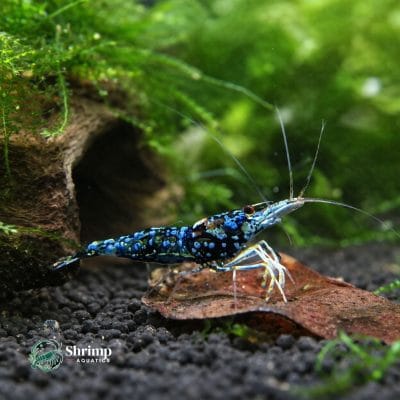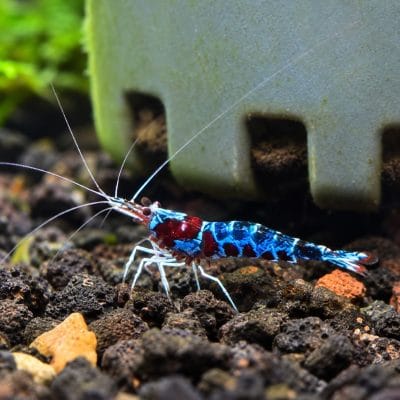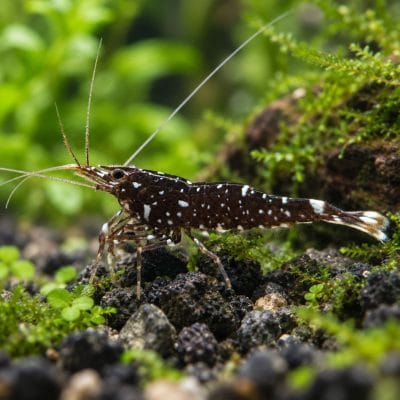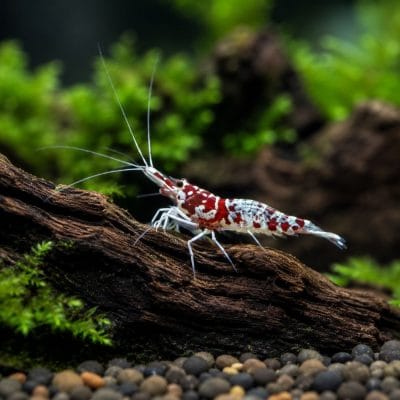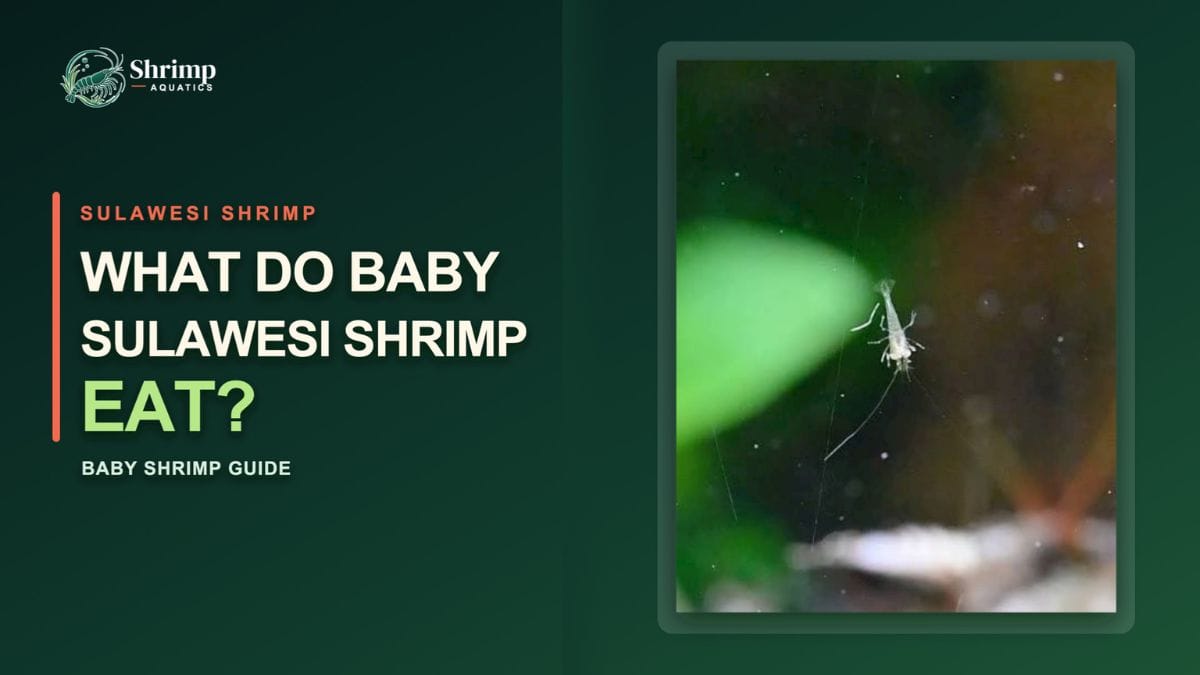
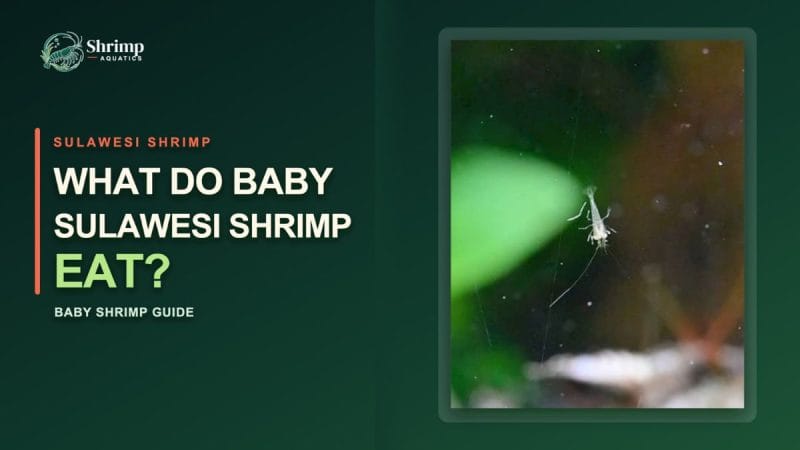
Baby Sulawesi shrimp eat what the adults eat: the living film of algae, diatoms and bacteria that grows over rock, glass and filter surfaces. Nothing published measures what a newly hatched Sulawesi shrimp actually takes, so the useful answer is about the tank rather than the food jar. You grow the grazing surface weeks before the first shrimplets appear, and you keep prepared food close to what the adults already get.
Do Sulawesi shrimplets need different food from the adults?
No separate food is required, and no measurement supports one. The reason sits in the eggs. When the Sulawesi Caridina were revised in 2009, ovigerous females were counted directly. Caridina dennerli, endemic to Lake Matano, carried 8 to 14 eggs across seven females, with eggs measuring 1.0 to 1.2 by 0.5 to 0.7 mm.1 Across the wider group the per species counts ran from 8 up to 80.1 That paper describes no larval stage for any of these species.
What’s published sits one genus away. In atyid shrimp generally the two life histories are distinct. Amphidromous species spawn many relatively small eggs.2 Landlocked species spawn a relatively small number of large eggs with considerable amounts of yolk.2 Those larger embryos produce non-feeding lecithotrophic larvae that live on their own yolk through an abbreviated or direct development into the juvenile stage. In one landlocked Paratya species the larvae stayed on the bottom of the rearing container from the early zoeal stage onward.2 That’s a different genus in a different lake system, so read it as the pattern the Sulawesi egg measurements fit, not as a description of a Sulawesi shrimplet.
Once a Caridina is feeding, what ends up inside it has been examined. A gut analysis of Caridina nilotica in Lake Victoria found that the main food was algae, mostly from the division Chlorophyta, with diatoms and cyanobacteria also common.3 Different species, different lake, but it matches what you see through the glass: shrimp working over a surface rather than chasing anything in open water. The practical consequence is the same for the young as for the adults. It’s the whole answer to this question: the food has to be on the surfaces, not in the water column.
One caution about the group name. The Malili lake shrimp are an adaptive radiation, and the species differ in trophic morphology according to the habitat they specialize in.4 Sulawesi shrimp is a shelf label covering several animals with different diets. So treat any group-wide feeding rule, including this page, as the starting point for watching your own tank.
What has been measured about feeding Sulawesi shrimp, and what hasn’t
One controlled feeding trial exists for the group. In 2025 a rearing study reared Caridina dennerli under four combinations of feed and shelter, starting from an average total length of 1.445 cm and an average weight of 0.022 g.5 The pellet groups ran 30 days and the bacterial starter groups 37 days, so the columns below aren’t equal time.
| Feed and shelter | Trial length | Average total length gained | Survival |
|---|---|---|---|
| Commercial pellets with Hydrilla | 30 days | 0.119 cm | 72.727% |
| Commercial pellets with stone | 30 days | 0.079 cm | 40.909% |
| Bacterial starter with Hydrilla | 37 days | 0.017 cm | 22.727% |
| Bacterial starter with stone | 37 days | 0.013 cm | 31.818% |
Two limits decide how far you can carry this. The shrimp started at about 1.4 cm total length, which is close to adult size in this species, so the trial says nothing about hatchlings. And those survival percentages describe animals in that setup, not stock in your tank or in ours.
What the trial does support is worth holding onto anyway, because it cuts against the most common thing said about this group. Prepared food is accepted by Caridina dennerli, and the pellet treatments both grew faster and kept more shrimp alive than the bacterial starter treatments. Anyone telling you these shrimp live on biofilm alone is going past the evidence, in the same direction as anyone selling you a daily powder for the babies.
Grow the grazing film before the Sulawesi shrimplets arrive
Because you can’t hand food to a 2 mm shrimp, the food has to be in place before it’s needed. That’s a tank age problem, not a shopping problem. A system that has run for weeks with light reaching the rock carries a visible film across the hardscape, the glass and the filter sponge. A tank stocked the week it finished cycling carries almost nothing, and adding more food doesn’t create the film any faster. Supplemental food never compensates for an immature system.
Surface area is the part you actually control. Porous rock, an established sponge filter and uncluttered glass all carry the same film, so a hardscape with more usable surface simply holds more of it. A berried female is your notice to leave those surfaces alone: stop scrubbing, keep the photoperiod steady, and let the film thicken while she carries.
Timing is where honesty helps more than precision. Treat a berried female as a signal to start preparing instead of guessing the egg hatching time for Sulawesi shrimp, and get the work done early. A film that’s already thick when the young appear costs you nothing. A thin one can’t be fixed quickly.
How much prepared food a Sulawesi tank with shrimplets can take
The common advice is a daily dusting of a powdered baby food. Nothing measured supports feeding a Sulawesi tank more often because shrimplets are present. The cost of getting it wrong falls on the whole colony, babies included.
At Shrimp Aquatics, mature algae and biofilm do most of the feeding in our Sulawesi systems. We normally offer prepared food only about once a week and remove leftovers, both because many of the shrimp in these systems show limited interest in it and because food that sits in warm water adds organic waste and can raise ammonia, nitrite and nitrate as it breaks down.
That cadence is what we run with young shrimp in the tank as well. If you want to add something the shrimplets can use, add it inside the weekly feeding amount and not on top of it. A finer particle scattered near the rock reaches surfaces the young are already working over, and it lands on a schedule the tank can absorb. Then look an hour later. Anything still sitting on a horizontal surface is the size of your next portion, and it should come back out.
The lines we sell as Sulawesi shrimp are all graded advanced or expert, and this is one of the reasons why. The useful adjustment is to the tank’s grazing surface, which takes weeks. The feeding schedule takes seconds to change, which is exactly why most keepers reach for it first.
Why leftover food is more dangerous in warm alkaline Sulawesi water
Uneaten food breaks down into ammonia, and the same total ammonia reading isn’t the same hazard in every aquarium. EPA’s freshwater ammonia criteria set out the relationship.6 The ratio of un-ionized ammonia to ammonium ion in fresh water increases by 10-fold for each rise of a single pH unit, and by approximately two-fold for each rise of 10 degrees Celsius across the range from 0 to 30 degrees Celsius.6 Un-ionized ammonia is the form that drives toxicity, and high external concentrations of it reduce or reverse diffusive gradients so that ammonia builds up in internal tissues and blood.6 Those criteria were derived for the freshwater assemblage EPA studied, not for shrimp, and they set no aquarium threshold.
Both halves of that relationship run against you here, at once. Sulawesi water sits at the warm, alkaline corner:
| Temperature | 79-86°F (26-30°C) |
|---|---|
| pH | 7.5-8.5 |
A cooler, near-neutral shrimp tank running the same trace of decaying food carries a smaller share of it as the toxic form. That’s the concrete reason a feeding habit imported from a Neocaridina tank doesn’t transfer, and it’s why the leftover matters more than the portion.
Take it back out
Removing uneaten food is the part of the routine that protects the youngest shrimp, because leftovers settle into the low-flow pockets around rock. Siphon them out gently instead of running a large water change to correct a reading. That trades an ammonia problem for a sudden shift in temperature and mineral content.
What to do when Sulawesi shrimplets appear in a tank that isn’t ready
Sometimes the young arrive before the tank has grown anything for them, usually because the adults settled in faster than expected. The instinct is to feed more, and that’s the one response that makes the situation worse. The shrimplets can’t reach a portion dropped in open water, and what they can’t reach still decays in warm alkaline water they’re breathing. Getting the timing right the other way around is the whole point of how to raise Sulawesi shrimplets.
So what helps? Something slower and duller. Leave the surfaces unscrubbed so the film can thicken, hold the photoperiod steady, and keep the water chemistry flat. Keep the weekly feeding small and take the leftovers out. Add grazing area if the layout is bare, placing new porous rock in an established tank rather than swapping the hardscape around the young. Then stop counting shrimplets: they’re small enough to miss easily, and not seeing them tells you less about the tank than the state of the film does.
If the tank is genuinely young, the honest expectation is that this first group is a poor test of your setup. The colony that establishes is usually the one that hatches into a mature system. That’s a reason to keep the tank running steadily.
References
6 Sources
- Radiation of endemic species flocks in ancient lakes: systematic revision of the freshwater shrimp Caridina from the ancient lakes of Sulawesi, Indonesia, with the description of eight new species, von Rintelen and Cai, The Raffles Bulletin of Zoology 57(2): 343-452, 2009.
- Larval performance of amphidromous and landlocked atyid shrimp species in the genus Paratya under different feeding conditions, Hamasaki, Okada, Nishimoto and Dan, Zoological Studies 59: 70, 2020.
- Gut analysis of the freshwater shrimp Caridina nilotica for its conservation in the face of its extensive utilization in aquaculture and climate change in Lake Victoria, Kenya, Otachi, Osano and Ogendo, Sustainable Aquatic Research 3(3): 151-160, 2024.
- Adaptive radiation and ecological diversification of Sulawesi’s ancient lake shrimps, abstract, von Rintelen, Glaubrecht, Schubart, Wessel and von Rintelen, Evolution 64(11): 3287-3299, 2010.
- Effect of using different shelter and feed types on growth and survival rate of Sulawesi endemic ornamental shrimps (Caridina dennerli), journal PDF, Abdullah, Hasim and Mulis, Jurnal Ilmiah PLATAX 13(1): 191-204, 2025.
- Aquatic life ambient water quality criteria for ammonia, freshwater, U.S. Environmental Protection Agency, Office of Water, April 2013.
Ready to get started?
Shop our Sulawesi Shrimp collection
27 products available · Live Arrival Guarantee