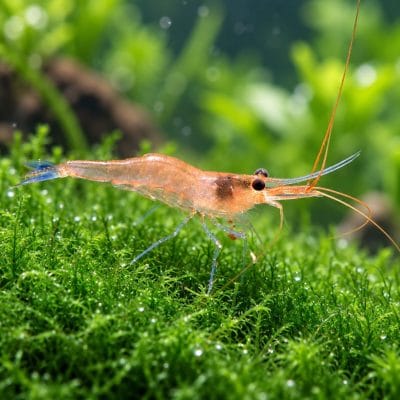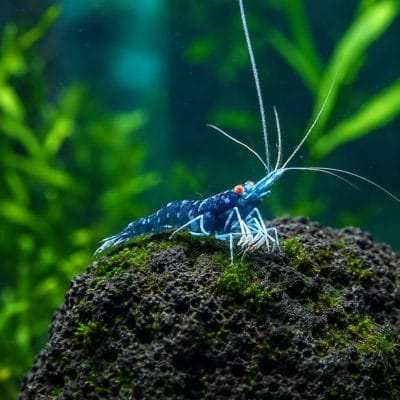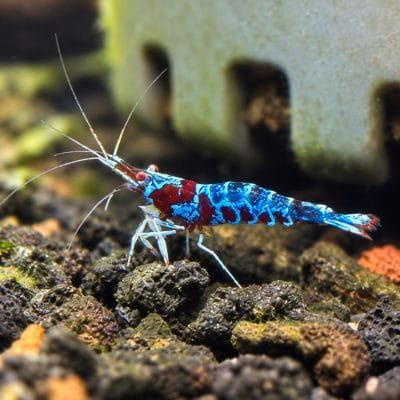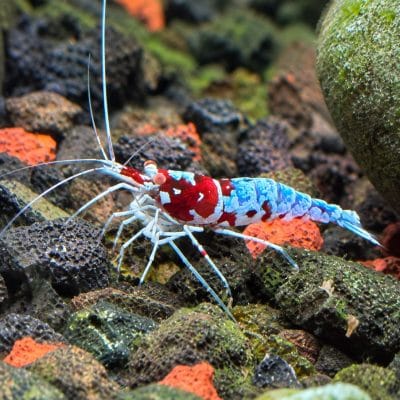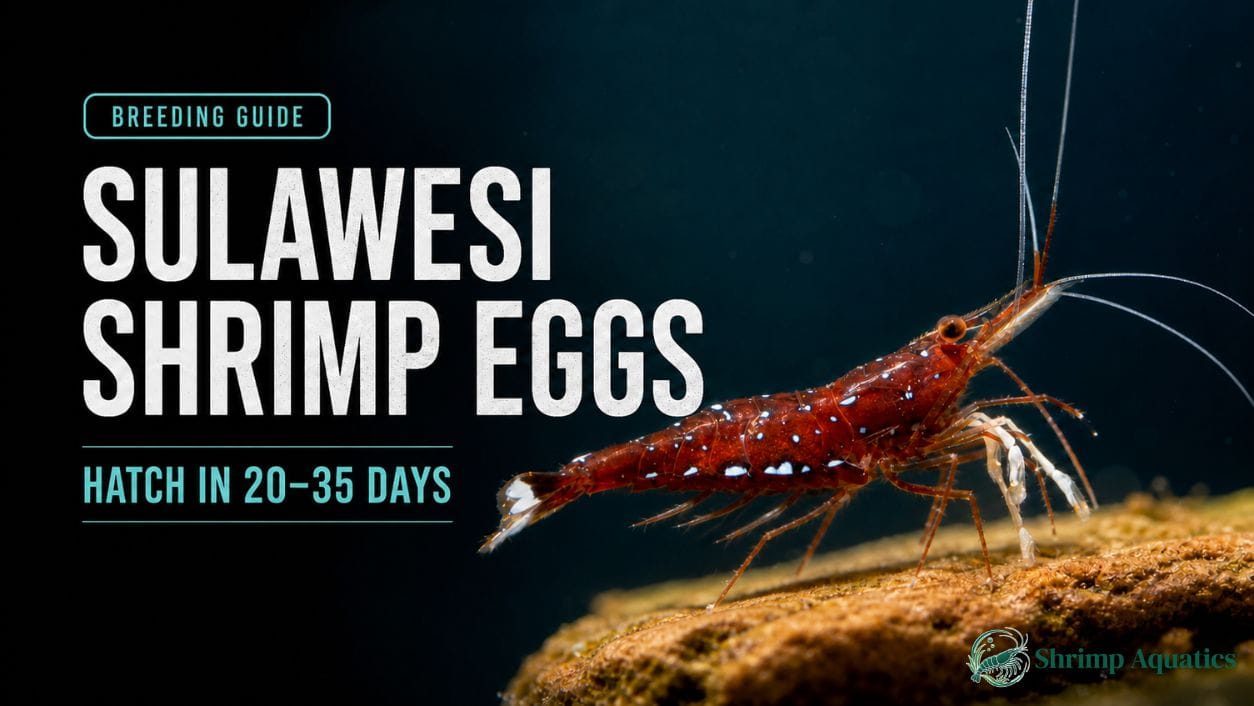

Sulawesi shrimp eggs, from lake Caridina such as the Cardinal shrimp (Caridina dennerli), usually hatch about three weeks after the eggs first appear. The female carries the whole clutch under her tail until each egg hatches directly into a tiny bottom dwelling shrimplet, with no free swimming larval stage. Where a clutch lands inside that window depends mostly on temperature within the recommended range and on steady water chemistry.
How Long Do Sulawesi Shrimp Eggs Take to Hatch?
Sulawesi lake shrimp incubate their eggs for about three weeks. The best documented example is the Cardinal shrimp (Caridina dennerli) from the Malili lakes of Sulawesi, and related lake species fall close to it. A few close relatives sit at the short end; the Poso Blue Leg (Caridina caerulea) is often reported hatching in roughly 18-20 days.
Treat this as a window rather than a fixed countdown. The exact day depends on the individual female, the species, and above all on how warm and how stable the tank is. Unlike pond shrimp that spawn in warm spring weather, these shrimp come from lakes that stay warm year round, so a well kept Sulawesi tank can produce clutches in any season.
What “berried” means
A female carrying eggs is described as berried. Shortly after she molts and mates, she pushes eggs from her body, fixes them to the swimmerets under her tail, and then fans them almost constantly until they hatch. Everything below is about helping her finish that job.
Why Sulawesi Shrimp Carry So Few Eggs and Skip the Larval Stage
As for how many eggs a Sulawesi shrimp carries, a berried Cardinal shrimp usually holds only about 10-15 eggs, sometimes up to around 20. That’s far fewer than a common cherry shrimp, and it’s a deliberate trade. Genetic and ecological study of the Malili lake shrimp shows these lake endemics evolved large, yolk rich eggs and an abbreviated development that stays in fresh water for the whole life cycle, unlike river relatives whose eggs hatch into drifting larvae that need brackish or coastal water.1 Each egg is small in absolute terms but very large relative to the female’s body, so she can only hold a handful at a time.
The payoff is what emerges. When the egg hatches, it doesn’t release a free swimming larva that you’d need to feed in the water column. It releases a fully formed shrimplet, roughly 2 mm long, that immediately settles onto rock and substrate and starts grazing like a miniature adult. This is why some older care notes that say the eggs “hatch and swim free” are misleading: nothing swims free, and any advice built on catching drifting larvae doesn’t apply to these shrimp.
What Makes a Sulawesi Clutch Hatch Faster or Slower?
Temperature is the main lever, and it works within the range these shrimp already need. Kept toward the warm end of the recommended 79-86°F (26-30°C) band, embryos develop quickly and a clutch tends to hatch a little sooner than three weeks. Held toward the cool end of that same band, development slows and the same clutch can take noticeably longer. Shrimp are cold blooded, so the surrounding water sets the pace of embryonic development; in a closely studied dwarf shrimp, warmer water sped reproduction while excessive heat pushed females to drop their eggs, a useful illustration of the same physics at work here.2
Stability is the second lever, and it can override the first. A clutch does best when temperature and chemistry barely move for the whole three weeks or so. Letting the tank drift below the recommended range stalls the embryos, so you end up with Sulawesi shrimp eggs not hatching, and stresses the female, who may drop her eggs to save herself. Pushing it above the range is also risky, because warm water holds less dissolved oxygen just as the developing eggs need more, which can again trigger egg loss. The practical goal is simple: keep the tank warm, keep it inside the range, and keep it steady.
How to Tell When Sulawesi Shrimp Eggs Are Close to Hatching
Because the eggs are large, you can follow their progress by eye or with a macro lens. The color and clarity of the clutch change in a fairly predictable sequence, so you can estimate how much time is left.
-
Days 1 to 10
Fresh eggs are opaque and densely colored, usually dark red brown, orange or amber, and look like solid beads. Rapid cell division is happening inside, but you can’t see through the shell yet.
-
Days 10 to 20
As the embryo uses up its yolk, the eggs gradually lighten and turn more translucent. This is a normal, slow change and a sign that the clutch is developing on schedule.
-
Final 1 to 2 weeks
Small dark eye spots become visible through the shell. These are the developing eyes, and their appearance means the clutch is past the halfway point and hatching is drawing near.
-
Last few days
When the eyes look sharp and you can make out the curled shrimplet inside, sometimes described as the baby “looking back at you,” hatching usually follows within about 5-7 days. In the final 24-48 hours you may spot faint movement inside the shell.
What Does a Berried Sulawesi Female Need to Carry Eggs to Term?
Getting to hatch day is less about doing anything special and more about not disturbing a system that’s already dialed in. These lake shrimp have very little tolerance for swings, and a stressed berried female will often molt early or shed her clutch, the two patterns behind Sulawesi shrimp dropping eggs. Three conditions matter most.
Don’t use active, pH lowering soil
Aquasoils made for Bee and Crystal Caridina are designed to pull pH down. In a Sulawesi tank they can collapse the pH within days, and a stressed female will abandon her eggs. Use an inert substrate only, such as inert sand or volcanic rock, so the high pH these shrimp need stays put.
Keep Sulawesi Water Stable Within the Group Range
Match the warm, hard, alkaline chemistry of the Sulawesi lakes and hold it steady. Most keepers build this water from RO water plus a Sulawesi specific mineral, because tap water is too variable to trust with such sensitive shrimp. Use these group ranges as your targets.
| Temperature | 79-86°F (26-30°C) |
|---|---|
| pH | 7.5-8.5 |
| GH | 4-8 dGH |
| KH | 3-6 dKH |
| TDS | 150-250 ppm |
| Ammonia and nitrite | 0 ppm |
| Nitrate | Under 10 ppm |
Holding the Sulawesi shrimp care parameters steady through evaporation and top offs matters more to a berried female than hitting any single number.
Give Sulawesi Eggs Oxygen With Gentle, Well Filtered Flow
Warm water holds less dissolved oxygen, yet the female’s constant fanning shows how much oxygen the clutch needs. Aim for high oxygen with soft movement: mature sponge filtration and gentle surface agitation keep the eggs supplied without a strong current that pushes the shrimp around or blows newly hatched young off the rocks.
From our Sulawesi systems
- At Shrimp Aquatics, our Sulawesi systems use biological filtration together with a Kaldnes moving bed filter. That gives us strong aeration and active biological media, but we tune the outlet so the shrimp aren’t pushed around while grazing. The goal is high oxygen with gentle movement at shrimp level.
Hold Ammonia and Nitrite at Zero While Sulawesi Eggs Develop
In the alkaline water these shrimp need, a larger share of any ammonia takes its more toxic, un-ionized form, so even a trace can harm both the developing eggs and the female. A fully cycled, mature tank with an established biological filter isn’t optional here, and nitrate is best kept under 10 ppm. A calendar alone doesn’t prove a tank is ready; confirm it with test results.
Caring for Sulawesi Shrimplets the Moment They Hatch
When the clutch hatches, usually under cover of darkness, the female releases the shrimplets and gives no further care. Each one is only about 2 mm long, too weak to fight a current and unable to travel far or compete with adults for food. Their survival depends almost entirely on what’s already growing within a few centimetres of where they land.
A tank that can feed shrimplets is a mature one, which is why keeping Sulawesi shrimp starts months before the first berried female. Getting that maturity in place before the first saddle is the whole opening move in how to breed Sulawesi shrimp.
That’s why mature biofilm, the living film of algae, bacteria and microorganisms coating rock and glass, decides the outcome. Several of these lake endemics, including the Cardinal shrimp, are assessed as Critically Endangered on the IUCN Red List, so raising Sulawesi shrimplets well is worth the patience.3 The single most useful thing you can do is have a well aged tank ready before you ever expect babies.
- Have a mature tank with visible biofilm on rock and glass before you expect a hatch.
- Keep gentle sponge or biological filtration so shrimplets aren’t pulled in or blown around.
- If you supplement, use a tiny amount of fine powdered food and remove leftovers, since excess quickly raises nitrate.
- Don’t add fish hoping they will leave shrimplets alone; most will eat the young and compete for the same food.
- Don’t rely on feeding to rescue a bare, immature tank; the biofilm has to be there first.
If you’re still choosing stock, the same rule applies to buying: tank-bred Sulawesi shrimp that arrive as juveniles give you the whole timeline to watch, from first saddle to first brood.
The shrimplets take their own time from here; how long Sulawesi shrimp take to reach breeding size is counted in molts rather than months.
References
3 Sources
- Adaptive Radiation and Ecological Diversification of Sulawesi’s Ancient Lake Shrimps, von Rintelen et al., Evolution, 2010.
- Effect of Temperature on Biochemical Composition, Growth and Reproduction of the Ornamental Red Cherry Shrimp Neocaridina heteropoda heteropoda, Tropea et al., PLoS ONE via PMC, 2015.
- Caridina dennerli, The IUCN Red List of Threatened Species, IUCN, accessed 2026-07-19.
Ready to get started?
Shop our Sulawesi Shrimp collection
27 products available · Live Arrival Guarantee