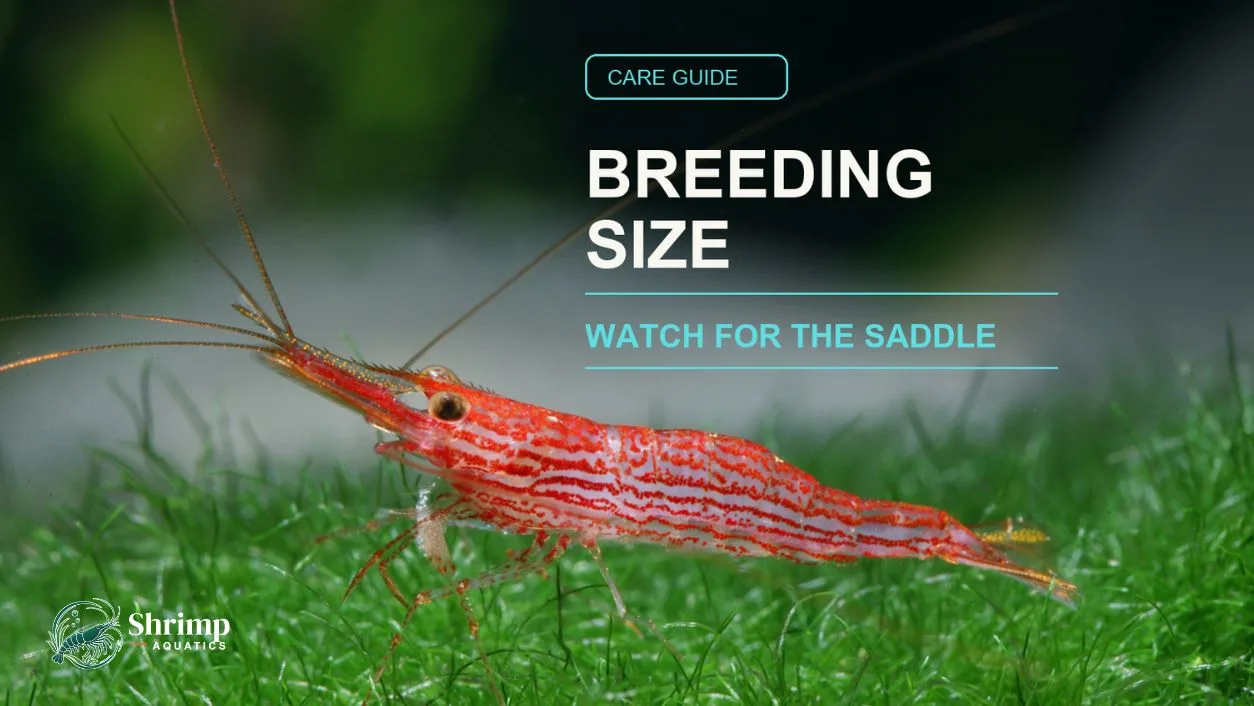
How many months before your young Sulawesi shrimp reach breeding size? Nobody has timed a Sulawesi shrimp from hatching to first brood, so judge maturity from visible cues such as a female’s ovarian saddle, not the calendar. Care sheets say three to five months, and some say four to six, but none of them cites a measurement. The only growth data on the group we could find is one published rearing trial on cardinal shrimp, and the gains it recorded over a month are small. So treat the timeline as something you protect, not something you push.
Where the three to five month figure for Sulawesi shrimp comes from
It comes from hobby care sheets that repeat each other. Search the question and you’ll find three to five months, four to six, three to four, and pages that give no figure at all. Each is stated plainly, and none of them points at a measurement. That spread is the useful part: if the published figures disagree by half a year and none is sourced, no single number is worth planning a tank around.
There’s a second reason to be careful with those numbers. Sulawesi shrimp are a group, not a species. Cardinal, Sulawesi White Sock, Blue Leg and the other lake Caridina in the trade differ in adult size. A maturation figure for one of them wouldn’t carry over to the others even if someone had measured it. When you read a month count, ask which species it came from, in what water, and who did the timing.
What the one published Caridina dennerli growth trial measured
At best, a little over a millimeter of total length in a month. A 2025 study in Jurnal Ilmiah PLATAX reared cardinal shrimp under four combinations of feed and shelter and measured what they gained. The shrimp started at an average total length of 1.445 cm and an average weight of 0.022 g.1 The trial ran 30 days for the two pellet-fed groups and 37 days for the two fed a bacterial starter. Growth and survival split sharply by treatment.1
| Feed | Shelter | Average total length gain | Survival |
|---|---|---|---|
| Commercial pellets | Hydrilla | 0.119 cm | 72.7% |
| Commercial pellets | Stone | 0.079 cm | 40.9% |
| Bacterial starter | Stone | 0.013 cm | 31.8% |
| Bacterial starter | Hydrilla | 0.017 cm | 22.7% |
Read the table for what it is. It measures one month of growth in shrimp that were already that size, so it says nothing directly about the climb from a newly hatched shrimplet. It was also run in a research setup, not a home tank. What it does give you is the order of magnitude. The best combination tested added a little over a millimeter of total length in a month. The worst added roughly a tenth of that, and lost most of its shrimp along the way.
Hold that number in your head the next time a care sheet promises breeding size in a season. Slow is the normal case. A shrimp that looks the same size in March as it did in February isn’t necessarily in trouble. It may simply be growing at Sulawesi speed.
How to tell a Sulawesi shrimp has reached breeding size
Look at a female’s shape and for an ovarian saddle, because size alone won’t tell you. Part of the trouble is that the published measurements of how big Sulawesi shrimp get aren’t ones you can take at the glass. In the original description of the species, carapace length across 53 examined cardinal shrimp ran 1.5-3.4 mm.2 Carapace length is measured across the shell behind the eye, not along the whole animal. The total length figures quoted in care sheets are a different measurement entirely, and mixing the two up is how the same shrimp gets called adult twice.
So what can you read from the outside? The female, and you read her from more than one cue at a time.
At Shrimp Aquatics we sex mature Sulawesi shrimp by combining several visible cues, and we treat no single cue as conclusive on its own, especially in juveniles or deeply pigmented shrimp. Mature females usually have a deeper, rounder lower abdomen with more brood space near the tail, while mature males stay slimmer and flatter underneath. When a yellow or darker patch is visible in the shell behind the head, that ovarian saddle is the strongest female cue, and its absence doesn’t prove a shrimp is male.
A saddle showing on a shrimp you’ve grown out is the first hard evidence that she’s mature, and it beats any calendar you were keeping. Before you rearrange the tank around it, work through the full method to sex and breed Sulawesi shrimp. One cue on one animal still doesn’t tell you what the group is made of.
Can you speed up Sulawesi shrimp growth with heat or more food?
Not reliably, and both of the usual attempts cost you something. Each one pushes on a real mechanism, which is why it sounds plausible, and each one takes back more than it gives in a warm alkaline tank. It helps to know what growth actually depends on before you decide what to change.
Every millimeter of growth has to wait for the next molt
Shrimp, like other crustaceans, only get larger by casting the old exoskeleton and expanding into a new one, so growth comes in steps.3 Those steps also spread further apart as the animal grows: in a brackish-water shrimp timed in the lab, larger individuals molted less often than smaller ones.4
That’s why a nearly grown shrimp can look stalled while it’s still growing normally. Each step is smaller, and the wait between steps is longer. Minerals matter at every one of those steps. A crustacean draws the calcium for its new shell mainly from the water it lives in, not from its food.5 Holding GH 4-8 dGH steady is part of growth, not only part of survival. It’s also the practical reason the rest of the Sulawesi shrimp care parameters need to sit still for months at a time instead of being corrected week by week.
Heat shortens the gap between molts and shrinks what each one adds
Temperature is the lever most keepers reach for, and it does move the molt cycle. In crabs reared warm, molts came closer together but each one added less, so the crabs were smaller at every stage.6 No equivalent measurement exists for Sulawesi shrimp, but the direction is worth respecting: more molts isn’t the same as more growth.
The cost isn’t speculative. Warm water holds less dissolved oxygen than cool water,7 and a Sulawesi tank already runs warm at 79-86°F (26-30°C). Sitting at the top of that range to force molts spends oxygen and stability on a gain the crustacean data doesn’t promise.
Extra food in a warm alkaline tank works against the shrimp you’re trying to grow
The other instinct is to feed harder. In a Sulawesi tank, that’s the more dangerous of the two. Total ammonia in water splits between ammonium and un-ionized ammonia according to pH and temperature, and the un-ionized form is the one that drives toxicity in aquatic animals.8 Warm alkaline water pushes that split the wrong way. An uneaten pellet that would sit quietly in a cool acidic Bee tank is a live risk here, and the shrimp you’re trying to grow pays for it first.
Feeding harder is the wrong lever
If growth looks slow, build grazing surface and let the biofilm mature instead of adding food. A grazing colony needs less prepared food than most keepers offer, because what Sulawesi shrimp eat is mostly the film already on the rock and glass.
The gap between molts is the clock here. How often Sulawesi shrimp molt is measured in days in related species, and it isn’t a schedule you can push.
What to expect once your Sulawesi females start carrying eggs
Expect to miss the mating and to notice a female who’s already carrying eggs. In most shrimps, mating takes place at the female’s premating molt and is over within seconds to a few minutes.9 So the first thing you usually see isn’t a mating at all. That’s also why the weeks when you expect it are the weeks to keep the tank boring.
From there, keepers generally report about three weeks before the young hatch. One keeper’s female arrived already carrying eggs, held them for about three weeks, and then the eggs were gone and little shrimplets were in the tank.
Before you plan for shrimplets, check how many eggs a female Sulawesi shrimp can carry per brood for the species you keep, and plan tank space from that. If the shrimp are clearly mature and months pass with saddles but no eggs, that’s a different problem from a slow grow-out. The checks for Sulawesi shrimp not breeding start with the water.
So what does all of this leave you with? Stop counting months, keep the tank identical week after week, feed the grazing surface instead of the shrimp, and let the first saddle tell you the grow-out worked.
What the research says about how fast Sulawesi shrimp grow
Apart from the cardinal shrimp trial, the growth, molting and mating studies behind this guide are on other crustaceans. Take the direction from them, not the days. In a laboratory study on a European brackish shrimp, Palaemon varians, smaller individuals molted faster than larger ones, and the interval lengthened steadily with size.4 That’s a different animal in cooler water than a Sulawesi tank.
In lesser blue crabs reared at elevated temperature, the intermolt period got shorter, but each molt added less growth. So the crabs were smaller at every stage. The authors note that temperature is understood to affect both intermolt period and growth per molt across many crustaceans. If the same pattern carried through the pubertal molt, elevated temperature would mean a smaller size at maturity.6 That’s a crab study, not a Caridina one.
On mating, the encounter in what researchers call pure-search species is recognized and completed within seconds to a few minutes. That brief window of attractiveness is also what keeps a female from being harassed, which can injure or kill her.9
References
9 Sources
- Effect of Using Different Shelter and Feed Types on Growth and Survival Rate of Sulawesi Endemic Ornamental Shrimps (Caridina dennerli), Abdullah, Hasim and Mulis, Jurnal Ilmiah PLATAX 13(1): 191-204, 2025, PDF.
- Radiation of endemic species flocks in ancient lakes: systematic revision of the freshwater shrimp Caridina from the ancient lakes of Sulawesi, Indonesia, von Rintelen and Cai, Raffles Bulletin of Zoology 57(2): 343-452, 2009, PDF.
- Farming freshwater prawns, biology chapter, FAO Fisheries Technical Paper 428, Food and Agriculture Organization of the United Nations.
- Moult cycle and setal development of the Atlantic ditch shrimp Palaemon varians, Kim, Antcliffe, Daley and Robinson-Rechavi, Journal of Crustacean Biology 44(4), 2024.
- Biomineralizations: insights and prospects from crustaceans, Luquet, ZooKeys 176: 103-121, 2012.
- Elevated temperature induces a decrease in intermolt period and growth per molt in the lesser blue crab Callinectes similis, Kuhn and Darnell, Journal of Crustacean Biology 39(1), 2019, abstract.
- Dissolved Oxygen and Water, U.S. Geological Survey Water Science School, June 5, 2018.
- Aquatic Life Ambient Water Quality Criteria for Ammonia, Freshwater, U.S. Environmental Protection Agency Office of Water, April 2013, PDF.
- Mating Behavior and Strategies, Raymond T. Bauer, University of Louisiana at Lafayette research page.
Ready to get started?
Shop our Sulawesi Shrimp collection
27 products available · Live Arrival Guarantee
Featured Sulawesi Shrimp
Sulawesi Orange Eyes White Sock
Caridina dennerli
Advanced · 79-86°F · pH 7.5-8.5
From $19.99View Product