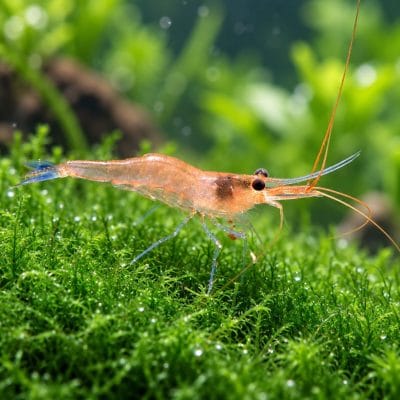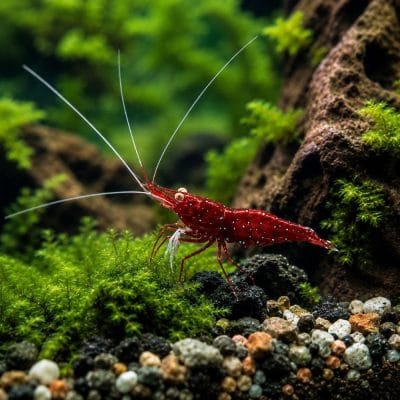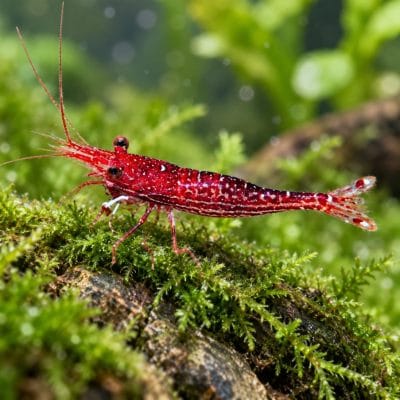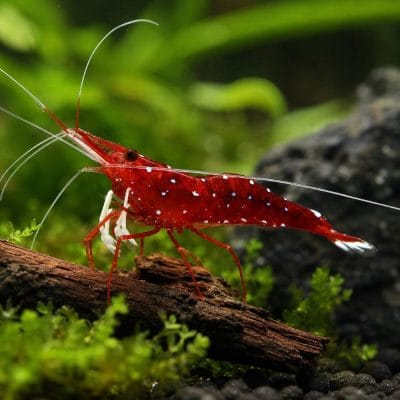

If your Sulawesi shrimp are alive but nothing is reproducing, the cause is almost always the tank rather than the animals. In most stalled systems it’s one of four things: water that drifted out of range or moves too much, a tank that was never mature enough to feed shrimplets, a colony too small or too male heavy for a female to be found during the few hours she is receptive, or an organic load that quietly suppresses the whole group. Work through them in that order.
Everything below applies across the group to lake system Caridina such as Cardinal, White Sock, Blue Leg and the other Sulawesi lines. Species differ, so check any narrower requirement for the exact line you keep.
Start by naming which Sulawesi breeding failure you’re seeing
The most common mistake in a stalled tank is treating “not breeding” as one problem. It’s at least three, and they point in different directions. Watch the tank for a week before you change anything, because a wrong correction adds a second instability on top of the first.
| What you can see | Most likely cause | First thing to check |
|---|---|---|
| No ovarian saddles on any female, no mating activity for months | Water out of range or drifting, an immature system, or animals that aren’t mature yet | The full parameter set plus ammonia, then colony age and size |
| Females develop saddles but never carry eggs | Too few males, failed molts, or disturbance around the molt window | Sex ratio, and any recent water change or handling |
| Females carry eggs and then drop them early | A parameter swing, unstable temperature, or handling stress | Temperature log, and the size and timing of recent water changes |
| Shrimplets appear and disappear within days | Not enough grazing surface, or mechanical and predation losses | Biofilm and algae coverage, filter intake, and tank mates |
If more than one row describes your tank, start with water chemistry. It sits underneath all the others.
Confirm your Sulawesi tank is actually holding the range you think it’s
Test the whole set on one day: temperature, pH, GH, KH, TDS, ammonia, nitrite and nitrate. A single reading tells you where you are. A short log tells you whether the tank is moving, which is the more useful answer in a stalled colony. Take the reading at the same time of day each time so you’re comparing like with like.
Compare your readings with the Sulawesi range
| Parameter | Typical range |
|---|---|
| Temperature | 79-86°F (26-30°C) |
| pH | 7.5-8.5 |
| GH | 4-8 dGH |
| KH | 3-6 dKH |
| TDS | 150-250 ppm |
| Ammonia and nitrite | Zero, with an established biological filter |
| Nitrate | Aim for under 10 ppm |
| Substrate | Inert substrate and hardscape, not an active pH lowering soil |
These are typical reference values for the group and they’re useful for catching an obvious error. Hitting them doesn’t produce breeding on its own. If your readings sit inside this range and have been steady for months, chemistry is probably not your bottleneck and you should move on to tank maturity. Building this water from scratch, and holding it, is the job of Sulawesi shrimp care parameters.
An active Bee shrimp soil will hold a Sulawesi tank below range
Active aquarium soils are engineered to pull water toward the soft, acidic conditions that Bee and Crystal Caridina need. In a Sulawesi tank that substrate works against you every day, stripping carbonate and dragging pH down no matter how carefully you remineralize. If the tank was set up on that soil, nothing further in this guide will fix the breeding problem until the substrate is replaced with inert material.
Don’t convert a Bee shrimp tank
Success with Bee or Crystal Caridina doesn’t transfer to Sulawesi shrimp. The two sets of water values are close to opposites, and reusing a soft water setup is one of the most common reasons a Sulawesi colony never establishes.
Sulawesi Mineral 8.5 needs CO2 to dissolve and aeration afterward
If you remineralize with SaltyShrimp Sulawesi Mineral 8.5 and your KH and GH never reach target, the salt may still be sitting in the container as undissolved powder. The manufacturer states that this product requires additional measures to dissolve fully, that it will almost totally dissolve when CO2 is added over roughly three to four days at about one bubble per second, and that the water must then be aerated with an air stone for at least three hours to drive the CO2 back off before use.1 Skipping either step is enough to explain a tank that never reaches its target hardness.
- Prepare the mineral outside the aquarium, in a separate container, days before you need it.
- Test the finished pH, GH, KH and TDS.
- Don’t add freshly CO2 charged water straight into a stocked tank.
- Don’t switch mineral products in the middle of troubleshooting. Changing the recipe removes your ability to tell what helped.
Follow the current instructions for the product you actually own, since formulations and directions change. The same manufacturer notes that less finicky Sulawesi species such as the cardinal shrimp have been kept and bred with either Sulawesi Mineral 7.5 or Sulawesi Mineral 8.5.1
A trace of ammonia is far more toxic in warm, alkaline Sulawesi water
Total ammonia in water splits between the ammonium ion and un-ionized ammonia, and it’s the un-ionized form that drives toxicity in aquatic animals. That split depends on pH and temperature: the ratio of un-ionized ammonia to ammonium rises roughly tenfold for each single pH unit, and roughly doubles for each ten degree Celsius rise in temperature.2 A Sulawesi tank sits high on both scales at once, so a reading you’d shrug off in a neutral Neocaridina tank is a real problem here.
Test ammonia before you assume a breeding problem
Confirm that ammonia and nitrite both read zero on an established biological filter before you change anything else. A persistent trace is easy to miss, because a tank carrying one can look outwardly normal.
Warm water also speeds up decomposition, and Sulawesi shrimp graze slowly. Prepared food that would be gone within an hour in a cooler tank can sit and break down here, adding organic waste and pushing ammonia, nitrite and nitrate up. If you’ve been overfeeding Sulawesi shrimp to compensate for a colony that looks thin, that’s very likely making the breeding problem worse.
If you notice a sudden rise in detritus worms or ostracods, treat it as a prompt to look at how much uneaten food and detritus has collected in the substrate. A shallow inert bed, or rock raised slightly off a near bare bottom, keeps waste visible and reachable during ordinary maintenance.
Topping off a Sulawesi tank with mineral water hardens it until females can’t molt
This is the quiet cause behind a large share of stalled colonies. A Sulawesi tank runs warm and evaporates quickly. The water leaves and the minerals it carried stay behind. Replace that loss with tap water or with freshly remineralized water and GH and TDS climb week after week, while nothing looks wrong on any single test day.
Rising hardness makes molting harder, and molting isn’t optional for reproduction. In most shrimps, mating happens immediately after the female’s premating molt while her new shell is still soft, and males find her during that short window rather than guarding her beforehand.3 A female who can’t cleanly leave her old shell never reaches that window. Persistent mineral creep therefore shows up as a colony that looks healthy and simply never reproduces.
- Replace evaporated water with pure RO water containing no added minerals.
- Use remineralized water only for real water changes, where you remove volume as well as add it.
- Log TDS weekly. A steady upward line across a month is the signal, not any single reading.
- Don’t correct weeks of accumulated drift in one large water change. Bring it down gradually across several small ones.
Berried females are the most sensitive point in this cycle. A large swap moves TDS, GH, KH and temperature at the same moment and is a common trigger for Sulawesi shrimp dropping eggs, so leave the tank alone while females are carrying and spread any correction over weeks. Change water only when a reading justifies it, and match it when you do, the routine in Sulawesi shrimp water changes.
Sulawesi shrimplets need grazing surfaces that already exist before the eggs hatch
If adults carry eggs and you occasionally glimpse a shrimplet that then disappears, the tank is usually too clean rather than too dirty. From the day they appear, what Sulawesi shrimplets eat is the biofilm, aufwuchs and algae growing across rock and glass, which means that surface has to be there before the eggs hatch, not after you notice young.
Tank age is a weak proxy for this. What you want to see is visible biological film across the hardscape, a soft coating on the glass that returns after you clean it, and a set of readings that hasn’t needed correcting for weeks. Supplemental food doesn’t compensate for an immature system, and adding more of it to a tank that’s already short on grazing surface simply raises the organic load.
- Increase the lit hardscape area and add porous rock instead of feeding more.
- Extend the photoperiod moderately while watching temperature stability.
- Culture spare rock in a separate bright container and rotate it in, so the food base grows without loading the display tank.
- Don’t strip the glass and hardscape clean while you’re waiting for young to appear.
In a small or male-heavy Sulawesi colony, females molt without being found
A group of eight shrimp can sit in perfect water and produce nothing for a year. Because mating depends on a male encountering a female during the hours after her molt, a thin colony fails on arithmetic before anything else goes wrong. Sulawesi shrimp are also often shy, and a small group spends more of its time hidden, which compounds the problem. Sex ratio cuts both ways. Too few males and saddled females release eggs that were never fertilized, while a crowd of males pursuing a newly molted female is itself an injury risk, and the brevity of that receptive period appears to be what limits such harassment in the wild.3
Sex mature Sulawesi shrimp from more than one cue
How we sex our mature Sulawesi lines
At Shrimp Aquatics we sex mature Sulawesi shrimp by combining three cues, and we treat no single cue as conclusive on its own. Mature females usually have a deeper, rounder lower abdomen with more brood space near the tail, while mature males are slimmer and flatter underneath. When visible, a yellow or darker patch in the cephalothorax behind the head, the ovarian saddle, is the strongest female cue, though pigmentation and reproductive stage can make it hard to see. In our lines the upper central antenna pair is often around one-half of body length in males and around one-third in females, using only the two upper central antennae for that comparison.
These cues apply to mature shrimp. Don’t sex from antenna length alone, don’t apply the ratios to juveniles, and don’t read a missing saddle as proof that a shrimp is male.
Build a female-heavy Sulawesi breeding group
How we set up a breeding group
When we can sex the shrimp with reasonable confidence, we usually build a Sulawesi breeding group with either 2 males to 8 females or 3 males to 7 females. We use a female-heavy group to reduce mating pressure on newly molted females, which are still soft and vulnerable. We confirm sex from multiple visible cues before setting the ratio.
If your group is small and the water is already right, adding animals is usually more effective than adjusting anything else. Add them gradually so the bioload rises in step with the biofilm, and accept that no supplier can promise you a sex ratio in a shipped group. Our Sulawesi shrimp are bred in our own tanks, not collected from the wild, which is worth confirming with any source when you expand a stalled colony.
Change one thing, then leave the Sulawesi tank alone for two to three months
The most useful discipline in a stalled tank is restraint. Every correction is itself a disturbance, and stacking three of them in a week guarantees you won’t know which one helped. Work in this order and give each step time.
- Test the full parameter set plus ammonia and nitrite and write the numbers down. Repeat weekly for a month so you can see drift.
- Switch evaporation top-off to pure RO water immediately. It costs nothing and stops the most common slow failure.
- Correct any drift gradually across several small, parameter matched water changes.
- Cut prepared food back and let grazing surface build. Add porous rock and extend lighting moderately if coverage is thin.
- Assess colony size and sex ratio once the water has been steady for several weeks, and add animals gradually if the group is small.
- Then stop. Keep maintenance small and routine, and reassess after two to three months.
Be realistic about the timescale. These are advanced animals, and a colony that has been stressed for months doesn’t turn around in a fortnight. A stable, mature, correctly stocked tank will usually start producing on its own, but no set of conditions guarantees breeding. If shrimp are dying rather than simply failing to reproduce, treat that as a separate and more urgent problem. That patience is exactly the mindset how to breed Sulawesi shrimp asks you to hold.
If you aren’t sure whether your water is workable, email contact@shrimpaquatics.com with your pH, GH, KH, TDS, temperature, tank size, cycle status and current livestock, and we will tell you honestly what we’d check first.
When harassment of freshly molted females is the failure you’re looking at, the fix is to remove male Sulawesi shrimp, not to add more females.
References
3 Sources
- Sulawesi Mineral 8,5: product information and instructions of use, SaltyShrimp, accessed August 7, 2026.
- Aquatic Life Ambient Water Quality Criteria for Ammonia, Freshwater (2013), U.S. Environmental Protection Agency, Office of Water, April 2013.
- Mating Behavior and Strategies, Raymond T. Bauer, University of Louisiana at Lafayette, accessed August 7, 2026.
Ready to get started?
Shop our Sulawesi Shrimp collection
27 products available · Live Arrival Guarantee
Featured Sulawesi Shrimp
Sulawesi Orange Eyes White Sock
Caridina dennerli
Advanced · 79–86°F · pH 7.5–8.5
From $19.99View ProductSulawesi Red Line Blue Dot
Caridina sp. "Red Line Blue Dot"
Advanced · 79–86°F · pH 7.5–8.5
From $15.99View Product