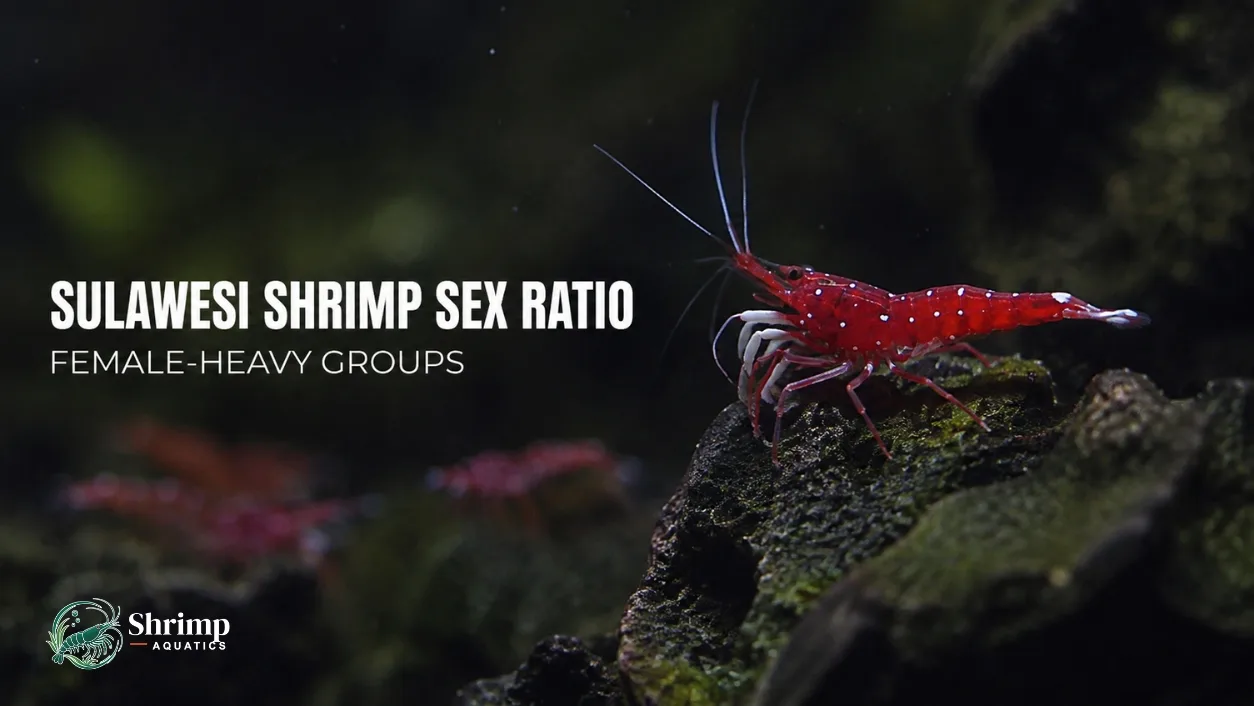
Do you need to pull the males out of your Sulawesi shrimp tank? Usually not: a colony that already holds more females than males rarely needs anything netted out, and removing males only helps once a group has drifted male-heavy. Males matter for one reason. Mating happens the moment a female finishes a molt, while her new shell is still soft. The risk lies in how many males can reach her inside that window.
Why a molting Sulawesi female is the shrimp at risk
She’s at risk because mating is timed to the hours when she’s softest. Studied shrimp and prawns mate only just after the female’s premating molt, while she’s soft-shelled.12 A male can find her and mate within minutes.1 It’s a timing problem, not a temper problem.
That’s the whole mechanism, and it’s why the count matters more than any single shrimp’s behavior. A female is receptive for a short window, and every mature male in the tank responds to it. She spends it under a shell that hasn’t hardened yet. One male finding her is ordinary. Five or six arriving at once means a soft animal gets handled again and again by hard-shelled shrimp, just when she’s least able to move away.
Can’t you just keep an eye on it? Not really, because molts come round often. The closest measured figure comes from cherry shrimp, which molted about every 10 days in a lab at 73°F (23°C).3 Warmer water tends to shorten the gap.4 Sulawesi tanks run at 79-86°F (26-30°C), so whatever happens at one molt soon comes around again.
How far this evidence reaches
The mating and molting work above was done on shrimps and crustaceans in general, not on Sulawesi Caridina. No one has measured what different sex ratios do to molt success, injury or survival in this group. Treat crowded molting as a risk worth managing in a small closed tank, not as a confirmed cause of a particular death in yours.
How often that molt comes round, and what it needs from the water, is covered under how often Sulawesi shrimp molt.
How to tell whether your Sulawesi tank needs males removed
Count them before you do anything. A skewed ratio is the problem, and plenty of tanks lose males to the net without ever having been male-heavy. Netting shrimp out of a mature Sulawesi tank is a disturbance in itself, so you want a reason you can point at.
- Count only the shrimp you can sex with real confidence, and compare males against females before you decide anything. Leave juveniles and deeply pigmented animals out, since they stay uncertain.
- Watch for several shrimp converging on one animal and tracking it across the tank, again and again over a week, not once on a single evening.
- Look at the cover a soft shrimp actually has. Piled hardscape rock with real gaps behind it gives her somewhere to sit out of reach after a molt. An open floor with two ornaments doesn’t.
- Don’t read one dead shrimp beside a shed shell as proof of mating pressure. Test ammonia, nitrite, temperature and TDS before you blame the males.
A shrimp that dies partway through a molt, with a white gap at the joint between the head section and the abdomen, is a different question. It sits with the other common health problems in Sulawesi shrimp. If your count already comes out female-heavy and you aren’t seeing repeated chasing, the best thing you can do is leave the tank alone. That’s the rare piece of advice that costs nothing.
What a female-heavy Sulawesi group means in practice
It means more females than males, not zero males. Fertilization still has to happen inside that short window after a molt. A tank running on one male puts every brood in the colony on one animal that may not be nearby when it opens. You’re removing males to lower how many can crowd a single molt, not to empty the tank of them.
At Shrimp Aquatics, when we can sex the shrimp with reasonable confidence, we usually build a Sulawesi breeding group with either 2 males to 8 females or 3 males to 7 females. We use a female-heavy group to reduce mating pressure on newly molted females, which are still soft and vulnerable, and we confirm sex from multiple visible cues before setting the ratio.
Getting to a ratio like that depends on sexing mature shrimp at all, and that’s the part most keepers find hardest in strongly pigmented lines. The cues that work on mature animals are the same ones you’d use to breed Sulawesi shrimp. If you’re still choosing stock, ordering a group of tank-bred Sulawesi shrimp in one go makes the composition easier to set later, because you can sex them as a batch once they mature instead of inheriting whatever ratio arrived across three separate orders.
Where the extra Sulawesi males go once you net them out
They go into a second Sulawesi tank. The males you remove still need everything a Sulawesi shrimp needs. That means matching the Sulawesi shrimp care parameters you’re already running, 79-86°F (26-30°C) and pH 7.5-8.5. It also means a cycled system with grazing surfaces already growing on the rock. A bare tank filled the same afternoon just swaps one problem for another.
- First, mature the Sulawesi tank that will hold them. Stable temperature, zero ammonia and nitrite, and visible biofilm on the hardscape come before any shrimp moves.
- Match the water in the new tank to the water they’re leaving, and test pH, GH and TDS in both tanks on the same day. Two tanks on the same recipe don’t stay identical.
- Move a few males at a time over several sessions. Chasing a whole colony around with a net in one evening works against the very animals you’re trying to protect.
- Watch both tanks over the following weeks. The new tank has a fresh bioload and the old one has lost part of its grazing pressure, so neither is quite the system it was yesterday.
What if a second Sulawesi tank isn’t realistic? Decide that early and pick another route. Passing the extra males to another keeper who already runs warm alkaline water is a fine outcome. So is adding more cover, so a soft female has somewhere to sit out of reach after a molt. Killing healthy shrimp to fix a ratio isn’t, and neither is moving them into a cooler, soft water tank that doesn’t meet the needs they came with.
What to watch in your Sulawesi tank after you change the ratio
Watch the same things you counted before you started, and judge the change over months, not days. A new ratio shows up slowly.
- Whether several shrimp still converge on one animal after a molt, and whether that eases over the following weeks.
- Whether females turn up berried at all over the following months, which tells you the remaining males are still finding them.
- Ammonia, nitrite and TDS in both tanks for a couple of weeks after the move, since you’ve changed the stocking of two systems at once.
- Don’t treat one berried female as proof that the ratio was the problem. And don’t keep pulling males until only one is left in the hope of speeding things up.
If a season passes with a female-heavy group, good cover and steady water, and you’re still finding losses around molts, the males probably weren’t the cause. Your water records are the more useful place to look at that point, and the losses belong in a health review.
What the research says about males and molting females
None of these studies were done on Sulawesi Caridina. Read them as the mechanism, not as a measurement of your tank. Across shrimps, mating is tied to the female’s premating molt. In what researchers call pure search species, a male recognizes a recently molted, receptive female by touching her with his antennae. He mates within seconds or a few minutes. Researchers describe that short window of premating attractiveness as limiting harassment of the female, which can result in her injury or even death.1 Prawn farming says the same.
The FAO’s prawn farming manual notes that prawns and other crustaceans have to cast the shell regularly to grow. Successful mating can only take place between a ripe female fresh from her premating molt, still soft-shelled, and a hard-shelled male.2 Molt timing comes from two other animals.
Adult male cherry shrimp in a lab culture at 73°F (23°C) molted about every 10 days.3 Heat speeds that up. In a crab, elevated temperature was reported to shorten the intermolt period and to reduce growth per molt.4 Neither figure is from Sulawesi shrimp. Together, though, they say a warm tank doesn’t space its molts far apart.
References
4 Sources
- Ray Bauer research: mating behavior and sexual strategies, Raymond T. Bauer, University of Louisiana at Lafayette, research page.
- Farming freshwater prawns. A manual for the culture of the giant river prawn (Macrobrachium rosenbergii), biology chapter, Food and Agriculture Organization of the United Nations, FAO Fisheries Technical Paper 428.
- Characterization of the molt cycle of the cherry shrimp, Neocaridina davidi, Kelleher and Mykles, Colorado State University, Society for Integrative and Comparative Biology meeting abstract.
- Elevated temperature induces a decrease in intermolt period and growth per molt in the lesser blue crab Callinectes similis (abstract), Journal of Crustacean Biology 39(1), 2019.
Ready to get started?
Shop our Sulawesi Shrimp collection
27 products available · Live Arrival Guarantee