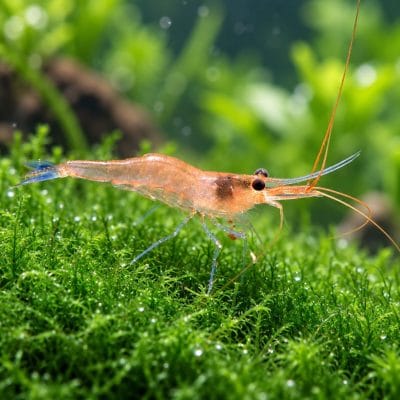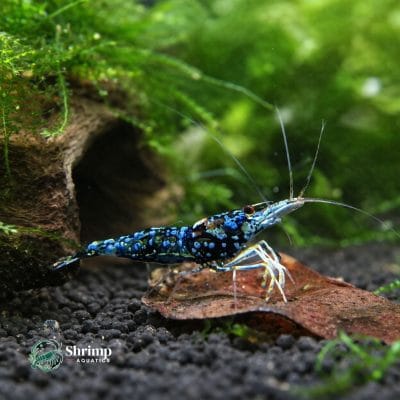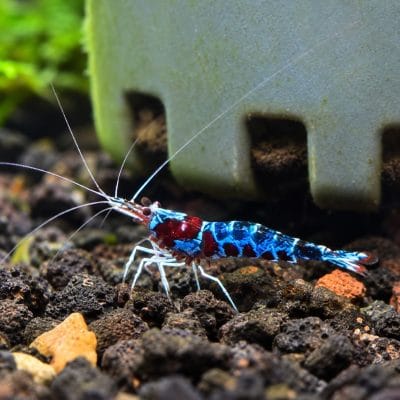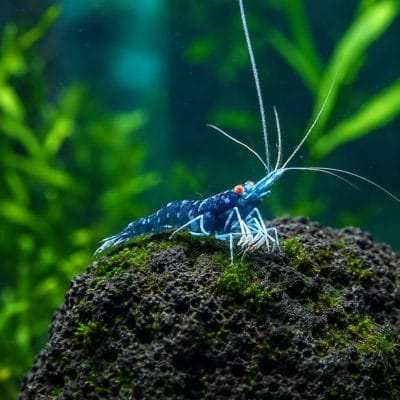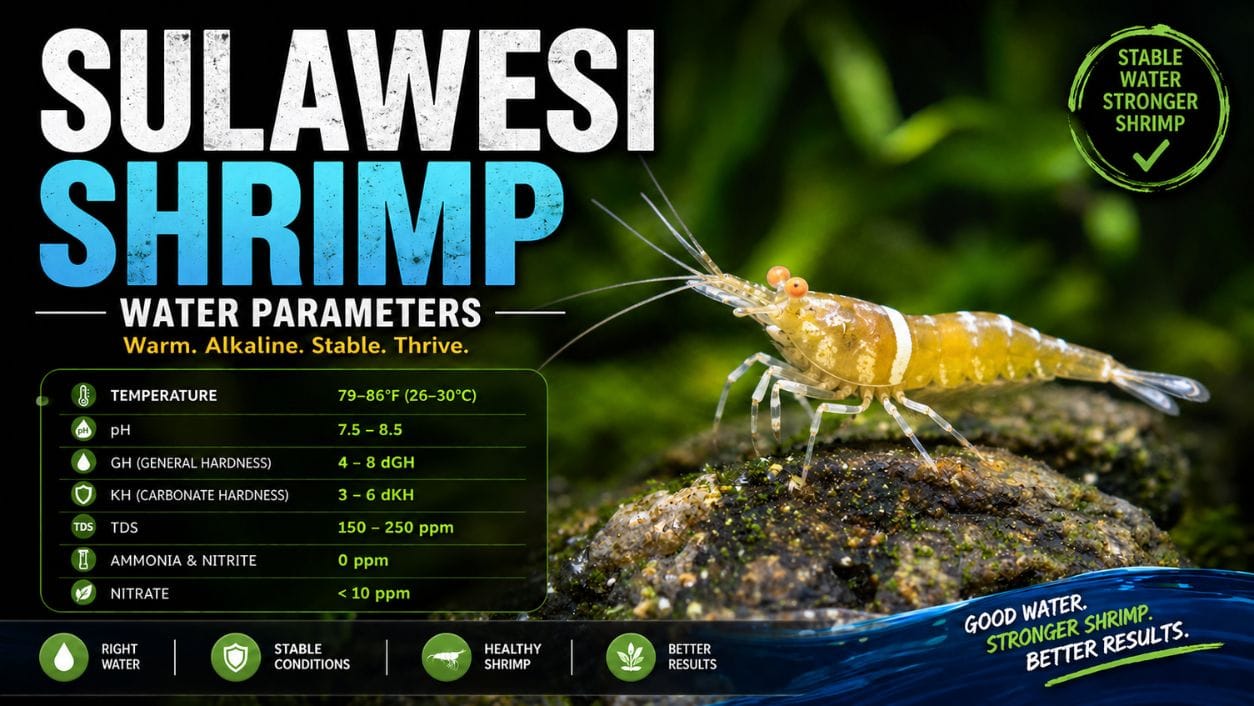

Sulawesi shrimp need warm, alkaline, mineral-rich water kept remarkably stable. As a working target, aim for about 79-86°F (26-30°C), pH 7.5-8.5, GH 4-8 dGH, KH 3-6 dKH and TDS 150-250 ppm, with ammonia and nitrite at 0 ppm and nitrate under 10 ppm. Hitting those numbers matters, but holding them steady matters even more.
What Water Parameters Do Sulawesi Shrimp Need?
Sulawesi shrimp are lake-system Caridina species such as the Cardinal (Caridina dennerli), Blue Leg Poso (Caridina caerulea) and Harlequin (Caridina spongicola). They evolved in ancient, warm, alkaline lakes in Sulawesi, Indonesia, where the chemistry barely changes from day to day. In the aquarium they expect the same: warm, mineral-balanced, alkaline water that stays put. The table below is the range we keep to for Sulawesi shrimp as a group. Check a specific species or listing before treating a narrower number as its exact requirement.
| Parameter | Typical range |
|---|---|
| Difficulty | Advanced to expert |
| Temperature | 79-86°F (26-30°C) |
| pH | 7.5-8.5 |
| GH | 4-8 dGH |
| KH | 3-6 dKH |
| TDS | 150-250 ppm |
| Ammonia and nitrite | 0 ppm |
| Nitrate | Aim for under 10 ppm |
Treat these as typical reference ranges rather than survival guarantees. A species or a line may sit inside a narrower band, and the point of the table is to keep you in a safe, sensible zone while you learn what your own colony settles into.
From our Sulawesi shrimp tanks
At Shrimp Aquatics, most of our Sulawesi systems currently run at TDS 150 ppm, GH 6-7 dGH and pH 7.5. These are the current settings in our Sulawesi shrimp tanks, and they sit at the lower, softer end of the group range, which is a reminder that there’s no single magic number. A stable value inside the range beats chasing a specific point.
Cycle first, every time
Never add Sulawesi shrimp to a tank with any measurable ammonia or nitrite. Warm, alkaline water makes nitrogen waste far more dangerous than it’s in a typical community tank, so a fully cycled, biologically mature system with 0 ammonia and 0 nitrite is the non-negotiable starting point.
These targets are the mirror image of a Crystal or Bee tank, and the Caridina vs Sulawesi shrimp comparison shows where habits from one setup break the other.
If this is your first Sulawesi tank, the beginner guide to keeping Sulawesi shrimp puts these numbers in the order you’ll actually meet them.
Why Stable Warm Alkaline Water Keeps Sulawesi Shrimp Alive
The reason Sulawesi shrimp are demanding isn’t that their numbers are exotic. It’s that their bodies were tuned by their ancient lakes to expect near-constant conditions, so they have little tolerance for change. Three things are worth understanding before you set up a tank.
Temperature is the parameter that fails fastest when equipment fails, so the heater Sulawesi shrimp need is a stability tool, not a comfort item.
First, molting. Shrimp grow by shedding their shell, and that process depends on the mineral content of the water, measured as GH and TDS. A sudden swing in TDS or temperature can force a shrimp to molt before it’s ready, and an unprepared molt often ends in a failed molt, where the animal can’t free itself from the old shell. Enough minerals in the water (the reason GH matters) and a steady TDS are what let molting finish safely.
pH holds only as long as carbonate does, and KH in a Sulawesi shrimp tank is the number to watch when pH starts sliding for no visible reason.
Second, ammonia chemistry. The share of total ammonia that exists as free, un-ionized ammonia (NH3), the highly toxic form, rises as pH and temperature go up.1 A warm, high-pH Sulawesi tank therefore turns even a small trace of ammonia into a serious threat, which is exactly why a mature biological filter and zero measurable ammonia and nitrite are so important here.
When a colony is losing a shrimp or two a day, drift in these values is the usual cause, and the Sulawesi shrimp dying gradually page gives the order to check them in.
Third, direction of change. Because the danger comes from movement, a value that’s slightly off but rock-steady is safer than a “perfect” value that drifts up and down. Aim for the ranges above, then defend stability above all else.
- Un-ionized ammonia (NH3)
- The toxic form of ammonia. A larger fraction of the total ammonia takes this form as pH and temperature climb, so warm alkaline tanks are less forgiving of any ammonia at all.
- Mineral creep
- A slow rise in GH, KH and TDS caused by topping up evaporated water with mineral-containing water. Over weeks it hardens the water and can trap shrimp in an overly rigid shell at the next molt.
Don’t reuse a Bee/Crystal Caridina setup
Bee/Crystal Caridina want soft, acidic, cooler water, close to the opposite of Sulawesi conditions. Success with Bee shrimp doesn’t transfer, and dropping Sulawesi shrimp into an acidic Caridina tank (or vice versa) is a common, avoidable way to lose them. Keep the two as separate systems.
What Does It Take to Reach Sulawesi Shrimp Parameters?
Tap water rarely lands in the right place for Sulawesi shrimp, and it can carry copper and chloramine that are dangerous to invertebrates. The reliable path is to build the water yourself from a pure base, then choose hardscape that supports alkaline chemistry.
Start With RO Water and a Sulawesi-Specific Remineralizer
Reverse osmosis (RO) water is a near-empty canvas, so you add exactly the minerals Sulawesi shrimp need and nothing you didn’t intend. Use a remineralizer made specifically for Sulawesi water, not a general Caridina or Neocaridina GH booster, because the mineral balance is different. Follow the product’s current instructions, let the water dissolve and stabilize fully, and test the finished pH, GH and TDS before it goes near livestock.
From our Sulawesi shrimp tanks
We start our Sulawesi systems with RO water, then use Sulawesi Mineral 7.5 to prepare the water for our current tank targets before shrimp are introduced. We still test the finished water instead of treating the product dose as proof that the tank is ready. Some keepers use a higher-pH Sulawesi mineral for species that sit at the top of the range, so match the product to your target and your species.
RO water, a Sulawesi remineralizer and a reliable heater make up most of the essential Sulawesi shrimp aquarium supplies; the rest is optional.
If you’re still weighing tap against RO, why Sulawesi shrimp need RO water comes down to what tap water carries in that no conditioner removes.
The choice between Sulawesi Mineral 7.5 and 8.5 is a choice of the pH you’ll hold, and the 8.5 salt asks more of you at every water change.
Choose Inert or Alkaline Hardscape, Never Active Aquasoil
Active, buffering aquasoils are designed to pull pH down for soft-water shrimp. In a Sulawesi tank they work directly against you, stripping carbonates and dragging pH below the range until the system fails. Use inert or gently alkaline materials instead: inert lava rock and sand hold no grudge against your chemistry, while crushed coral or aragonite slowly release carbonate that helps hold KH and pH up. Keep tannin-leaching driftwood to a minimum, since it lowers pH over time.
- RO base water remineralized with a Sulawesi-specific product to the target GH, KH, pH and TDS.
- Inert or alkaline hardscape, with active pH-lowering aquasoil kept out of the tank.
- A fully cycled, mature system reading 0 ammonia and 0 nitrite before any shrimp go in.
- Don’t use untreated tap water or a Caridina/Neocaridina remineralizer for Sulawesi water.
The same rule decides the plant question: aquatic plants in a Sulawesi shrimp tank are optional, and the substrate they would want is the one this tank can’t have.
How Do You Maintain Stable Water in a Sulawesi Shrimp Tank?
Once the tank is dialed in, the job is to keep it there. Two well-established routines both work, and both put stability first. Nitrate and TDS climb mainly from feeding and waste, so feed sparingly and let a mature biofilm do most of the work rather than pushing food that fouls warm water.
Choose small frequent water changes if
You want to actively export nitrate and refresh minerals. Change roughly 10-15% on a regular schedule using RO water remineralized to match the tank, and add it slowly so nothing shifts abruptly.
Choose a minimal-change mature system if
You have a heavily biological, well-established tank and prefer to disturb it as little as possible. You lean on biofilm and biological filtration for waste, siphon spot waste, and replace evaporation with pure RO.
Either way
The shared rule is that stability comes first. Whichever routine you pick, test regularly, keep any water you add matched to the tank, and change your approach slowly.
Keep Water Changes Small, Slow and Parameter-Matched
Large or fast water changes are one of the most common ways keepers lose Sulawesi shrimp. Match the replacement water to the tank’s temperature, pH, GH, KH and TDS, then introduce it gradually so the shrimp never feel a jump.
- Prepare replacement water from RO and a Sulawesi remineralizer, and let it stabilize.
- Confirm it matches the tank on temperature, pH, GH, KH and TDS before you start.
- Remove only a small volume, roughly 10-15% or less.
- Add the new water slowly, for example by a gentle drip, so parameters stay flat throughout.
- Retest the tank afterward and note anything that drifted.
How often and how much is covered in Sulawesi shrimp water changes; the short version is small, matched and only when a test says so.
Top Off Evaporation With Pure RO to Stop Mineral Creep
Warm tanks evaporate quickly, and only the water leaves; the minerals stay behind and concentrate. If you top up with remineralized water, GH, KH and TDS climb week after week, hardening the water until molting becomes dangerous. Replace evaporated volume with pure, un-remineralized RO water, which brings the dissolved solids back down to baseline. A useful habit is watching TDS as your daily consistency check, since a steady creep upward is an early warning. Gentle surface movement also helps: in our systems we tune filtration for good oxygen and gentle flow, which keeps the water oxygenated at high temperature and supports steady pH.
Which Warning Signs Mean You Should Recheck Sulawesi Shrimp Parameters?
Sulawesi shrimp tell you when their water is drifting, usually before you’d otherwise notice. Read the behavior, then let your test kit confirm the cause instead of guessing. The most important rule in an emergency isn’t to panic with a large water change, which only adds a second shock on top of the first.
| What you see | Parameters to check first | Sensible first response |
|---|---|---|
| Failed molt or a white band stuck around the middle of the body | GH, TDS, temperature stability | Test GH and TDS. If GH is low, raise the remineralization of your top-off and change water slightly slower and more matched. Make sure additions are gradual. |
| Fading color, lethargy, reduced grazing | Nitrate, TDS, temperature | Test nitrate and TDS and verify the heater. Cut back feeding to lower the load, then use tiny, matched water changes to bring the baseline back gently. |
| Erratic swimming, climbing out of the water, sudden death | Ammonia and nitrite, temperature | Check for a heater failure and test ammonia and nitrite. If ammonia shows, use a shrimp-safe conditioner per its label and do only a small, slow, matched change. Don’t do a large emergency change. |
If losses are slow, one or two shrimp every few days, suspect a chronic drift such as mineral creep or a temperature that runs slightly low rather than a single acute event. Tighten your testing routine, confirm your meter and heater are accurate, and correct the baseline slowly. When symptoms are severe, persistent or clearly not explained by water chemistry, consult an experienced Sulawesi keeper or a qualified aquatic specialist rather than dosing blindly.
Failed molts, the white ring and sudden hiding are described in common health problems in Sulawesi shrimp, and nearly all of them point back to this page.
A colony that has quietly stopped reproducing is also a parameter signal; see why Sulawesi shrimp stop breeding before assuming the group is the problem.
Once a tank has held these numbers for a month, it’s ready for tank-bred Sulawesi shrimp; every line we sell is kept in the water this page describes.
References
1 Source
- Ammonia (CADDIS Volume 2), US Environmental Protection Agency, accessed July 18, 2026.
Ready to get started?
Shop our Sulawesi Shrimp collection
27 products available · Live Arrival Guarantee