
A Sulawesi shrimp aquarium needs six groups of supplies: an RO source and a Sulawesi specific mineral, test gear that reads TDS and carbonate hardness accurately, a reliable heater with an independent temperature check, inert substrate and alkaline rock, gentle filtration with strong oxygenation, and biofilm focused food with a timed light. Most standard shrimp equipment is the wrong equipment here, because these lake Caridina want warm, alkaline, mineral balanced water rather than the soft acidic water that Bee and Crystal shrimp need.
The reason the list looks unusual is the natural habitat of Sulawesi shrimp. Lake Towuti, one of the Malili lakes these shrimp come from, is ultra oligotrophic, weakly conductive at around 210 microsiemens per centimeter, close to circumneutral at about pH 7.8, and sits at roughly 28-31°C at the surface with very little variation.1 You aren’t recreating a river or a blackwater tank. You’re recreating a warm, low nutrient, mineral specific lake, and the supplies exist to build that water and then hold it still.
Before you buy anything
Sulawesi shrimp are an advanced to expert group. If this is your first shrimp tank, or if you’ve only kept Neocaridina, read Caridina vs Sulawesi shrimp first and be honest about whether you want this project. Buying the right gear doesn’t make the species forgiving.
What Supplies Does a Sulawesi Shrimp Tank Actually Need?
Every item below earns its place by doing one of six jobs. If a supply doesn’t build the water, hold the temperature, keep the chemistry from drifting, process waste, oxygenate, or grow food, it’s optional. Buy the essentials before you buy decor.
| Supply | Job it does |
|---|---|
| RO or RO/DI water source | Gives you a near empty starting water so you add only the minerals you intend |
| Sulawesi specific mineral salt | Rebuilds the alkaline hardness and trace elements a general shrimp booster can’t |
| TDS meter plus liquid GH and KH tests | Proves the finished water actually landed in range instead of assuming the dose worked |
| Ammonia and nitrite tests | Decides when the tank is safe to stock, which a calendar can’t |
| Heater sized to the tank and room | Holds the warm end of the range without swinging |
| Independent thermometer | Catches a heater whose own thermostat has drifted or stuck |
| Tight fitting lid | Slows evaporation, which otherwise concentrates minerals and pushes TDS upward |
| Inert substrate and alkaline or inert rock | Supports the chemistry instead of fighting it, and carries the biofilm shrimp graze |
| Air pump with sponge filtration | Gentle movement, high oxygen, shrimplet safe intake and extra grazing surface |
| Porous biological media | Extra ammonia and nitrite capacity for warm alkaline water |
| Biofilm booster and a fine grazing food | Grows and maintains the surface layer the shrimp actually eat |
| Aquarium light on a timer | Runs a consistent photoperiod so algae and biofilm establish predictably |
The target those supplies exist to hit is a narrow one, and it’s published in full on our Sulawesi shrimp care parameters guide. As a working summary: 79-86°F (26-30°C), pH 7.5-8.5, GH 4-8 dGH, KH 3-6 dKH, TDS 150-250 ppm, ammonia and nitrite at 0 ppm and nitrate held conservatively under 10 ppm. Treat those as typical reference ranges for the group and verify a specific species or listing before treating a narrower number as its exact requirement.
Volume is a supply too
Buy the largest tank your space and budget allow. Volume is what slows temperature and TDS movement between water changes, and movement is what kills these shrimp. We don’t publish a single minimum figure, because the honest answer depends on your room, your lid and how steady your heating is.
Build Sulawesi Water From RO Plus a Sulawesi Specific Mineral
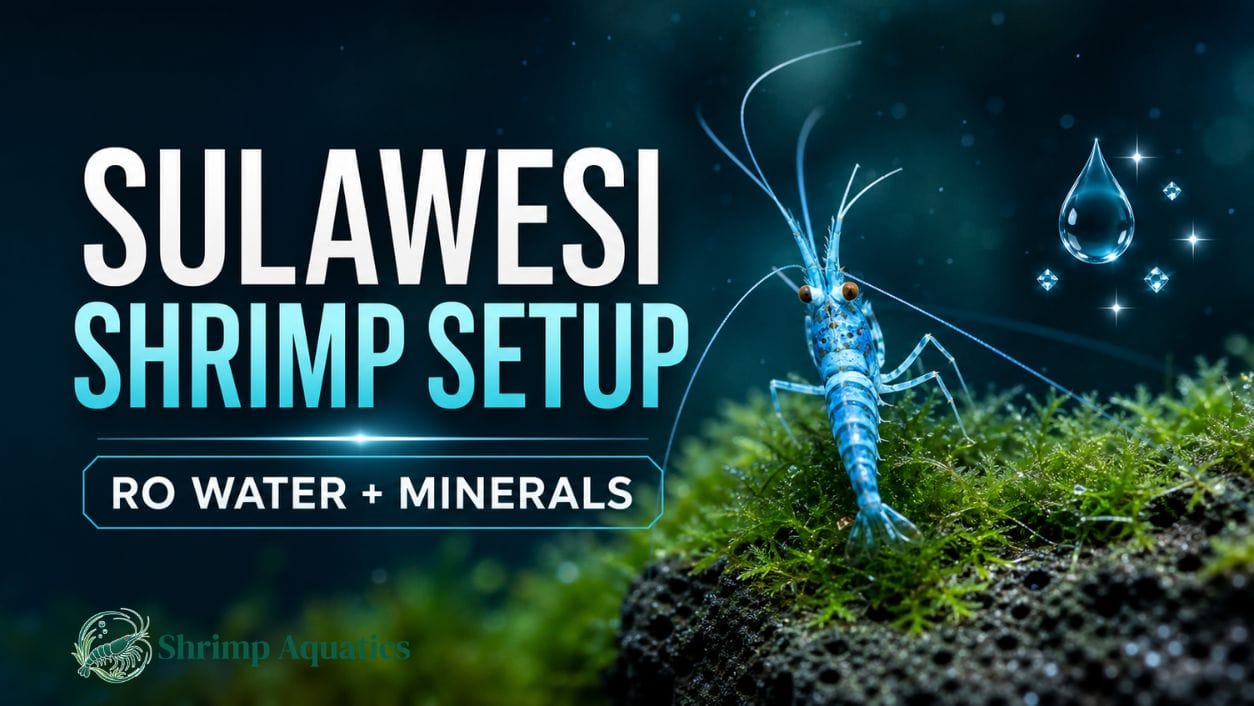
This is the purchase that decides whether the tank works. Tap water is unsuitable in almost every case: it can carry chlorine, chloramine and copper, and its mineral balance won’t match these lakes even where the hardness number looks close. Start from RO or RO/DI water, then add back exactly what you want.
The mineral has to be a Sulawesi formula. A Neocaridina GH/KH booster or a Bee shrimp GH+ product carries a different mineral balance and will leave you with water that reads roughly right on one meter and behaves nothing like the lake.
From our Sulawesi shrimp tanks
At Shrimp Aquatics we start our Sulawesi systems with RO water, then use Sulawesi Mineral 7.5 to prepare the water for our current tank targets before shrimp are introduced. We still test the finished water instead of treating the product dose as proof that the tank is ready. Most of our Sulawesi systems currently run at TDS 150 ppm, GH 6-7 dGH and pH 7.5. Those are the current settings in our Sulawesi shrimp tanks, and they sit at the lower, softer end of the group range.
Which Sulawesi Mineral Should You Buy, 7.5 or 8.5?
The two common formulas differ in the pH they buffer toward and in how much work they’re to prepare. Buy the one that matches the species you intend to keep and the effort you’re willing to put into mixing water every week.
Choose the 7.5 formula if
You want the easier route and are starting with hardier lake species such as the Cardinal, Caridina dennerli. The manufacturer describes it as the most easily soluble variant, says it dissolves within seconds and buffers pH at around 7.5, and gives a target of roughly 6 °dH or a conductance of around 270 microsiemens.2
Choose the 8.5 formula if
You’re aiming at the more demanding Lake Towuti species and want water closer to that lake. The manufacturer developed it from water analyses of the Malili lakes, targets roughly 7 °dH or a conductance of around 220 microsiemens, and states it requires additional measures to dissolve fully.3
Watch the units before you trust the number
The mineral instructions give a target conductance in microsiemens. A hobby TDS meter reports ppm, which it calculates from conductivity using a conversion factor that differs between meters. Those aren’t the same number and should never be compared directly. Follow the current product instructions, then confirm the finished water against the group range with your own meter and your own GH and KH tests. If the two disagree, check your meter’s conversion factor. Don’t split the difference.
How Do You Dissolve Sulawesi Mineral 8.5 Before It Reaches the Tank?
The 8.5 formula is the reason people buy an extra mixing container and an air pump they didn’t expect to need. Undissolved carbonate that lands on the substrate doesn’t remineralize anything. Prepare it outside the aquarium, following the manufacturer’s current instructions.
- Mix outside the tank. Add the salt to RO water in a separate vessel, never straight into a stocked aquarium.
- Add CO2 to help it dissolve. The manufacturer states the salt dissolves almost totally when CO2 is added for a few days, and that at a regular rate of about one bubble per second it dissolves fully in roughly 3-4 days.3
- Aerate the CO2 back out. The same instructions require aerating the water afterward with an air stone for at least three hours to expel the CO2 before use.3
- Test before it goes near livestock. Confirm pH, GH, KH and TDS on the finished water and match its temperature to the tank.
If that routine sounds like more than you want to run every week, that’s a genuine argument for choosing the 7.5 formula and a species it suits, rather than buying the 8.5 and preparing it badly.
Which Test Gear Confirms Your Sulawesi Water Hit Its Targets?
Buy the measuring tools at the same time as the minerals, not after the first loss. Test strips aren’t precise enough for water you’re building from scratch.
- A digital TDS meter, calibrated, for daily consistency checks.
- Liquid titration tests for GH and KH, because carbonate hardness is what holds your pH up.
- A pH test appropriate to the alkaline range you’re targeting.
- Ammonia and nitrite tests, which decide when the tank may be stocked.
- A nitrate test, so you can keep nitrate under 10 ppm in view.
- Don’t rely on strips alone, and don’t treat a product dose as evidence that the water is correct.
Which Heating and Temperature Safety Gear Does a Sulawesi Tank Need?
A Sulawesi tank sits at the warm end of freshwater keeping, so heating is about holding a steady value. Size the heater to your tank volume and room temperature using the manufacturer’s own guidance; we don’t publish a wattage, because the right figure depends on how cold your room gets and how well the tank is covered.
Buy a second, independent way to read the temperature. A heater’s built in thermostat is a single point of failure, and in water this warm a stuck heater has very little headroom before conditions become dangerous. An independent thermometer, or a separate controller that cuts power at a set maximum, is what turns a silent failure into something you notice. Whether you need a heater at all depends on your room rather than your climate, which we work through in Do Sulawesi shrimp need a heater.
A tight lid belongs in this section. Warm water evaporates quickly, and only the water leaves. The dissolved minerals stay behind and concentrate, so an open tank drifts upward in GH, KH and TDS week after week until molting becomes dangerous. A lid slows that drift, and pure RO top offs correct what’s left.
Buy Inert Substrate and Alkaline Rock for Sulawesi Shrimp, Not Active Aquasoil
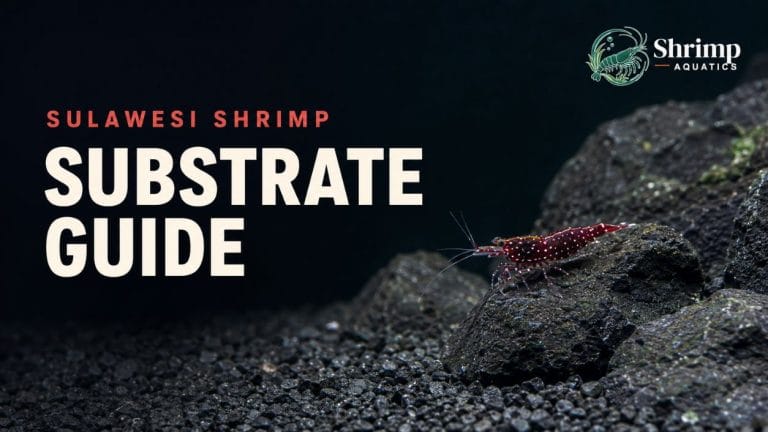
The tank floor is a chemistry decision before it’s an aesthetic one. Inert materials leave your mineral work alone. Calcareous materials such as crushed coral or aragonite slowly release carbonate, which helps hold KH and pH at the top of the range. Both are appropriate. Active aquasoil isn’t.
Never use active, buffering aquasoil
Active soils sold for Bee and Crystal shrimp are designed to pull pH down into acidic territory. In a Sulawesi tank they work directly against every mineral you add, which produces exactly the drifting chemistry this species can’t tolerate. Keep tannin releasing driftwood to a minimum for the same reason.
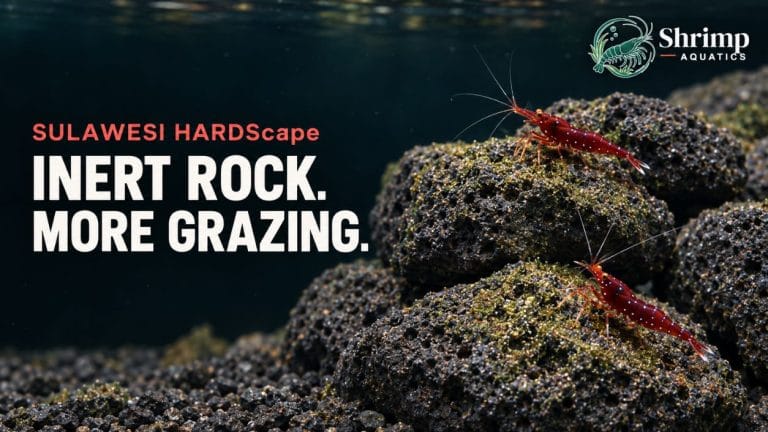
Keep the layer thin. A shallow substrate is easier to siphon and gives fine waste nowhere to accumulate, which matters more here than in a cooler tank. Choose porous hardscape rock over smooth rock where you can, because the rock isn’t only structure; it’s the pasture.
From our Sulawesi shrimp tanks
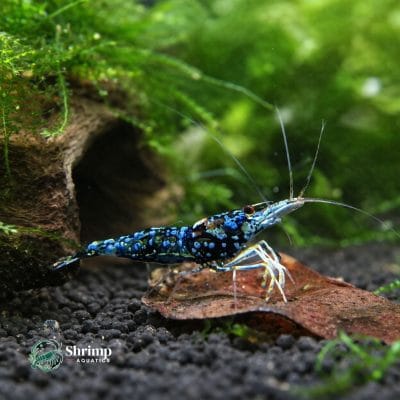
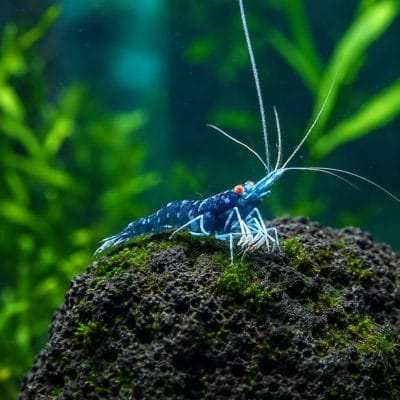
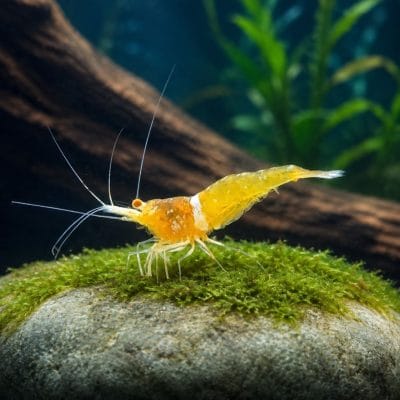
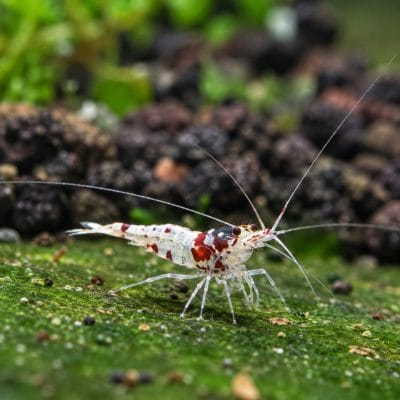
We commonly use Sula Sand Volcanic Rock in our Sulawesi systems because it’s inert and has worked well in tanks where we need pH to remain steady. We’ve also seen Blue Ghost, Yellow Ghost, White Ghost and Oiran shrimp retain their color more consistently as they mature in these systems. Lighting, genetics, nutrition, water chemistry, age and stress also affect visible color. Lighting, genetics, nutrition, water chemistry, age and stress may also affect visible color.
Why a Sulawesi Shrimp Tank Needs Oversized Biology and Gentle Flow
This is the section where buying the obvious equipment goes wrong. The instinct is to buy a strong filter. What you actually need is a large amount of biological capacity moving very little water.
The chemistry drives the decision. The share of total ammonia present as free, un-ionized ammonia, which is the form most toxic to aquatic life, rises as pH and temperature increase, so ammonia criteria become more stringent at higher pH and temperature.4 A warm tank held at pH 7.5-8.5 is therefore far less forgiving of a small waste spike than a cooler, near neutral tank would be. Mature biological media and a genuinely cycled system are the answer, not a bigger pump.
- Un-ionized ammonia
- The more toxic form of ammonia. A larger fraction of the total ammonia takes this form as pH and temperature climb, which is why a warm alkaline tank needs more biological capacity than its size suggests.
- Grazing surface
- The biofilm and algae layer on rock, glass and filter sponge. In a Sulawesi tank this layer is the main food supply, so equipment that provides surface area is doing two jobs at once.
An air driven sponge filter is the workhorse purchase. It gives gentle movement, strong surface exchange, an intake that can’t draw in shrimplets, and a spongy surface that accumulates the biofilm the shrimp graze. Add porous biological media in a second chamber if you want more capacity. Warm water also holds less dissolved oxygen than cool water, so plan for good surface exchange. A filter alone may not cover it.
Which Food and Lighting Supplies Grow the Biofilm Sulawesi Shrimp Graze On?
In a Sulawesi tank the food budget mostly buys surfaces and time. These lakes are ultra oligotrophic, with very little dissolved nutrient available, and a mature grazing layer is what carries a colony between the occasional prepared meal. That makes the light and its timer a food supply, and makes the food jar a smaller purchase than new keepers expect.
Buy a biofilm booster or a fine powdered grazing food rather than high protein pellets meant for other shrimp, and buy less of it than you think. How much and how often to feed a stocked colony is its own subject, covered in what Sulawesi shrimp eat. Acceptance of prepared food varies by species, system and product, so watch your own tank to see whether these shrimp ignore or accept it.
Confirm Your Sulawesi Tank Is Ready Before You Order Shrimp
The final supply is patience, and it’s the one most often skipped. A tank with perfect equipment and no established grazing surface will still lose shrimp, because there is nothing for them to eat and no biological buffer under them.
Run through this before you place an order. If any line fails, the answer is to wait rather than to compensate with equipment.
- Ammonia and nitrite both read 0 ppm on a liquid test.
- Temperature holds inside 79-86°F (26-30°C) across a full day and night, confirmed on an independent thermometer.
- pH, GH, KH and TDS sit inside the group range and have stayed there across at least two prepared water changes.
- Rock and glass carry a visible grazing layer.
- You’ve prepared, tested replacement water ready before the shrimp arrive, not after.
- Don’t stock on a date because the calendar says the tank is old enough.
These are the supply mistakes we see repeat most often, and every one of them is cheaper to avoid than to fix.
- Reusing a Bee or Crystal shrimp setup. The active soil and the soft acidic target are the opposite of what this group needs, and success with Bee shrimp doesn’t transfer.
- Buying minerals without meters. A dose is a prediction. A tested result is evidence.
- Skipping the lid. Evaporation concentrates minerals and pushes TDS up quietly, week after week.
- Buying flow instead of biology. These shrimp graze in calm water, and warm alkaline water needs biological capacity far more than it needs current.
- Topping off with remineralized water. Replace evaporation with pure RO, or hardness climbs until molting becomes risky.
- Ordering livestock while the tank is still bare. A new tank has no grazing layer, and prepared food can’t substitute for a mature system.
When your water is built and holding, browse the current Sulawesi shrimp we’ve available, or email us your pH, GH, KH, TDS, temperature, tank size and cycle status at contact@shrimpaquatics.com and we will tell you honestly whether the setup is ready.
Two of those supplies deserve their own decision. The first is why Sulawesi shrimp need RO water at all, which comes down to what tap water carries in that no conditioner removes.
The second is whether Sulawesi Mineral 7.5 or 8.5 is the salt to mix it with, which depends on the pH you intend to hold.
References
4 Sources
- Geomicrobiological Features of Ferruginous Sediments from Lake Towuti, Indonesia, Frontiers in Microbiology, accessed July 20, 2026.
- Sulawesi Mineral 7,5 product information and instructions of use, SaltyShrimp, accessed July 20, 2026.
- Sulawesi Mineral 8,5 product information and instructions of use, SaltyShrimp, accessed July 20, 2026.
- Ammonia (CADDIS Volume 2), US Environmental Protection Agency, accessed July 20, 2026.
Ready to get started?
Shop our Sulawesi Shrimp collection
27 products available · Live Arrival Guarantee
Featured Sulawesi Shrimp
Sulawesi Orange Eyes Yellow Ghost
Caridina dennerli
Advanced · 79–86°F · pH 7.5–8.5
$120.00View Product