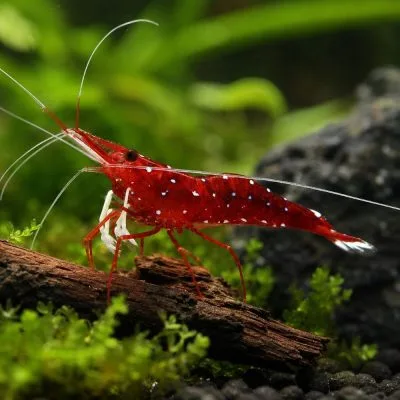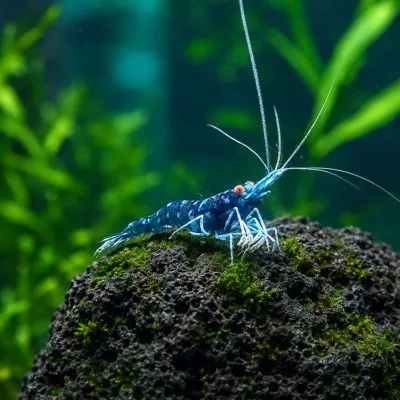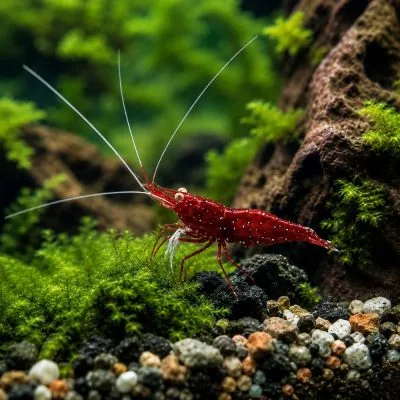
Your tap water reads somewhere near the Sulawesi range, and an RO unit looks like one more thing to buy before the shrimp arrive. Sulawesi shrimp, the lake-system Caridina species traded as Cardinal, Sulawesi White Sock, Sulawesi Blue Ghost and Oiran, still need RO water, because it’s the only starting point you fully control. A reverse osmosis unit pushes water through a semi-permeable membrane and splits it into treated water and a reject stream, and reduction of total dissolved solids is one of the criteria such systems are certified against.1 What comes through is close to empty, so every mineral in the tank is one you put there on purpose, at a level you can measure and repeat. Tap water is the opposite. It was treated to be safe for people, it carries things you can’t take back out at home, and it changes without telling you.
What tap water carries into a Sulawesi tank that you can’t take back out
Copper, disinfectant and nitrate, at levels that can pass every drinking water rule and still be wrong for shrimp. Drinking water standards describe what’s safe for you to drink. Under the United States national primary drinking water regulations, copper is handled through a treatment technique with an action level of 1.3 mg/L, nitrate is capped at 10 mg/L measured as nitrogen, and chloramine carries a maximum residual disinfectant level of 4.0 mg/L.2 Your water can sit under all three numbers, satisfy the rule completely, and still be the wrong liquid to put a Sulawesi colony into.
Copper is the clearest case. The same regulations name corrosion of household plumbing as a source of copper in drinking water,2 so your own building helps decide the number. No utility report can tell you what came out of your kitchen line this morning. And in juvenile freshwater prawns, a laboratory study found gill and hepatopancreas damage at copper levels below that 1.3 mg/L action level.3
Disinfectant is the second thing you can’t simply wait out. Many systems use chloramine instead of free chlorine precisely because it keeps working as water travels through the pipes, and it now reaches systems serving more than one in five people in the United States.4 A residual built to survive the distribution network won’t vanish because a bucket stood open overnight. It has to be removed or chemically broken, which means adding another product to water you already don’t fully understand.
Then there’s the part no single test result protects you from. Drinking water rules set limits, not constants, so whatever you measured on setup day describes that day and nothing else. RO takes that whole category of surprise off the table, because the membrane becomes the last thing standing between your plumbing and your mixing bucket.
Why remineralized RO holds the Sulawesi range steadier than treated tap water
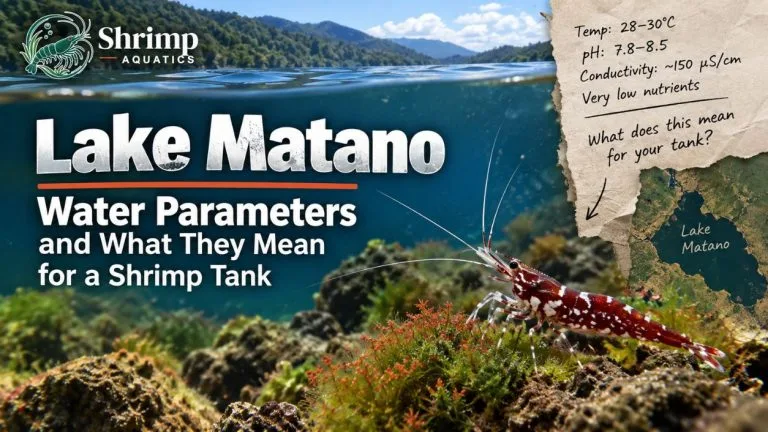
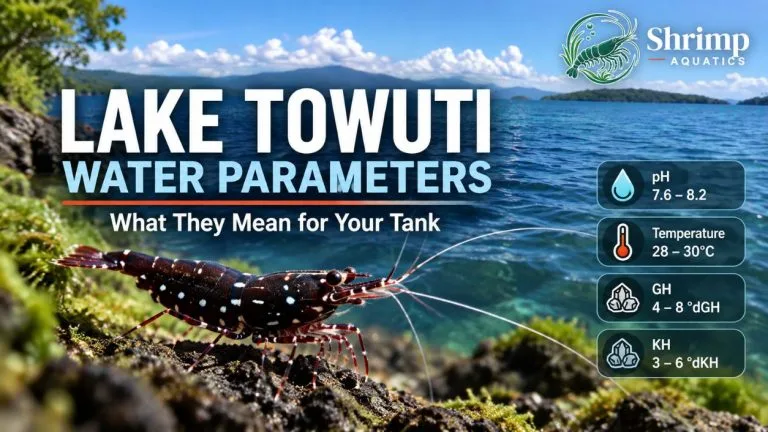
Because you build every number up from nothing, the same way each time. You’re aiming for pH 7.5-8.5, GH 4-8 dGH, KH 3-6 dKH and TDS 150-250 ppm, at 79-86°F (26-30°C). From RO you get there by addition: add a measured amount of mineral, read the result, adjust, and write down what worked. From tap you’d have to subtract, and you can’t subtract in a kitchen. You can only dilute, and dilution moves every value at once, so pulling hardness down drags pH and TDS with it. It’s a bit like trying to take the salt back out of a soup by adding water.
Most keepers can mix water that reads correctly once. Holding Sulawesi shrimp care parameters steady for months is the real work, and it’s far easier when the source water is a known quantity every single time you open the tap.
The second reason is what your target chemistry does to ordinary waste. Total ammonia in any aquarium sits in two forms, and the un-ionized form is the one that drives ammonia toxicity. Its share isn’t fixed. The EPA freshwater ammonia criteria state that the ratio of un-ionized ammonia to ammonium ion increases 10-fold for each rise of a single pH unit, and by approximately two-fold for each rise of 10 degrees Celsius.5 They also state that high external un-ionized ammonia reduces or reverses diffusive gradients and causes ammonia to build up in internal tissues and blood.5
What that relationship means at Sulawesi settings
Work it through from those ratios and a tank sitting at pH 8.5 carries roughly ten times the un-ionized share of the same total ammonia reading at pH 7.5, and the warm end of the range pushes it further in the same direction. A reading you’d shrug at in a cool acidic shrimp tank isn’t one to shrug at here. That’s an argument for keeping nitrogen out of the water and the tank properly cycled. It isn’t an argument for a push to lower pH in a Sulawesi shrimp tank, which isn’t a safe adjustment for this group.
So the tap water question is never only about hardness. Water that arrives carrying nitrate, dissolved organics or a disinfectant residual adds to the nitrogen load of a system that’s already unusually unforgiving about it. RO arrives with nothing to contribute, and that’s exactly what you want from a raw ingredient.
Can your tap water work for Sulawesi shrimp?
Sometimes, on a hard alkaline supply, but you’d be choosing to monitor something you could have removed. A supply that lands in the Sulawesi band isn’t automatically fatal, and the numbers do sometimes land close. Before you decide, work through what you actually know about your own water.
- Test pH, GH, KH and TDS straight from the tap, then again after the water has stood and been aerated, because the two readings often differ.
- Repeat the test on separate days across several weeks.
- Ask your supplier whether the residual disinfectant is chlorine or chloramine. A chloramine residual is the longer lasting of the two and needs removing, and waiting won’t clear it.
- Don’t read copper off a TDS meter. TDS gives you a total, not a metal, and copper enters after the water has left the utility.
- Don’t treat one passing set of readings as a permanent property of your supply.
If everything checks out and you still want to run tap water, that risk is yours to accept, and it’s a real one for animals in this difficulty class. Would you rather have someone look at your numbers before you commit Sulawesi shrimp to them? Email your pH, GH, KH, TDS, temperature, tank size and cycle status to contact@shrimpaquatics.com.
Remineralize RO water before it reaches the shrimp
Pure RO water isn’t aquarium water
Straight out of the membrane it has effectively no hardness and no carbonate buffer. Shrimp placed into it face an osmotic load they can’t manage, and unbuffered water moves its pH at the slightest provocation. RO is the ingredient, never the finished water. Turning that empty water into something a shrimp can live in is how to remineralize RO water for Sulawesi shrimp.
Hardness isn’t a cosmetic line on the target list. A crustacean draws most of the calcium for its new shell from the water it lives in, with food and stored reserves contributing less.6 That’s why an animal in mineral-poor water is under pressure at the point in its life when it’s most vulnerable, and why you rebuild hardness deliberately, not by eye.
Carbonate hardness is what stops the pH you built from wandering back down, so treat Sulawesi shrimp KH and alkalinity as a target in its own right.
At Shrimp Aquatics we start our Sulawesi systems with RO water rather than tap water, then use Sulawesi Mineral 7.5 to prepare the water for our current tank targets before shrimp are introduced. We test the finished pH, GH and TDS before the water goes into a tank.
Whichever mineral you use, follow the current manufacturer instructions for the dose and let the finished readings decide, not the scoop. Water that hasn’t been measured in the mixing container gets measured in the tank instead, by the shrimp.
Which salt to mix with, Sulawesi Mineral 7.5 or 8.5, is your next decision, and it sets the pH you’ll live with.
Top off a Sulawesi tank with plain RO, not with remineralized water
Use plain RO, because evaporation concentrates dissolved solids in the water left behind.7 A tank held at 79-86°F (26-30°C) loses water all the time, and none of the minerals leave with it. Top that loss up with remineralized water, or with tap, and you’re adding a fresh dose of minerals to a load that never went anywhere. Keep that up for a few weeks and TDS, GH and KH all sit above the numbers you mixed so carefully, with nothing visibly wrong until something is.
Plain RO puts back only what actually left. That’s why it’s the right top-off water, even though it would be lethal as tank water on its own. Water changes are a different job with a different rule: Sulawesi shrimp water changes start from the tank’s current readings, so you build the replacement to match what’s in there now, not the recipe you used on day one.
What the research says about RO and tap water for Sulawesi shrimp
Two of the studies behind this guide are on other crustaceans, not on Sulawesi Caridina, so read them as the mechanism and not as a threshold for your tank. In a laboratory study on juvenile giant freshwater prawns, Macrobrachium rosenbergii, seven days in water carrying 0.01 to 0.4 mg/L of copper produced swelling and fusion of the gill lamellae, hyperplastic and necrotic tissue and damage to the hepatopancreas, and the damage tracked the copper concentration.3 Set those figures beside the drinking water rules and the concentrations that damaged prawn gills sit below the level at which a water system is required to act.2
The calcium point comes from a review of crustacean biomineralization. It names water as the major source of the calcium used for exoskeleton calcification, while food and stored reserves contribute less.6 That’s a crustacean-level finding, not a measured Sulawesi requirement, but it’s the reason this guide treats GH as something you rebuild on purpose.
References
7 Sources
- Point-of-Use Reverse Osmosis Systems, U.S. Environmental Protection Agency WaterSense, updated August 21, 2026.
- National Primary Drinking Water Regulations, U.S. Environmental Protection Agency, updated August 31, 2026.
- Impact of Waterborne Copper on the Structure of Gills and Hepatopancreas and Its Impact on the Content of Metallothionein in Juvenile Giant Freshwater Prawn Macrobrachium rosenbergii (Crustacea: Decapoda) (abstract), Li, Zhao and Yang, Archives of Environmental Contamination and Toxicology 52(1): 73-79, 2007.
- Chloramines in Drinking Water, U.S. Environmental Protection Agency, updated March 12, 2026.
- Aquatic Life Ambient Water Quality Criteria for Ammonia, Freshwater, U.S. Environmental Protection Agency Office of Water, April 2013.
- Biomineralizations: insights and prospects from crustaceans, ZooKeys 176, 2012, open access copy at PubMed Central.
- Chloride, Salinity, and Dissolved Solids, U.S. Geological Survey Water Resources Mission Area, March 1, 2019.
Ready to get started?
Shop our Sulawesi Shrimp collection
27 products available · Live Arrival Guarantee
Featured Sulawesi Shrimp
Sulawesi Orange Eyes White Sock
Caridina dennerli
Advanced · 79-86°F · pH 7.5-8.5
From $19.99View Product